

Urban Traffic Simulation Course with Microsimulation
About our
The Urban Traffic Simulation with Microsimulation course focuses on the use of advanced tools to model and analyze vehicular flow in urban environments. It explores microsimulation techniques to understand individual vehicle behavior and its impact on congestion, travel time, and road network efficiency. The course covers the practical application of specialized software, such as VISSIM or SUMO, to evaluate traffic scenarios, optimize traffic lights, and plan road improvements, based on concepts of queuing theory and transport modeling. Hands-on training is provided in creating realistic traffic models, calibrating and validating simulations, and analyzing results for decision-making. The course is designed for professionals and students interested in transportation engineering, urban planning, and traffic management, providing skills to address mobility challenges and improve the efficiency of urban transport.
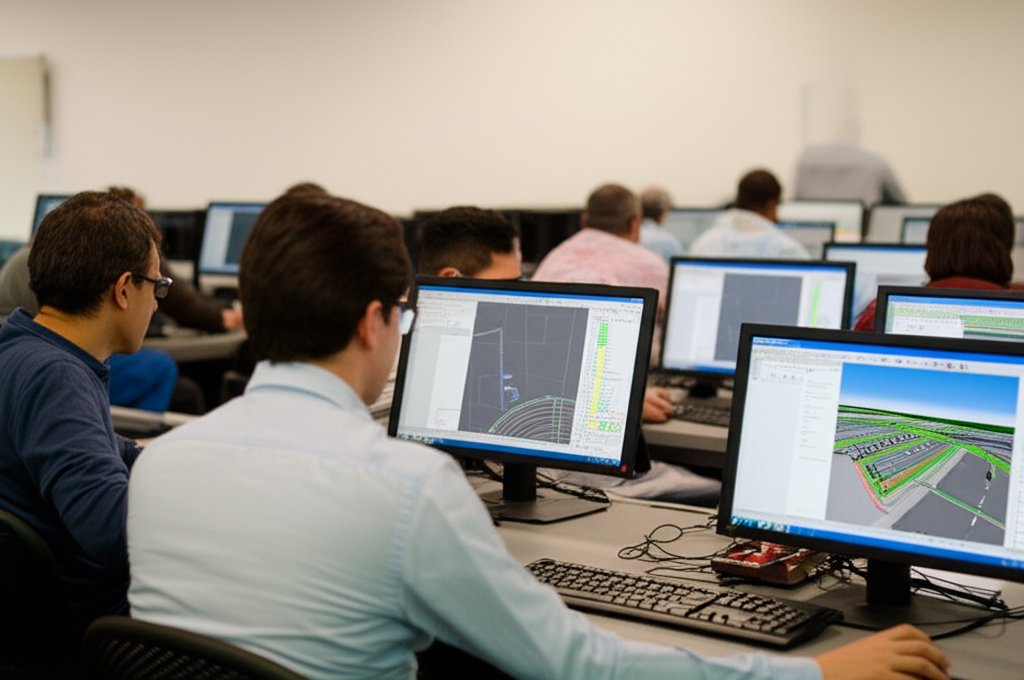
Urban Traffic Simulation Course with Microsimulation
- Format: Online
- Duration: 3 months
- Hours: 300 H
- Language: English / Spanish
- Registration date: 23-10-2026
- Start date: 12-12-2026
- Available places: 2
399 $
Competencies and results
What you will learn
1. Expert Domain in Urban Traffic Simulation with Microsimulation
Here is the requested content:
- Plan and execute urban traffic simulations using microsimulation tools.
- Model and analyze traffic behavior in complex urban environments, considering different scenarios and variables.
- Interpret simulation results to identify bottlenecks, evaluate the impact of traffic interventions, and optimize traffic flow.
- Use specialized microsimulation software to create realistic and accurate traffic models.
- Apply data analysis techniques to extract relevant information from simulation results and make informed decisions.
2. Advanced Simulation of Vehicular Flows in Urban Environments
- Master the modeling and simulation of vehicular flows in complex urban environments.
- Understand the key variables that influence traffic, including density, speed, and volume.
- Apply different traffic models, from microscopic vehicle-tracking models to macroscopic fluid dynamics models.
- Use specialized software to simulate realistic traffic scenarios, including intersections, traffic signals, and different road types.
- Analyze simulation results to identify bottlenecks, optimize vehicular flow, and improve the efficiency of urban transport.
- Evaluate the impact of new infrastructure, such as bus lanes or cycleways, on traffic behavior.
- Design and evaluate traffic management strategies, such as traffic signal synchronization and speed regulation.
- Understand the interaction between vehicular flow and other factors.
Modes of transport, such as public transport and pedestrian traffic.
Explore the use of real-time data and smart technologies for traffic management.
Apply traffic flow simulation to improve road safety and reduce congestion in cities.
3. Comprehensive user-oriented design and validation (from modeling to manufacturing)
You will learn to integrate the entire product development process, from initial model conception to final validation, applying user-centered methodologies. You will develop skills in parametric design, ergonomics, simulation, sustainable materials, 3D visualization, and manufacturing management, ensuring efficient, safe solutions that meet current industry standards.
4. Detailed Evaluation of Intersections and Urban Bottlenecks
## What Will You Learn in the Detailed Assessment of Urban Intersections and Bottlenecks?
- Identify and analyze the underlying causes of congestion at intersections and urban bottlenecks.
- Apply traffic data collection and analysis methodologies, including vehicle counts, speed measurements, and travel time analysis.
- Use specialized software to simulate traffic flow at complex intersections, identifying problem areas and evaluating proposed solutions.
- Evaluate different traffic management strategies, such as traffic signal optimization, implementation of dedicated lanes, and signal synchronization.
- Analyze the impact of road infrastructure, such as lane design, turning radii, and signage, on traffic flow and intersection capacity.
- Study the effect of environmental conditions, such as rain, fog, and reduced visibility, on intersection performance.
- Evaluate the impact of alternative modes of transportation, such as public transportation and bicycle use, in traffic congestion.
Develop innovative solutions to improve traffic flow, including the implementation of Intelligent Transportation Systems (ITS) and the optimization of urban design.
Analyze the cost-benefit of different intersection improvement strategies, considering economic, social, and environmental aspects.
Apply the acquired knowledge to design and evaluate projects for improving intersections and bottlenecks, contributing to efficient and sustainable urban mobility.
5. Optimization of Vehicular Movement in Urban Simulations
- Modeling and simulation of vehicular flows in urban environments using specialized software.
- Analysis of road infrastructure, including streets, traffic lights, intersections, and public transportation systems.
- Implementation of strategies to optimize vehicular flow, such as adaptive traffic light control and lane management.
- Evaluation of the impact of transportation policies on the efficiency of vehicular movement and the reduction of congestion.
- Study of autonomous vehicle technologies and their influence on the optimization of urban traffic.
- Analysis of real-time traffic data and its application for decision-making in traffic management.
- Use of simulation tools to predict the impact of unexpected events, such as accidents or road closures.
- Exploration of innovative solutions for urban transportation, such as the use of electric vehicles and transport systems shared.
- Development of optimization models to minimize travel time, reduce emissions, and improve road safety.
- Integration of data from different sources, such as traffic sensors, weather data, and public transport information, for more effective traffic management.
6. Design and Analysis of Urban Road Networks Using Microsimulation
- Understand the fundamentals of microsimulation in the urban context.
- Model and simulate traffic flow in urban road networks using specialized software.
- Analyze the impact of different road design elements (intersections, lanes, etc.) on network performance.
- Evaluate and optimize the capacity and efficiency of urban road networks.
- Interpret and use microsimulation data for decision-making in transport planning and management.
- Apply microsimulation to evaluate traffic management strategies, such as changes in signage or the implementation of dedicated lanes.
- Identify bottlenecks and problem areas in road networks.
- Study vehicle and driver behavior in simulations.
- Use microsimulation to analyze the environmental impact of road networks.
- Develop practical skills in the use of microsimulation software.
Who this program is for:
Urban Traffic Simulation Course with Microsimulation
- Traffic, transportation, urban planning, civil, and related engineers.
- Urban planning and traffic management professionals who wish to simulate scenarios.
- Data analysts and technicians working with traffic modeling and simulation.
- Transportation and mobility consultants seeking to optimize flows and analyze impacts.
Recommended requirements: Basic knowledge of transportation and traffic modeling. Proficiency in using software. ES/EN (Intermediate level). Supporting materials will be provided.
- Standards-driven curriculum: you will work with CS-27/CS-29, DO-160, DO-178C/DO-254, ARP4754A/ARP4761, ADS-33E-PRF from the first module.
- Accreditable laboratories (EN ISO/IEC 17025) with rotor bench, EMC/Lightning pre-compliance, HIL/SIL, vibrations/acoustics.
- Evidence-oriented TFM: safety case, test plan, compliance dossierand operational limits.
- Mentored by industry: teachers with experience in rotorcraft, tiltrotor, eVTOL/UAM and flight test.
- Flexible modality (hybrid/online), international cohorts and support from SEIUM Career Services.
- Ethics and security: safety-by-design approach, cyber-OT, DIH and compliance as pillars.
Module 1 — Introduction to Roadway Microsimulation
1.1 Fundamentals of Microsimulation: What is it and how does it work?
1.2 Advantages and Disadvantages of Microsimulation
1.3 Applications of Microsimulation in Urban Traffic
1.4 Microsimulation Tools: Introduction and Comparison
1.5 Data Collection and Preparation for Simulation
1.6 Importance of Model Calibration and Validation
1.7 Basic Principles of Traffic Modeling
1.8 Understanding the Concepts of Flow, Speed, and Density
1.9 Introduction to Vehicle Interaction and Driver Behavior
1.10 Results Analysis: Key Metrics and Their Interpretation
2.2 Introduction to Advanced Traffic Flow Simulation
2.2 Driver Behavior Modeling in Urban Environments
2.3 Simulation of Different Vehicle Types (Cars, Buses, Bicycles)
2.4 Implementation of Traffic Lights and Road Signage
2.5 Data Analysis and Key Metrics in Simulation
2.6 Congestion and Delay Analysis in the Road Network
2.7 Traffic Flow Optimization: Strategies and Models
2.8 Impact of Events and Incidents on Traffic Flow
2.9 Advanced Techniques for Visualizing and Reporting Results
2.20 Practical Applications and Case Studies
3.3 Introduction to Microsimulation in the Urban Context
3.2 Data Modeling and Calibration for Simulation
3.3 Analysis of Key Performance Indicators (KPIs) for Traffic
3.4 Strategies for Optimizing Traffic Signals and Signage
3.5 Modeling Different Traffic and Demand Scenarios
3.6 Evaluating the Impact of Infrastructure Changes
3.7 Route Optimization and Congestion Management
3.8 Cost-Benefit Analysis of Implemented Improvements
3.9 Specific Microsimulation Tools and Software
3.30 Case Studies and Real-World Applications
4.4 Identification and Characterization of Critical Intersections
4.2 Geometry and Signaling Modeling in Microsimulation
4.3 Capacity and Level of Service Analysis at Intersections
4.4 Evaluation of Delays and Queues
4.5 Simulation of Different Traffic Control Strategies
4.6 Optimization of Cycle Times and Signal Phases
4.7 Impact Study of Turns and Specific Movements
4.8 Evaluation of Bottlenecks and Congestion Points
4.9 Traffic Demand Sensitivity Analysis
4.40 Reporting and Visualization of Simulation Results
5.5 Introduction to Microsimulation: Key Concepts and Tools
5.5 Data Collection and Preparation for Simulation
5.3 Building Urban Traffic Models in Microsimulation
5.4 Calibration and Validation of Microsimulation Models
5.5 Results Analysis and Data Visualization
5.6 Case Studies: Applications of Microsimulation in Real-World Environments
5.7 Designing Experiments in Urban Simulation
5.8 Optimizing Model Efficiency
5.9 Using Specific Software for Microsimulation
5.50 Integrating Microsimulation into Urban Planning
5.5 Fundamentals of Vehicle Flow Modeling
5.5 Driver Behavior Models in Urban Environments
5.3 Modeling Vehicle Interactions in Different Scenarios
5.4 Modeling Traffic Signaling and Control
5.5 Simulation of Public Transportation and Active Modes
5.6 Flow Modeling at Complex Intersections
5.7 Congestion and Bottleneck Analysis
5.8 Optimization of Vehicular Flow in Road Networks
5.9 Real-Time Data Integration for Simulation
5.50 Case Studies: Advanced Flow Simulation in Smart Cities
3.5 Principles of Urban Traffic Analysis
3.5 Key Performance Indicators (KPIs) in Urban Traffic
3.3 Optimization Techniques Applied to Simulation
3.4 Sensitivity Analysis in Simulation Models
3.5 Optimization of Traffic Signals and Control Systems
3.6 Impact Assessment of Infrastructure Changes
3.7 Use of Specific Software for Analysis and Optimization
3.8 Design of Congestion Mitigation Strategies
3.9 Cost-Benefit Analysis of Traffic Improvements
3.50 Case Studies: Practical Application of Optimization in Cities
4.5 Identifying Critical Points in the Road Network
4.5 Detailed Intersection Analysis
4.3 Bottleneck Modeling and Evaluation
4.4 Analysis of Road Capacity and Levels of Service
4.5 Evaluating the Impact of Incidents on the Network
4.6 Supply and Demand Analysis in Urban Traffic
4.7 Mitigation Techniques at Critical Points
4.8 Optimizing Intersection Geometry
4.9 Using Specific Traffic Analysis Tools
4.50 Case Studies: Detailed Evaluation in Real-World Environments
5.5 Vehicle Movement Optimization Strategies
5.5 Optimizing Intelligent Signaling
5.3 Designing Optimized Routes for Different Vehicles
5.4 Optimizing Traffic Flow in Specific Environments
5.5 Modeling and Simulation of Intelligent Transportation Systems
5.6 Parking Management Optimization
5.7 Use of Real-Time Data for Optimization
5.8 Evaluating the Impact of Improvements on Movement
5.9 Software and Tools for Movement Optimization
5.50 Case Studies: Vehicle Movement Optimization in Practice
6.5 Design of Urban Road Networks
6.5 Evaluation of Different Road Network Configurations
6.3 Modeling and Simulation of New Infrastructure
6.4 Capacity and Congestion Analysis in Road Networks
6.5 Optimization of Road Network Design
6.6 Environmental Impact Assessment of Road Networks
6.7 Integration of Sustainable Transportation Modes
6.8 Use of Specific Software for Road Network Design
6.9 Cost-Benefit Analysis in Road Network Design Networks
6.50 Case Studies: Design and Analysis of Successful Road Networks
7.5 In-Depth Analysis of Simulation Results
7.5 Advanced Traffic Optimization Techniques
7.3 Large-Scale Data Analysis in Simulation
7.4 Simulation of Complex and Dynamic Scenarios
7.5 Integration of Different Data Types in Simulation
7.6 Design of Advanced Congestion Mitigation Strategies
7.7 Sensitivity Analysis and Validation of Complex Models
7.8 Use of Advanced Simulation and Analysis Tools
7.9 Case Studies: In-Depth Simulation and Optimization in Smart Cities
7.50 Future Trends in Traffic Simulation and Optimization
8.5 Principles of Dynamic Urban Traffic Modeling
8.5 Real-Time Transport Demand Modeling
8.3 Simulation 8.4 Real-Time Driver Behavior Modeling
8.5 Real-Time Event and Incident Modeling
8.6 Real-Time Data Integration for Modeling
8.7 Applications of Artificial Intelligence in Modeling
8.8 Use of Real-Time Traffic Management Systems
8.9 Road Network Resilience Analysis
8.50 Software and Tools for Dynamic Modeling
8.50 Case Studies: Dynamic Traffic Modeling in Real-World Environments
6.6 Introduction to Urban Road Network Design with Microsimulation
6.2 Data Collection and Analysis for Road Design
6.3 Modeling Streets and Highways in Urban Environments
6.4 Designing Safe and Efficient Intersections and Crossings
6.5 Optimizing Road Design for Traffic Flow
6.6 Capacity Analysis and Levels of Service in Road Networks
6.7 Implementing Traffic Management Measures in Simulations
6.8 Environmental Impact Assessment and Sustainability in Road Design
6.9 Case Studies: Design of Successful Urban Road Networks
6.60 Microsimulation Tools and Software for Road Design
- Hands-on methodology: test-before-you-trust, design reviews, failure analysis, compliance evidence.
- Software (depending on licenses/partners): MATLAB/Simulink, Python (NumPy/SciPy), OpenVSP, SU2/OpenFOAM, Nastran/Abaqus, AMESim/Modelica, acoustics tools, planning toolchains DO-178C.
- SEIUM Laboratories: scale rotor bench, vibrations/acoustics, EMC/Lightning pre-compliance, HIL/SIL for AFCS, data acquisition with strain gauging.
- Standards and compliance: EN 9100, 17025, ISO 27001, GDPR.
Capstone-type projects
- Traffic Optimization: Microsimulation; intersection modeling; traffic signal optimization.
- Flow Analysis: Vehicle simulation; bottleneck identification; improvement proposals.
- Network Design: Scenario evaluation; impact analysis; flow optimization.
- Road Network Optimization: Modeling, simulation, and analysis of urban traffic flows.
- Intersection Analysis: Identification and optimization of bottlenecks using microsimulation.
- Network Design: Evaluation of scenarios and optimization of road design.
- Traffic Optimization: Implementation of strategies to improve traffic flow.
- Congestion Analysis: Scenario modeling, traffic light optimization, infrastructure impact analysis.
- Mobility Simulation: Data integration, route analysis, traffic flow optimization.
- Road Network Evaluation: Design of new routes, bottleneck analysis, simulation of different scenarios.
- Impact Analysis: Evaluation of traffic changes, optimization of urban mobility strategies.
- Urban Traffic Optimization: Simulation, modeling, and analysis of road networks.
- Intersection Evaluation: Identification of bottlenecks and optimization of traffic flow.
- Design of Road Solutions: Microsimulation to improve vehicular movement.
- In-Depth Analysis: Traffic optimization and evaluation of urban scenarios.
Admissions, fees, and scholarships
- Profile: Background in Computer Engineering, Mathematics, Statistics, or related fields; practical experience in NLP and valued information retrieval systems.
- Documentation: Updated CV, academic transcript, SOP/statement of purpose, project examples or code (optional).
- Process: Application → Technical evaluation of profile and experience → Technical interview → Review of case studies → Final decision → Enrollment.
- Fees:
- Single payment: 10% discount.
- Payment in 3 installments: No fees; 30% upon registration + 2 equal monthly payments of the remaining 35%.
Monthly payment: available with a 7% commission on the total; annual review.
Scholarships: based on academic merit, financial need, and promoting inclusion; agreements with companies in the sector for partial or full scholarships.
See “Calendar & Calls for Applications,” “Scholarships & Grants,” and “Fees & Financing” in the SEIUM mega-menu.
Do you have any questions?
Our team is ready to help you. Contact us, and we will respond as soon as possible.
F. A. Q
Frequently asked questions
Yes, we have international certification
Yes: experimental models, real data, applied simulations, professional environments, real case studies.
It is not mandatory. We offer leveling tracks and tutoring.
Completely. It covers e-propulsion, integration, and emerging regulations (SC-VTOL).
Recommended. There are also internal challenges and consortiums.
Yes. Online/hybrid modality with planned labs and visa support (see “Visa & Residence”).