

Tunnel Inspection Robot Course
About our
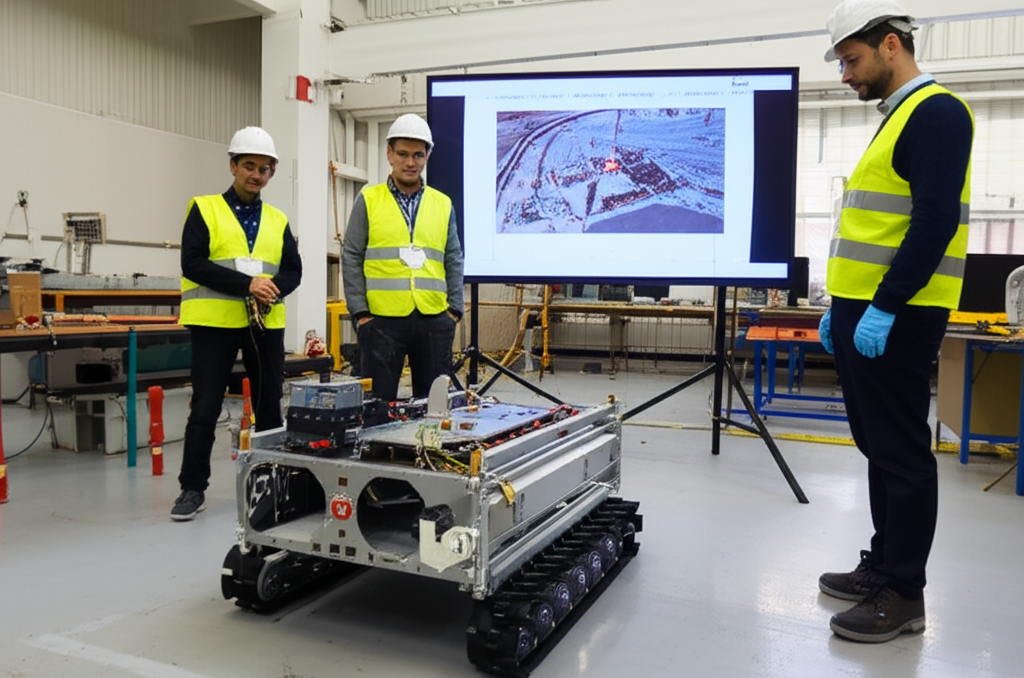
The Tunnel Inspection Robots Course focuses on training in the use and implementation of robotic technology for tunnel inspection and maintenance. It includes learning about sensors, cameras, and advanced navigation systems for detecting structural damage and assessing the condition of infrastructure. 3D mapping techniques and artificial intelligence are explored for process automation and improving tunnel safety. The course prepares participants for the development of robotic solutions in underground environments and the optimization of inspection processes. Participants will acquire skills in operating drones and ground robots equipped with laser scanners and other detection tools for data collection. The course covers seismic data analysis and thermal image interpretation for the early identification of problems. It focuses on the practical application of these technologies for inspection planning, fault diagnosis, and the management of generated information. The course aligns with current safety standards and technical requirements in the industry.
Tunnel Inspection Robot Course
- Format: Online
- Duration: 3 months
- Hours: 300 H
- Language: English / Spanish
- Registration date: 23-10-2026
- Start date: 12-12-2026
- Available places: 3
299 $
Competencies and results
What you will learn
1. Mastery of Inspection Robots: Navigation, Sensors and Tunnel Analysis
- Remote Control and Navigation: You will learn to pilot and steer inspection robots in confined environments, mastering techniques for overcoming obstacles and maintaining a precise trajectory.
- Advanced Sensor Integration: You will become familiar with the operation and interpretation of data from various sensors (cameras, LiDAR, sonar, etc.) for anomaly detection and the creation of detailed maps.
- Tunnel Inspection and Analysis: You will develop specific skills for the visual inspection and structural evaluation of tunnels, using robots and sensors to identify cracks, corrosion, and other damage.
2. Robotic Tunnel Exploration: Design, Operation and Comprehensive Evaluation
- Understand the fundamentals of robotics applied to tunnel exploration, including sensors, actuators, and control systems.
- Learn about the design and construction of tunnel robots, considering robustness, mobility, and navigation capabilities in confined environments.
- Master the techniques for operating robots in tunnels, including remote control, route programming, and data management.
- Acquire knowledge about the different types of sensors used in tunnel exploration, such as cameras, lidar, and gas sensors.
- Understand how to process and analyze the data obtained by robots, including creating 3D maps and detecting anomalies.
- Study the methodologies for the comprehensive evaluation of robotic tunnel exploration, considering efficiency, safety, and environmental impact.
- Explore the applications of robotic tunnel exploration in different industries, such as mining, construction, and
- Inspection of infrastructure.
- Analyze the safety aspects of robot operation in tunnels, including accident prevention and personnel protection.
- Learn to design and simulate tunnel environments using specialized software, allowing for testing and optimization of robot performance.
- Understand the legal and ethical considerations related to robotic tunnel exploration, such as privacy and liability.
3. Comprehensive user-oriented design and validation (from modeling to manufacturing)
You will learn to integrate the entire product development process, from initial model conception to final validation, applying user-centered methodologies. You will develop skills in parametric design, ergonomics, simulation, sustainable materials, 3D visualization, and manufacturing management, ensuring efficient, safe solutions that meet current industry standards.
4. Robotic Optimization in Tunnels: Sensors, Analysis and Predictive Maintenance
4. Robotic Optimization in Tunnels: Sensors, Analysis, and Predictive Maintenance
- Understand the operation and application of advanced sensors for tunnel robotics, including vision, lidar, ultrasound, and inertial sensors.
- Learn sensor data analysis techniques for creating 3D maps of the environment, detecting anomalies, and identifying risks.
- Master the use of signal processing algorithms and machine learning for sensor data analysis and improving robotic perception.
- Study the principles of predictive maintenance in robotics, including trend analysis, fault detection, and component life estimation.
- Acquire knowledge of non-destructive testing (NDT) techniques applicable to tunnels, such as thermography, ultrasonography, and reflectance measurement.
- Learn to design and implement strategies for
- Predictive maintenance based on sensor data and risk analysis, including task scheduling and resource management.
- Become familiar with control systems and robot programming used in tunnels, including inverse kinematics, path planning, and autonomous navigation.
- Study safety standards and regulations related to robotics in tunnels, including risk prevention and personnel protection.
- Develop practical skills through simulations and experiments with robots in virtual and real tunnel environments.
5. Robotic Tunnel Inspection: Design, Operation, Analysis and Evaluation
Here is the requested content:
**5. Robotic Tunnel Inspection: Design, Operation, Analysis, and Evaluation**
* Design and construction of robots for inspection in confined spaces.
* Principles of robotics applied to tunnel inspection: kinematics, dynamics, and control.
* Operation and handling of robotic systems in tunnels: navigation, positioning, and remote control.
* Analysis and processing of inspection data: images, video, and sensor data.
* Evaluation of the structural integrity of tunnels using robotic inspection techniques.
* Identification and classification of defects in tunnels: cracks, leaks, corrosion, etc.
* Risk and safety analysis in robotic tunnel inspection.
* Software and tools for the analysis and visualization of inspection data.
* Implementation of predictive maintenance strategies based on robotic inspection.
* Case studies and practical examples of robotic tunnel inspection.
6. Rotor Evaluation: Modeling, Performance and Robotic Optimization
- Understand and apply advanced modeling techniques for rotor simulation, including finite element analysis (FEA).
- Evaluate rotor performance under critical operating conditions, considering aerodynamic, structural, and dynamic effects.
- Master rotor design optimization methods to improve efficiency, reduce vibration, and extend service life.
- Model and analyze rotor dynamics, including the identification and mitigation of phenomena such as flutter and instability.
- Study the interaction between the rotor and the control system, including robotics and the automation of functions.
- Apply failure analysis techniques and damage tolerance assessment to rotors.
- Design and analyze rotors using specialized software and simulation tools.
- Understand the principles of rotor manufacturing, including the use of composite materials and manufacturing processes. union.
Perform tests and trials on rotors, including vibration measurement, fatigue assessment, and non-destructive inspection.
Who this program is for:
Tunnel Inspection Robot Course
- Engineers with degrees in Tunnel Engineering, Civil Engineering, Mining Engineering, Road Engineering, or related disciplines.
- Technicians and professionals from construction companies, infrastructure management companies, and public bodies.
- Tunnel maintenance and conservation personnel who wish to optimize their inspections.
- Experts in tunnel safety, including those dedicated to risk detection.
Recommended requirements: Basic knowledge of tunnel inspection and maintenance; ability to work in multidisciplinary teams. Language: Knowledge of English will be valued.
- Standards-driven curriculum: you will work with CS-27/CS-29, DO-160, DO-178C/DO-254, ARP4754A/ARP4761, ADS-33E-PRF from the first module.
- Accreditable laboratories (EN ISO/IEC 17025) with rotor bench, EMC/Lightning pre-compliance, HIL/SIL, vibrations/acoustics.
- Evidence-oriented TFM: safety case, test plan, compliance dossierand operational limits.
- Mentored by industry: teachers with experience in rotorcraft, tiltrotor, eVTOL/UAM and flight test.
- Flexible modality (hybrid/online), international cohorts and support from SEIUM Career Services.
- Ethics and security: safety-by-design approach, cyber-OT, DIH and compliance as pillars.
1. Introduction to Inspection Robots: Types and Applications
2. Principles of Robotic Navigation: Kinematics and Odometry
3. Sensor Systems for Inspection Robots: LiDAR, Cameras, Ultrasound
4. Sensor Data Analysis: Sensor Fusion and Signal Processing
5. Trajectory Design and Route Planning in Tunnels
6. Motion and Stability Control in Constrained Environments
7. Simultaneous Localization and Mapping (SLAM) for Inspection Robots
8. Autonomous Navigation and Remote Teleoperation
9. Performance Evaluation of Navigation Systems
10. Case Studies: Practical Applications and Challenges in Robotic Navigation
2.2 Fundamentals of Robotics: Components and Basic Principles
2.2 Sensors and Actuators: Types and Applications in Inspection
2.3 Robot Navigation and Control Systems
2.4 Designing Robots for Tunnel Inspection: Key Considerations
2.5 Software and Programming for Robotics: Introduction
2.6 Safety in the Operation of Inspection Robots
2.7 Inspection Methodologies: Planning and Execution
2.8 Analysis of Inspection Data: Introduction to Processing
2.9 Introduction to Robot Maintenance and Repair
2.20 Regulations and Standards in Robotic Inspection
3.3 Introduction to Tunnel Inspection Robotics
3.2 Designing Robots for Confined Environments
3.3 Selecting and Calibrating Inspection Sensors
3.4 Navigation and Remote Control Systems
3.5 Tunnel Operation Strategies
3.6 Planning and Executing Robotic Inspections
3.7 Data Analysis and Report Generation
3.8 Safety Protocols and Basic Maintenance
3.9 Case Studies: Practical Inspection Examples
3.30 The Future of Robotics in Tunnel Inspection
4.4 Advanced Sensors for Robotic Tunnel Inspection
4.2 Data Analysis and Visualization in Tunnel Environments
4.3 Predictive Maintenance and Optimization Strategies
4.4 Integration of Robotic Systems and Management Software
4.5 Performance and Energy Efficiency Assessment
4.6 Design and Selection of Robots for Specific Conditions
4.7 Structural Analysis and Damage Assessment in Tunnels
4.8 Route Optimization and Inspection Planning
4.9 Implementation of Artificial Intelligence and Machine Learning
4.40 Case Studies: Best Practices and Current Challenges
5.5 Design and Planning of Robotic Inspection
5.5 Selection and Configuration of the Inspection Robot
5.3 Navigation and Remote Control in Tunnels
5.4 Acquisition and Processing of Sensory Data
5.5 Structural Analysis and Flaw Detection
5.6 Tunnel Integrity Assessment
5.7 Operation and Maintenance of the Robotic System
5.8 Risk and Safety Analysis in Tunnel Environments
5.9 Preparation of Inspection Reports and Documentation
5.50 Case Studies: Practical Applications and Challenges
6.6 Rotor Fundamentals: Theory and Design
6.2 Rotor Modeling and Simulation
6.3 Rotor Performance Analysis
6.4 Sensors and Data Acquisition Systems for Evaluation
6.5 Robotic Rotor Inspection: Techniques and Technologies
6.6 Evaluation of Rotor Structural Integrity
6.7 Rotor Design Optimization Through Data Analysis
6.8 Predictive Maintenance and Failure Analysis of Rotors
6.9 Integration of Robots in Rotor Evaluation and Optimization
6.60 Case Studies and Practical Applications
- Hands-on methodology: test-before-you-trust, design reviews, failure analysis, compliance evidence.
- Software (depending on licenses/partners): MATLAB/Simulink, Python (NumPy/SciPy), OpenVSP, SU2/OpenFOAM, Nastran/Abaqus, AMESim/Modelica, acoustics tools, planning toolchains DO-178C.
- SEIUM Laboratories: scale rotor bench, vibrations/acoustics, EMC/Lightning pre-compliance, HIL/SIL for AFCS, data acquisition with strain gauging.
- Standards and compliance: EN 9100, 17025, ISO 27001, GDPR.
Capstone-type projects
- Tunnel Inspection: Robots, sensors, structural analysis, optimization, and predictive maintenance.
- Tunnel Robots: Design, operation, modeling, evaluation, and data analysis.
- Modeling and Analysis: Design, analysis, and optimization of inspection systems.
- Comprehensive Evaluation: Design, operation, analysis, and structural evaluation of tunnels.
- Project 1: Inspection and Predictive Maintenance of Tunnels with Autonomous Robots.
- Project 2: Design and Evaluation of a Robotic System for Structural Tunnel Inspection.
- Project 3: Optimization of the Design and Operation of Robots for Tunnel Inspection.
- Comprehensive Robotic Inspection: Design, deployment, and analysis of railway and road tunnels; 3D modeling and detection of structural anomalies.
- Inspection Automation: Development of algorithms for sensor data interpretation, route optimization, and predictive reporting.
- Predictive Maintenance: Integration of data analysis techniques for maintenance planning and extending the lifespan of tunnels.
- Tunnel Inspection: Robotic design, advanced sensors, structural analysis, and predictive maintenance.
Admissions, fees, and scholarships
- Profile: Background in Computer Engineering, Mathematics, Statistics, or related fields; practical experience in NLP and valued information retrieval systems.
- Documentation: Updated CV, academic transcript, SOP/statement of purpose, project examples or code (optional).
- Process: Application → Technical evaluation of profile and experience → Technical interview → Review of case studies → Final decision → Enrollment.
- Fees:
- Single payment: 10% discount.
- Payment in 3 installments: No fees; 30% upon registration + 2 equal monthly payments of the remaining 35%.
Monthly payment: available with a 7% commission on the total; annual review.
Scholarships: based on academic merit, financial need, and promoting inclusion; agreements with companies in the sector for partial or full scholarships.
See “Calendar & Calls for Applications,” “Scholarships & Grants,” and “Fees & Financing” in the SEIUM mega-menu.
Do you have any questions?
Our team is ready to help you. Contact us, and we will respond as soon as possible.
F. A. Q
Frequently asked questions
Yes, we have international certification
Yes: experimental models, real data, applied simulations, professional environments, real case studies.
It is not mandatory. We offer leveling tracks and tutoring.
Completely. It covers e-propulsion, integration, and emerging regulations (SC-VTOL).
Recommended. There are also internal challenges and consortiums.
Yes. Online/hybrid modality with planned labs and visa support (see “Visa & Residence”).