

TT&C (Telemetry and Control) Course
About our
The TT&C (Telemetry and Control) course focuses on the acquisition, processing, and control of data in space and terrestrial environments. It delves into telemetry, analyzing the transmission of information from a remote source, and control, which encompasses the management of systems and equipment. The use of communication protocols, antennas, and signal processing systems is explored. Key technologies such as radio frequency (RF) and telecommunications, crucial for the operation of satellites, ground stations, and spacecraft, are examined.
This course provides practical knowledge in mission planning, tracking space objects, and resource management.
Exercises using specialized software for simulation and data analysis are included, preparing participants for roles in space operations, systems engineering, and telecommunications. The importance of data integrity and security in critical environments is emphasized.
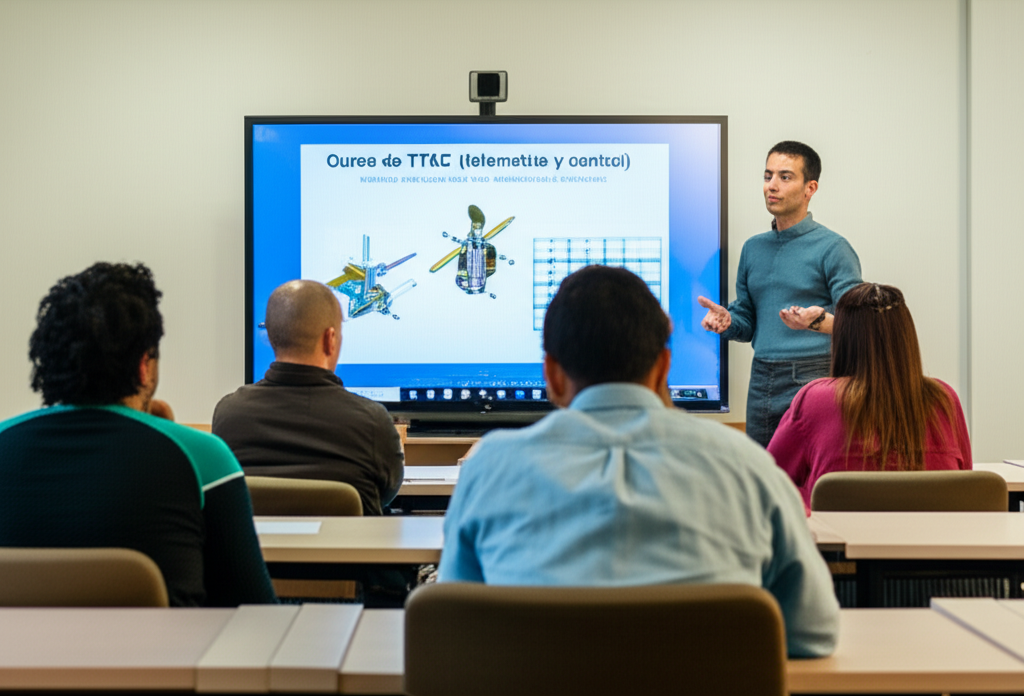
TT&C (Telemetry and Control) Course
- Format: Hybrid
- Duration: 3 months
- Hours: 300 H
- Language: English / Spanish
- Registration date: 23-10-2026
- Start date: 12-12-2026
- Available places: 3
399 $
Competencies and results
What you will learn
1. Mastery of Naval Telemetry and Control: Fundamentals and Applications
Here is the SEO-optimized content and the provided title:
**What Will You Learn in Naval Telemetry and Control Mastery: Fundamentals and Applications?**
Understand the fundamental principles of naval telemetry, including data transmission and reception in maritime environments.
Master naval control systems, from sensor data acquisition to real-time command execution.
Analyze and apply signal processing techniques to improve the accuracy and reliability of telemetry data.
Study naval telemetry system architectures, including radio frequency (RF), satellite, and underwater communication systems.
Evaluate and optimize the performance of control systems, considering factors such as latency, bandwidth, and security.
Learn about the communication protocols and standards used in naval telemetry and control (e.g., NMEA, CANbus).
Implement telemetry solutions for monitoring and controlling critical systems aboard ships and submarines.
Explore the applications of telemetry in navigation, positioning, threat detection, and maritime safety management.
Become familiar with the software and hardware tools used in naval telemetry and control, including simulators and data acquisition systems.
Develop practical skills in troubleshooting, fault analysis, and optimization of naval telemetry and control systems.
2. Expert Analysis in Naval TT&C: Data Optimization and Remote Control
Master the analysis of Telemetry, Telecommand, and Control (TT&C) systems in naval environments.
Interpret and evaluate critical data from sensors and systems on board ships.
Optimize data transmission and reception, ensuring information integrity and security.
Implement remote control strategies for the efficient management of naval systems.
Identify and troubleshoot problems related to real-time communication and control.
Apply advanced techniques for interference mitigation and signal enhancement.
Understand the relevant international regulations and standards for naval TT&C systems.
Develop skills in using specialized software for the analysis and simulation of TT&C systems.
Evaluate and select state-of-the-art technologies and equipment to optimize system performance.
Design and optimize robust and adaptable TT&C system architectures for different naval scenarios.
3. Comprehensive user-oriented design and validation (from modeling to manufacturing)
You will learn to integrate the entire product development process, from initial model conception to final validation, applying user-centered methodologies. You will develop skills in parametric design, ergonomics, simulation, sustainable materials, 3D visualization, and manufacturing management, ensuring efficient, safe solutions that meet current industry standards.
4. Master's Degree in Telemetry and Naval Control: From Theory to Practice
4. Master’s Degree in Naval Telemetry and Control: From Theory to Practice
- Understand the fundamentals of naval telemetry, including data acquisition, transmission, and processing in maritime environments.
- Master naval control systems, from classical control theory to advanced adaptive and predictive control techniques.
- Apply signal processing techniques for the interpretation and analysis of telemetry data.
- Design and optimize communication systems for real-time data transmission in complex naval environments.
- Analyze the integration of telemetry and control systems on naval platforms, including ships, submarines, and unmanned vehicles.
- Use simulation and modeling tools to evaluate the performance of telemetry and control systems.
- Implement cybersecurity strategies to protect telemetry and control systems against cyber threats.
- Study the regulations and standards of the naval industry related to telemetry and control.
- Develop leadership and project management skills in the field of naval telemetry and control.
- Conduct research and develop innovative solutions for current and future challenges in naval telemetry and control.
5. Unraveling Naval TT&C: Key Principles, Techniques and Strategies
- Understand the fundamentals of Naval TT&C: its objectives, architecture, and essential components.
- Identify and analyze the communication protocols used in naval TT&C systems.
- Master signal modulation and demodulation techniques in naval environments.
- Learn about frequency resource management and interference mitigation.
- Explore methods for synchronizing and tracking naval platforms and sensors.
- Acquire knowledge of data encryption and security in TT&C systems.
- Study TT&C network planning and optimization strategies in operational scenarios.
- Analyze the design and implementation of land-based and shipboard stations.
- Become familiar with international regulations and standards related to naval TT&C.
- Evaluate case studies and practical applications of TT&C in naval operations.
6. TT&C Naval: Fundamentals, Practices and Strategies of Remote Control
6. Naval TT&C: Fundamentals, Practices, and Remote Control Strategies
- Understand the fundamentals of TT&C (Telemetry, Tracking & Command) communication applied to naval environments.
- Identify and analyze the key components of TT&C systems on naval platforms, including antennas, receivers, transmitters, and signal processing systems.
- Study the different frequency bands used in naval TT&C communications and their implications for performance and safety.
- Learn the communication protocols and standard data formats used in naval TT&C systems.
- Become familiar with naval platform tracking techniques, including the use of radar, GPS systems, and other sensors.
- Master remote control strategies applied to naval platforms, including command management, payload control, and The safety of operations.
Analyze the specific challenges of T&C communication in naval environments, such as interference, signal attenuation, and the effects of propagation in saltwater.
Apply simulation and modeling tools to evaluate the performance of T&C systems and optimize their design.
Study best practices for the security of T&C systems, including protection against cyber threats and risk mitigation.
Explore emerging trends in naval T&C technology, such as the use of satellites, artificial intelligence, and automation.
Who this program is for:
TT&C (Telemetry and Control) Course
- Graduates in Aerospace Engineering, Mechanical Engineering, Industrial Engineering, Automation Engineering, or related fields.
- Professionals in OEM rotorcraft/eVTOL, MRO, consulting, and technology centers.
- Flight Testing, certification, avionics, control, and dynamics seeking specialization.
- Regulators/authorities and UAM/eVTOL professionals requiring compliance skills.
Recommended qualifications: based in Aerodynamics, control and structures; ES/EN B2+/C1. We offer bridging tracks if you need them.
- Standards-driven curriculum: you will work with CS-27/CS-29, DO-160, DO-178C/DO-254, ARP4754A/ARP4761, ADS-33E-PRF from the first module.
- Accreditable laboratories (EN ISO/IEC 17025) with rotor bench, EMC/Lightning pre-compliance, HIL/SIL, vibrations/acoustics.
- Evidence-oriented TFM: safety case, test plan, compliance dossierand operational limits.
- Mentored by industry: teachers with experience in rotorcraft, tiltrotor, eVTOL/UAM and flight test.
- Flexible modality (hybrid/online), international cohorts and support from SEIUM Career Services.
- Ethics and security: safety-by-design approach, cyber-OT, DIH and compliance as pillars.
Module 1 — Fundamentals of Naval Telemetry
1.1 Introduction to Naval Telemetry: History and Evolution
1.2 Basic Principles of Telemetry: Sensors and Transducers
1.3 Transmission Systems: Radio Frequency and Satellite Links
1.4 Communication Protocols: Standards and Data Formats
1.5 Architecture of a Naval Telemetry System: Key Components
1.6 Data Acquisition in Marine Environments: Challenges and Solutions
1.7 Signal Processing: Filtering and Digitization
1.8 Remote Control: Fundamentals and Applications in the Naval Sector
1.9 Security in Naval Telemetry: Encryption and Data Protection
1.10 Application Examples: Monitoring Ships and Submarines
2.2 Fundamentals of Data Optimization in Naval Telecommunications
2.2 Data Sources in Naval Systems and Their Prioritization
2.3 Data Filtering and Reduction Techniques
2.4 Data Compression Strategies for Telecommunications
2.5 Data Quality Analysis and Anomaly Detection
2.6 Database Design for Naval Telecommunications
2.7 Communication and Data Transfer Protocols
2.8 Data Visualization and Analysis Tools
2.9 Data Security and Protection in Naval Systems
2.20 Case Studies: Data Optimization in Real Naval Scenarios
3.3 Design Principles of Naval TT&C Systems
3.2 Hardware and Software Selection for TT&C
3.3 Implementation of Naval Communication Protocols
3.4 Integration of Sensors and Actuators in TT&C Systems
3.5 Configuration and Calibration of TT&C Systems
3.6 Validation and Verification of TT&C Systems
3.7 Analysis of Naval Telemetry Data
3.8 Troubleshooting and Diagnosing Problems in TT&C Systems
3.9 Design of User Interfaces for Naval Control
3.30 Optimizing Performance and Safety in TT&C Systems
4.4 Principles of Naval Telemetry: Signals, Transmission, and Reception
4.2 Naval TT&C Systems Architecture: Key Components and Functions
4.3 Communication Protocols in Naval Environments: Implementation and Security
4.4 Sensors and Transducers for Data Acquisition at Sea
4.5 Telemetry Data Processing and Filtering: Advanced Techniques
4.6 Remote Control Systems: Design and Strategic Applications
4.7 Integration of TT&C Systems: Hardware, Software, and Networks
4.8 Testing and Validation of TT&C Systems: Methodologies and Standards
4.9 Telemetry Data Analysis: Interpretation and Decision Making
4.40 Case Studies: Real-World Implementations in the Naval Sector
5.5 Fundamental Principles of Naval Telemetry
5.5 Key Components in Telemetry Systems
5.3 Communication Protocols in Naval Environments
5.4 Design of Naval Telemetry Systems
5.5 Remote Control Strategies and Operations
5.6 Analysis of Naval Telemetry Data
5.7 Integration of Telemetry Systems on Naval Platforms
5.8 Maintenance and Management of Telemetry Systems
5.9 Regulations and Standards in Naval Telemetry
5.50 Case Studies and Practical Applications
6.6 Principles of Naval Telemetry: Sensors and Transducers
6.2 TT&C Communication Protocols: Uplink and Downlink
6.3 Ground Stations and Remote Control Systems
6.4 Fundamentals of Data Transmission in Naval Environments
6.5 Modulation and Demodulation Techniques for TT&C Signals
6.6 Global Positioning Systems (GPS) and Navigation
6.7 Data Integrity Management and Error Control
6.8 Remote Control Strategies: Command Execution and Monitoring
6.9 Cybersecurity in Naval TT&C Systems: Protection and Defense
6.60 Case Studies: Real-World Applications and Challenges of Remote Control
- Hands-on methodology: test-before-you-trust, design reviews, failure analysis, compliance evidence.
- Software (depending on licenses/partners): MATLAB/Simulink, Python (NumPy/SciPy), OpenVSP, SU2/OpenFOAM, Nastran/Abaqus, AMESim/Modelica, acoustics tools, planning toolchains DO-178C.
- SEIUM Laboratories: scale rotor bench, vibrations/acoustics, EMC/Lightning pre-compliance, HIL/SIL for AFCS, data acquisition with strain gauging.
- Standards and compliance: EN 9100, 17025, ISO 27001, GDPR.
Capstone-type projects
- TT&C Optimization: Protocol design and data analysis.
- Advanced Remote Control: Algorithm implementation and validation.
- TT&C Systems Analysis: Modeling and simulation of naval scenarios.
- Naval Data Management: Architecture, storage, and security.
- Autonomous Navigation System: Sensor integration, fusion algorithms, course control.
- Secure Naval Communications: Encryption, robust protocols, threat mitigation.
- Naval Combat Simulation: Scenario modeling, performance analysis, strategies.
- Sensor Data Analysis: Processing, pattern identification, prediction.
- TT&C Simulation: System design, link simulation, performance analysis, and optimization.
- TT&C Implementation: Hardware and software development, laboratory and naval environment testing.
- TT&C Data Analysis: Processing, visualization, and analysis for decision-making.
- Design and Analysis of Naval TT&C Systems: Implementation of protocols and data optimization on naval platforms.
- Development of Remote Control Algorithms: Creation of robust and efficient control systems for naval operations.
- Simulation and Validation of TT&C Systems: Testing in SIL/HIL environments to ensure reliability and performance.
- Telemetry Data Management and Analysis: Implementation of solutions for the acquisition, processing, and management of critical data.
Admissions, fees, and scholarships
- Profile: Background in Computer Engineering, Mathematics, Statistics, or related fields; practical experience in NLP and valued information retrieval systems.
- Documentation: Updated CV, academic transcript, SOP/statement of purpose, project examples or code (optional).
- Process: Application → Technical evaluation of profile and experience → Technical interview → Review of case studies → Final decision → Enrollment.
- Fees:
- Single payment: 10% discount.
- Payment in 3 installments: No fees; 30% upon registration + 2 equal monthly payments of the remaining 35%.
Monthly payment: available with a 7% commission on the total; annual review.
Scholarships: based on academic merit, financial need, and promoting inclusion; agreements with companies in the sector for partial or full scholarships.
See “Calendar & Calls for Applications,” “Scholarships & Grants,” and “Fees & Financing” in the SEIUM mega-menu.
Do you have any questions?
Our team is ready to help you. Contact us, and we will respond as soon as possible.
F. A. Q
Frequently asked questions
Yes, we have international certification
Yes: experimental models, real data, applied simulations, professional environments, real case studies.
It is not mandatory. We offer leveling tracks and tutoring.
Completely. It covers e-propulsion, integration, and emerging regulations (SC-VTOL).
Recommended. There are also internal challenges and consortiums.
Yes. Online/hybrid modality with planned labs and visa support (see “Visa & Residence”).