

Sustainable Urban Drainage Systems (SUDS) Design Course
About our
The Sustainable Urban Drainage Systems (SUDS) Design Course explores the implementation of innovative strategies for stormwater management in urban environments. It focuses on the planning, design, and construction of systems that integrate techniques such as infiltration trenches, green roofs, constructed wetlands, and permeable pavements. It relates to disciplines such as urban hydrology, civil engineering, and urban planning, considering environmental sustainability and flood mitigation.
The course provides practical knowledge in the application of hydrological modeling, watershed analysis, and the use of GIS (Geographic Information Systems) tools for the design of efficient SUDS. This course addresses local regulations and international standards related to water management, preparing professionals for roles such as environmental engineers, urban planners, and sustainability consultants, promoting urban resilience to climate change.
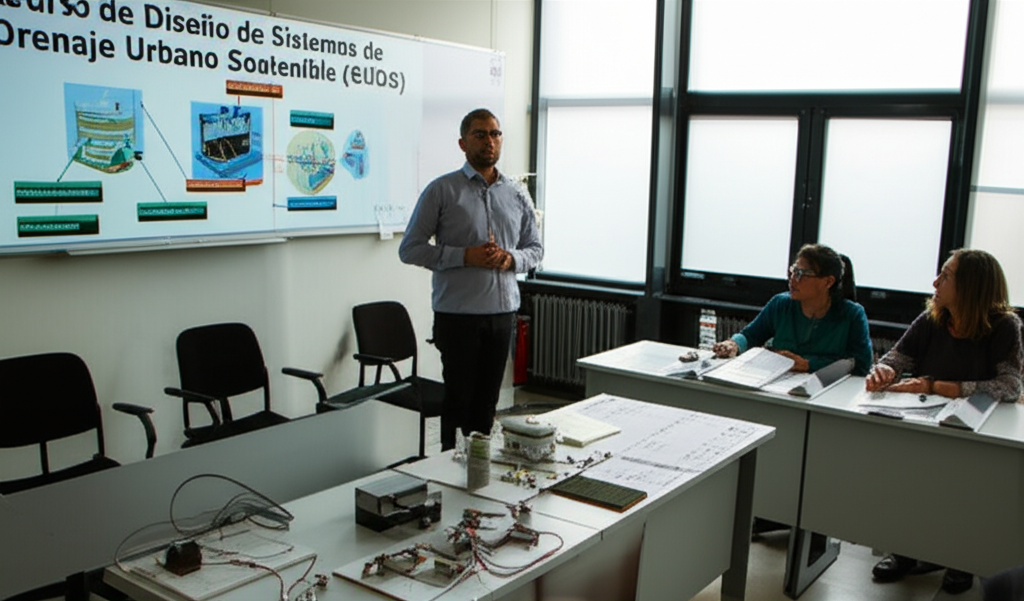
Sustainable Urban Drainage Systems (SUDS) Design Course
- Format: Online
- Duration: 3 months
- Hours: 300 H
- Language: English / Spanish
- Registration date: 23-10-2026
- Start date: 12-12-2026
- Available places: 2
399 $
Competencies and results
What you will learn
1. Comprehensive Design of SUDS Systems: Advanced Techniques and Strategies
- Master the conceptualization and modeling of Sustainable Urban Drainage Systems (SUDS).
- Understand the hydrological and hydraulic design principles for runoff management.
- Apply advanced modeling and numerical simulation techniques (e.g., SWMM, HEC-RAS) for SUDS design.
- Design and optimize specific SUDS components: retention basins, infiltration ponds, infiltration trenches, permeable pavements, etc.
- Evaluate the performance of SUDS in terms of flood control, water quality, and aquifer recharge.
- Analyze the sustainability aspects and environmental benefits of SUDS systems.
- Integrate SUDS within the context of urban planning and sustainable development.
- Become familiar with regulations and best practices in the design and implementation of SUDS.
2. Practical Implementation of SUDS: Design, Construction and Evaluation
- Identify and understand the fundamental principles of Sustainable Urban Drainage Systems (SUDS) design and construction.
- Analyze different SUDS techniques, including their application in diverse urban contexts and the selection of the most appropriate one.
- Design SUDS systems, considering hydraulic, hydrological, and water quality aspects.
- Construct and commission SUDS projects, applying industry best practices.
- Evaluate the performance and effectiveness of implemented SUDS systems, monitoring their environmental and social impact.
- Learn about the regulations and standards related to SUDS, as well as the available incentives and funding.
- Use modeling and simulation tools for the design and analysis of SUDS systems.
- Manage the long-term maintenance and rehabilitation of SUDS systems.
3. Comprehensive user-oriented design and validation (from modeling to manufacturing)
You will learn to integrate the entire product development process, from initial model conception to final validation, applying user-centered methodologies. You will develop skills in parametric design, ergonomics, simulation, sustainable materials, 3D visualization, and manufacturing management, ensuring efficient, safe solutions that meet current industry standards.
4. SUDS Mastery: Design, Implementation and Urban Sustainability
- Identify the fundamental principles of **Sustainable Urban Design (SUDS)**, including its importance in water management and urban development.
- Evaluate different **SUDS implementation** techniques, such as infiltration, storage, and stormwater treatment systems.
- Analyze the environmental, social, and economic benefits of **urban sustainability**, and how SUDS contribute to these benefits.
- Design strategies for the **long-term sustainability of SUDS systems**, considering maintenance, management, and adaptation to climate change.
- Apply tools and methodologies for the **planning and implementation of SUDS projects**, including site analysis, conceptual design, and hydrological modeling.
- Understand the regulatory framework and **policies related to SUDS** in different urban contexts.
- Explore case studies and practical examples of Successful SUDS around the world.
Evaluate the impact of SUDS on water quality, biodiversity, and urban resilience.
Develop skills for communication and citizen participation in SUDS projects.
Learn to measure and monitor the performance of SUDS systems.
5. SUDS Design: Principles, Applications and Environmental Sustainability
- Definition and Fundamentals of SUDS: Understand the nature of Sustainable Urban Drainage Systems (SUDS), their purpose, and the key principles that govern them.
- Principles of Hydrologic Design: Master the essential concepts of urban hydrology, including water cycle management, flow analysis, and runoff volume estimation.
- Selection and Design of SUDS Components: Learn to select and design a wide range of SUDS components, such as retention basins, infiltration trenches, permeable pavements, and green roofs, considering their capacities and limitations.
- Environmental Considerations and Benefits of SUDS: Explore the environmental benefits of SUDS, including water pollution reduction, aquifer recharge, improved air quality, and habitat creation.
- Practical Applications of SUDS: Examine case studies and examples Real-world examples of successful SUDS implementation in diverse urban contexts, from small-scale interventions to large-scale projects.
Sustainability and Life Cycle Assessment: Evaluate the sustainability of SUDS systems, considering factors such as carbon footprint, energy consumption, and component lifespan, along with life cycle analysis.
Integration of SUDS into Urban Planning: Understand how to integrate SUDS into urban planning and land management, including climate change adaptation and resilience building.
Regulations and Legislation Related to SUDS: Become familiar with regulations, standards, and legislation related to SUDS, both locally and internationally.
Monitoring and Maintenance of SUDS: Learn monitoring techniques to evaluate the performance of SUDS systems and develop effective maintenance strategies to ensure their long-term functionality.
6. Design and Application of SUDS: From Theory to Urban Practice
Here is the requested content:
6. Design and Application of SUDS: From Theory to Urban Practice
- Understand the fundamental principles of Sustainable Urban Drainage Systems (SUDS).
- Identify and evaluate the different SUDS techniques available, including:
- Infiltration trenches
- Constructed wetlands
- Permeable pavements
- Green roofs
- Stormwater retention basins
- Analyze urban hydrology and its impact on SUDS design.
- Apply hydrological models to simulate SUDS performance.
- Design SUDS to control the quantity and quality of runoff water.
- Integrate SUDS into the urban environment, considering aspects aesthetic, functional, and social aspects.
Evaluate the feasibility and cost-benefit of SUDS projects.
Implement maintenance strategies to ensure the long-term performance of SUDS.
Study practical case studies of SUDS implementation in different urban contexts.
Become familiar with the regulations and policies related to SUDS.
Who this program is for:
Sustainable Urban Drainage Systems (SUDS) Design Course
- Civil, environmental, urban planning engineers and related professionals.
- Professionals from construction companies, engineering consultancies, and public administrations.
- Technicians and staff from urban planning, water resource management, and environmental departments.
- Individuals interested in the design and implementation of sustainable solutions for rainwater management.
- Standards-driven curriculum: you will work with CS-27/CS-29, DO-160, DO-178C/DO-254, ARP4754A/ARP4761, ADS-33E-PRF from the first module.
- Accreditable laboratories (EN ISO/IEC 17025) with rotor bench, EMC/Lightning pre-compliance, HIL/SIL, vibrations/acoustics.
- Evidence-oriented TFM: safety case, test plan, compliance dossierand operational limits.
- Mentored by industry: teachers with experience in rotorcraft, tiltrotor, eVTOL/UAM and flight test.
- Flexible modality (hybrid/online), international cohorts and support from SEIUM Career Services.
- Ethics and security: safety-by-design approach, cyber-OT, DIH and compliance as pillars.
1.1 Introduction to SUDS Systems: Concepts and Benefits
1.2 Fundamental Principles of SUDS Design
1.3 Analysis of the Urban Hydrologic Cycle
1.4 Identification of SUDS System Components
1.5 Selection of Appropriate SUDS Techniques
1.6 Preliminary SUDS Design: Site and Feasibility Studies
1.7 Design of Volume Control Elements
1.8 Design of Infiltration and Retention Elements
1.9 Design of Filtration and Treatment Elements
1.10 Integration of SUDS into the Urban Landscape: Aesthetic and Functional Aspects
2. SUDS Site Planning and Selection: Key Criteria and Preliminary Studies
3. SUDS Detailed Design: Component Selection and Precise Sizing
4. SUDS Construction: Installation Techniques and Quality Control
5. SUDS Water Management: Operation and Maintenance for Long-Term Success
6. SUDS Performance Evaluation: Monitoring, Measurement, and Adjustments
7. SUDS Integration into the Urban Environment: Landscaping and Design Considerations
8. SUDS Case Studies: Practical Examples and Lessons Learned
9. SUDS Standards and Regulations: Compliance and Best Practices
20. SUDS Implementation: Troubleshooting and Mitigation Strategies
22. SUDS Sustainability: Environmental, Social, and Economic Benefits
3.3 Principles of Hydrology Applied to SUDS
3.2 Analysis of Urban Watersheds
3.3 Estimation of Runoff Flows and Volumes
3.4 Hydrological Modeling for SUDS Design
3.5 Design of Sustainable Urban Drainage Systems (SUDS)
3.6 Water Quality Management in Urban Environments
3.7 Stormwater Retention and Detention Techniques
3.8 Implementation of Hydraulic Design Criteria
3.9 Environmental Impact Assessment of SUDS Projects
3.30 Integrated Urban Water Management and Planning
4.4 SUDS Fundamentals: Principles and Philosophy of Sustainable Design
4.2 Urban Water Cycle Analysis: Identifying Challenges and Opportunities
4.3 Advanced Hydrologic Design: Estimating Flow Rates and Volumes
4.4 Hydraulic Modeling of SUDS: Simulation Tools and Techniques
4.5 Selection and Design of SUDS Components: Key Elements and Criteria
4.6 Practical Implementation: Construction and Management Strategies
4.7 Sustainability Considerations: Environmental Impact and Social Benefits
4.8 Urban Integration: Designing SUDS in the Urban Context
4.9 Optimization and Maintenance: Strategies for Long-Term Efficiency
4.40 Case Studies: Analysis of Successful Projects and Lessons Learned
5.5 Definition and Scope of SUDS: Objectives and Benefits
5.5 Fundamental Principles of SUDS Design: Filtration, Infiltration, Retention
5.3 Site Analysis: Terrain and Urban Context Assessment
5.4 Selection of SUDS Techniques: Criteria and Applications
5.5 Conceptual Design: Schemes and Diagrams
5.6 Hydrologic Modeling: Tools and Methodology
5.7 Detailed Design: Components and Sizing
5.8 Regulatory Aspects and Permits
5.9 Landscape Integration: Sustainable Urban Design
5.50 Case Study: Comprehensive SUDS Design
5.5 Planning and Detailed Design of SUDS Construction
5.5 Material Selection: Sustainability and Durability
5.3 Construction of Infiltration Systems: Trenches, Wells
5.4 Construction of Retention Systems: Ponds, Wetlands
5.5 Construction of Filtration Systems: Filters, Biofilters
5.6 Construction Management: Quality Control and Safety
5.7 Testing and Commissioning: Functional Verification
5.8 Performance Evaluation: Measurement and Monitoring
5.9 Maintenance and Cleaning: Strategies and Programs
5.50 Case Study: Practical Implementation of SUDS
3.5 Urban Hydrological Cycle: Impact of Urbanization
3.5 Watershed Analysis: Delineation and Characterization
3.3 Estimation of Design Flows: Methods and Tools
3.4 Hydraulic Modeling: Surface and Subsurface Flow
3.5 Stormwater Management: Collection and Reuse
3.6 Design of Storage Systems: Tanks and Cisterns
3.7 Design of Sustainable Drainage Systems: Networks and Channels
3.8 Legislation and Regulations: Water Regulatory Framework
3.9 Urban Planning: Integrating Water Management
3.50 Case Study: SUDS Design and Urban Water Management
4.5 Sustainable Urban Planning: SUDS Integration
4.5 Resilient Urban Design: Adapting to Climate Change
4.3 Selecting SUDS Techniques: Adapting to the Urban Environment
4.4 Designing Green Infrastructure Systems: Parks, Gardens
4.5 Designing Permeable Pavements: Applications and Advantages
4.6 Designing Green Roofs: Benefits and Considerations
4.7 Integrating SUDS into the Urban Landscape: Aesthetics and Functionality
4.8 Large-Scale SUDS Implementation: Urban Projects
4.9 Sustainability Assessment: Indicators and Metrics
4.50 Case Study: Urban SUDS Design and Implementation
5.5 Principles of Sustainability: Ecological Design
5.5 Environmental Impact of Urbanization
5.3 SUDS Design: Pollution Reduction
5.4 SUDS Design: Biodiversity Protection
5.5 SUDS Design: Water Quality Improvement
5.6 SUDS Design: Mitigating the Urban Heat Island Effect
5.7 SUDS Design: Social and Economic Benefits
5.8 Life Cycle Assessment (LCA) of SUDS
5.9 Certification and Urban Sustainability: Tools and Standards
5.50 Case Study: SUDS Principles and Sustainability
6.5 From Theory to Practice: A Practical Approach
6.5 Case Study: SUDS Design in Different Contexts
6.3 Infiltration System Design: Urban Applications
6.4 Retention System Design: Implementation
6.5 Filtration System Design: Integration
6.6 Constructed Wetland Design: Functioning and Benefits
6.7 Rain Garden Design: Aesthetics and Functionality
6.8 Permeable Pavement Design: Selection and Application
6.9 SUDS Maintenance and Management: Practical Aspects
6.50 Case Study: SUDS Application in Real-World Projects
7.5 SUDS Design Optimization: Advanced Strategies
7.5 Modeling and Simulation: Performance Prediction
7.3 Water Quality Optimization: Advanced Techniques
7.4 Retention Volume Optimization: Efficient Design
7.5 Cost-Benefit Optimization: Economic Analysis
7.6 Remote Monitoring and Control: Smart Technologies
7.7 Data-Driven Design: Feedback and Continuous Improvement
7.8 Integration with Smart Technologies: Sustainable Cities
7.9 Predictive Maintenance: Performance Optimization
7.50 Case Study: Urban SUDS Optimization
8.5 Innovation in SUDS Design: Latest Trends
8.5 SUDS Design: Adapting to Climate Change
8.3 Water Efficiency: Reducing Water Consumption
8.4 Water Reuse System Design: Applications
8.5 SUDS Design: Integrating Renewable Energy
8.6 Implementing SUDS in Complex Projects: Challenges
8.7 Parametric Design: Automation and Optimization
8.8 Performance Indicators: Measurement and Evaluation
8.9 Life Cycle Assessment (LCA): Sustainable Design
8.50 Case Study: Expert SUDS Design
6.6 Introduction to SUDS: Fundamentals and Objectives
6.2 SUDS Design Principles: Selection and Sizing
6.3 Site Analysis: Evaluation of the Terrain and Urban Context
6.4 SUDS System Design: Selection of Appropriate Technologies
6.5 SUDS Implementation: Construction and Supervision
6.6 Stormwater Management: Collection and Reuse
6.7 Case Studies: Examples of SUDS in Urban Environments
6.8 Regulatory Aspects and Permits: Regulations and Compliance
6.9 Costs and Benefits: Economic Analysis of SUDS
6.60 Urban Sustainability: Environmental and Social Impact of SUDS
- Hands-on methodology: test-before-you-trust, design reviews, failure analysis, compliance evidence.
- Software (depending on licenses/partners): MATLAB/Simulink, Python (NumPy/SciPy), OpenVSP, SU2/OpenFOAM, Nastran/Abaqus, AMESim/Modelica, acoustics tools, planning toolchains DO-178C.
- SEIUM Laboratories: scale rotor bench, vibrations/acoustics, EMC/Lightning pre-compliance, HIL/SIL for AFCS, data acquisition with strain gauging.
- Standards and compliance: EN 9100, 17025, ISO 27001, GDPR.
Capstone-type projects
- Urban SUDS: Modeling, design, and analysis of sustainable water management systems.
- SUDS Implementation: Construction and evaluation of practical solutions for infiltration and retention.
- SUDS & Sustainability: Integration of SUDS systems into urban projects, including environmental impact analysis.
- Water Efficiency: Optimization of SUDS for stormwater management.
- Comprehensive Urban SUDS: Modeling, design, and optimization of SUDS systems.
- SUDS Pilot Implementation: Construction and evaluation of a real-world SUDS project.
- SUDS and Sustainability: Analysis of the environmental and social impact of SUDS.
- Advanced SUDS: Innovative design and efficient management of urban water.
- SUDS Planning: Selection, design, cost-benefit analysis; hydrological and hydraulic modeling.
- SUDS Implementation: Construction, monitoring, water management; performance evaluation and optimization.
- SUDS Sustainability: Life cycle assessment; urban integration; environmental impact; certification.
- Urban SUDS: Design, implementation, and evaluation of sustainable stormwater management systems.
- Hydrological Analysis: Flow modeling and simulation, design of green and blue infrastructure.
- Sustainable Management: Implementation of SUDS in real urban environments, optimization, and monitoring.
- SUDS Innovation: Research into new technologies, strategies, and approaches for sustainability.
Admissions, fees, and scholarships
- Profile: Background in Computer Engineering, Mathematics, Statistics, or related fields; practical experience in NLP and valued information retrieval systems.
- Documentation: Updated CV, academic transcript, SOP/statement of purpose, project examples or code (optional).
- Process: Application → Technical evaluation of profile and experience → Technical interview → Review of case studies → Final decision → Enrollment.
- Fees:
- Single payment: 10% discount.
- Payment in 3 installments: No fees; 30% upon registration + 2 equal monthly payments of the remaining 35%.
Monthly payment: available with a 7% commission on the total; annual review.
Scholarships: based on academic merit, financial need, and promoting inclusion; agreements with companies in the sector for partial or full scholarships.
See “Calendar & Calls for Applications,” “Scholarships & Grants,” and “Fees & Financing” in the SEIUM mega-menu.
Do you have any questions?
Our team is ready to help you. Contact us, and we will respond as soon as possible.
F. A. Q
Frequently asked questions
Yes, we have international certification
Yes: experimental models, real data, applied simulations, professional environments, real case studies.
It is not mandatory. We offer leveling tracks and tutoring.
Completely. It covers e-propulsion, integration, and emerging regulations (SC-VTOL).
Recommended. There are also internal challenges and consortiums.
Yes. Online/hybrid modality with planned labs and visa support (see “Visa & Residence”).