

Space Debris Management Course
About our
The Space Debris Management course explores crucial strategies for addressing the growing problem of orbital debris. It focuses on the application of orbit models, debris detection and tracking techniques, and the development of space cleanup technologies, such as capture and deorbiting. It links with disciplines such as astrodynamics, space systems engineering, and space law, considering the sustainability of space operations.
The course offers knowledge in risk analysis, remediation mission design, and compliance with international regulations for debris management. It prepares professionals for roles such as space project managers, orbital safety engineers, and space policy specialists, promoting a clean and sustainable space industry.
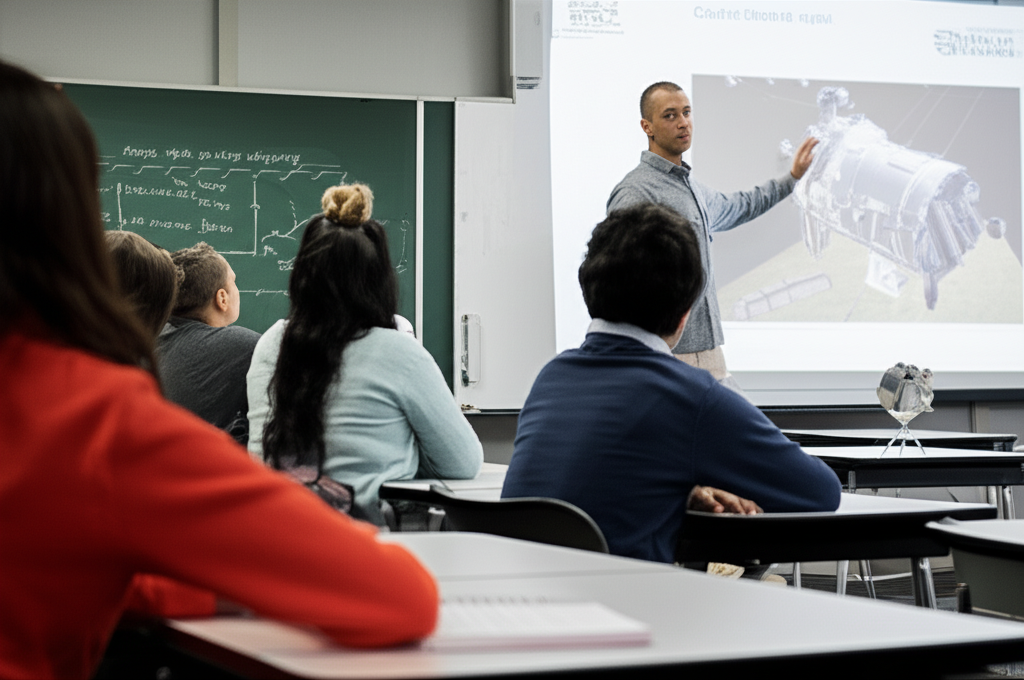
Space Debris Management Course
- Format: Hybrid
- Duration: 3 months
- Hours: 300 H
- Language: English / Spanish
- Registration date: 23-10-2026
- Start date: 12-12-2026
- Available places: 3
299 $
Competencies and results
What you will learn
1. Comprehensive Management of Space Waste: Expert Course
- Identify and classify the different types of space debris, from rocket and inactive satellite remnants to collision fragments.
- Understand the international laws and regulations related to space debris management and space sustainability.
- Evaluate the risks associated with space debris, including collisions, debris propagation, and the impact on space operations.
- Use tools and models to predict the evolution of space debris orbits and simulate collision scenarios.
- Design and evaluate strategies for space debris mitigation, such as preventing the generation of new debris and reducing the probability of collisions.
- Explore technologies for space cleanup, including methods for capturing and removing space debris, as well as controlled reentry.
- Analyze the impact of space debris management on the economic viability and sustainability of space activities.
- Develop skills for planning and executing space debris management missions, considering technical, legal, and financial aspects.
- Understand the challenges and opportunities related to international cooperation in space debris management.
- Apply the acquired knowledge to contribute to creating a safe and sustainable space for future generations.
2. Analysis and Strategies for Mitigating Orbital Debris
- Identify the sources and types of orbital debris.
- Understand the risks associated with space debris for missions.
- Evaluate orbital debris mitigation strategies, including active and passive deorbiting.
- Analyze international regulations and policies on space debris.
- Study technologies for tracking and monitoring orbital debris.
- Explore methods for designing space debris-resistant satellites.
- Investigate initiatives for cleaning up and removing orbital debris.
- Develop strategies to minimize the generation of new space debris.
- Evaluate the economic and environmental impact of orbital debris.
- Analyze case studies of collisions and events involving space debris.
3. Comprehensive user-oriented design and validation (from modeling to manufacturing)
You will learn to integrate the entire product development process, from initial model conception to final validation, applying user-centered methodologies. You will develop skills in parametric design, ergonomics, simulation, sustainable materials, 3D visualization, and manufacturing management, ensuring efficient, safe solutions that meet current industry standards.
4. Space Debris Planning and Control: Specialized Course
4. Space Debris Planning and Control: Specialized Course
- Identify the sources and types of space debris, including satellite fragments, rocket remnants, and other objects.
- Understand the risks associated with space debris, such as catastrophic collisions and the Kessler syndrome.
- Analyze the orbital trajectories and dynamics of space debris using models and simulations.
- Evaluate strategies to mitigate the creation of new space debris, including the responsible design of satellites and rockets.
- Study technologies for space debris removal, such as capture, atmospheric reentry, and relocation to graveyard orbits.
- Understand international regulations and policies on space debris.
- Apply planning and control techniques for the sustainable management of space.
- Use specialized tools and software for the analysis and simulation of space debris.
Develop decision-making skills in risky situations related to space debris.
Participate in debates and case studies on the problem of space debris and its solutions.
5. Advanced Strategies for Space Debris Cleaning and Management
5. Advanced Strategies for Space Debris Cleanup and Management
- Identify and assess the risks associated with the proliferation of space debris, including collisions and fragmentation events.
- Understand space debris detection and tracking technologies, including the use of radar, telescopes, and sensor systems.
- Analyze different space debris mitigation strategies, such as preventing new debris creation and capturing existing objects.
- Study methods for capturing and removing space debris, including the use of nets, harpoons, grabs, and propulsion systems.
- Evaluate the legal and regulatory aspects related to space debris cleanup and management, including the Outer Space Treaty.
- Explore the economic and financial considerations associated with space debris cleanup missions, including cost-benefit analysis.
- Understand the impact of space debris cleanup in the sustainability of space and the preservation of the space environment.
Design and simulate space debris cleanup missions using modeling and simulation tools.
Analyze the technological and scientific challenges faced by space debris cleanup missions, such as autonomy, navigation, and control.
Evaluate future trends and developments in the field of space debris cleanup and management, including the use of artificial intelligence and robotics.
6. In-depth Analysis and Innovative Solutions in Space Debris Management
6. In-Depth Analysis and Innovative Solutions in Space Debris Management
- Identify and classify the types of space debris and their associated risks.
- Understand the orbital dynamics and trajectories of space debris.
- Analyze space debris detection and tracking methods.
- Evaluate the impacts of space debris on space operations and exploration.
- Study current technologies for space debris mitigation (e.g., deorbiting, capture).
- Explore innovative solutions for space debris cleanup and management.
- Analyze international regulations and policies related to space debris.
- Develop strategies for the long-term sustainability of space.
- Evaluate the satellite lifecycle and its impact on debris generation.
- Understand the framework legal framework for satellite ownership and liability for waste.
Who this program is for:
Space Debris Management Course
- Professionals and graduates with experience in the space sector, including aerospace, mechanical, industrial, and related engineers.
- Experts in space debris management, including but not limited to satellite operators, launch companies, and space agencies.
- Researchers and academics interested in the research and development of solutions for space debris.
- Staff from regulatory bodies and decision-makers in the space industry seeking knowledge of space debris management policies and regulations.
- Standards-driven curriculum: you will work with CS-27/CS-29, DO-160, DO-178C/DO-254, ARP4754A/ARP4761, ADS-33E-PRF from the first module.
- Accreditable laboratories (EN ISO/IEC 17025) with rotor bench, EMC/Lightning pre-compliance, HIL/SIL, vibrations/acoustics.
- Evidence-oriented TFM: safety case, test plan, compliance dossierand operational limits.
- Mentored by industry: teachers with experience in rotorcraft, tiltrotor, eVTOL/UAM and flight test.
- Flexible modality (hybrid/online), international cohorts and support from SEIUM Career Services.
- Ethics and security: safety-by-design approach, cyber-OT, DIH and compliance as pillars.
**Module 1 — Introduction to Space Debris Management**
1.1 Definition and Nature of Space Debris
1.2 History and Evolution of the Orbital Debris Problem
1.3 Impact of Space Debris on Space Operations and Sustainability
1.4 Regulatory Framework and International Agreements on Space Debris Management
1.5 Types of Space Debris: Origin and Classification
1.6 Sensors and Technologies for Detecting and Tracking Space Objects
1.7 Modeling and Simulation of Orbital Debris Dynamics
1.8 Mitigation Concepts: Design for Zero Debris Generation
1.9 Active Debris Removal Strategies: Key Concepts
1.10 Current Landscape and Future Trends in Space Debris Management Space Debris
2.2 Identification and Classification of Orbital Debris
2.2 Origins and Causes of Space Debris
2.3 Modeling and Simulation of Debris Orbits
2.4 Collision and Debris Propagation Risk Analysis
2.5 Space Object Detection and Tracking Technologies
2.6 Environmental Impact of Space Debris
2.7 Legal and Regulatory Framework for Debris Management
2.8 Space Sustainability Metrics and Standards
2.9 Case Studies: Incidents and Implemented Solutions
2.20 Future of Research and Development in Space Debris Management
3.3 Definition and Context of Space Debris
3.2 Impact of Space Debris on Sustainability
3.3 Origins and Causes of Space Debris
3.4 Legal Framework and International Regulations
3.5 Importance of Mitigation and Management
3.6 Key Concepts in Space Sustainability
3.7 The Role of Space Agencies and Organizations
3.8 Current and Future Trends
3.9 Challenges and Opportunities
3.30 Introduction to Mitigation Technologies
4.4 Fundamentals of Orbital Planning: Trajectories and Orbits
4.2 Modeling and Simulation of Space Debris: Orbital Dynamics
4.3 Space Traffic Control Systems: Monitoring and Tracking
4.4 Risk Mitigation Strategies: Collision Analysis
4.5 Mission Design for Debris Removal: Technologies and Methods
4.6 Regulatory and Normative Framework: Compliance and Standards
4.7 Space Debris Management Tools and Software: Practical Applications
4.8 Planning Cleanup Missions: Case Studies
4.9 Economic and Financial Aspects: Cost-Benefit Analysis of Waste Management
4.40 Future of Orbital Planning and Control: Trends and Challenges
5.5 Introduction to International and National Space Law
5.5 Key Treaties and Agreements on Space Activities
5.3 Definition and Classification of Orbital Debris
5.4 Types of Space Objects in Orbit: Satellites, Rockets, Fragments
5.5 Sources of Debris: Collisions, Explosions, Wear and Tear
5.6 The Problem of Space Debris: Current Scenario and Projections
5.7 Impact of Debris on Long-Term Space Sustainability
5.8 Emerging Technologies and Legal Framework
5.9 Trends in International Regulation
5.50 Mitigation Regulations: Principles and Application
6.6 Identification and Characterization of Space Debris
6.2 Modeling and Simulation of Orbits and Fragmentation
6.3 Collision Risk and Impact Analysis
6.4 Space Debris Detection and Tracking Technologies
6.5 Mitigation Strategies: Responsible Design and Launch
6.6 Space Debris Removal Techniques: Capture and Deorbiting
6.7 Legal and Policy Considerations in Space Management
6.8 Cost-Benefit Analysis of Cleanup Solutions
6.9 Technological Innovations and Future Research
6.60 Case Studies: Analysis of Existing and Proposed Projects
- Hands-on methodology: test-before-you-trust, design reviews, failure analysis, compliance evidence.
- Software (depending on licenses/partners): MATLAB/Simulink, Python (NumPy/SciPy), OpenVSP, SU2/OpenFOAM, Nastran/Abaqus, AMESim/Modelica, acoustics tools, planning toolchains DO-178C.
- SEIUM Laboratories: scale rotor bench, vibrations/acoustics, EMC/Lightning pre-compliance, HIL/SIL for AFCS, data acquisition with strain gauging.
- Standards and compliance: EN 9100, 17025, ISO 27001, GDPR.
Capstone-type projects
- Sustainable Space Management: Modeling and simulation of orbital debris scenarios, development of mitigation strategies, and feasibility analysis of cleanup technologies.
- Risk Analysis and Strategies: Assessment of debris impacts, identification of critical orbits, and proposals for regulatory policies for space sustainability.
- Strategy Design: Orbit modeling and simulation; evaluation of space cleanup technologies.
- Impact Analysis: Studies of collision and debris propagation; risk models and mitigation strategies.
- Solution Development: Design of capture missions; proposals for sustainable space policies.
- Implementation and Management: Mission planning; evaluation of technical and economic feasibility.
- Orbital Footprint Analysis: Modeling and simulation of debris dispersal, risk assessment, and collision prediction.
- Mitigation Mission Design: Development of strategies for the capture, deorbiting, and cleanup of space objects.
- Implementation of Policies and Regulations: Study and proposal of regulations for space sustainability.
- Capture Design and Simulation: 3D satellite modeling, risk analysis, capture strategies.
- Trajectory Analysis: Orbit optimization, return maneuvers, safe atmospheric reentry.
- Cleanup Technologies: Propulsion, capture, and deorbiting system design.
- Legal and Regulatory Framework: Analysis of international treaties and regulations.
Admissions, fees, and scholarships
- Profile: Background in Computer Engineering, Mathematics, Statistics, or related fields; practical experience in NLP and valued information retrieval systems.
- Documentation: Updated CV, academic transcript, SOP/statement of purpose, project examples or code (optional).
- Process: Application → Technical evaluation of profile and experience → Technical interview → Review of case studies → Final decision → Enrollment.
- Fees:
- Single payment: 10% discount.
- Payment in 3 installments: No fees; 30% upon registration + 2 equal monthly payments of the remaining 35%.
Monthly payment: available with a 7% commission on the total; annual review.
Scholarships: based on academic merit, financial need, and promoting inclusion; agreements with companies in the sector for partial or full scholarships.
See “Calendar & Calls for Applications,” “Scholarships & Grants,” and “Fees & Financing” in the SEIUM mega-menu.
Do you have any questions?
Our team is ready to help you. Contact us, and we will respond as soon as possible.
F. A. Q
Frequently asked questions
Yes, we have international certification
Yes: experimental models, real data, applied simulations, professional environments, real case studies.
It is not mandatory. We offer leveling tracks and tutoring.
Completely. It covers e-propulsion, integration, and emerging regulations (SC-VTOL).
Recommended. There are also internal challenges and consortiums.
Yes. Online/hybrid modality with planned labs and visa support (see “Visa & Residence”).