

Satellite thermal control course
About our
The Satellite Thermal Control Course explores the fundamentals and practice of designing thermal control systems for satellites. It focuses on the analysis of heat transfer, including conduction, convection, and radiation, and on the application of techniques such as thermal simulation using specialized software. The course covers the selection and use of thermal materials and components, such as coatings, radiators, and insulation, to maintain optimal satellite temperatures in the space environment. The program provides knowledge of the regulations and standards applicable to space thermal design, as well as the importance of system verification and validation. Participants will develop skills to analyze and solve thermal control problems, from the design phase to on-orbit operation, preparing professionals for roles in space engineering, satellite design, and mission management, in both the public and private sectors.
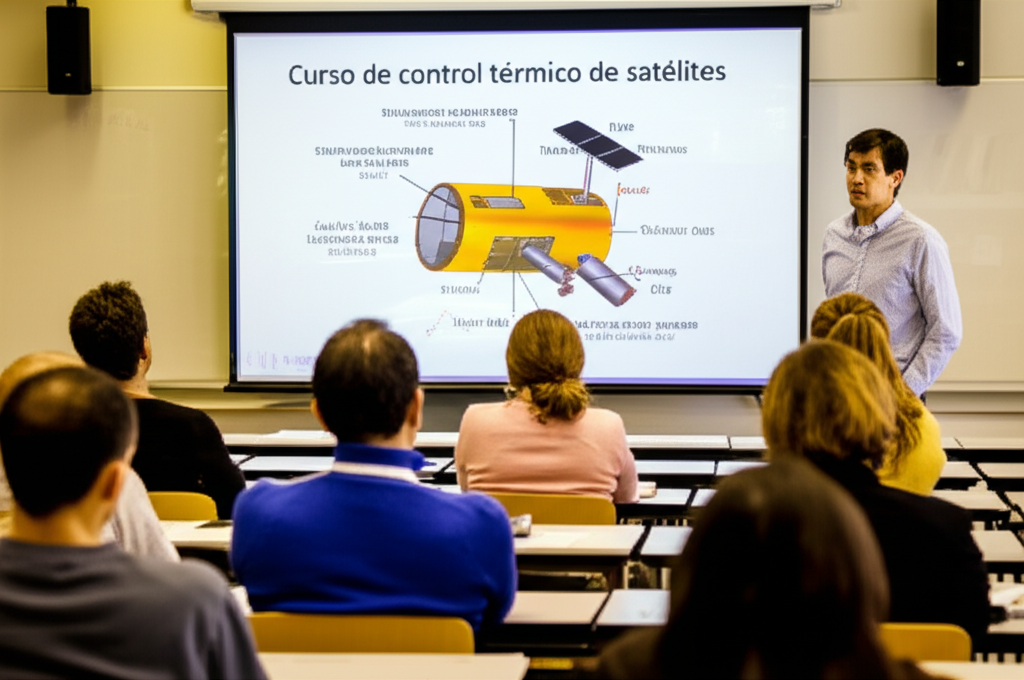
Satellite thermal control course
- Format: Hybrid
- Duration: 3 months
- Hours: 300 H
- Language: English / Spanish
- Registration date: 23-10-2026
- Start date: 12-12-2026
- Available places: 3
699 $
Competencies and results
What you will learn
1. Design and Analysis of Satellite Thermal Control Systems
- Principles of Thermodynamics Applied to Satellites: You will understand the fundamentals of heat transfer by conduction, convection, and radiation in the space environment, crucial for the design of thermal control systems.
- Analysis of Satellite Thermal Models: You will learn to develop and simulate complex thermal models using specialized software, considering the satellite’s geometry, materials, internal and external heat sources (sun, Earth, etc.), and boundary conditions.
- Design of Thermal Control Components: You will study the design and selection of key components, such as radiators, heat sinks, thermal insulation (MLI), heaters, thermostats, and heat pipes, to maintain the temperature of satellite equipment within specified limits.
- Materials and Finishes in Thermal Systems: You will explore the thermal properties of materials used in satellite construction, including metals, polymers, and composites, and how surface finishes (paints, coatings) influence heat absorption and emission.
Heat Transfer Analysis and Simulation: You will be trained in the use of numerical simulation tools (CFD and FEA) to analyze heat transfer in different satellite components and configurations, optimizing thermal design.
Active and Passive Thermal Control: You will differentiate between passive (insulation, radiators) and active (heaters, coolers) thermal control systems, understanding their advantages and disadvantages, and when to apply each.
Heating and Cooling Circuit Design: You will learn to design efficient and reliable heating and cooling circuits, using thermistors, thermocouples, and other sensors to control the temperature of the components.
- Validation and Testing of Thermal Systems: You will learn the testing and validation procedures for thermal control systems, including thermal vacuum, vibration, and EMC testing, to ensure their proper functioning in space.
- Specific Applications and Case Studies: You will analyze real-world satellite case studies, identifying thermal control challenges and implemented solutions, and learn about specific applications such as Earth observation, communications, and space exploration satellites.
1. Fundamentals of Satellite Thermal Control
- Understand the basic principles of heat transfer by conduction, convection, and radiation, as applied to satellites.
- Identify and analyze the key components of a satellite’s thermal control system: radiators, insulators, heaters, and sensors.
- Calculate the thermal loads acting on a satellite, including those from the Sun, Earth, and space.
- Design passive thermal control systems, using optimal materials and configurations for heat management.
- Select and size heaters and thermistors for the active thermal control of satellite components.
- Simulate the thermal behavior of a satellite using specialized software (e.g., Thermal Desktop, ESATAN).
- Interpret the results of thermal simulations and make adjustments to the design of the thermal control system.
- Understand the concepts of thermal stability and how to maintain the temperature within acceptable limits.
- Understand the standards and regulations related to the design and testing of satellite thermal control systems.
- Analyze thermal failures and design strategies to mitigate risks related to thermal control.
specified.
3. Comprehensive user-oriented design and validation (from modeling to manufacturing)
You will learn to integrate the entire product development process, from initial model conception to final validation, applying user-centered methodologies. You will develop skills in parametric design, ergonomics, simulation, sustainable materials, 3D visualization, and manufacturing management, ensuring efficient, safe solutions that meet current industry standards.
4. Thermal Control of Satellites: Design, Analysis and Simulation
Here is the SEO-optimized content about what you will learn in the course “Satellite Thermal Control: Design, Analysis, and Simulation”:
4. Satellite Thermal Control: Design, Analysis, and Simulation
Insulation).
Design of active thermal control systems, such as the use of heaters and thermistors.
Optimization of heat dissipation of electronic components and batteries.
Evaluation and validation of thermal models using ground tests and flight data.
Impact of space environmental conditions (e.g., vacuum, extreme temperatures) on thermal control.
Design considerations for the reliability and durability of thermal systems in space.
5. Mastery of Thermal Control in Satellite Design and Operation
- Fundamentals of Heat Transfer: Conduction, Convection, and Radiation
- Principles of Thermal Design for Satellites: Selection of Materials and Components
- Thermal Simulation: Use of Specialized Software for Modeling and Analysis
- Passive Thermal Control: Design of Surfaces, Insulation, and Radiators
- Active Thermal Control: Use of Heaters, Thermostats, and Cooling Systems
- Design of Thermal Control Systems for Different Types of Satellites and Missions
- Analysis of Thermal Failures and Mitigation Strategies
- Testing and Validation of Thermal Control Systems in Simulated Environments
- Practical Applications: Case Studies of Successful Satellite Design and Operation
- Management of Thermal Stress in Electronic Components and Satellite Structures
6. Satellite Thermal Control: Fundamentals and Applications
6. Satellite Thermal Control: Fundamentals and Applications
- Principles of Heat Transfer: Conduction, convection, and radiation in space.
- Materials and Coatings: Selection of materials with specific thermal properties.
- Thermal System Design: Analysis of satellite designs and configurations.
- Modeling and Simulation: Use of specialized software for temperature prediction.
- Passive Temperature Control: Techniques for maintaining thermal equilibrium.
- Active Temperature Control: Heating and cooling systems.
- Thermal Sensors: Types and applications in satellite monitoring.
- Testing and Validation: Thermal testing and performance verification under space conditions.
- Specific Applications: Thermal design for different types of satellites and missions.
- Impact of Solar and Terrestrial Radiation: Evaluation of Effects on Temperature.
Who this program is for:
Satellite thermal control course
- Engineers with degrees in Aerospace, Mechanical, Industrial, or related fields.
- Industry experts: professionals from satellite OEMs, systems integrators, launch companies, and satellite operators.
- Engineers and technicians in areas such as satellite design, integration, testing, and satellite operations who wish to specialize.
- Professionals interested in satellite thermal control, including thermal systems engineers, thermal analysis engineers, and component design engineers. thermal.
Recommended requirements: knowledge of heat transfer, thermodynamics, and programming; ES/EN B2+/C1. Support resources are provided.
- Standards-driven curriculum: you will work with CS-27/CS-29, DO-160, DO-178C/DO-254, ARP4754A/ARP4761, ADS-33E-PRF from the first module.
- Accreditable laboratories (EN ISO/IEC 17025) with rotor bench, EMC/Lightning pre-compliance, HIL/SIL, vibrations/acoustics.
- Evidence-oriented TFM: safety case, test plan, compliance dossierand operational limits.
- Mentored by industry: teachers with experience in rotorcraft, tiltrotor, eVTOL/UAM and flight test.
- Flexible modality (hybrid/online), international cohorts and support from SEIUM Career Services.
- Ethics and security: safety-by-design approach, cyber-OT, DIH and compliance as pillars.
Module 1 — Fundamentals of Satellite Thermal Control
1.1 Principles of Heat Transfer: Conduction, Convection, and Radiation
1.2 Thermodynamics Applied to Space Systems
1.3 Materials and Thermal Properties in Satellite Design
1.4 The Space Thermal Environment: Sun, Earth, and Albedo
1.5 Key Concepts: Temperature, Heat Flow, and Thermal Resistance
1.6 Passive Thermal Design: Radiators, Insulation, and Cladding
1.7 Active Thermal Design: Heaters and Coolers
1.8 Sensors and Actuators for Thermal Control
1.9 Basic Thermal Modeling and Simulation
1.10 Introduction to Space Regulations and Standards
2.2 Introduction to Space Thermodynamics
3.2 Heat Transfer: Conduction, Convection, and Radiation in Space
4.3 Materials and Coatings for Satellite Thermal Control
5.4 Analysis of Solar Radiation and its Effects
6.5 Thermal Control Components: Radiators, Insulators, Heaters, and Sensors
7.6 Design of Passive Thermal Control Systems
8.7 Design of Active Thermal Control Systems
9.8 Modeling and Simulation of Satellite Thermal Systems
20.9 Testing and Validation of Thermal Control Systems in Space Environments
22.20 Case Studies: Analysis of Thermal Control Systems in Real Satellites
3.3 Principles of Heat Transfer in Space
3.2 Materials and Coatings for Thermal Control
3.3 Preliminary Thermal Design Analysis
3.4 Simulation of Thermal Control Systems
3.5 Design of Heat Sinks and Radiators
3.6 Selection and Application of Thermal Insulators
3.7 Testing and Validation of Thermal Systems
3.8 Environmental Impact and Waste Management in Space Projects
3.9 Optimization of Energy Efficiency in Satellites
3.30 Case Studies: Analysis and Solutions to Thermal Problems
4.4 Introduction to Satellite Thermal Design: Concepts and Objectives
4.2 Heat Transfer Analysis: Conduction, Convection, and Radiation
4.3 Thermal Modeling: Creating Models in Specialized Software
4.4 Thermal Simulation: Analysis of Scenarios and Operating Conditions
4.5 Design of Thermal Subsystems: Radiators, Insulation, and Heat Sinks
4.6 Material Selection: Thermal Properties and Spatial Compatibility
4.7 Design of Thermal Control Circuits: Sensors and Actuators
4.8 Validation and Verification: Simulation Testing and Experimental Validation
4.9 Results Analysis: Interpretation and Optimization of the Design
4.40 Case Study: Practical Application in a Real Satellite Design
5.5 Introduction to Satellite Thermal Design and Analysis
5.5 Principles of Heat Transfer in Space
5.3 Materials and Coatings for Thermal Control
5.4 Thermal Simulation Tools (Software and Methodologies)
5.5 Design of Radiators and Heat Sinks
5.6 Thermal System Analysis: Modeling and Validation
5.7 Thermal Sensing and Satellite Sensors
5.8 Design of Thermal Control Circuits
5.9 Case Studies: Thermal Design of Specific Satellites
5.50 Challenges and Future Trends in Satellite Thermal Design
6.6 Principles of Heat Transfer in Space
6.2 Key Components of Satellite Thermal Control
6.3 Analysis of Thermal Loads on Satellites
6.4 Materials and Coatings for Thermal Control
6.5 Design of Passive Thermal Control Systems
6.6 Basic Thermal Modeling and Simulation
6.7 Thermal Instrumentation and Sensors
6.8 Fundamentals of Active Thermal Control Systems
6.9 Typical Applications in Satellite Missions
6.60 Introduction to Regulations and Standards
- Hands-on methodology: test-before-you-trust, design reviews, failure analysis, compliance evidence.
- Software (depending on licenses/partners): MATLAB/Simulink, Python (NumPy/SciPy), OpenVSP, SU2/OpenFOAM, Nastran/Abaqus, AMESim/Modelica, acoustics tools, planning toolchains DO-178C.
- SEIUM Laboratories: scale rotor bench, vibrations/acoustics, EMC/Lightning pre-compliance, HIL/SIL for AFCS, data acquisition with strain gauging.
- Standards and compliance: EN 9100, 17025, ISO 27001, GDPR.
Capstone-type projects
- Analysis and design of satellite thermal control systems: 3D thermal modeling, simulation, and optimization.
- Advanced thermal management: Material selection, heat transfer analysis, and heat sink design.
- Simulation and validation: Virtual prototyping, performance evaluation, and design optimization.
- Satellite Thermal Analysis: FEA modeling, simulation, thermal management.
- Thermal Subsystem Design: Radiators, insulation, material selection.
- Energy Optimization: Design and simulation with specialized software.
- Satellite Thermal Analysis: 3D modeling, simulation, material selection, and thermal management strategies.
- Design and Simulation: Thermal control systems, specialized software, validation, and optimization.
- Applications and Case Studies: Practical examples from space missions.
- Satellite Thermal Simulation: Modeling and analysis of thermal control systems, design validation.
- Thermal PCB Design: Material selection, CFD analysis, heat dissipation optimization.
- Thermal Radiation Analysis: Flux calculations, heat transfer simulation, mitigation of effects.
Admissions, fees, and scholarships
- Profile: Background in Computer Engineering, Mathematics, Statistics, or related fields; practical experience in NLP and valued information retrieval systems.
- Documentation: Updated CV, academic transcript, SOP/statement of purpose, project examples or code (optional).
- Process: Application → Technical evaluation of profile and experience → Technical interview → Review of case studies → Final decision → Enrollment.
- Fees:
- Single payment: 10% discount.
- Payment in 3 installments: No fees; 30% upon registration + 2 equal monthly payments of the remaining 35%.
Monthly payment: available with a 7% commission on the total; annual review.
Scholarships: based on academic merit, financial need, and promoting inclusion; agreements with companies in the sector for partial or full scholarships.
See “Calendar & Calls for Applications,” “Scholarships & Grants,” and “Fees & Financing” in the SEIUM mega-menu.
Do you have any questions?
Our team is ready to help you. Contact us, and we will respond as soon as possible.
F. A. Q
Frequently asked questions
Yes, we have international certification
Yes: experimental models, real data, applied simulations, professional environments, real case studies.
It is not mandatory. We offer leveling tracks and tutoring.
Completely. It covers e-propulsion, integration, and emerging regulations (SC-VTOL).
Recommended. There are also internal challenges and consortiums.
Yes. Online/hybrid modality with planned labs and visa support (see “Visa & Residence”).