

Satellite testing course in laboratory
About our
The Satellite Testing in Laboratory course provides comprehensive training in the essential testing methodologies for satellite validation and certification. It focuses on the practical application of techniques such as space environment simulation, vacuum thermal testing, vibration testing, and electromagnetic compatibility (EMC) analysis. Participants gain experience using advanced instrumentation and operating data acquisition systems in a controlled laboratory environment.
The course covers critical aspects such as unit test (UUT) preparation, test setup, results interpretation, and accurate documentation, in compliance with international space industry standards. Students become familiar with the testing phases from development to qualification, preparing them for roles in test engineering, space project management, and quality control, ensuring the reliability of satellite missions.
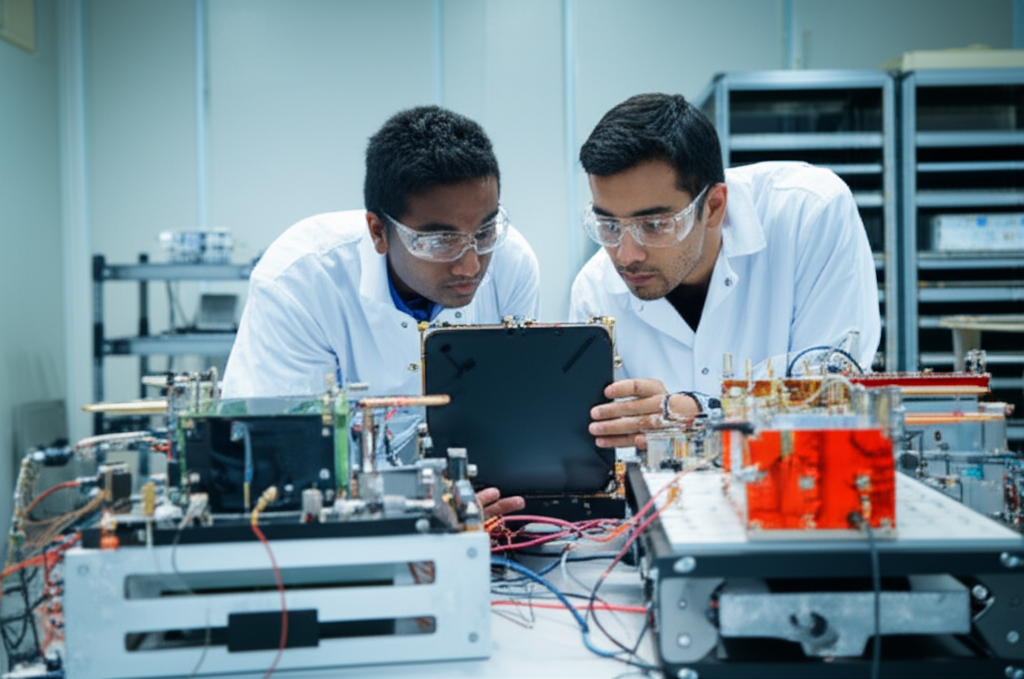
Satellite testing course in laboratory
- Format: Hybrid
- Duration: 3 months
- Hours: 300 H
- Language: English / Spanish
- Registration date: 23-10-2026
- Start date: 12-12-2026
- Available places: 2
780 $
Competencies and results
What you will learn
1. **Mastery of Satellite Testing: Laboratory, Trials and Validation**
- Gain in-depth knowledge of satellite testing methodologies, from the design phase to final validation.
- Understand the operation of the testing systems used in the laboratory, including environmental and vibration simulation equipment.
- Apply non-destructive testing (NDT) techniques for the inspection of satellite components, such as ultrasound, radiography, and thermography.
- Interpret vibration and shock test results to evaluate the resistance of satellites to launch and in-orbit operating conditions.
- Participate in the design and execution of satellite acceptance and qualification tests, ensuring compliance with performance requirements.
- Identify and troubleshoot problems in test systems and satellites during testing.
- Evaluate the durability and lifespan of satellite components through aging and fatigue testing.
- Analyze test data and generate clear and concise technical reports.
concise.
2. **Comprehensive Satellite Evaluation: Testing Methodologies in Controlled Environments**
- Identify and understand the fundamental principles of comprehensive satellite evaluation.
- Master the testing methodologies employed in controlled environments for satellites.
- Analyze the design and operation of onboard systems, including their subsystems.
- Learn about the different flight and environmental tests to which satellites are subjected.
- Evaluate the structural integrity of satellites under extreme conditions, such as vibrations, shocks, and thermal gradients.
- Use simulation and analysis tools to predict satellite behavior.
- Apply risk management techniques to minimize the probability of failures in satellite missions.
- Become familiar with the international standards and regulations applicable to the satellite industry.
- Understand the safety and reliability aspects in the design and operation of satellites.
- Apply the knowledge acquired to solve practical problems related to satellite evaluation.
3. Comprehensive user-oriented design and validation (from modeling to manufacturing)
You will learn to integrate the entire product development process, from initial model conception to final validation, applying user-centered methodologies. You will develop skills in parametric design, ergonomics, simulation, sustainable materials, 3D visualization, and manufacturing management, ensuring efficient, safe solutions that meet current industry standards.
4. **Satellite Testing: Design, Implementation and Analysis in Laboratory Environments**
4. **Satellite Testing: Design, Execution, and Analysis in Laboratory Environments**
- Comprehensive planning of satellite tests, from defining objectives to final documentation.
- Design of test environments simulating space conditions (vacuum, temperature, radiation).
- Selection and calibration of specific instrumentation for satellite testing (sensors, actuators, data acquisition systems).
- Execution of vibration, shock, thermal, and vacuum tests, complying with international standards.
- Analysis of test data using specialized software, identifying failure modes and evaluating satellite performance.
- Interpretation of results and preparation of detailed technical reports.
- Validation of simulation models by comparison with experimental results.
- Safety management in laboratories Testing, including the handling of hazardous equipment and materials.
Application of uncertainty analysis techniques to assess the reliability of results.
Implementation of corrective measures and recommendations to improve satellite design and manufacturing.
5. **Satellite Validation: Rigorous Testing and Reliable Laboratory Results**
5. **Satellite Validation: Rigorous Testing and Reliable Laboratory Results**
Evaluate the structural integrity of satellites through comprehensive testing.
Identify and analyze critical failure modes in laboratory environments.
Understand the fundamentals of satellite validation and its importance.
Apply advanced techniques for simulation and analysis of test data.
Interpret test results and generate detailed technical reports.
Use specialized tools and software for satellite validation.
Ensure the reliability and optimal performance of satellites in orbit.
Understand the certification process and regulatory compliance in the space industry.
Become familiar with vibration, thermal shock, and space vacuum testing.
Apply risk analysis and mitigation techniques. failures.
6. **Satellite Testing: Design, Execution, Analysis and Validation in the Laboratory**
- Fundamentals of satellite system design and its key components.
- Methodologies for planning and executing tests in controlled laboratory environments.
- Analysis of data from satellite tests, including the identification of faults and anomalies.
- Simulation and modeling techniques to predict satellite behavior under various conditions.
- Validation and verification procedures to ensure satellite reliability and performance.
- Evaluation of electromagnetic compatibility (EMC) and electromagnetic interference (EMI).
- Environmental testing, including vibration, shock, thermal vacuum, and radiation.
- Use of specialized software for data analysis and the generation of technical reports.
- Relevant regulations and standards for satellite testing and validation (e.g., ECSS, NASA).
- Safety and risk management aspects of satellite testing.
Who this program is for:
Satellite testing course in laboratory
- Graduates in Aerospace Engineering, Mechanical Engineering, Industrial Engineering, Automation Engineering, or related fields.
- Professionals in OEM rotorcraft/eVTOL, MRO, consulting, and technology centers.
- Flight Testing, certification, avionics, control, and dynamics seeking specialization.
- Regulators/authorities and UAM/eVTOL professionals requiring compliance skills.
Recommended requirements: foundation in aerodynamics and control and structures; ES/EN B2+/C1. We offer bridging tracks if you need them.
- Standards-driven curriculum: you will work with CS-27/CS-29, DO-160, DO-178C/DO-254, ARP4754A/ARP4761, ADS-33E-PRF from the first module.
- Accreditable laboratories (EN ISO/IEC 17025) with rotor bench, EMC/Lightning pre-compliance, HIL/SIL, vibrations/acoustics.
- Evidence-oriented TFM: safety case, test plan, compliance dossierand operational limits.
- Mentored by industry: teachers with experience in rotorcraft, tiltrotor, eVTOL/UAM and flight test.
- Flexible modality (hybrid/online), international cohorts and support from SEIUM Career Services.
- Ethics and security: safety-by-design approach, cyber-OT, DIH and compliance as pillars.
1. Introduction to Satellite Testing: Fundamentals and Key Concepts
2. Types of Satellite Testing: Overview
3. Laboratory Environments for Testing: Design and Configuration
4. Instrumentation and Equipment: Selection and Use
5. Testing Methodology: Design of Experiments
6. Data Analysis: Interpretation and Reporting
7. Laboratory Safety: Protocols and Procedures
8. Quality Management in Satellite Testing
9. Case Studies: Practical Examples of Satellite Testing
10. Future Trends in Satellite Testing
2. Introduction to Satellite Testing Methodologies
3. Test Design: Selection and Planning
4. Environmental Testing: Vibration, Shock, and Temperature
5. Electromagnetic Compatibility (EMC) Testing
6. Functional Testing: Onboard Systems
7. Performance Testing: Sensors and Communication
8. Data Analysis and Results Validation
9. Test Documentation and Reporting
20. Safety and Security Considerations
22. Best Practices in Satellite Testing
3.3 Test Design for Satellite Systems: Planning and Strategies
3.2 Configuration and Preparation of Test Equipment: Laboratories and Simulated Environments
3.3 Functional Testing: Verification of Satellite Systems and Subsystems
3.4 Test Data Analysis: Interpretation and Reporting of Results
3.5 Validation of Models and Simulations: Comparison with Real Data
3.6 Performance Testing: Evaluation of Satellite Efficiency and Capacity
3.7 Environmental Testing: Exposure to Extreme Conditions and Response Analysis
3.8 Failure Analysis: Identification of Root Causes and Corrective Actions
3.9 Documentation and Reporting: Creation of Accurate and Comprehensive Technical Reports
3.30 Quality Assurance: Monitoring and Control of Testing and Validation
4.4 Satellite Test Design: Fundamentals and Methodologies
4.2 Test Planning: Test Selection and Acceptance Criteria
4.3 Test Execution: Protocols and Procedures
4.4 Instrumentation and Laboratory Equipment
4.5 Test Data Collection and Analysis
4.6 Test Documentation and Report Writing
4.7 Functional and Performance Testing
4.8 Environmental Testing: Vibration, Shock, and Temperature
4.9 Space Environment Simulation
4.40 Quality Assurance in the Testing Process
5.5 Introduction to Satellite Testing Systems
5.5 Test Laboratories: Design and Equipment
5.3 Environmental Testing: Vibration, Thermal Vacuum
5.4 Functional Testing: Telemetry, Attitude Control
5.5 Data Validation: Analysis and Reporting of Results
5.6 Quality Assurance: Standards and Regulations
5.7 Test Management: Planning and Execution
5.8 Instrumentation and Calibration: Precise Measurements
5.5 Test Methodologies: Overview
5.5 Acceptance Testing: Hardware and Software
5.3 Integration Testing: Subsystems and Systems
5.4 Performance Testing: Measurements and Analysis
5.5 Electromagnetic Compatibility (EMC) Testing
5.6 Safety Testing: Failures and Redundancy
5.7 Controlled Environments: Simulation of Space Conditions
5.8 Test Documentation: Reports and Records
3.5 Functional Testing: Onboard Systems
3.5 Data Validation: Performance Analysis
3.3 Scenario Simulation: Orbits and Conditions
3.4 Analysis Tools: Specialized Software
3.5 Subsystem Testing: Practical Examples
3.6 Test Design: Specifications and Test Cases
3.7 Verification and Validation: Results and Conclusions
3.8 Technical Report: Analysis Documentation
4.5 Test Design: Defining Objectives
4.5 Test Execution: Procedures and Protocols
4.3 Results Analysis: Data Interpretation
4.4 Instrumentation: Sensors and Measuring Equipment
4.5 Laboratory Environments: Configuration and Security
4.6 Hardware Testing: Fault Identification
4.7 Software Testing: Code Verification
4.8 Test Report: Complete Documentation
5.5 Rigorous Testing: Requirements and Standards
5.5 Reliable Results: Uncertainty Analysis
5.3 Model Validation: Simulation and Reality
5.4 Analysis of 5.5 Failures: Identification and Resolution
5.6 Quality Assurance: Review and Verification
5.7 Performance Testing: Optimization and Improvement
5.8 Documentation: Detailed Reports and Records
5.9 Final Validation: Approval and Certification
6.5 Test Design: Strategic Planning
6.5 Test Execution: Quality Control
6.3 Data Analysis: Interpretation and Presentation
6.4 Laboratory Testing: Equipment and Tools
6.5 Results Validation: Accuracy and Reliability
6.6 Technical Reports: Comprehensive Documentation
6.7 Test Optimization: Efficiency and Effectiveness
6.8 Continuous Improvement: Feedback and Learning
7.5 Satellite Laboratory: Facilities and Equipment
7.5 Environmental Testing: Simulation of Extreme Conditions
7.3 System Verification: Operation and Performance
7.4 Quality Assurance: Control and Monitoring
7.5 Functional Testing: Subsystem Verification
7.6 Test Management: Planning and Monitoring
7.7 Documentation: Reports, Records, and Standards
7.8 Continuous Improvement: Results Analysis
8.5 Performance Testing: Parameter Measurement
8.5 Data Analysis: Interpretation and Optimization
8.3 Performance Optimization: Strategies and Techniques
8.4 Laboratory Testing: Case Studies
8.5 Analysis Tools: Specialized Software
8.6 System Improvement: Identifying Areas for Improvement
8.7 Technical Report: Documenting Results
8.8 Validation and Verification: Final Results
6.6 Introduction to Satellite Testing: Key Concepts and Fundamentals
6.2 Types of Satellites and Their Main Components
6.3 Importance of Testing in the Space Industry
6.4 Relevant Regulations and Standards in Satellite Testing
6.5 Overview of the Satellite Testing Process
2.6 Test Methodologies: Design, Execution, and Analysis
2.2 Environmental Testing: Vibration, Thermal Vacuum, EMC
2.3 Functional Testing: Onboard Systems and Payload
2.4 Electromagnetic Compatibility (EMC) Testing
2.5 Space Environment Simulation: Radiation and Particles
3.6 Test Data Analysis: Techniques and Tools
3.2 Validation of Results: Compliance with Requirements
3.3 Fault Identification and Analysis
3.4 Test Reports and Documentation
3.5 Quality Assurance and Fault Control
4.6 Test Design: Planning and Strategy
4.2 Selection of Equipment and Tools Testing
4.3 Test Execution: Procedures and Protocols
4.4 Real-Time Data Collection and Analysis
4.5 Results Interpretation and Evaluation
5.6 Requirements Validation: Traceability and Compliance
5.2 Acceptance Testing: Criteria and Levels
5.3 Design Review and Conformance Testing
5.4 Risk Analysis and Mitigation
5.5 Validation Report and Test Closure
6.6 Test Design: Test Plan, Test Cases
6.2 Test Execution: Configuration and Procedures
6.3 Data Analysis: Interpretation and Reporting
6.4 Results Validation: Requirements Verification
6.5 Test Optimization: Efficiency and Effectiveness
6.6 Fault Management: Identification and Correction
7.6 Laboratory Equipment: Selection and Use
7.2 Environmental Testing: Vibration, Shock, Thermal
7.3 System Verification: Performance and Functionality
7.4 Quality Assurance: Control of Failures
7.5 Laboratory documentation: records and protocols
8.6 Performance testing: data analysis and metrics
8.2 System optimization: performance improvement
8.3 Results analysis: identifying areas for improvement
8.4 Experimental design: techniques and tools
8.5 Optimization report: recommendations and conclusions
- Hands-on methodology: test-before-you-trust, design reviews, failure analysis, compliance evidence.
- Software (depending on licenses/partners): MATLAB/Simulink, Python (NumPy/SciPy), OpenVSP, SU2/OpenFOAM, Nastran/Abaqus, AMESim/Modelica, acoustics tools, planning toolchains DO-178C.
- SEIUM Laboratories: scale rotor bench, vibrations/acoustics, EMC/Lightning pre-compliance, HIL/SIL for AFCS, data acquisition with strain gauging.
- Standards and compliance: EN 9100, 17025, ISO 27001, GDPR.
Capstone-type projects
- Satellite Validation: Design and execution of functional tests in the laboratory.
- Satellite Analysis: Performance testing and data optimization.
- Environmental Testing: Rigorous evaluation under DO-160 protocols.
- Satellite Validation: Functional testing, design, implementation, and laboratory analysis.
- Performance Testing: Optimization and laboratory analysis to ensure quality and results.
- Environmental Testing: DO-160 evaluation (vibration, temperature, EMI) and failure mitigation.
- Satellite Validation: Design, execution, analysis, and validation of laboratory tests.
- Functional Testing: Design and simulation of tests in controlled environments.
- Quality Assurance: Testing, verification, and performance validation.
- Satellite Optimization: Performance testing and analysis.
- Satellite Validation: Design, execution, and analysis of functional and performance tests in the laboratory.
- Satellite Testing: Rigorous testing and reliable results, including simulation of space environments.
- Satellite Data Analysis: Verification and quality assurance using testing methodologies.
- Environmental Testing: Evaluation of vibration, temperature, and EMI.
Admissions, fees, and scholarships
- Profile: Background in Computer Engineering, Mathematics, Statistics, or related fields; practical experience in NLP and valued information retrieval systems.
- Documentation: Updated CV, academic transcript, SOP/statement of purpose, project examples or code (optional).
- Process: Application → Technical evaluation of profile and experience → Technical interview → Review of case studies → Final decision → Enrollment.
- Fees:
- Single payment: 10% discount.
- Payment in 3 installments: No fees; 30% upon registration + 2 equal monthly payments of the remaining 35%.
Monthly payment: available with a 7% commission on the total; annual review.
Scholarships: based on academic merit, financial need, and promoting inclusion; agreements with companies in the sector for partial or full scholarships.
See “Calendar & Calls for Applications,” “Scholarships & Grants,” and “Fees & Financing” in the SEIUM mega-menu.
Do you have any questions?
Our team is ready to help you. Contact us, and we will respond as soon as possible.
F. A. Q
Frequently asked questions
Yes, we have international certification
Yes: experimental models, real data, applied simulations, professional environments, real case studies.
It is not mandatory. We offer leveling tracks and tutoring.
Completely. It covers e-propulsion, integration, and emerging regulations (SC-VTOL).
Recommended. There are also internal challenges and consortiums.
Yes. Online/hybrid modality with planned labs and visa support (see “Visa & Residence”).