

Safety and Health Course in Urban Hydraulic Works
About our
The Safety and Health in Urban Hydraulic Works course provides comprehensive training in the prevention of occupational risks specific to this sector. It focuses on the identification and control of hazards related to excavations, earthmoving, working at heights, and the use of heavy machinery. It includes the study of current regulations, the use of personal and collective protective equipment (PPE/CPE), and the application of safety protocols during construction work.
The course aims to train professionals to implement effective safety and health plans, conduct risk assessments, and adopt appropriate preventive measures to minimize accidents and occupational illnesses. This document addresses the management of health and safety coordination on construction sites, incident investigation, and the promotion of a safety culture in the workplace.
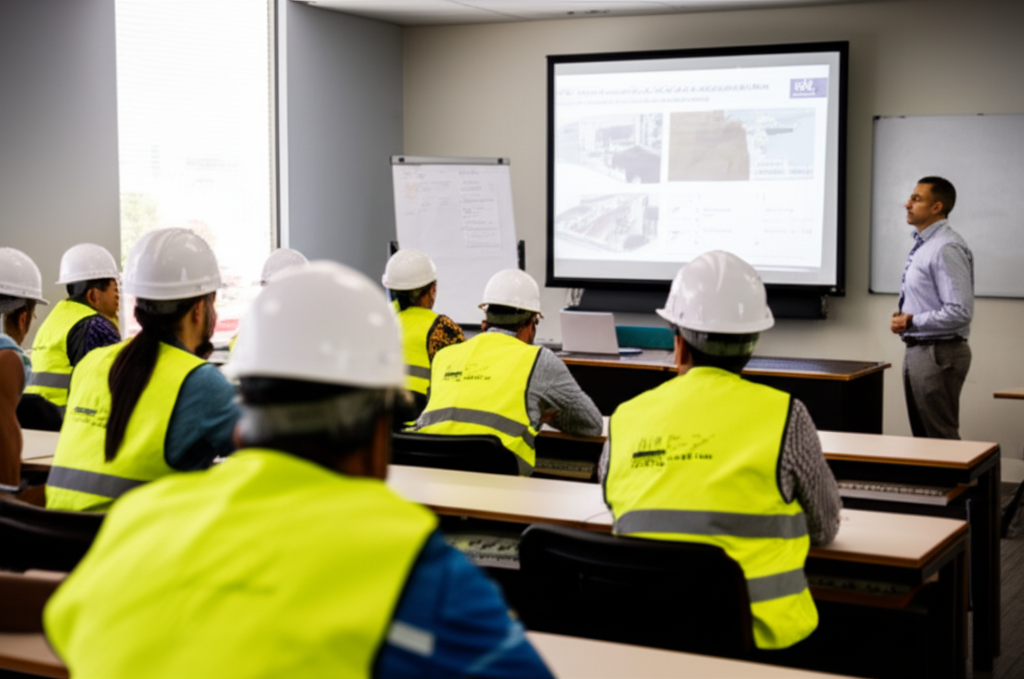
Safety and Health Course in Urban Hydraulic Works
- Format: Online
- Duration: 3 months
- Hours: 300 H
- Language: English / Spanish
- Registration date: 23-10-2026
- Start date: 12-12-2026
- Available places: 2
425 $
Competencies and results
What you will learn
1. **Comprehensive Safety in Urban Hydraulic Works: Prevention and Protection.**
- Identify and assess the specific risks inherent in urban hydraulic works.
- Understand and apply relevant safety regulations, including legislation and technical standards.
- Develop occupational risk prevention plans, considering the particularities of each phase of the work.
- Implement collective and individual protection measures to minimize risks and protect workers.
- Manage emergencies and accidents, including action protocols and first aid.
- Inspect and maintain equipment and machinery used in urban hydraulic works.
- Analyze the environmental impact of the works and apply mitigation and control measures.
- Know the different types of urban hydraulic structures and their associated risks.
- Apply risk assessment and root cause analysis techniques to identify and prevent accidents.
- Develop communication and leadership skills to foster a workplace safety culture.
2. **Mastery of Safety and Health: An Essential Course for Urban Hydraulic Works.**
2. **Mastery of Occupational Safety and Health: An Essential Course for Urban Hydraulic Works.**
- Identification and assessment of specific risks in urban hydraulic works, including excavations, operation of heavy machinery, work at heights, and exposure to pollutants.
- Application of current occupational safety and health regulations, adapted to the specific characteristics of urban hydraulic works.
- Implementation of preventive and corrective measures to control identified risks, such as signage, area demarcation, and the use of personal protective equipment (PPE) and collective protective equipment (CPE).
- Development and management of safety and health plans for construction projects (SHPs), including the coordination of business activities and effective communication among all stakeholders.
- Emergency management and first aid in the environment of urban hydraulic works, with special attention to the risks of flooding, collapses, and electrical accidents.
- Knowledge and application of safety inspection and control techniques, including audits, safety inspections, and incident analysis.
- Promotion of a safety and health culture at work, encouraging worker participation and the continuous improvement of safety conditions.
- Proficiency in the tools and resources necessary for safety and health management, such as specialized software, technical documentation, and best practice guides.
3. Comprehensive user-oriented design and validation (from modeling to manufacturing)
You will learn to integrate the entire product development process, from initial model conception to final validation, applying user-centered methodologies. You will develop skills in parametric design, ergonomics, simulation, sustainable materials, 3D visualization, and manufacturing management, ensuring efficient, safe solutions that meet current industry standards.
4. **Safety Enhancement: Advanced Training for Urban Hydraulic Works.**
- Identify and assess risk factors in the safety of urban hydraulic works.
- Apply specific safety regulations and standards for this type of infrastructure.
- Develop accident prevention and crisis management strategies.
- Implement safety protocols in all phases of the project, from design to operation.
- Use advanced tools and technologies for safety monitoring and control.
- Conduct safety inspections and audits to ensure compliance with standards.
- Manage safety in interaction with the urban environment and the public.
- Promote a safety culture within the work team and the organization.
- Analyze and respond to safety incidents, learning from mistakes and continuously improving.
- Integrate safety into the project lifecycle Hydraulics, from planning to maintenance.
5. **Safety and Health in Urban Hydraulic Works: A Practical and Professional Approach.**
- Identify and assess the specific risks present in urban hydraulic works.
- Understand the health and safety regulations applicable to this type of project.
- Apply occupational risk prevention techniques in the design and execution of works.
- Manage health and safety in the different phases of the work, from planning to completion.
- Use appropriate personal and collective protective equipment and tools.
- Investigate incidents and accidents, determining the causes and proposing corrective measures.
- Promote a culture of health and safety in the workplace.
- Coordinate business activities to guarantee the health and safety of workers.
- Develop health and safety plans adapted to the characteristics of the work.
- Understand the relevant aspects of industrial hygiene in hydraulic works.
6. **Building Safety: A Complete Guide for Urban Hydraulic Works.**
6. **Building Safety: A Complete Guide to Urban Hydraulic Works.**
- Understand the principles of hydraulic design for flow optimization and energy efficiency in urban systems.
- Evaluate and select appropriate materials for the construction of hydraulic works, considering durability, corrosion resistance, and sustainability.
- Master hydraulic modeling and simulation techniques to predict the behavior of complex systems, such as water distribution networks and sewer systems.
- Apply design standards and regulations to urban hydraulic works, ensuring safety, efficiency, and legal compliance.
- Analyze and mitigate the risks associated with floods, droughts, and other extreme hydrological events in urban environments.
- Design and manage Sustainable Urban Drainage Systems (SUDS), promoting stormwater management and water resource protection.
- Implement technologies for
- Real-time monitoring and control to optimize the operation of hydraulic works and facilitate decision-making.
- Conduct environmental and social impact studies to minimize the negative effects of hydraulic works on the urban environment.
- Develop project management and supervision skills for hydraulic works, ensuring quality, adherence to deadlines, and budget management.
- Become familiar with the latest trends in innovation and emerging technologies in the field of urban hydraulic works, including the use of renewable energies and digitalization.
Who this program is for:
Safety and Health Course in Urban Hydraulic Works
- Construction professionals, civil engineers, architects, technicians, and construction supervisors with experience or interest in urban hydraulic works projects.
- Occupational risk prevention (ORP) technicians, health and safety managers, prevention delegates, and anyone involved in health and safety management on construction sites.
- Students of construction-related degrees, civil engineering, architecture, or occupational risk prevention who wish to acquire specialized knowledge in health and safety for urban hydraulic works.
- Construction companies, developers, project managers, and public entities that need to train their teams on current regulations and best practices for health and safety in this type of work.
- Standards-driven curriculum: you will work with CS-27/CS-29, DO-160, DO-178C/DO-254, ARP4754A/ARP4761, ADS-33E-PRF from the first module.
- Accreditable laboratories (EN ISO/IEC 17025) with rotor bench, EMC/Lightning pre-compliance, HIL/SIL, vibrations/acoustics.
- Evidence-oriented TFM: safety case, test plan, compliance dossierand operational limits.
- Mentored by industry: teachers with experience in rotorcraft, tiltrotor, eVTOL/UAM and flight test.
- Flexible modality (hybrid/online), international cohorts and support from SEIUM Career Services.
- Ethics and security: safety-by-design approach, cyber-OT, DIH and compliance as pillars.
Module 1 — Introduction to Safety in Hydraulic Works
1.1 Legal and regulatory framework for safety in hydraulic works.
1.2 Identification and risk assessment in urban hydraulic works.
1.3 Principles of occupational risk prevention applied to hydraulic works.
1.4 Personal protective equipment (PPE) and collective protective equipment (CPE).
1.5 Signage and demarcation of work areas.
1.6 First aid in the vicinity of hydraulic works.
1.7 Introduction to safety management in hydraulic works.
1.8 Responsibilities and roles in safety: workers, technicians, and managers.
1.9 Safety planning in hydraulic works: basic tools.
1.10 Case studies: common incidents and accidents in hydraulic works.
2.2 Applicable Legislation and Regulations for Urban Hydraulic Works
2.2 Safety Signage: Types and Location
2.3 Interpretation of Plans and Safety Signs
2.4 Occupational Safety Standards (OSS)
2.5 Signage for Specific Risks in Hydraulic Works
2.6 Emergency and Evacuation Signage
2.7 Communication and Signage Protocols
2.8 Inspection and Maintenance of Signage
2.9 Regulatory Compliance and Safety Audits
2.20 Case Studies: Application of Regulations and Signage
3.3 Hazard Identification in Urban Hydraulic Works
3.2 Specific Risk Assessment in Hydraulic Projects
3.3 General Preventive Measures: Workplace Safety
3.4 Personal Protective Equipment: Equipment and its Correct Use
3.5 First Aid and Emergency Response
3.6 Signage and Demarcation of Work Areas
3.7 Access Control and Security Management
3.8 Fire Prevention and Waste Management
3.9 Safety Plans and Action Protocols
3.30 Safety Inspections and Continuous Improvement
4.4 Risk Identification and Assessment in Hydraulic Works
4.2 Applicable Health and Safety Regulations
4.3 Personal Protective Equipment (PPE) and Collective Protective Equipment (CPE)
4.4 Emergency and Evacuation Plans
4.5 First Aid in Construction Environments
4.6 Signage and Demarcation of Risk Zones
4.7 Fall Prevention and Working at Heights
4.8 Fire and Explosion Protection
4.9 Electrical Safety and Tool Handling
4.40 Safety Inspections and Audits
5.5 Risk Identification and Assessment in Urban Hydraulic Works
5.5 Applicable Health and Safety Regulations
5.3 Personal Protective Equipment (PPE) and Collective Protective Equipment (CPE)
5.4 First Aid and Medical Care in the Workplace
5.5 Emergency and Evacuation Plans
5.6 Signage and Demarcation of Work Areas
5.7 Fall Prevention and Protection Against Rockfalls
5.8 Safe Operation of Machinery and Tools
5.9 Electrical Hazard Control and Work in Proximity to Electrical Installations
5.50 Safety Inspections and Audits on Construction Sites
6.6 Introduction to Safety in Urban Hydraulic Works: Key Concepts
6.2 Hazard Identification and Risk Assessment in Hydraulic Works
6.3 Safety Regulations Applicable to Urban Hydraulic Works
6.4 Safety Planning in Hydraulic Works: Development of Plans and Protocols
6.5 Personal Protective Equipment (PPE) and Collective Protective Equipment (CPE): Selection and Use
6.6 Signage and Demarcation of Work Areas in Hydraulic Works
6.7 First Aid and Emergency Response in Hydraulic Works
6.8 Prevention of Workplace Accidents: Control Measures and Best Practices
6.9 Inspection and Maintenance of Equipment and Tools in Hydraulic Works
6.60 Accident Investigation: Root Cause Analysis and Corrective Measures
- Hands-on methodology: test-before-you-trust, design reviews, failure analysis, compliance evidence.
- Software (depending on licenses/partners): MATLAB/Simulink, Python (NumPy/SciPy), OpenVSP, SU2/OpenFOAM, Nastran/Abaqus, AMESim/Modelica, acoustics tools, planning toolchains DO-178C.
- SEIUM Laboratories: scale rotor bench, vibrations/acoustics, EMC/Lightning pre-compliance, HIL/SIL for AFCS, data acquisition with strain gauging.
- Standards and compliance: EN 9100, 17025, ISO 27001, GDPR.
Capstone-type projects
- Risk Analysis: Comprehensive identification and evaluation of hazards on construction sites.
- Emergency Plans: Development and implementation of effective response protocols.
- Access Control: Design of physical and digital security systems.
- Security Inspections: Audits and verification of regulatory compliance.
- Incident Management: Investigation and reporting of accidents with improvements.
- Scenario Simulations: Risk training and preparedness.
- Regulatory Implementation: Compliance with safety regulations.
- Monitoring and Evaluation: Continuous monitoring of safety performance.
- Risk Analysis: Identification, assessment, and control of hazards on construction sites.
- Safety Plans: Development and implementation of protocols, strategies, and measures.
- Inspections and Audits: Verification of regulatory compliance and detection of deficiencies.
- Emergency Management: Development and simulation of critical scenarios.
- Risk Analysis: Identification, assessment, and control of hazards.
- Emergency Plans: Development and simulation of critical scenarios.
- Regulations: Compliance with current laws and regulations.
- Safety Protocols: Implementation and auditing of procedures.
- Training: Design and delivery of training programs.
- Risk Assessment: Identification and thorough analysis of hazards.
- Emergency Plans: Development of effective protocols and drills.
- Accident Prevention: Implementation of proactive and corrective measures.
- Inspections and Audits: Verification of regulatory compliance.
Admissions, fees, and scholarships
- Profile: Background in Computer Engineering, Mathematics, Statistics, or related fields; practical experience in NLP and valued information retrieval systems.
- Documentation: Updated CV, academic transcript, SOP/statement of purpose, project examples or code (optional).
- Process: Application → Technical evaluation of profile and experience → Technical interview → Review of case studies → Final decision → Enrollment.
- Fees:
- Single payment: 10% discount.
- Payment in 3 installments: No fees; 30% upon registration + 2 equal monthly payments of the remaining 35%.
Monthly payment: available with a 7% commission on the total; annual review.
Scholarships: based on academic merit, financial need, and promoting inclusion; agreements with companies in the sector for partial or full scholarships.
See “Calendar & Calls for Applications,” “Scholarships & Grants,” and “Fees & Financing” in the SEIUM mega-menu.
Do you have any questions?
Our team is ready to help you. Contact us, and we will respond as soon as possible.
F. A. Q
Frequently asked questions
Yes, we have international certification
Yes: experimental models, real data, applied simulations, professional environments, real case studies.
It is not mandatory. We offer leveling tracks and tutoring.
Completely. It covers e-propulsion, integration, and emerging regulations (SC-VTOL).
Recommended. There are also internal challenges and consortiums.
Yes. Online/hybrid modality with planned labs and visa support (see “Visa & Residence”).