

Safe Fueling and Refueling Course
About our
The Safe Fueling and Refueling course provides comprehensive training on best practices for handling and dispensing fuel in diverse environments. It focuses on safety, covering topics such as fire prevention, spill control, and compliance with safety regulations. It delves into equipment inspection, safe handling of products, and emergency protocols. The course ensures the safe handling of hazardous materials.
Participants will learn to identify risks, implement safety procedures, and respond effectively in emergency situations. Tools and techniques related to fuel safety are used, from equipment inspection to incident prevention. Training is crucial for roles such as fuel operators, refueling personnel, and anyone involved in fuel handling, ensuring compliance with current regulations.
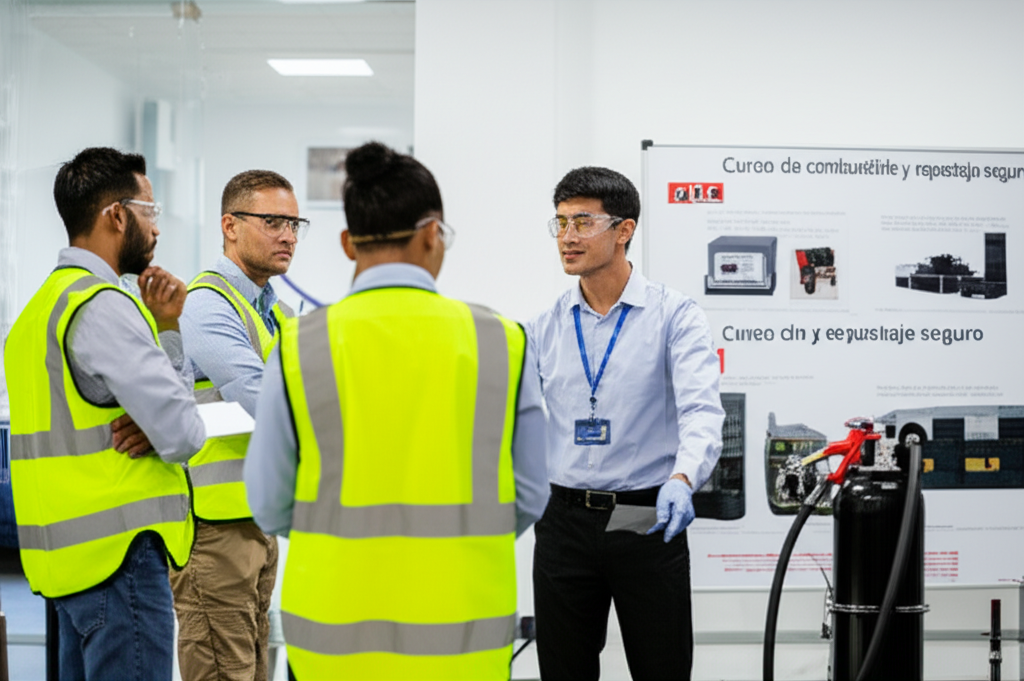
Safe Fueling and Refueling Course
- Format: Hybrid
- Duration: 3 months
- Hours: 300 H
- Language: English / Spanish
- Registration date: 23-10-2026
- Start date: 12-12-2026
- Available places: 3
299 $
Competencies and results
What you will learn
1. **Marine Fuels: Safety and Efficient Refueling**
- Identify the different types of marine fuels and their key characteristics, including their classification, composition, and physical and chemical properties.
- Evaluate the risks associated with the storage, handling, and transportation of marine fuels, focusing on the prevention of fires, explosions, and spills.
- Apply international and national regulations related to fuel refueling safety, such as SOLAS, MARPOL, and port-specific regulations.
- Develop safe refueling procedures, including vessel preparation, equipment and piping inspection, and process monitoring.
- Use measuring tools and equipment to control the quantity, quality, and temperature of fuels during refueling.
- Implement strategies to optimize refueling efficiency, minimizing downtime and reducing operating costs.
- Understand the
- Analyze the environmental impact of marine fuels and implement sustainable practices to minimize pollution during refueling and vessel operation.
- Analyze emerging marine fuel technologies, such as liquefied natural gas (LNG), methanol, and biofuels, and assess their potential for the maritime sector.
2. **Propeller Performance Optimization: Analysis and Design**
- Identify and analyze the critical parameters that affect propeller performance, including load, forward speed, and hydrodynamic profile.
- Understand the fundamentals of propeller design, from selecting the optimal geometry to optimizing pitch and blade area.
- Study computational fluid dynamics (CFD) techniques to simulate propeller behavior and predict performance.
- Evaluate the impact of cavitation on propeller performance and learn to design propellers that minimize this effect.
- Learn to apply optimization techniques to improve efficiency and reduce propeller noise and vibration.
- Analyze the different materials used in propeller construction, including metals, alloys, and composites.
- Study the factors that influence propeller durability and service life, and learn to implement preventive maintenance strategies.
- Analyze flap–lag–torsion couplings, whirl flutter and fatigue.
- Size laminates in composites, unions and bonded joints with FE.
- Implement damage tolerance and NDT (UT/RT/thermography).
3. Comprehensive user-oriented design and validation (from modeling to manufacturing)
You will learn to integrate the entire product development process, from initial model conception to final validation, applying user-centered methodologies. You will develop skills in parametric design, ergonomics, simulation, sustainable materials, 3D visualization, and manufacturing management, ensuring efficient, safe solutions that meet current industry standards.
4. **Naval Refueling: Safety Protocols and Fuels**
4. **Naval Refueling: Safety Protocols and Fuels**
- Comprehensive mastery of maritime safety protocols for refueling operations, including international (SOLAS, MARPOL) and national regulations.
- Identification and management of specific risks associated with naval refueling, such as leaks, fires, explosions, and environmental pollution.
- In-depth knowledge of the different types of naval fuels (HFO, MDO, MGO, LNG), their physicochemical properties, and their impact on safety and the environment.
- Application of advanced techniques for the safe handling and storage of fuels, including containment, ventilation, and leak detection systems.
- Understanding and application of emergency procedures for responding to incidents during refueling operations, including containment, mitigation, and rescue protocols.
- Analysis of fuel transfer systems, including pumps, pipelines, Hoses and connectors, to ensure their proper functioning and minimize risks.
Evaluation and compliance with the training and certification requirements of personnel involved in naval refueling, ensuring a high level of competence and knowledge.
Implementation of sustainability and energy efficiency practices in refueling operations, reducing environmental impact and optimizing fuel consumption.
5. **Marine Fuels: Safe and Strategic Refueling**
5. **Marine Fuels: Safe and Strategic Refueling**
Understand sustainable fuel management practices, including emissions reduction and the use of cleaner alternatives.
Learn about emerging technologies in the marine fuel sector, such as liquefied natural gas (LNG), methanol, and hydrogen.
Analyze the economic aspects of refueling, including purchase, storage, and transportation costs.
Implement an emergency response plan in case of spills or other adverse situations during refueling.
6. **Marine Fuels: Safe and Efficient Refueling Techniques**
6. **Marine Fuels: Safe and Efficient Refueling Techniques**
Who this program is for:
Safe Fueling and Refueling Course
- Onboard personnel of naval vessels of different types and sizes.
- Officers and non-commissioned officers of the Navy, Merchant Marine, and Coast Guard.
- Technicians and specialists in fuel loading and unloading operations.
- Personnel of maritime service stations and oil terminals.
- Standards-driven curriculum: you will work with CS-27/CS-29, DO-160, DO-178C/DO-254, ARP4754A/ARP4761, ADS-33E-PRF from the first module.
- Accreditable laboratories (EN ISO/IEC 17025) with rotor bench, EMC/Lightning pre-compliance, HIL/SIL, vibrations/acoustics.
- Evidence-oriented TFM: safety case, test plan, compliance dossierand operational limits.
- Mentored by industry: teachers with experience in rotorcraft, tiltrotor, eVTOL/UAM and flight test.
- Flexible modality (hybrid/online), international cohorts and support from SEIUM Career Services.
- Ethics and security: safety-by-design approach, cyber-OT, DIH and compliance as pillars.
1.1 Introduction to Marine Fuels: Types and Properties
1.2 Fuel-Related Hazards: Flammability and Toxicity
1.3 Maritime Safety Regulations: SOLAS and MARPOL
1.4 Refueling Procedures: Planning and Preparation
1.5 Personal and Collective Safety Equipment: Mandatory Protection
1.6 Spill Control: Prevention and Immediate Response
1.7 Waste Management: Regulatory Compliance
1.8 Refueling Efficiency: Waste Minimization
1.9 Audits and Maintenance: Safety Verification
1.10 Case Studies: Incident Analysis and Lessons Learned
2.2 Fundamentals of Naval Propeller Design
2.2 Hydrodynamic Performance Analysis of Propellers
2.3 Material Selection and Propeller Manufacturing
2.4 Optimization of Propeller Pitch and Diameter
2.5 Study of Cavitation and its Effects
2.6 Vibration Analysis Techniques for Propellers
2.7 Propeller Design for Different Types of Vessels
2.8 Energy Efficiency and Fuel Savings
2.9 Propeller Maintenance and Repair
2.20 Case Studies: Analysis and Optimization of Specific Propellers
3.3 Introduction to Marine Fuels and Their Classification
3.2 Risks Associated with Fuel Handling and Storage
3.3 Safety Protocols in Naval Refueling
3.4 Personal Protective Equipment (PPE) and First Aid
3.5 Emergency Procedures and Spill Response
3.6 Types of Fuels and Their Characteristics
3.7 Inspection and Preparation of the Refueling Platform
3.8 Safe and Efficient Refueling Techniques
3.9 Fuel Monitoring and Control Systems
3.30 Legislation and Regulations on Marine Fuels
4.4 Types of Marine Fuels: Classification and Properties
4.2 Fuel Handling Safety: Risks and Prevention
4.3 Refueling Protocols: Procedures and Regulations
4.4 Refueling Equipment: Operation and Maintenance
4.5 Risk Assessment: Identification and Mitigation in Refueling
4.6 Refueling Planning: Strategies and Logistics
4.7 Fuel Quality Control: Testing and Analysis
4.8 Emergency Response: Protocols and Equipment
4.9 Environmental Impact: Minimizing Pollution
4.40 Legislation and Regulations: Regulatory Compliance
5.5 Introduction to Marine Fuels: Types and Characteristics
5.5 International and National Regulations on Fuels
5.3 Risks Associated with Marine Fuels: Explosion, Fire, and Pollution
5.4 Safety Protocols for Onboard Fuel Storage
5.5 Personal Protective Equipment (PPE) and Fuel Handling Safety
5.6 Emergency Procedures and Spill Response
5.7 Efficient Refueling Techniques and Waste Reduction
5.8 Fuel Management and Monitoring Systems
5.9 Inspection and Maintenance of Fuel Tanks and Pipelines
5.50 Environmental Aspects and Sustainability in the Use of Marine Fuels
6.6 Types of Marine Fuels and Their Characteristics
6.2 Risks Associated with Marine Fuels
6.3 Refueling Safety Regulations
6.4 Safety Protocols: Pre-Refueling, During, and Post-Refueling
6.5 Personal Protective Equipment (PPE) and Its Use
6.6 Spill Management and Emergency Response
6.7 Efficient Refueling Procedures: Optimization and Savings
6.8 Onboard Fuel Systems: Inspection and Maintenance
6.9 Safe Storage and Handling of Fuels
6.60 Environmental Aspects of Refueling and Sustainability
- Hands-on methodology: test-before-you-trust, design reviews, failure analysis, compliance evidence.
- Software (depending on licenses/partners): MATLAB/Simulink, Python (NumPy/SciPy), OpenVSP, SU2/OpenFOAM, Nastran/Abaqus, AMESim/Modelica, acoustics tools, planning toolchains DO-178C.
- SEIUM Laboratories: scale rotor bench, vibrations/acoustics, EMC/Lightning pre-compliance, HIL/SIL for AFCS, data acquisition with strain gauging.
- Standards and compliance: EN 9100, 17025, ISO 27001, GDPR.
Capstone-type projects
- Fuel Safety: Refueling risk analysis; drills; emergency procedures.
- Propeller Efficiency: CFD design; pitch optimization; performance simulation.
- Refueling Protocols: Tank inspection; transfer systems; waste management.
- Strategic Fuels: Selection; storage; quality analysis; environmental impact.
- Fuel Analysis: Risk assessment and safety protocols for naval refueling.
- Refueling Optimization: Design of procedures for efficiency and safety in fuel supply.
- Simulation and Analysis: Modeling of refueling scenarios and design of mitigation measures.
- Risk Management: Development of plans to minimize accidents and ensure regulatory compliance.
- Fuel Analysis: Study of fuel types, risks, and safety protocols during refueling.
- Propeller Efficiency: Design and optimization for superior performance and fuel economy.
- Safe Refueling: Implementation of protocols for safe and efficient operations.
- Refueling Strategies: Planning to minimize risks and maximize safety.
- Fuel Safety: Risk analysis, refueling protocols, spill management.
- Propeller Optimization: Design, simulation, efficiency, cavitation reduction.
- Marine Refueling: Procedures, regulatory compliance, accident prevention.
- Marine Fuels: Selection, storage, environmental impact.
Admissions, fees, and scholarships
- Profile: Background in Computer Engineering, Mathematics, Statistics, or related fields; practical experience in NLP and valued information retrieval systems.
- Documentation: Updated CV, academic transcript, SOP/statement of purpose, project examples or code (optional).
- Process: Application → Technical evaluation of profile and experience → Technical interview → Review of case studies → Final decision → Enrollment.
- Fees:
- Single payment: 10% discount.
- Payment in 3 installments: No fees; 30% upon registration + 2 equal monthly payments of the remaining 35%.
Monthly payment: available with a 7% commission on the total; annual review.
Scholarships: based on academic merit, financial need, and promoting inclusion; agreements with companies in the sector for partial or full scholarships.
See “Calendar & Calls for Applications,” “Scholarships & Grants,” and “Fees & Financing” in the SEIUM mega-menu.
Do you have any questions?
Our team is ready to help you. Contact us, and we will respond as soon as possible.
F. A. Q
Frequently asked questions
Yes, we have international certification
Yes: experimental models, real data, applied simulations, professional environments, real case studies.
It is not mandatory. We offer leveling tracks and tutoring.
Completely. It covers e-propulsion, integration, and emerging regulations (SC-VTOL).
Recommended. There are also internal challenges and consortiums.
Yes. Online/hybrid modality with planned labs and visa support (see “Visa & Residence”).