

RF Space Communications Course
About our
The Space RF Communications Course explores the fundamentals of radio frequencies (RF) applied to space telecommunication. It covers the design, simulation, and analysis of communication systems, including antennas, low-noise amplifiers (LNAs), and modulation/demodulation. It focuses on signal propagation in space, error correction, and the impact of factors such as distance and the atmosphere. In addition, the course covers key protocols and standards for the design of uplinks and downlinks, essential for space missions. The course includes hands-on practice with simulation tools (e.g., RF simulators) and application examples in satellites, ground stations, and satellite navigation systems. Emphasis is placed on understanding the specific regulations and technical requirements for developing space communication systems that ensure reliability and optimal performance in challenging environments. It prepares students for roles such as space communications engineers, RF systems designers, and signal processing specialists.
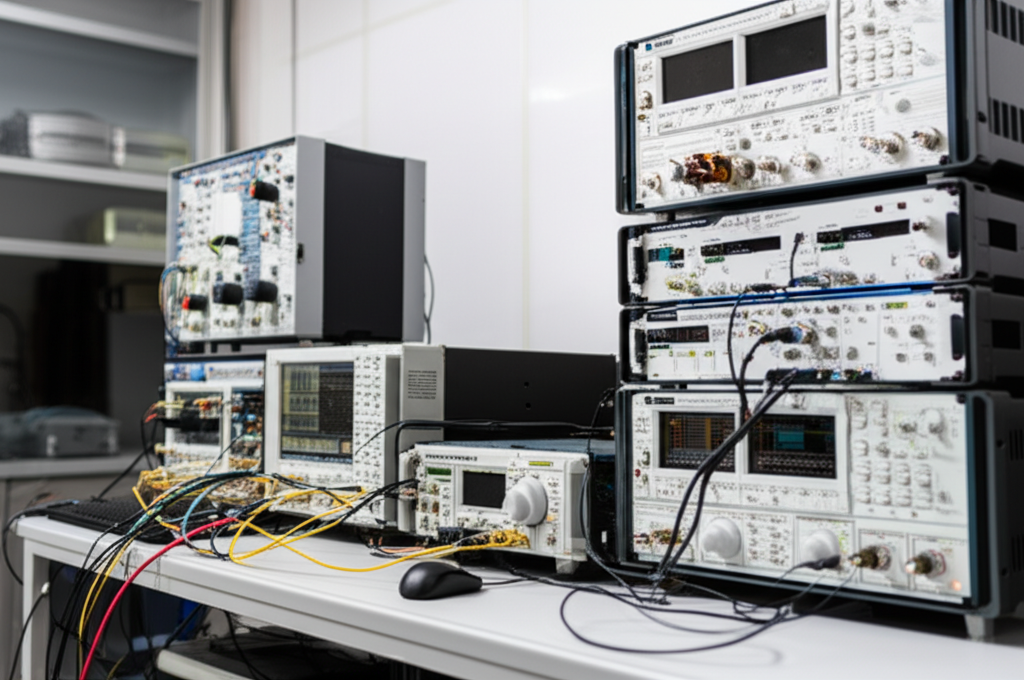
RF Space Communications Course
- Format: Hybrid
- Duration: 3 months
- Hours: 300 H
- Language: English / Spanish
- Registration date: 23-10-2026
- Start date: 12-12-2026
- Available places: 2
399 $
Competencies and results
What you will learn
1. Domain of RF Space Communications: Fundamentals and Advanced Applications
-
Fundamentals of RF Space Communications: You will understand the basic principles of radio frequency (RF) applied to satellite and space communications.
- Space Communication Systems Architecture: You will study the structure of space communication systems, including satellites, ground stations, and communication links.
- RF Propagation Theory in Space: You will learn about the phenomena of radio wave propagation in a vacuum and the atmosphere, including attenuation, scattering, and Doppler effects.
- Signal Modulation and Coding: You will master RF signal modulation and coding techniques to optimize data transmission in space environments.
- Satellite Communication Link Design: You will acquire the skills to design satellite communication links, considering signal power, antenna gain, and link budget.
- Antennas for Space Communications: You will explore the design and characteristics of antennas used in space communications, including parabolic antennas, phased array antennas, and broadband antennas.
- Power Amplifiers and RF Components: You will learn about power amplifiers and other RF components used in space systems, including their operation and specifications.
- Advanced Applications of Space Communications: You will analyze specific applications, such as broadband communications, telemetry, tracking and control (TT&C), and global positioning systems (GPS).
- Interference and Mitigation: You will study the sources of interference in space communications and mitigation techniques to ensure signal quality.
- Standards and Regulations: You will become familiar with the standards and regulations relevant to space communications, including the regulations of the International Telecommunication Union (ITU).
2. Design, Simulation and Optimization of RF Communication Systems for Space
- Fundamentals of Radio Frequency (RF) Wave Propagation in Space: Understand the theoretical basis of RF wave propagation, including the electromagnetic spectrum, polarization, diffraction, refraction, and atmospheric effects.
- Modeling and Simulation of Space RF Communication Links: Use simulation tools to model and analyze RF communication links, including communication channel simulation, implementation of modulation and demodulation techniques, and evaluation of link performance (BER, SNR).
- Antenna Design for Space Applications: Learn the principles of antenna design, including dipole antennas, parabolic antennas, array antennas, and broadband antennas, with an emphasis on their application in space environments and considering factors such as size, weight, directivity, and polarization.
- RF Communication System Design for Satellites: Design RF communication systems for satellites, including transceiver design, RF component selection, system architecture considerations, and power budget management.
Space RF Communication Systems Optimization: Apply optimization techniques to improve the performance of RF communication systems, including antenna design optimization, transmit power optimization, and filter and amplifier design optimization.
Interference Analysis and Mitigation: Analyze interference sources in space RF communication systems and apply mitigation techniques, including filtering, channel coding, and spectrum management.
Satellite Telecommunications Systems Design and Simulation: Design different types of satellite telecommunications systems, including point-to-point communication systems, broadcast systems, and mobile communication systems, with an emphasis on network topology, multiple access, and routing.
RF Communication Applications in Space: Explore RF communication applications in space. space, including satellite data communication, satellite navigation (GPS, Galileo), remote sensing, and space exploration.
3. Comprehensive user-oriented design and validation (from modeling to manufacturing)
You will learn to integrate the entire product development process, from initial model conception to final validation, applying user-centered methodologies. You will develop skills in parametric design, ergonomics, simulation, sustainable materials, 3D visualization, and manufacturing management, ensuring efficient, safe solutions that meet current industry standards.
4. RF Space Communications: Design, Implementation and Performance
4. RF Space Communications: Design, Implementation, and Performance
- Fundamentals of RF Space Communications: Introduction to radio frequency (RF) communication systems in the space context.
- RF System Design Principles: Analysis of RF system architecture, including uplinks and downlinks.
- Space Communication Link Design: Calculation of link balance, considering free-space attenuation, noise, and antenna gains.
- Radio Wave Propagation in Space: Study of the effects of the ionosphere, the atmosphere, and other phenomena on RF signal propagation.
- Antenna Design for Space Applications: Selection and design of antennas, including parabolic antennas, phased arrays, and broadband antennas.
- Modulation and Coding: Techniques Digital modulation and channel coding to maximize spectral efficiency and communication robustness.
RF Transceivers and Components: Selection and design of RF components, such as low-noise amplifiers (LNAs), power amplifiers (PAs), and filters.
Space Communications System Implementation: Integration, testing, and commissioning of RF systems in the space environment.
RF Signal Measurement and Characterization: Use of measuring instruments to analyze the performance of RF systems.
Performance and Optimization: Analysis of the performance of space communication systems, including fault analysis and performance optimization.
5. Optimization of RF Networks in Space Environments: Design, Implementation and Performance Analysis
- Understand the fundamentals of radio frequency (RF) communications in a space context, including wave propagation, attenuation, and the effects of the space environment.
- Study the design of RF links for space applications, considering key parameters such as frequency, power, antenna gain, noise, and interference.
- Analyze the different types of antennas used in space environments, including parabolic antennas, phased array antennas, and broadband antennas, and evaluate their performance.
- Learn about RF signal modulation and coding to optimize data transmission in space, considering digital modulation techniques and error correction codes.
- Design and implement RF systems for space applications, including component selection, equipment configuration, and subsystem integration.
- Evaluate the performance of RF systems in space environments, using simulation tools and Analysis, considering factors such as signal quality, bit error rate, and link availability.
Explore interference mitigation techniques and spectrum management to ensure the reliable operation of RF systems in space.
Understand the regulations and standards related to RF communications in space, including international standards and licensing requirements.
Study the applications of RF communications in space, including telemetry, satellite tracking and control, inter-satellite communications, and scientific data transmission.
Analyze future trends in RF communications in space, including new technologies, emerging applications, and upcoming challenges.
6. Domain of RF Space Communications: From Theory to Orbital Practice
Here is the requested content:
6. Mastery of RF Space Communications: From Theory to Orbital Practice
Fundamental principles of radio frequency (RF) signal transmission and reception in space.
Key concepts of satellite communications: uplink, downlink, and crosslink.
Analysis and design of RF systems for space environments, considering wave propagation, attenuation, and interference.
Understanding the different frequency bands used in space communications, including their advantages and disadvantages.
Study of antennas and their characteristics: directivity, gain, polarization, and radiation patterns.
Design and optimization of satellite communication links, including link budget calculation and component selection.
Implementation of modulation and coding techniques to maximize the efficiency and robustness of communications.
Knowledge of the communication protocols used in space and their application in different scenarios.
Analysis of the influence of the space environment on RF communications, such as the ionosphere, the troposphere, and solar perturbations.
Practice with space communications simulation software for the design, analysis, and validation of systems.
Application of acquired knowledge in practical space communications projects, from system design to the simulation of orbital scenarios.
Considerations of the regulations and standards applicable to space communications.
Who this program is for:
RF Space Communications Course
- Engineers with degrees in Aerospace, Mechanical, Industrial, Automation, or related fields.
- Specialists from the rotorcraft/eVTOL (OEM), MRO, technology consulting, and research center industries.
- Experts in Flight Testing, aeronautical certification, avionics, flight control, and aircraft dynamics who wish to deepen their knowledge.
- Personnel from regulatory bodies and authorities involved in UAM/eVTOL, seeking to acquire knowledge in compliance.
Recommendations: Prior knowledge of aerodynamics, control systems, and structures is suggested. English/Spanish proficiency at level B2+ or C1 is required. We offer leveling courses for those who need them.
- Standards-driven curriculum: you will work with CS-27/CS-29, DO-160, DO-178C/DO-254, ARP4754A/ARP4761, ADS-33E-PRF from the first module.
- Accreditable laboratories (EN ISO/IEC 17025) with rotor bench, EMC/Lightning pre-compliance, HIL/SIL, vibrations/acoustics.
- Evidence-oriented TFM: safety case, test plan, compliance dossierand operational limits.
- Mentored by industry: teachers with experience in rotorcraft, tiltrotor, eVTOL/UAM and flight test.
- Flexible modality (hybrid/online), international cohorts and support from SEIUM Career Services.
- Ethics and security: safety-by-design approach, cyber-OT, DIH and compliance as pillars.
Module 1 — Space RF Fundamentals and Applications
1.1 Introduction to Space RF Communications: Basic Principles
1.2 The Radio Frequency (RF) Spectrum and Its Use in Space
1.3 Radio Wave Propagation in the Space Environment
1.4 Key Components of Space RF Communication Systems: Antennas, Transceivers, etc.
1.5 RF Communication System Architectures: Uplink, Downlink, and Crosslink
1.6 Applications of Space RF Communications: Telecommunications, Navigation, Earth Observation
1.7 International Standards and Regulations for Space RF Communications
1.8 Effects of the Atmosphere and the Space Environment on RF Signals
1.9 Types of Modulation and Coding in Space RF Communication Systems
1.10 Challenges and Future Trends in Space RF Communications
2.2 Fundamentals of Radio Frequency (RF) Engineering for Space
2.2 Design Principles of Space RF Communication Systems
2.3 RF System Simulation: Tools and Techniques
2.4 Antenna Design for Space Environments
2.5 RF Circuit Design for Space Applications
2.6 Selection and Characterization of RF Components for Space
2.7 Modeling RF Signal Propagation in Space
2.8 Radio Frequency Link Analysis: Budgeting and Performance
2.9 Simulation of Satellite Communication Systems
2.20 RF System Design and Simulation: Practical Case Studies
3.3 Introduction to Space RF Link Analysis
3.2 Key RF Link Parameters: Power, Gain, Loss
3.3 Free Space Propagation and Path Modeling
3.4 Atmospheric Effects on RF Signals: Attenuation, Fading
3.5 Uplink and Downlink Design
3.6 Link Budget Analysis
3.7 Equipment Selection: Antennas, Transceivers
3.8 Modulation and Coding Techniques for Space Links
3.9 Interference Analysis and Mitigation
3.30 Case Studies: RF Link Analysis in Specific Space Missions
4.4 Introduction to RF Communications in Space: Overview
4.2 RF Fundamentals for Space Communications: Theory and Principles
4.3 Space RF Link Design: Link Budget Analysis
4.4 Modulation, Coding, and Multiple Access Techniques in Space RF Communications
4.5 RF Signal Propagation in Space: Effects and Mitigation
4.6 Antennas for Space Communications: Design and Selection
4.7 RF Subsystems in Satellites and Ground Stations: Design and Functionality
4.8 Implementation of RF Communication Systems: Hardware and Software
4.9 Performance of Space RF Communication Systems: Evaluation and Analysis
4.40 Case Studies: Applications and Challenges in Space RF Communications
5.5 Key Concepts of RF in Space: Frequency Band, Propagation, Attenuation
5.5 Components of a Space RF Communication System: Transmitters, Receivers, Antennas
5.3 Modulation and Demodulation: Techniques and Applications in Space Environments
5.4 Noise and Interference in Space RF Systems: Sources and Mitigation
5.5 Uplink and Downlink: Design and Specific Considerations
5.6 Standards and Regulations: Compliance in Space Communications
5.5 RF Communication System Architecture: Topologies and Configurations
5.5 RF Link Design: Link Budget, Link Margin
5.3 RF Component Selection: Amplifiers, Filters, Oscillators
5.4 Antenna Design for Space Environments: Types, Gain, Radiation Pattern
5.5 System Simulation and Modeling RF: Software and Tools
5.6 Design Considerations for Different Space Missions
3.5 Key Parameters for Link Analysis: BER, SNR, Received Power
3.5 Modeling Propagation in Space: Atmospheric Effects, Fading
3.3 Link Performance Analysis: Availability, Reliability
3.4 Interference Mitigation Techniques: Filtering, Encoding
3.5 Link Optimization: Parameter and Component Selection
3.6 Analysis of Case Studies: Real Missions and Simulations
4.5 Design of RF Communication Systems: Requirements and Specifications
4.5 Implementation of RF Systems: Hardware and Software
4.3 Testing and Performance Measurement: Parameters and Methodologies
4.4 Quality Control in Space RF Systems: Quality Assurance
4.5 Performance Analysis in Real-World Environments Field and In-Orbit Testing
4.6 Documentation and Results Reporting: Protocols and Standards
**5.5 RF Network Topologies in Space: Star, Mesh, Ad-Hoc**
**5.5 RF Network Protocols: TCP/IP, Space Protocols**
**5.3 Design of Optimized RF Networks: Capacity, Delay, Packet Loss**
**5.4 RF Network Implementation: Hardware and Software**
**5.5 RF Network Performance Analysis: Metrics and Tools**
**5.6 RF Network Optimization Techniques: Power Control, Path Selection**
**5.7 Security in Space RF Networks: Encryption and Authentication**
**5.8 Design of RF Networks for Specific Missions: Satellites, Ground Stations**
**5.9 RF Network Modeling and Simulation: Tools and Techniques**
**5.50 Analysis of Case Studies: Networks RF in Operation**
6.5 Orbit Fundamentals: Types of Orbits and Considerations
6.5 Designing RF Systems for Orbital Environments: Requirements and Challenges
6.3 RF Propagation in Space: Doppler Effects, Fading
6.4 Designing Communication Links: Parameter Calculation and Margin
6.5 Implementing Orbital RF Systems: Hardware and Software
6.6 Testing and Validation in Orbital Environments: Simulation and Experiments
7.5 Electromagnetic Theory Applied to RF: Fields, Waves, Power
7.5 Designing RF Circuits: Impedance Matching, Filters
7.3 Digital and Analog Modulation: Techniques and Applications
7.4 Antenna Design: Types, Gain, Radiation Patterns
7.5 Implementing RF Systems: Amplifiers, Mixers, Oscillators
7.5 7.6 RF Subsystem Design: Transmitters and Receivers
8.5 RF Fundamentals: Key Concepts and Principles
8.5 Space RF System Design: Architecture and Components
8.3 RF Link Optimization: Power, Bandwidth, SNR
8.4 Antenna Design for Space: Gain, Radiation Pattern
8.5 Space RF Network Design: Topologies and Protocols
8.6 Design Considerations for Different Space Missions
6.6 Introduction to the Theory of RF Communications in Space
6.2 Fundamentals of Radio Frequency Wave Propagation in the Space Environment
6.3 RF Communication Link Design: Key Concepts
6.4 Implementation of RF Communication Links: Practical Aspects
6.5 Characterization and Performance Analysis of Space RF Systems
6.6 Modulation and Coding Techniques for Orbital Communications
6.7 Communication Protocols and Standards for Space Systems
6.8 Antenna Design and Optimization for Space Applications
6.9 Analysis of Practical Cases of Orbital RF Communications
6.60 The Future of Space RF Communications: Trends and Challenges
- Hands-on methodology: test-before-you-trust, design reviews, failure analysis, compliance evidence.
- Software (depending on licenses/partners): MATLAB/Simulink, Python (NumPy/SciPy), OpenVSP, SU2/OpenFOAM, Nastran/Abaqus, AMESim/Modelica, acoustics tools, planning toolchains DO-178C.
- SEIUM Laboratories: scale rotor bench, vibrations/acoustics, EMC/Lightning pre-compliance, HIL/SIL for AFCS, data acquisition with strain gauging.
- Standards and compliance: EN 9100, 17025, ISO 27001, GDPR.
Capstone-type projects
- Satellite RF Link Design and Simulation: Link budget calculation, propagation modeling, modulation and coding selection.
- Space RF Network Optimization: Performance analysis, antenna design, and resource planning for improved efficiency.
- Space RF Transceiver Implementation and Testing: Hardware and software development, integration, and validation.
- Design and Simulation: Satellite RF links, loss and gain analysis, propagation study.
- Implementation and Performance: Performance testing, modulation analysis, error evaluation.
- Network Optimization: Access protocol design, traffic analysis, spectral efficiency improvement.
- Practical Applications: Earth-to-space communication, telemetry, satellite remote control.
- Satellite RF Link Design and Simulation: Propagation study, link budget analysis, and antenna optimization.
- Implementation of Space Communication Protocols: Development and testing of protocols for data transmission in space environments.
- Performance Analysis of Space RF Networks: Simulation and performance evaluation of satellite communication networks, including latency and packet loss.
- Satellite RF Link Design: Analysis, simulation, and optimization of uplink/downlink, considering atmospheric effects and disturbances.
- Space RF Network Implementation: Network architecture design, protocol selection, performance analysis, and interference mitigation.
- Space RF Transceiver Development: Hardware/software design, simulation, implementation, and performance testing in a simulated environment.
- Orbit Communications Optimization: Study of advanced techniques, comparative analysis, and proposed improvements for existing systems.
Admissions, fees, and scholarships
- Profile: Background in Computer Engineering, Mathematics, Statistics, or related fields; practical experience in NLP and valued information retrieval systems.
- Documentation: Updated CV, academic transcript, SOP/statement of purpose, project examples or code (optional).
- Process: Application → Technical evaluation of profile and experience → Technical interview → Review of case studies → Final decision → Enrollment.
- Fees:
- Single payment: 10% discount.
- Payment in 3 installments: No fees; 30% upon registration + 2 equal monthly payments of the remaining 35%.
Monthly payment: available with a 7% commission on the total; annual review.
Scholarships: based on academic merit, financial need, and promoting inclusion; agreements with companies in the sector for partial or full scholarships.
See “Calendar & Calls for Applications,” “Scholarships & Grants,” and “Fees & Financing” in the SEIUM mega-menu.
Do you have any questions?
Our team is ready to help you. Contact us, and we will respond as soon as possible.
F. A. Q
Frequently asked questions
Yes, we have international certification
Yes: experimental models, real data, applied simulations, professional environments, real case studies.
It is not mandatory. We offer leveling tracks and tutoring.
Completely. It covers e-propulsion, integration, and emerging regulations (SC-VTOL).
Recommended. There are also internal challenges and consortiums.
Yes. Online/hybrid modality with planned labs and visa support (see “Visa & Residence”).