

RAMS Course in Railway Projects
About our
The RAMS in Railway Projects course focuses on the application of the RAMS (Reliability, Availability, Maintainability, and Safety) methodology in railway project development. The course covers risk identification and management, failure analysis, and design for safety and reliability, encompassing international regulations and standards. It focuses on optimizing the life cycle of railway systems, from design to operation and maintenance.
The program prepares professionals for roles such as RAMS engineers, railway safety managers, risk analysts, and reliability specialists, providing tools to ensure regulatory compliance and the efficiency of railway systems. Risk analysis, reliability modeling, and scenario simulation techniques are explored with the aim of improving the safety and availability of railway transport systems.
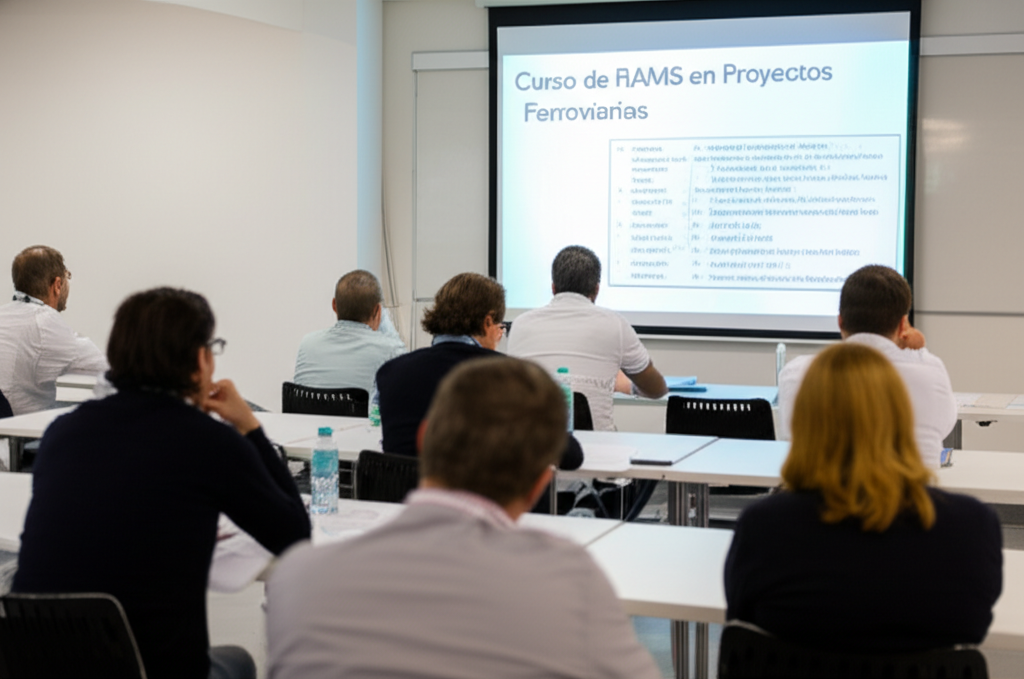
RAMS Course in Railway Projects
- Format: Online
- Duration: 3 months
- Hours: 300 H
- Language: English / Spanish
- Registration date: 23-10-2026
- Start date: 12-12-2026
- Available places: 3
380 $
Competencies and results
What you will learn
1. RAMS Domain: Safety, Reliability, Availability, Maintainability in Railways
- Understand the fundamental principles of RAMS (Safety, Reliability, Availability, Maintainability) in railway systems.
- Identify and assess the risks associated with the operation and maintenance of rolling stock.
- Apply reliability and availability analysis methodologies to optimize equipment performance.
- Design preventive and corrective maintenance strategies based on RAMS principles.
- Analyze the influence of human factors on railway safety and develop mitigation measures.
- Use specialized tools and software for RAMS analysis and management in railway projects.
- Interpret and apply international regulations and standards related to railway safety and reliability.
- Evaluate the life cycle of railway assets considering RAMS aspects.
1. RAMS Analysis: Ensuring Excellence in Railway Projects
- Understand the fundamentals of RAMS Analysis and its importance in the railway industry.
- Identify and assess the risks associated with the reliability, availability, maintainability, and safety (RAMS) of railway systems.
- Apply methodologies and tools for RAMS analysis in the different phases of a railway project’s life cycle.
- Analyze data and generate technical reports on the RAMS performance of railway systems.
- Use specialized software for RAMS analysis and simulation.
- Develop strategies to improve RAMS performance and minimize risks in railway projects.
- Apply relevant regulations and standards in the field of railway RAMS analysis.
- Collaborate effectively in multidisciplinary teams for RAMS management.
3. Comprehensive user-oriented design and validation (from modeling to manufacturing)
You will learn to integrate the entire product development process, from initial model conception to final validation, applying user-centered methodologies. You will develop skills in parametric design, ergonomics, simulation, sustainable materials, 3D visualization, and manufacturing management, ensuring efficient, safe solutions that meet current industry standards.
4. RAMS: Implementation and Optimization in Railway Design and Operation
-
Understand the fundamentals of RAMS (Reliability, Availability, Maintainability, and Safety) and its importance in the life cycle of railway systems.
-
Identify and analyze the specific risks and hazards associated with railway design and operation, using tools such as HAZOP and FMEA.
-
Apply methodologies for estimating and predicting the reliability of railway components and systems.
-
Develop strategies to improve the availability of railway systems, including failure analysis and maintenance management.
-
Implement optimized preventive and corrective maintenance plans, considering costs and operational efficiency.
-
Evaluate the safety of railway systems, including compliance with relevant regulations and standards.
-
Use software tools for RAMS analysis and railway scenario simulation.
Optimize the design of railway systems to improve RAMS performance and reduce lifecycle costs.
Manage RAMS documentation throughout the project lifecycle, including reports, records, and plans.
Apply best practices in RAMS implementation across different railway contexts, such as high-speed trains, subways, and freight systems.
5. RAMS in Railways: Design, Evaluation and Continuous Improvement
5. RAMS in Railways: Design, Evaluation, and Continuous Improvement
- RAMS Fundamentals: Understanding reliability, availability, maintainability, and safety in railway systems.
- Regulatory Framework and Standards: Becoming familiar with the regulations and standards relevant to RAMS in the railway industry (EN 50126, etc.).
- Hazard Analysis and Risk Assessment (HAZOP, FMEA, FTA): Identifying hazards, assessing risks, and determining mitigation measures.
- RAMS Design: Integrating RAMS principles into the design of railway systems, including subsystems and components.
- RAMS Modeling and Simulation: Using modeling and simulation tools to predict the RAMS performance of railway systems.
- RAMS Testing and Validation: Developing and executing test plans to verify compliance with RAMS requirements.
- Life Cycle Analysis Lifecycle Costing (LCC): Evaluate lifecycle costs and optimize design and maintenance decisions.
Reliability-Centered Maintenance (RCM): Apply RCM techniques to develop effective maintenance strategies.
RAMS Continuous Improvement: Implement a continuous improvement process to optimize RAMS performance throughout the system lifecycle.
Case Studies and Practical Examples: Analyze real-world case studies and apply the acquired knowledge to practical scenarios.
6. RAMS in Railway Projects: Ensuring Operational Integrity and Efficiency
Here is the requested content:
6. RAMS in Railway Projects: Ensuring Operational Integrity and Efficiency
- Understand the fundamental principles of RAMS (Reliability, Availability, Maintainability, and Safety) applied to railway systems.
- Identify RAMS requirements in the different phases of a railway project’s life cycle.
- Apply tools and techniques for risk management and safety assessment in the design, construction, and operation of railway systems.
- Analyze and evaluate the reliability and availability of railway components and systems, including signaling, traction, and control systems.
- Develop maintenance plans and strategies to optimize maintainability and reduce life cycle costs.
- Use simulation software and tools for RAMS analysis and system performance optimization.
- Ensure compliance with regulations and standards of railway safety, such as EN 50126, EN 50128, and EN 50129.
Integrate RAMS aspects into the design and specification of new railway projects.
Perform failure analysis and root cause studies to improve system safety and reliability.
Apply configuration management and change control techniques to ensure the integrity and consistency of railway systems.
Who this program is for:
RAMS Course in Railway Projects
- Engineers in Railway Engineering, Civil Engineering, Electronic Engineering, Industrial Engineering, or related disciplines.
- Professionals from railway companies, construction companies, consulting firms, rolling stock manufacturers, and railway infrastructure operators.
- Engineers and technicians involved in the design, construction, operation, and maintenance of railway systems who wish to specialize in RAMS.
- Personnel from safety, quality, and risks of railway projects, as well as auditors and project managers.
Recommended qualifications: Basic engineering knowledge and experience in the railway sector; Fluency in Spanish. Knowledge of technical English is an asset.
- Standards-driven curriculum: you will work with CS-27/CS-29, DO-160, DO-178C/DO-254, ARP4754A/ARP4761, ADS-33E-PRF from the first module.
- Accreditable laboratories (EN ISO/IEC 17025) with rotor bench, EMC/Lightning pre-compliance, HIL/SIL, vibrations/acoustics.
- Evidence-oriented TFM: safety case, test plan, compliance dossierand operational limits.
- Mentored by industry: teachers with experience in rotorcraft, tiltrotor, eVTOL/UAM and flight test.
- Flexible modality (hybrid/online), international cohorts and support from SEIUM Career Services.
- Ethics and security: safety-by-design approach, cyber-OT, DIH and compliance as pillars.
1.1 Fundamental Concepts of RAMS: Definitions and Scope
1.2 The Importance of RAMS in the Railway Industry
1.3 RAMS Methodology: Systematic Approach and Life Cycle
1.4 Key Standards and Regulations in Railway RAMS
1.5 Interrelationship of Safety, Reliability, Availability, and Maintainability
1.6 Basic RAMS Analysis Tools and Techniques
1.7 Introduction to Risk Management in Railway Projects
1.8 Railway Project Phases and the Application of RAMS
1.9 RAMS Documentation: Requirements and Structure
1.10 Case Studies: Examples of RAMS Application
2.2 Definition and objectives of RAMS analysis in the railway context.
2.2 Components of RAMS: Safety, Reliability, Availability, and Maintainability.
2.3 Importance of RAMS in the planning and execution of railway projects.
2.4 Benefits of implementing RAMS: risk reduction, cost optimization.
2.5 Key regulations and standards in railway RAMS.
2.6 Introduction to RAMS analysis tools and methodologies.
2.7 Case studies: examples of RAMS application in railway projects.
2.2 The RAMS conceptual framework: definition, scope, and responsibilities.
2.2 Relevant international and national regulations for RAMS in railways.
2.3 RAMS analysis process: stages, methodologies, and tools.
2.4 Application of RAMS in the different phases of the railway project lifecycle.
2.5 Hazard analysis and risk assessment: techniques and methodologies. 2.6 Reliability, Availability, and Maintainability Analysis: Calculation and Modeling
2.7 Case Studies: Examples of RAMS Analysis Applications in Real-World Railway Projects
3.2 Advanced Risk Analysis Techniques: FMEA, FTA, HAZOP
3.2 Reliability and Availability Modeling: Monte Carlo Simulation and Analysis
3.3 Design Optimization: Component and System Selection
3.4 Design for Maintainability: Strategies and Considerations
3.5 Implementing a RAMS Optimization Program: Metrics and Key Indicators
3.6 Cost-Benefit Analysis and Return on Investment (ROI) in RAMS
3.7 Case Studies: Analysis of Examples of Railway Projects with RAMS Optimization
4.2 Integrating RAMS Requirements into Conceptual and Detailed Design
4.2 Designing Railway Systems and Subsystems Considering Safety, Reliability, Availability, and Maintainability 4.3 Implementation of RAMS in the operation and maintenance phase.
4.4 Failure analysis in operation: diagnostic techniques and tools.
4.5 Maintenance planning: strategies and programs.
4.6 Implementation of a railway safety management system.
4.7 Case studies: implementation of RAMS in railway projects.
5.2 RAMS-based design requirements: standards and regulations.
5.2 Methodology for RAMS assessment: hazard analysis, risk assessment.
5.3 Techniques for continuous improvement of the railway system.
5.4 Implementation of a PDCA (Plan, Do, Check, Act) cycle in RAMS.
5.5 Management of changes and modifications in design and operation.
5.6 Key performance indicators (KPIs) and metrics for RAMS monitoring.
5.7 Case studies: design, assessment, and continuous improvement in railway projects.
6.2 Integration of RAMS into the design and construction of railway infrastructure.
6.2 Ensuring operational safety: strategies and procedures.
6.3 Optimizing operational efficiency: availability and maintainability.
6.4 Risk analysis in operation: incident and accident management.
6.5 Implementation of a Safety Management System (SMS).
6.6 Monitoring and tracking RAMS performance: indicators and tools.
6.7 Case studies: application of RAMS to ensure integrity and efficiency.
7.2 Comprehensive safety assessment: hazard and risk analysis.
7.2 Reliability and availability assessment: modeling and simulation.
7.3 Risk management: identification, assessment, mitigation, and monitoring.
7.4 Configuration management and change control.
7.5 RAMS audits: planning, execution, and follow-up.
7.6 Failure analysis: techniques and tools. 7.7 Case Studies: Comprehensive Assessment and Risk Management in Railway Projects
8.2 The Role of RAMS in Optimizing Project Safety and Profitability
8.2 Strategies for Minimizing Risks and Maximizing Availability
8.3 Implementing Low-Cost Solutions to Improve Safety and Reliability
8.4 Analyzing the Return on Investment in RAMS
8.5 Implementing Safety Management Systems (SMS)
8.6 Monitoring and Tracking RAMS Performance: Key Indicators
8.7 Case Studies: RAMS to Ensure Safety and Profitability in Projects
3.3 RAMS Principles in Complex Railway Systems
3.2 RAMS Methodology in Railway System Design
3.3 Risk Analysis in the Railway RAMS Context
3.4 Implementation of RAMS Requirements in Detailed Design
3.5 RAMS Verification and Validation: Testing and Trials
3.6 RAMS Optimization for Continuous Improvement in Railways
3.7 RAMS Integration in the Operation and Maintenance Phase
3.8 Tools and Software for Railway RAMS Analysis
3.9 Configuration and Change Management in RAMS Projects
3.30 Case Studies: Practical Application of RAMS
4.4 Introduction to RAMS Implementation and Optimization in Railways
4.2 Legal and Regulatory Framework for RAMS in Railway Design
4.3 Application of RAMS in the Design Phase: Requirements and Specifications
4.4 Failure Mode and Effects Analysis (FMEA) in Railway Systems
4.5 Design for Reliability and Availability: Strategies and Tools
4.6 Implementation of RAMS in the Construction and Commissioning Phase
4.7 Maintainability Analysis: Maintenance Strategies and Plans
4.8 Risk Management and Operational Safety Assessment
4.9 Life Cycle Optimization: Total Cost of Ownership (TCO) and RAMS
4.40 Practical Cases and Case Studies: Successful RAMS Implementation
5.5 Introduction to Railway RAMS Design
5.5 Principles of Risk Assessment in Railway Systems
5.3 RAMS Design in the Conceptualization Phase
5.4 RAMS Design in the Development Phase
5.5 Reliability and Availability Assessment
5.6 Maintainability Analysis
5.7 Design for Operational Safety
5.8 Continuous Improvement Management in RAMS
5.9 RAMS Analysis Tools and Techniques
5.50 Case Studies: Practical Application
6.6 Introduction to Railway Safety: Concepts and Principles
6.2 Reliability in Railway Systems: Definitions and Metrics
6.3 Availability of Railway Assets: Key Factors
6.4 Maintainability: Strategies and Planning in Railways
6.5 The Role of RAMS in the Comprehensive Safety of the Railway System
6.6 RAMS Regulations and Standards Applicable to the Railway Sector
6.7 Case Studies: Application of RAMS in Real Railway Projects
6.8 Tools and Techniques for RAMS Safety Management
6.9 Risk Identification and Analysis in Railway Environments
6.60 Ensuring RAMS Compliance Throughout the Project Lifecycle
2.6 Introduction to RAMS Analysis: Methodology and Approach
2.2 Data Collection and Analysis for Railway Projects
2.3 Hazard Identification and Risk Assessment
2.4 Failure Analysis (FMEA, FTA): Techniques and Applications
2.5 Fault Tree Analysis (FTA): Construction and Interpretation
2.6 RAMS Modeling and Simulation: Tools and Software
2.7 Availability and Maintainability Assessment in Railway Projects
2.8 Design for Reliability: Strategies and Best Practices
2.9 RAMS Documentation: Report and Presentation Preparation
2.60 Integrating RAMS Analysis into the Design Process
3.6 Advanced Reliability Analysis Techniques
3.2 Availability Optimization: Strategies and Models
3.3 Cost-Benefit Analysis in RAMS Implementation
3.4 Optimization of Reliability-Centered Maintenance (RCM)
3.5 Application of Monte Carlo Simulation in RAMS
3.6 Bayesian Network Modeling for Risk Analysis
3.7 Implementation of RAMS in Railway Signaling Systems
3.8 Integration of RAMS with Electronic Systems Design
3.9 Continuous Improvement and Feedback in Railway Projects
3.60 Advanced Case Studies: RAMS Implementation and Optimization
4.6 RAMS Requirements in Railway Design: Regulations and Standards
4.2 Integration of RAMS in Rolling Stock Design
4.3 Design of Railway Control and Signaling Systems
4.4 Design for Maintainability: Strategies and Techniques
4.5 RAMS Analysis in the Design Phase: Risk Assessment and Mitigation
4.6 Railway Operation: RAMS Considerations in Planning
4.7 Operational Safety Management in Railways
4.8 Monitoring and Evaluation of RAMS Performance in Operations
4.9 Incidents and Accidents: RAMS Investigation and Analysis
4.60 Continuous Improvement in Railway Design and Operation
5.6 Introduction to RAMS Assessment: Methodologies and Approaches
5.2 Risk Analysis in the Railway Operation Phase
5.3 Key Performance Indicators (KPIs) in RAMS
5.4 Implementing a RAMS Management System
5.5 RAMS Audits: Planning and Execution
5.6 Root Cause Analysis (RCA) in Railway Incidents
5.7 Evaluating Railway Safety Performance
5.8 Designing Continuous Improvement Programs
5.9 Feedback and Learning from Experience
5.60 Developing a Safety Culture in the Railway Sector
6.6 Ensuring the Integrity of Railway Systems
6.2 RAMS and Project Life Cycle Management
6.3 Risk Analysis in the Construction and Commissioning Phase Course Outline
6.4 Evaluation of Operational Efficiency and its Relationship with RAMS
6.5 Integration of RAMS into Railway Project Management
6.6 Configuration Management in Railway Systems
6.7 Ensuring the Traceability of RAMS Requirements
6.8 Change and Modification Management in Railway Projects
6.9 Case Studies: Success and Failure in RAMS Implementation
6.60 Lessons Learned and Best Practices in the Railway Industry
7.6 Introduction to Risk Management in the Railway Sector
7.2 Risk Identification and Assessment: Methodologies and Tools
7.3 Quantitative and Qualitative Risk Analysis
7.4 Risk Mitigation: Strategies and Techniques
7.5 Risk Response Planning
7.6 Risk Monitoring and Control
7.7 Risk Management Crisis in Railway Environments
7.8 Cost-Benefit Analysis in Risk Management
7.9 Risk Communication and Documentation
7.60 Case Studies: Risk Management in Railway Projects
8.6 RAMS and Return on Investment (ROI) in Railway Projects
8.2 Life Cycle Cost Analysis (LCC)
8.3 Maintenance Cost Optimization
8.4 Impact of RAMS on Incident and Accident Reduction
8.5 RAMS and Improved Asset Availability
8.6 Design for Profitability: Strategies and Techniques
8.7 Quality Management and its Relationship with RAMS
8.8 Key Performance Indicators (KPIs) for Profitability
8.9 Case Studies: Profitability Analysis of RAMS Projects
8.60 Conclusions and Future Perspectives Railway sector
- Hands-on methodology: test-before-you-trust, design reviews, failure analysis, compliance evidence.
- Software (depending on licenses/partners): MATLAB/Simulink, Python (NumPy/SciPy), OpenVSP, SU2/OpenFOAM, Nastran/Abaqus, AMESim/Modelica, acoustics tools, planning toolchains DO-178C.
- SEIUM Laboratories: scale rotor bench, vibrations/acoustics, EMC/Lightning pre-compliance, HIL/SIL for AFCS, data acquisition with strain gauging.
- Standards and compliance: EN 9100, 17025, ISO 27001, GDPR.
Capstone-type projects
“`html
- RAMS in Railway Design: Risk analysis, reliability analysis, and predictive maintenance plans to ensure availability and safety.
- RAMS in Railway Operations: Implementation of RAMS strategies to optimize efficiency and profitability, including data management and continuous improvement.
- Integrated RAMS: Application of RAMS from the design phase to operation, guaranteeing the safety and performance of the railway system.
“
- RAMS in Design: Risk analysis and mitigation in railway system design.
- RAMS in Operation: Evaluation of operational availability and maintainability.
- Integrated RAMS Analysis: Implementation of a complete RAMS system for a railway project.
- RAMS Risk Management: Identification and mitigation of risks throughout the entire lifecycle.
- RAMS in Design and Operation: RAMS analysis for optimizing the availability of railway systems, including failure simulation and predictive maintenance strategies.
- RAMS Risk Management: Risk assessment and mitigation through hazard analysis and the definition of safety measures, ensuring operational integrity.
- RAMS Continuous Improvement: Implementation of a continuous improvement system, based on data analysis and operational feedback, to optimize reliability and maintainability.
- RAMS Analysis: Study of the reliability and availability of specific railway systems, identifying vulnerabilities and proposing solutions to improve safety and operational efficiency.
- RAMS Risk Assessment: Implementation of a risk management model for a railway project, including hazard identification, risk assessment, and the implementation of preventive and corrective measures.
Admissions, fees, and scholarships
- Profile: Background in Computer Engineering, Mathematics, Statistics, or related fields; practical experience in NLP and valued information retrieval systems.
- Documentation: Updated CV, academic transcript, SOP/statement of purpose, project examples or code (optional).
- Process: Application → Technical evaluation of profile and experience → Technical interview → Review of case studies → Final decision → Enrollment.
- Fees:
- Single payment: 10% discount.
- Payment in 3 installments: No fees; 30% upon registration + 2 equal monthly payments of the remaining 35%.
Monthly payment: available with a 7% commission on the total; annual review.
Scholarships: based on academic merit, financial need, and promoting inclusion; agreements with companies in the sector for partial or full scholarships.
See “Calendar & Calls for Applications,” “Scholarships & Grants,” and “Fees & Financing” in the SEIUM mega-menu.
Do you have any questions?
Our team is ready to help you. Contact us, and we will respond as soon as possible.
F. A. Q
Frequently asked questions
Yes, we have international certification
Yes: experimental models, real data, applied simulations, professional environments, real case studies.
It is not mandatory. We offer leveling tracks and tutoring.
Completely. It covers e-propulsion, integration, and emerging regulations (SC-VTOL).
Recommended. There are also internal challenges and consortiums.
Yes. Online/hybrid modality with planned labs and visa support (see “Visa & Residence”).