

Public Electric Vehicle Charging Planning Course
About our
The Public Electric Vehicle Charging Planning Course focuses on developing skills in the design, implementation, and management of electric vehicle charging infrastructure. It explores key aspects such as energy demand analysis, charging equipment selection (AC/DC chargers), station location optimization, and integration with the electrical grid. Current regulations and safety standards are covered, including the use of simulation software for planning. This course prepares professionals for roles such as charging planners, electric mobility consultants, and EV infrastructure project managers, driving the transition to sustainable mobility. The course provides practical knowledge of charging standards (CCS, CHAdeMO, Tesla), traffic flow modeling, and energy management at charging stations. It examines market trends and government incentives, as well as V2G (Vehicle-to-Grid) technology. Participants gain skills in the economic evaluation of projects and the development of business plans for the implementation of charging infrastructure, fostering energy innovation and the development of efficient electric mobility.
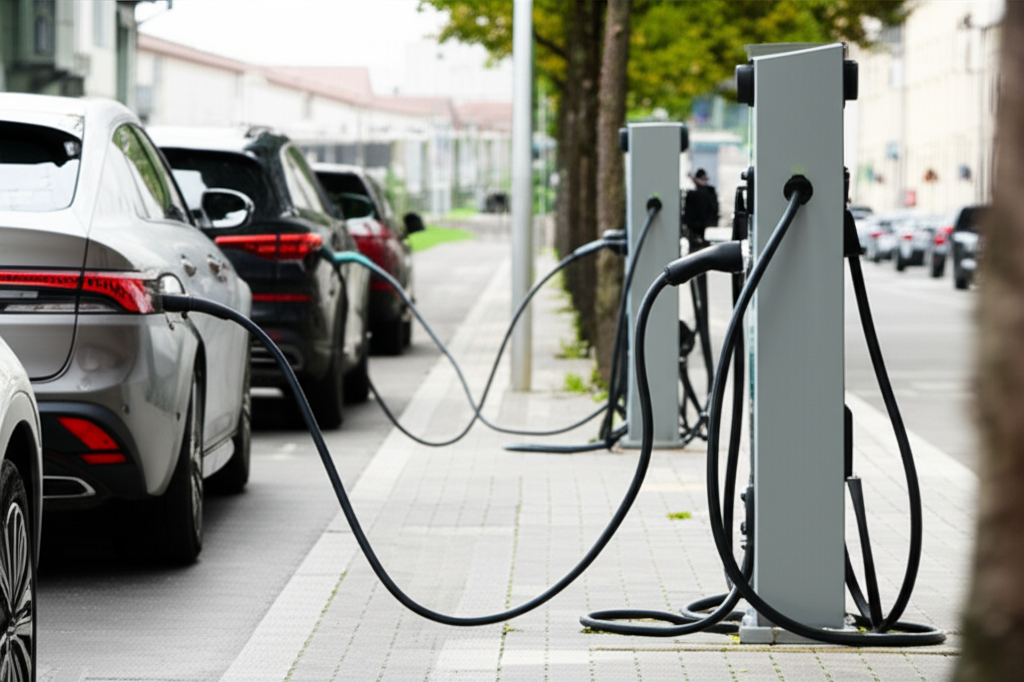
Public Electric Vehicle Charging Planning Course
- Format: Online
- Duration: 3 months
- Hours: 300 H
- Language: English / Spanish
- Registration date: 23-10-2026
- Start date: 12-12-2026
- Available places: 2
575 $
Competencies and results
What you will learn
1. Expert Planning: Public Charging of Electric Vehicles
- Design optimized public charging strategies for electric vehicle fleets.
- Evaluate energy demand and the necessary charging infrastructure.
- Select and configure charging equipment according to specific needs.
- Understand electric vehicle charging standards and regulations.
- Manage and maintain charging infrastructure to ensure its efficiency and availability.
2. Strategic Domain: Comprehensive Planning for Public Electric Vehicle Charging
## What will you learn in the course “Strategic Domain: Comprehensive Planning for Public Electric Vehicle Charging”?
1. **Conceptual Framework and Context:**
* Understand the evolution and current landscape of the electric vehicle (EV) market.
* Analyze government policies and incentives related to charging infrastructure.
* Evaluate the current and projected demand for public charging, considering different scenarios and variables.
* Identify business models and investment opportunities in the sector.
2. **Charging Network Planning:**
* Study the different types of chargers (Level 1, 2, 3) and their technical specifications.
* Determine the optimal location of charging points, considering factors such as demand, energy availability, and accessibility.
* Evaluate the electrical infrastructure needed to support public charging, including network capacity and connections.
* * Design the charging network architecture, including equipment selection, circuit design, and energy management.
3. **Technical and Technological Aspects:**
* Analyze communication protocols and charging standards (CCS, CHAdeMO, Tesla).
* Understand the operation of Charge Management Systems (CMS) and software platforms.
* Evaluate the compatibility and interoperability of chargers with different vehicle models.
* Explore emerging charging technologies, such as wireless charging and bidirectional charging.
4. **Network Management and Operation:**
* Implement energy management strategies to optimize network utilization and reduce costs.
* Develop pricing and tariff models for public charging.
* Manage the operation and maintenance of charging points, including troubleshooting and customer support.
* Analyze network performance data and implement continuous improvements.
5. **Financial and Economic Aspects:**
* Develop a business plan for a public charging project, including cost, revenue, and profitability analysis.
* Identify available funding sources and incentives.
* Evaluate the risks and opportunities in the public charging market.
* Understand the regulations and permits required to operate a charging network.
6. **Sustainability and Future of Charging:**
* Analyze the environmental impact of public charging and strategies for reducing its carbon footprint.
* Explore the role of renewable energy in generating power for EV charging.
* Consider future trends in the public charging market, including the electrification of public transportation and integration with the smart grid.
3. Comprehensive user-oriented design and validation (from modeling to manufacturing)
You will learn to integrate the entire product development process, from initial model conception to final validation, applying user-centered methodologies. You will develop skills in parametric design, ergonomics, simulation, sustainable materials, 3D visualization, and manufacturing management, ensuring efficient, safe solutions that meet current industry standards.
4. Charging Strategies: Mastering Electric Vehicle Planning
4. Charging Strategies: Mastering Electric Vehicle Planning
- Understand the challenges of electric vehicle charging infrastructure.
- Evaluate different charging technologies (AC, DC, wireless) and their advantages.
- Develop optimized charging strategies to maximize efficiency and battery life.
- Analyze factors that influence charging demand, such as location, usage, and user behavior.
- Design simulation models to predict charging infrastructure performance.
- Identify and mitigate risks associated with charging planning, including grid overload.
- Explore the role of renewable energy in electric vehicle charging infrastructure.
- Study policies and regulations related to electric vehicle charging.
- Learn about smart grid development for Load management.
- Apply data analytics tools to optimize load planning and user experience.
5. Advanced Planning: Implementation of Public Charging for Electric Vehicles
- Comprehensive assessment of the needs and context for the installation of public charging infrastructure for electric vehicles.
- Analysis of current regulations and standards related to electric vehicle charging, including technical, safety, and interoperability aspects.
- Detailed design of the charging infrastructure, considering location, charger type, charging capacity, and integration with the existing electrical grid.
- Energy management planning, including charging optimization, demand management, and integration of renewable energy sources.
- Economic and financial feasibility study of public charging projects, including cost, revenue, and profitability analysis.
- Selection of suppliers and contractors, including evaluation of technical and economic proposals.
- Installation project management, including construction supervision, commissioning, and operational testing.
- Implementation of monitoring systems and control for the efficient management of the charging infrastructure.
Analysis of the safety aspects related to electric vehicle charging, including protection against overloads, short circuits, and electrical discharges.
Consideration of the environmental impacts of electric vehicle charging, including the reduction of greenhouse gas emissions and the promotion of sustainable mobility.
6. Master Plan: Deployment of Public Charging for Electric Vehicles
6. Master Planning: Public Electric Vehicle Charging Deployment
- Understand the regulatory framework and government policies driving the adoption of electric vehicles (EVs).
- Evaluate the existing electrical infrastructure and its capacity to support EV charging.
- Design and plan the installation of charging stations, including the selection of strategic locations.
- Analyze the different types of EV chargers (Level 1, Level 2, fast charging) and their characteristics.
- Estimate the energy demand for EV charging and determine the necessary electrical grid capacity.
- Manage the connection to the electrical grid and optimize energy consumption.
- Explore financing options and business models for public charging deployment.
- Implement charging management systems and monitoring software.
- Consider the
- Safety and regulatory aspects related to EV charging.
- Evaluate the environmental impact and sustainability of the charging infrastructure.
Who this program is for:
Public Electric Vehicle Charging Planning Course
- Professionals in the field of charging infrastructure planning.
- Engineers of any specialty with an interest in electric mobility.
- Project managers and business developers in the energy and mobility sector.
- Consultants and advisors seeking to expand their knowledge in public electric vehicle charging planning.
- Public officials and policy makers related to sustainable mobility.
- Individuals interested in electric vehicle charging infrastructure design.
- Standards-driven curriculum: you will work with CS-27/CS-29, DO-160, DO-178C/DO-254, ARP4754A/ARP4761, ADS-33E-PRF from the first module.
- Accreditable laboratories (EN ISO/IEC 17025) with rotor bench, EMC/Lightning pre-compliance, HIL/SIL, vibrations/acoustics.
- Evidence-oriented TFM: safety case, test plan, compliance dossierand operational limits.
- Mentored by industry: teachers with experience in rotorcraft, tiltrotor, eVTOL/UAM and flight test.
- Flexible modality (hybrid/online), international cohorts and support from SEIUM Career Services.
- Ethics and security: safety-by-design approach, cyber-OT, DIH and compliance as pillars.
1.1 Importance of electric vehicle (EV) charging in the energy transition.
1.2 Overview of the EV market and charging infrastructure.
1.3 Types of chargers: Level 1, Level 2, and DC fast charging.
1.4 Regulations and standards relevant to EV charging.
1.5 Benefits of public charging planning.
1.6 Initial considerations for charging infrastructure planning.
1.7 Key concepts: demand, location, availability, and costs.
1.8 Case studies of successful EV charging planning.
1.9 Common challenges and solutions in charging planning.
1.10 Introduction to available tools and resources for planning.
2.2 Market Context and Trends for Electric Vehicles
2.2 Demand Analysis and Growth Projection
2.3 Selection of Strategic Locations for Charging Stations
2.4 Charging Network Design: Charger Types and Power Levels
2.5 Assessment of Existing Electrical Infrastructure and Upgrade Needs
2.6 Financial Modeling and Economic Feasibility Analysis
2.7 Applicable Regulatory and Normative Considerations
2.8 Energy Management Strategies and Charging Optimization
2.9 User Experience Design and Value-Added Services
2.20 Implementation Plan and Project Timeline
3.3 Introduction to Public Electric Vehicle (EV) Charging
3.2 Types of Chargers and Connectors
3.3 EV Charging Regulations and Standards
3.4 Electrical Load and Demand Analysis
3.5 Location and Selection of Charging Sites
3.6 Key Factors in Initial Planning
3.7 Feasibility Study for EV Charging Projects
3.8 EV Charging Modeling and Simulation
3.9 Environmental Impact and Sustainability
3.30 Regulatory Framework and Subsidies
4.4 Introduction to electric mobility and its impact.
4.2 Types of electric vehicles (EVs) and their charging needs.
4.3 Current and future landscape of public EV charging.
4.4 Key components of an EV charging station.
4.5 Charging standards and protocols.
4.6 The role of the charging network operator.
4.7 Benefits of public charging: sustainability, cost-effectiveness, and convenience.
4.8 Basic concepts of electricity and safety.
2.4 Market analysis and demand for EV charging.
2.2 Identifying strategic locations for charging stations.
2.3 Evaluating existing infrastructure and improvement needs.
2.4 Modeling traffic flows and usage patterns.
2.5 Selecting appropriate charging types and levels.
2.6 Cost-benefit analysis of comprehensive planning.
2.7 Regulatory aspects and required permits. 2.8 Development of a business plan for public charging.
3.4 Charging infrastructure design: equipment and technology selection.
3.2 Electrical design: load sizing and distribution.
3.3 Physical design: station location, layout, and accessibility.
3.4 Design optimization to minimize costs and maximize efficiency.
3.5 Safety and security considerations.
3.6 Integration with the electrical grid and demand management.
3.7 User experience design: comfort and ease of use.
3.8 Data analysis to optimize infrastructure performance and utilization.
4.4 Slow, fast, and ultra-fast charging strategies.
4.2 Load management: demand balancing and energy optimization.
4.3 Tariffs and pricing models for EV charging.
4.4 Incentive and subsidy programs for public charging. 4.5 Energy Management and Storage
4.6 Charging Management Systems (CMS) and Software
4.7 Integration with Payment Systems and Mobile Platforms
4.8 Marketing and Promotion Strategies for EV Charging
5.4 Selection and Acquisition of Charging Equipment
5.2 Installation and Commissioning of Charging Stations
5.3 Connection to the Electrical Grid and Regulatory Compliance
5.4 Testing and Certification of Charging Stations
5.5 Preventive and Corrective Maintenance of the Infrastructure
5.6 Troubleshooting and Technical Support
5.7 Contract Management and Supplier Relations
5.8 Remote Monitoring and Control of Charging Stations
6.4 Site Selection and Feasibility Analysis
6.2 Deployment Plan Design: Phases and Timeline
6.3 Project Management and Cost Control 6.4 Obtaining permits and licenses.
6.5 Stakeholder relations: owners, communities, and authorities.
6.6 Integration with the electrical grid and energy management.
6.7 Marketing and communication strategies for deployment.
6.8 Performance evaluation and deployment optimization.
7.4 Innovative business models for EV charging.
7.2 Integrating EV charging with renewable energy.
7.3 Demand management and load response.
7.4 The role of technology in load optimization.
7.5 Data analysis and load demand forecasting.
7.6 Strategies for managing electric vehicle fleets.
7.7 Future trends in public EV charging.
7.8 Developing new business opportunities in the EV charging sector.
8.4 Optimizing the charging network design. 8.2 Intelligent energy and demand management.
8.3 Implementation of bidirectional charging technologies.
8.4 Use of artificial intelligence and machine learning for optimization.
8.5 Data analysis for real-time decision-making.
8.6 Remote monitoring and control of infrastructure.
8.7 Adaptation to market and technological changes.
8.8 Assessment of the environmental and social impact of public charging.
5.5 Location and Demand Analysis for Electric Vehicle Charging
5.5 Selection and Sizing of Charging Equipment: Standards and Technologies
5.3 Charging Infrastructure Design: Electrical and Civil Aspects
5.4 Integration of Charging into the Electrical Grid: Impact and Solutions
5.5 Legal and Regulatory Aspects of EV Charging Implementation
5.6 Financial Modeling and Feasibility Analysis of Charging Projects
5.7 Project Management and Quality Control in Installation
5.8 Phased Implementation Strategies and Future Expansion
5.9 Implementation of Charging Management and Monitoring Systems
5.50 Case Studies and Best Practices in Implementation
6.6 Demand Assessment and Market Analysis
6.2 Site Selection and Feasibility Analysis
6.3 Charging Station Design and Configuration
6.4 Grid Integration and Energy Management
6.5 Financial Modeling and Return on Investment Analysis
6.6 Permits, Regulations, and Compliance
6.7 Project Management and Scheduling
6.8 Equipment Selection and Procurement
6.9 Implementation and Deployment Strategies
6.60 Operation, Maintenance, and Optimization
- Hands-on methodology: test-before-you-trust, design reviews, failure analysis, compliance evidence.
- Software (depending on licenses/partners): MATLAB/Simulink, Python (NumPy/SciPy), OpenVSP, SU2/OpenFOAM, Nastran/Abaqus, AMESim/Modelica, acoustics tools, planning toolchains DO-178C.
- SEIUM Laboratories: scale rotor bench, vibrations/acoustics, EMC/Lightning pre-compliance, HIL/SIL for AFCS, data acquisition with strain gauging.
- Standards and compliance: EN 9100, 17025, ISO 27001, GDPR.
Capstone-type projects
- EV Charging: Demand analysis, location optimization, and station sizing.
- Electrical Grid: Grid integration, modeling, and impact analysis.
- Sustainability: Life cycle assessment, environmental impact, and renewable energy sources.
- Regulation and Policy: Regulatory compliance and incentive analysis.
“`
- EV Planning: Modeling and optimization of public charging demand, location analysis and station design, integration of renewable energy.
- Charging Strategies: Financial analysis, grid impact assessment, smart management and scalability.
- Implementation: Hardware selection, project management, regulatory compliance and marketing strategies.
“
- EV Charging: Strategic planning and deployment, infrastructure optimization, and demand analysis.
- Charging Networks: Intelligent station design, site evaluation, and efficient energy management.
- Simulation: Traffic flow modeling, charging time optimization, and impact analysis.
- Sustainability: Integration of renewable energy and life cycle assessment.
- EV Planning: Demand/location analysis; load models; grid impact.
- Optimization: Station design; charger selection; energy management; simulation/optimization.
- Implementation: Deployment plan; permits/regulations; project management; monitoring/maintenance.
Admissions, fees, and scholarships
- Profile: Background in Computer Engineering, Mathematics, Statistics, or related fields; practical experience in NLP and valued information retrieval systems.
- Documentation: Updated CV, academic transcript, SOP/statement of purpose, project examples or code (optional).
- Process: Application → Technical evaluation of profile and experience → Technical interview → Review of case studies → Final decision → Enrollment.
- Fees:
- Single payment: 10% discount.
- Payment in 3 installments: No fees; 30% upon registration + 2 equal monthly payments of the remaining 35%.
Monthly payment: available with a 7% commission on the total; annual review.
Scholarships: based on academic merit, financial need, and promoting inclusion; agreements with companies in the sector for partial or full scholarships.
See “Calendar & Calls for Applications,” “Scholarships & Grants,” and “Fees & Financing” in the SEIUM mega-menu.
Do you have any questions?
Our team is ready to help you. Contact us, and we will respond as soon as possible.
F. A. Q
Frequently asked questions
Yes, we have international certification
Yes: experimental models, real data, applied simulations, professional environments, real case studies.
It is not mandatory. We offer leveling tracks and tutoring.
Completely. It covers e-propulsion, integration, and emerging regulations (SC-VTOL).
Recommended. There are also internal challenges and consortiums.
Yes. Online/hybrid modality with planned labs and visa support (see “Visa & Residence”).