

Orbital Transfer Course
About our
The Orbital Transfers Course explores the essential techniques for planning and executing changes in the orbit of space objects, focusing on the physics and mathematics underlying the maneuvers. It centers on trajectory calculations, the use of Kepler’s equations, and propulsion optimization for specific missions. It includes the study of elliptical orbits and Hohmann transfers, along with the consideration of gravitational perturbations and the influence of the atmosphere. The course provides tools for understanding mission design and determining the delta-v required to achieve orbital objectives. Participants will learn to apply simulation and analysis models for energy efficiency assessment and understand the limitations imposed by rocket technology and spacecraft characteristics. Key concepts such as satellite stabilization and navigation error correction will be addressed. The course is designed for professionals and students seeking to develop skills in orbital dynamics, astrodynamics, and space mission design, preparing them for roles in the aerospace and space exploration industry.
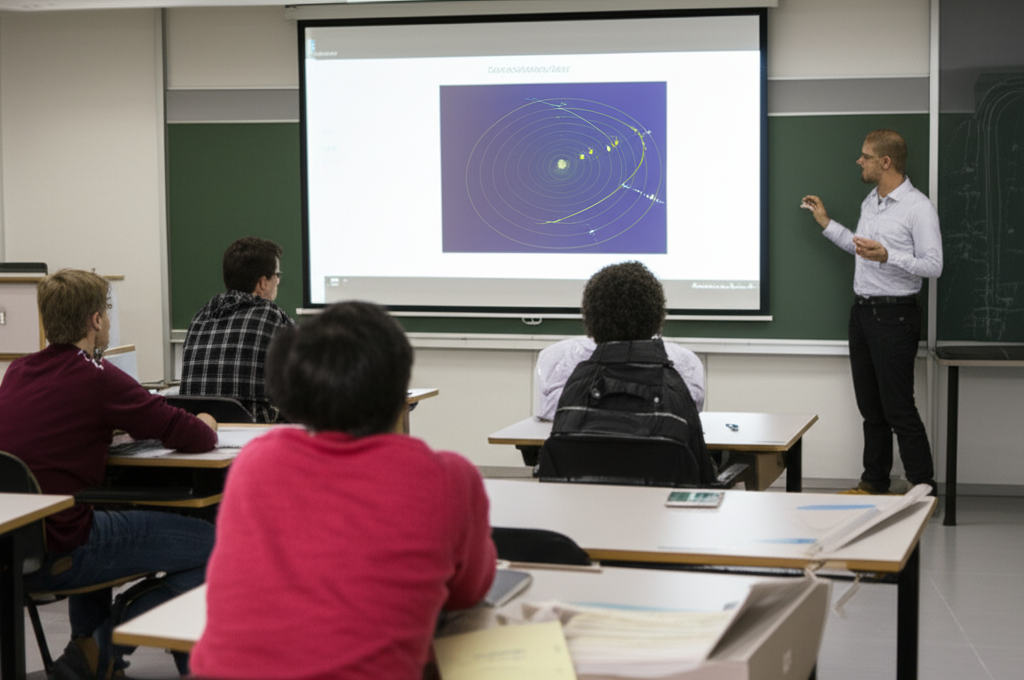
Orbital Transfer Course
- Format: Hybrid
- Duration: 3 months
- Hours: 300 H
- Language: English / Spanish
- Registration date: 23-10-2026
- Start date: 12-12-2026
- Available places: 2
480 $
Competencies and results
What you will learn
1. Mastery of Orbital Maneuvers and Optimization of Spatial Trajectories
- Principles of celestial mechanics and Kepler’s laws.
- Definition and analysis of classical orbital elements.
- Modeling Earth’s gravity and orbital perturbations.
- Calculating and executing orbital maneuvers: Hohmann, bi-elliptical transfer, and more.
- Optimizing delta-v for different space missions.
- Navigation and attitude control in space.
- Planning interplanetary and exploration missions.
- Using simulation and trajectory analysis software.
- Launch, Reentry, and Landing Considerations.
- Types of Space Propulsion: Chemical, Electric, and Nuclear.
- Propulsion System Performance and Efficiency.
- Selecting the Appropriate Propulsion System for Each Mission.
- Satellite Constellation Design and Orbit Management.
- Space Debris Risk Analysis and Mitigation.
- Applications in Satellite Navigation (GPS, Galileo, etc.).
1. Understanding the Fundamentals of Orbital Mechanics:
2. Mastering Orbital Maneuvering Techniques:
3. Designing and Optimizing Space Trajectories:
4. Propulsion Systems Analysis:
5. Applications of Orbital Mechanics:
2. Precise Calculation and Execution of Orbital Transfers: A Complete Guide
2. **Precise Calculation and Execution of Orbital Transfers: A Complete Guide**
Understand the fundamentals of orbital mechanics and Kepler’s laws.
Master key terminology and concepts related to orbits.
Calculate elliptical, circular, and Hohmann transfer orbits.
Analyze the influence of multibody gravity on orbital trajectories.
Use orbital simulation software to plan and visualize transfers.
Calculate the delta-v (change in velocity) required for orbital maneuvers.
Determine the optimal time for orbital transfers.
Consider and mitigate the effects of orbital perturbations (atmospheric drag, solar pressure).
Plan and execute rendezvous and rendezvous maneuvers. Docking.
Design and analyze complex space missions involving multiple transfers.
Apply knowledge to real and simulated mission scenarios.
3. Comprehensive user-oriented design and validation (from modeling to manufacturing)
You will learn to integrate the entire product development process, from initial model conception to final validation, applying user-centered methodologies. You will develop skills in parametric design, ergonomics, simulation, sustainable materials, 3D visualization, and manufacturing management, ensuring efficient, safe solutions that meet current industry standards.
4. Master's Degree in Orbital Transfers: Planning, Execution and Course Correction
4. Master’s Degree in Orbital Transfers: Planning, Execution, and Course Correction
Master the fundamentals of orbital mechanics, including Kepler’s laws and the equations of motion.
Plan complex space missions, considering factors such as duration, budget, and scientific objectives.
Calculate optimal orbital trajectories using specialized software tools.
Understand and apply orbital transfer techniques, such as Hohmann transfers and bi-elliptical transfers.
Analyze and mitigate the risks associated with orbital transfers, such as gravitational perturbations and limited propulsion.
Execute precise orbital maneuvers using state-of-the-art navigation and control systems.
Design and optimize propulsion systems for efficient orbital transfers.
Study the impact of The atmosphere in orbital transfer and mitigation strategies.
Learn about atmospheric reentry and the design of spacecraft to withstand it.
Use simulations and modeling tools to validate designs and analyze mission scenarios.
Become familiar with space regulations and the legal aspects of orbital transfers.
Develop leadership and teamwork skills to manage orbital transfer projects.
5. Orbital Engineering: Design, Calculation and Implementation of Efficient Transfers
5. Orbital Engineering: Design, Calculation, and Execution of Efficient Transfers
- Master the fundamentals of orbital mechanics, including Newton’s Law of Universal Gravitation and Kepler’s Laws.
- Understand the different types of orbits, such as low Earth orbits (LEO), geostationary orbits (GEO), Hohmann transfer orbits, and elliptical orbits.
- Learn to calculate orbital trajectories, including determining orbital parameters and equations of motion.
- Analyze the perturbing forces that affect orbits, such as atmospheric drag, solar radiation pressure, and gravitational perturbations.
- Design and optimize orbital maneuvers, including orbital transfers, space rendezvous, and satellite reorientations.
- Use orbital simulation software to model and Analyze the behavior of satellites in orbit.
Apply the acquired knowledge to the design of space missions, including orbit selection, trajectory design, and maneuver planning.
Study the propulsion systems used in orbital transfers, such as chemical rocket engines, ion engines, and electric propulsion systems.
Analyze the stability and control of satellites in orbit, including the design of attitude and orbit control systems.
Evaluate the safety and reliability aspects of space missions, including protection against radiation, micrometeorite impacts, and system failures.
6. Advanced Strategies for Orbital Transfers: From Calculation to Practical Implementation
6. Advanced Strategies for Orbital Transfers: From Calculation to Practical Implementation
- Master the calculation of optimal orbital trajectories, including Hohmann, bi-elliptical, and other orbit-change maneuvers.
- Understand and apply optimization techniques to minimize delta-v and transfer time in different orbital scenarios.
- Analyze and simulate the effect of gravitational perturbations, including the J2, and other perturbing forces on orbital transfers.
- Use specialized spaceflight simulation software to plan and execute complex orbital transfers.
- Design and evaluate navigation and control strategies for the precise execution of orbital transfers, considering uncertainty and errors.
- Study the selection and design of thrusters and propulsion systems suitable for different types of orbital transfers.
- Analyze the safety and reliability considerations associated with orbital transfers, including risk management and contingency planning.
- Explore the practical applications of orbital transfers in current and future space missions, including planetary exploration, satellite deployment, and space debris cleanup.
- Apply sensitivity analysis techniques to assess the impact of different parameters on the performance of orbital transfers.
- Investigate and evaluate new technologies and concepts to improve the efficiency and effectiveness of orbital transfers, such as advanced propulsion systems and autonomous navigation techniques.
Who this program is for:
Orbital Transfer Course
- Graduates in Aerospace Engineering, Mechanical Engineering, Industrial Engineering, Automation Engineering, or related fields.
- Professionals in OEM rotorcraft/eVTOL, MRO, consulting, and technology centers.
- Flight Testing, certification, avionics, control, and dynamics seeking specialization.
- Regulators/authorities and UAM/eVTOL professionals requiring compliance skills.
Recommended requirements: foundation in aerodynamics and control and structures; ES/EN B2+/C1. We offer bridging tracks if you need them.
- Standards-driven curriculum: you will work with CS-27/CS-29, DO-160, DO-178C/DO-254, ARP4754A/ARP4761, ADS-33E-PRF from the first module.
- Accreditable laboratories (EN ISO/IEC 17025) with rotor bench, EMC/Lightning pre-compliance, HIL/SIL, vibrations/acoustics.
- Evidence-oriented TFM: safety case, test plan, compliance dossierand operational limits.
- Mentored by industry: teachers with experience in rotorcraft, tiltrotor, eVTOL/UAM and flight test.
- Flexible modality (hybrid/online), international cohorts and support from SEIUM Career Services.
- Ethics and security: safety-by-design approach, cyber-OT, DIH and compliance as pillars.
1.1 Fundamentals of Orbital Mechanics: Kepler’s Laws and Fundamental Equations
1.2 Orbital Parametrization: Orbital Elements and Reference Frames
1.3 Basic Orbital Maneuvers: Impulses and Orbit Changes
1.4 Trajectory Optimization: Objective Functions and Constraints
1.5 Maneuver Programming and Control: Algorithms and Simulation
1.6 Hohmann Transfers: Calculation and Applications
1.7 Gravitational Assists: Principles and Advantages
1.8 Mission Design: Selection of Optimal Orbits and Trajectories
1.9 Orbital Simulation Software and Tools
1.10 Case Studies: Analysis of Successful Space Missions
2.2 Fundamentals of Orbital Mechanics: Kepler’s Laws and Fundamental Equations
2.2 Orbit Determination: Orbital Elements and Reference Frames
2.3 Modeling Orbital Propagation: Perturbations and Space Flight Dynamics
2.4 Calculation of Orbital Transfers: Hohmann and Low-Thrust Transfers
2.5 Design of Orbital Maneuvers: Orbit Correction and Space Rendezvous
2.6 Simulation Software and Tools: Practical Use for Orbital Design
2.7 Trajectory Analysis: Optimization and Mission Constraints
2.8 Orbital Navigation: Position Determination and Estimation Techniques
2.9 Mission Control: Planning, Execution, and Monitoring of Maneuvers
2.20 Case Studies: Practical Applications in Real Missions
3.3 Fundamentals of Orbital Mechanics: Kepler’s Laws and orbital elements.
3.2 Types of Orbits: Geostationary, Sun-synchronous, transfer orbits.
3.3 Orbital Maneuvers: Boosts, plane changes, orbital rendezvous.
3.4 Trajectory Optimization: Cost functions, constraints.
3.5 Orbital Simulation Software: Use and results analysis.
3.6 Mission Design: Orbit selection, launch windows.
3.7 Orbital Propagation: Perturbation modeling, accuracy.
3.8 Attitude and Orbit Control: Sensors, actuators, algorithms.
3.9 Case Study: Analysis of real missions, successes and failures.
3.30 Evaluation and Simulation: Scenario creation and results analysis.
4.4 Fundamentals of Orbital Transfer Planning
4.2 Calculating Orbital Trajectories: First Steps
4.3 Selecting Orbital Transfer Strategies
4.4 Preliminary Design of the Orbital Transfer
4.5 Precise Maneuver Calculation: Delta-v and Time
4.6 Scheduling Maneuvers and Ignition Sequences
4.7 Maneuver Execution: Practical Considerations
4.8 Course Correction and Adjustments During the Transfer
4.9 Risk and Contingency Management in the Orbital Transfer
4.40 Post-Mission Analysis and Lessons Learned
5.5 Fundamentals of Orbital Engineering: Introduction to Efficient Transfers
5.5 Delta-V Calculation: Principles and Applications in Orbital Transfers
5.3 Trajectory Design: Modeling and Simulation of Transfers
5.4 Hohmann Transfers: Optimization and Limitations
5.5 Gravitational-Assisted Transfers: Leveraging Gravity
5.6 Orbital Insertion Maneuvers: Techniques and Considerations
5.7 Trajectory Correction and Mission Control
5.8 Propulsion and Orbital Control Systems
5.9 Space Mission Design: Practical Applications
5.50 Risk Analysis and Mission Evaluation
6.6 Modeling and Simulation of Complex Orbital Transfers
6.2 Selection and Optimization of Trajectory Software
6.3 Sensitivity and Tolerance Analysis in Orbital Maneuvers
6.4 Practical Implementation of Course Corrections
6.5 Mission Planning Techniques for Real-World Environments
6.6 Real-Time Resource and Constraint Management
6.7 Integration of Subsystems for Efficient Transfers
6.8 Risk Analysis and Mitigation in Transfers
6.9 Case Studies: Real-World Applications and Challenges
6.60 Tools and Resources for Implementation
- Hands-on methodology: test-before-you-trust, design reviews, failure analysis, compliance evidence.
- Software (depending on licenses/partners): MATLAB/Simulink, Python (NumPy/SciPy), OpenVSP, SU2/OpenFOAM, Nastran/Abaqus, AMESim/Modelica, acoustics tools, planning toolchains DO-178C.
- SEIUM Laboratories: scale rotor bench, vibrations/acoustics, EMC/Lightning pre-compliance, HIL/SIL for AFCS, data acquisition with strain gauging.
- Standards and compliance: EN 9100, 17025, ISO 27001, GDPR.
Capstone-type projects
- Interplanetary Mission Design: Simulation and optimization of trajectories for a journey to Mars.
- Orbital Transfer Calculation: Implementation of algorithms for Hohmann and low-power transfers.
- Heading Correction: Design of strategies to minimize orbital errors and optimize fuel consumption.
- Efficient Orbital Transfers: simulation and optimization of trajectories for space missions.
- Maneuver Calculation: implementation of algorithms for Hohmann and low-thrust transfers.
- Heading Correction: design of control systems and autonomous navigation strategies.
- Orbital Simulation: Design of orbital maneuvers and trajectory optimization, including Hohmann transfers and corrections.
- Interplanetary Transfers: Planning missions to Mars, calculating launch windows and travel time.
- Advanced Space Navigation: Implementation of algorithms for course correction and attitude control in simulations.
- Fuel Optimization: Design of strategies to minimize fuel consumption in orbital transfers.
- Orbital Transfer Analysis: Simulation and optimization of missions using different transfer techniques (Hohmann, bi-elliptical), considering delta-v and time constraints.
- Interplanetary Mission Design: Complete mission planning (e.g., to Mars), including launch window selection, trajectory design, course correction, and feasibility analysis.
- Navigation Software Implementation: Development of an orbital simulator that calculates and displays trajectories, including gravitational perturbations and propulsion.
Admissions, fees, and scholarships
- Profile: Background in Computer Engineering, Mathematics, Statistics, or related fields; practical experience in NLP and valued information retrieval systems.
- Documentation: Updated CV, academic transcript, SOP/statement of purpose, project examples or code (optional).
- Process: Application → Technical evaluation of profile and experience → Technical interview → Review of case studies → Final decision → Enrollment.
- Fees:
- Single payment: 10% discount.
- Payment in 3 installments: No fees; 30% upon registration + 2 equal monthly payments of the remaining 35%.
Monthly payment: available with a 7% commission on the total; annual review.
Scholarships: based on academic merit, financial need, and promoting inclusion; agreements with companies in the sector for partial or full scholarships.
See “Calendar & Calls for Applications,” “Scholarships & Grants,” and “Fees & Financing” in the SEIUM mega-menu.
Do you have any questions?
Our team is ready to help you. Contact us, and we will respond as soon as possible.
F. A. Q
Frequently asked questions
Yes, we have international certification
Yes: experimental models, real data, applied simulations, professional environments, real case studies.
It is not mandatory. We offer leveling tracks and tutoring.
Completely. It covers e-propulsion, integration, and emerging regulations (SC-VTOL).
Recommended. There are also internal challenges and consortiums.
Yes. Online/hybrid modality with planned labs and visa support (see “Visa & Residence”).