

Non-destructive testing course UT/RT/ET/MT/PT
About our
The Non-Destructive Testing (UT/RT/ET/MT/PT) course provides comprehensive training in the essential methodologies for evaluating materials without causing damage. It focuses on ultrasound (UT), radiography (RT), eddy current testing (ET), magnetic particle testing (MT), and liquid penetrant testing (PT) techniques. The course prepares participants to identify and evaluate discontinuities in a wide range of materials, including metals, plastics, and composites.
Participants will learn to apply these techniques in various industrial sectors, such as aerospace, construction, energy, and manufacturing. Emphasis is placed on understanding theoretical principles, equipment calibration, results interpretation, and compliance with international standards. Hands-on practice with state-of-the-art equipment, simulations, and real-world case studies is encouraged to ensure a solid foundation of knowledge and skills.
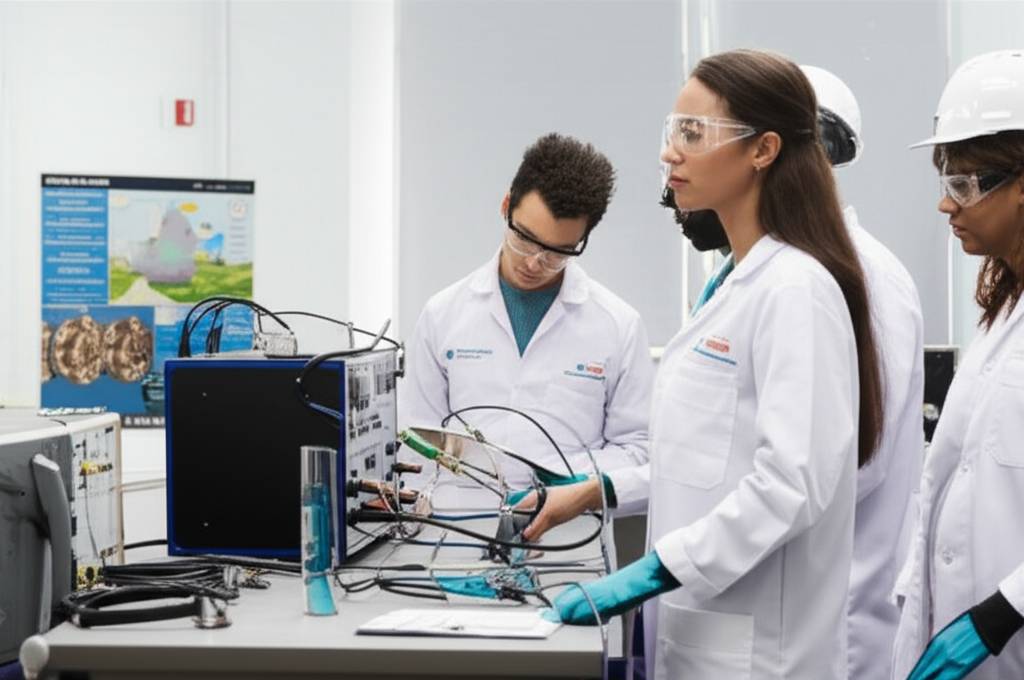
Non-destructive testing course UT/RT/ET/MT/PT
- Format: Hybrid
- Duration: 3 months
- Hours: 300 H
- Language: English / Spanish
- Registration date: 23-10-2026
- Start date: 12-12-2026
- Available places: 3
499 $
Competencies and results
What you will learn
1. Domain of Non-Destructive Testing: UT, RT, ET, MT and PT
- Interpret and apply Ultrasonic Testing (UT), Radiography (RT), Eddy Current Testing (ET), Magnetic Particle Testing (MT), and Liquid Penetrant Testing (PT) techniques for detecting discontinuities in materials.
- Evaluate the structural integrity of naval components using the results of Non-Destructive Testing (NDT).
- Understand the theoretical and practical principles of each NDT technique, including its advantages, limitations, and specific applications.
- Select the appropriate NDT technique for each type of material and naval component.
- Calibrate and operate NDT equipment, following industry procedures and standards.
- Analyze and interpret the data obtained from the tests, identifying and evaluating the severity of the indications.
- Prepare detailed technical reports that document the test results and conclusions.
- Apply the Knowledge acquired in the inspection, quality control, and predictive maintenance of naval components.
Familiarization with international regulations and standards related to NDT in the naval industry.
Development of problem-solving and decision-making skills related to the structural integrity of naval components.
2. Comprehensive Evaluation: Ultrasound, Radiography, Eddy Current, Magnetic Particle and Penetrant Testing
- Master advanced **ultrasound** techniques for detecting internal defects, including echo interpretation and equipment calibration.
- Apply the principles of industrial **radiography** for structural integrity assessment, encompassing image generation and results evaluation.
- Utilize **eddy currents** for detecting surface and subsurface defects in conductive materials, including probe selection and signal interpretation.
- Employ **magnetic particle testing** techniques for detecting surface discontinuities in ferromagnetic materials, including surface preparation and indication evaluation.
- Utilize **liquid penetrant testing** for detecting surface defects in a wide range of materials, including penetrant and developer selection, and results interpretation.
3. Comprehensive user-oriented design and validation (from modeling to manufacturing)
You will learn to integrate the entire product development process, from initial model conception to final validation, applying user-centered methodologies. You will develop skills in parametric design, ergonomics, simulation, sustainable materials, 3D visualization, and manufacturing management, ensuring efficient, safe solutions that meet current industry standards.
4. Master's Degree in Non-Destructive Inspection: UT/RT/ET/MT/PT
4. Master’s Degree in Non-Destructive Testing: UT/RT/ET/MT/PT
Select the appropriate NDT technique based on the material type, part geometry, and type of defect to be detected.
Calibrate equipment and validate inspection results according to international standards.
Analyze and interpret inspection results, determining the severity of discontinuities and their impact on component integrity.
Develop clear and concise technical reports, documenting inspection procedures, results, and conclusions.
Become familiar with automated NDT systems and their application in industry.
Understand quality management concepts in NDT and their importance for inspection reliability.
5. Expert in Non-Destructive Testing: Complete Mastery UT/RT/ET/MT/PT
- Ultrasound (UT): You will learn to master ultrasound techniques, including weld inspection, internal defect detection, and thickness measurement. You will understand the fundamentals of sound propagation, transducer selection, and signal interpretation.
- Radiography (RT): You will gain in-depth knowledge of industrial radiography, from X-ray generation to radiograph interpretation. This includes the safe handling of radioactive sources, image quality assessment, and defect identification in a variety of materials.
- Eddy Current Testing (ET): You will specialize in eddy current testing, a versatile technique for detecting surface and subsurface defects, measuring conductivity, and evaluating material properties. You will learn to calibrate equipment, interpret results, and apply this technique in different industrial contexts.
- Magnetic Particle Testing (MT): You will master magnetic particle inspection, an effective technique for detecting surface discontinuities in ferromagnetic materials. This includes magnetizing parts, applying magnetic particles, and visually evaluating indications.
- Penetrant Testing (PT): You will become an expert in penetrant testing, a simple yet effective technique for detecting surface defects in a wide range of materials. You will learn about the types of penetrants, application methods, and results interpretation.
- Standards and Regulations: You will understand and apply the main international standards and regulations (such as ASME, ASTM, EN ISO) related to nondestructive testing. This will allow you to perform inspections in accordance with industry requirements and ensure product quality.
- Interpretation of Results and Reports: You will develop the ability to analyze and evaluate the results of non-destructive testing, identifying and classifying defects. You will learn to prepare accurate and detailed reports, meeting industry requirements and facilitating decision-making.
- Applications in Diverse Sectors: You will explore the applications of non-destructive testing in a variety of industries, including aerospace, energy, petrochemical, construction, and manufacturing. You will understand how these techniques are used to ensure the safety and integrity of components and structures.
6. Expert Domain in Non-Destructive Testing: UT, RT, ET, MT, PT
6. Expert Mastery in Non-Destructive Testing: UT, RT, ET, MT, PT
- Fundamental principles and specific applications of ultrasonic testing (UT), radiography (RT), eddy current testing (ET), magnetic particle testing (MT), and liquid penetrant testing (PT).
- Interpretation of results and acceptance/rejection criteria according to international standards (ASME, ASTM, ISO).
- Selection and configuration of non-destructive testing (NDT) equipment for different materials and geometries.
- Identification and evaluation of discontinuities and defects in metallic and non-metallic materials.
- Quality control and assurance of structural integrity using NDT.
- Advanced UT techniques: Phased Array, TOFD, and their applications in the detection of corrosion and cracks.
- Digital radiography (DR) and image analysis Radiographic testing.
- ET applications in the inspection of welds, pipes, and aeronautical components.
- MT and PT techniques for detecting surface defects.
- Preparation of technical reports and documentation of test results.
Who this program is for:
Non-destructive testing course UT/RT/ET/MT/PT
- Graduates in Naval Engineering, Naval Mechanics, Shipbuilding, Industrial Engineering, or related fields.
- Professionals from Shipyards, Naval Repair Companies, Naval Maintenance Companies, Naval Consulting, and Naval Technology Centers.
- Technicians and inspectors in the areas of Quality Control, Welding, Naval Metal Structures, Naval Maintenance, and Quality Assurance, seeking specialization in Non-Destructive Testing.
- Naval engineers and personnel from Companies wishing to obtain certifications in UT/RT/ET/MT/PT, with the aim of inspecting and evaluating the integrity of naval components and structures.
Recommended requirements: Basic knowledge of mechanics of materials, welding, and familiarity with nautical terminology; ES/EN B2+/C1. Supporting materials and leveling courses will be provided if necessary.
- Standards-driven curriculum: you will work with CS-27/CS-29, DO-160, DO-178C/DO-254, ARP4754A/ARP4761, ADS-33E-PRF from the first module.
- Accreditable laboratories (EN ISO/IEC 17025) with rotor bench, EMC/Lightning pre-compliance, HIL/SIL, vibrations/acoustics.
- Evidence-oriented TFM: safety case, test plan, compliance dossierand operational limits.
- Mentored by industry: teachers with experience in rotorcraft, tiltrotor, eVTOL/UAM and flight test.
- Flexible modality (hybrid/online), international cohorts and support from SEIUM Career Services.
- Ethics and security: safety-by-design approach, cyber-OT, DIH and compliance as pillars.
Module 1 — Introduction to Non-Destructive Testing
1.1 History and Evolution of Non-Destructive Testing
1.2 Fundamental Principles of NDT
1.3 Advantages and Limitations of NDT
1.4 International Standards and Regulations in NDT
1.5 General Applications of NDT in the Shipbuilding Industry
1.6 Quality Control and Assurance in NDT
1.7 Occupational Health and Safety in NDT
1.8 Introduction to UT, RT, ET, MT, and PT Techniques
1.9 Documentation and Reporting in NDT
1.10 Future Trends in NDT
2.2 Fundamentals of Ultrasound (UT): Principles and Applications
2.2 Fundamentals of Radiography (RT): Principles and Applications
2.3 Fundamentals of Eddy Current (ET): Principles and Applications
2.4 Fundamentals of Magnetic Particle Testing (MT): Principles and Applications
2.5 Fundamentals of Liquid Penetrant Testing (PT): Principles and Applications
2.6 Selection of NDT Methods: Criteria and Considerations
2.7 Surface Preparation and Cleaning Techniques
2.8 Inspection Procedures: Development and Documentation
2.9 Interpretation of Results and Evaluation of Discontinuities
2.20 Quality Control and Applicable Standards
**Module 3 — Advanced NDT Techniques UT/RT/ET/MT/PT**
3.3 Fundamental Principles of Industrial Ultrasound (UT)
3.2 Advanced Ultrasound Applications: Welding, Composite Materials, Thickness Measurement
3.3 Principles of Industrial Radiography (RT)
3.4 Advanced Radiographic Techniques: Digitization, Tomography, Image Interpretation
3.5 Fundamentals of Eddy Current Testing (ET)
3.6 Advanced Eddy Current Applications: Crack Detection, Conductivity Measurement, Material Classification
3.7 Principles of Magnetic Particle Testing (MT)
3.8 Advanced Magnetic Particle Techniques: Inspection of Complex Surfaces, Demagnetization
3.9 Fundamentals of Liquid Penetrant Testing (PT)
3.30 Advanced Applications of Liquid Penetrant Testing: Inspection of Non-Porous Materials, Penetrant Selection
3.33 Data Analysis and Reporting in NDT
3.32 International Standards and Regulations in NDT (ASNT, ISO)
4.4 Ultrasound Fundamentals: Principles, Equipment, and Applications
4.2 Industrial Radiography: Techniques, Safety, and Image Analysis
4.3 Eddy Current Testing: Theory, Applications, and Material Evaluation
4.4 Magnetic Particle Testing: Methods, Equipment, and Indication Analysis
4.5 Liquid Penetrant Testing: Principles, Methods, and Results Evaluation
4.6 Advanced Ultrasonic Inspection: Phased Array and Time-of-Flight (TOFD) Techniques
4.7 Digital Radiography and Computed Tomography Techniques
4.8 Automation and Robotics in Nondestructive Testing (NDT)
4.9 International Standards and Regulations in NDT
4.40 Quality Management and Certification in NDT
5.5 Fundamentals and Principles of Non-Destructive Testing (NDT)
5.5 Ultrasound (UT): Theory, Equipment, and Advanced Applications
5.3 Radiography (RT): Digital Techniques and Image Evaluation
5.4 Eddy Current (ET): Inspection of Complex Materials and Surfaces
5.5 Magnetic Particle Testing (MT): Detection of Surface and Subsurface Discontinuities
5.6 Liquid Penetrant Testing (PT): Applications in Critical Materials and Components
5.7 Integration of NDT Methods: Selection and Combination of Techniques
5.8 International Standards and Regulations in NDT
5.9 Quality Management in NDT: Process Control and Documentation
5.50 Advanced Practices and Case Studies in NDT
6.6 Advanced Fundamentals of UT: Principles, Equipment, and Calibration
6.2 Interpretation and Analysis of UT Results: Defects, Evaluation, and Reports
6.3 Advanced Fundamentals of RT: Principles, Equipment, and Radiological Safety
6.4 Interpretation and Analysis of RT Results: Defects, Evaluation, and Reports
6.5 Advanced Fundamentals of ET: Principles, Equipment, and Frequencies
6.6 Interpretation and Analysis of ET Results: Defects, Evaluation, and Reports
6.7 Advanced Fundamentals of MT: Principles, Equipment, and Special Techniques
6.8 Interpretation and Analysis of MT Results: Defects, Evaluation, and Reports
6.9 Advanced Fundamentals of PT: Principles, Equipment, and Types of Penetrants
6.60 Interpretation and Analysis of PT Results: Defects, Evaluation, and Reports
- Hands-on methodology: test-before-you-trust, design reviews, failure analysis, compliance evidence.
- Software (depending on licenses/partners): MATLAB/Simulink, Python (NumPy/SciPy), OpenVSP, SU2/OpenFOAM, Nastran/Abaqus, AMESim/Modelica, acoustics tools, planning toolchains DO-178C.
- SEIUM Laboratories: scale rotor bench, vibrations/acoustics, EMC/Lightning pre-compliance, HIL/SIL for AFCS, data acquisition with strain gauging.
- Standards and compliance: EN 9100, 17025, ISO 27001, GDPR.
Capstone-type projects
- Naval Structural Integrity (UT/RT/ET/MT/PT): Weld evaluation, corrosion detection, failure analysis.
- Welding NDT: UT/RT/ET/MT/PT; failure analysis of naval structures.
- Hulh Inspection: Corrosion assessment and crack detection.
- Engine Assessment: NDT on critical components (turbines, crankshafts).
- Piping Analysis: Structural integrity and leak detection.
- Structural Analysis ND: UT/RT/ET/MT/PT; Failures, corrosion, welds.
- Component Integrity ND: Materials evaluation, critical inspection.
- Certification ND: Procedures, standards, comprehensive quality control.
- Optimization ND: Selection, advanced techniques, continuous improvement.
“`html
- NDT Analysis: UT/RT/ET/MT/PT in welds and structures.
- Inspection Management: Planning, procedures, and regulations.
- Structural Integrity: Failure and service life assessment.
- NDT Reports: Analysis and technical recommendations.
“
Admissions, fees, and scholarships
- Profile: Background in Computer Engineering, Mathematics, Statistics, or related fields; practical experience in NLP and valued information retrieval systems.
- Documentation: Updated CV, academic transcript, SOP/statement of purpose, project examples or code (optional).
- Process: Application → Technical evaluation of profile and experience → Technical interview → Review of case studies → Final decision → Enrollment.
- Fees:
- Single payment: 10% discount.
- Payment in 3 installments: No fees; 30% upon registration + 2 equal monthly payments of the remaining 35%.
Monthly payment: available with a 7% commission on the total; annual review.
Scholarships: based on academic merit, financial need, and promoting inclusion; agreements with companies in the sector for partial or full scholarships.
See “Calendar & Calls for Applications,” “Scholarships & Grants,” and “Fees & Financing” in the SEIUM mega-menu.
Do you have any questions?
Our team is ready to help you. Contact us, and we will respond as soon as possible.
F. A. Q
Frequently asked questions
Yes, we have international certification
Yes: experimental models, real data, applied simulations, professional environments, real case studies.
It is not mandatory. We offer leveling tracks and tutoring.
Completely. It covers e-propulsion, integration, and emerging regulations (SC-VTOL).
Recommended. There are also internal challenges and consortiums.
Yes. Online/hybrid modality with planned labs and visa support (see “Visa & Residence”).