

LEO, MEO and GEO orbits course
About our
The LEO, MEO, and GEO Orbits Course provides an in-depth understanding of Earth orbits, from low Earth orbit (LEO) to geostationary (GEO) and intermediate Earth orbit (MEO). It explores orbital mechanics, including factors that influence the selection of each orbit, such as altitude, inclination, and orbital period. The design and operation of satellites are analyzed, considering the advantages and disadvantages of each type of orbit for specific applications, such as telecommunications, Earth observation, and navigation. The course includes the study of environmental effects on satellites, such as radiation and the atmosphere, and positioning and control techniques. The importance of satellite constellation management and the regulatory challenges associated with space traffic are addressed. Participants gain knowledge to evaluate and optimize the use of different orbits, preparing them for roles in the space and telecommunications industries.
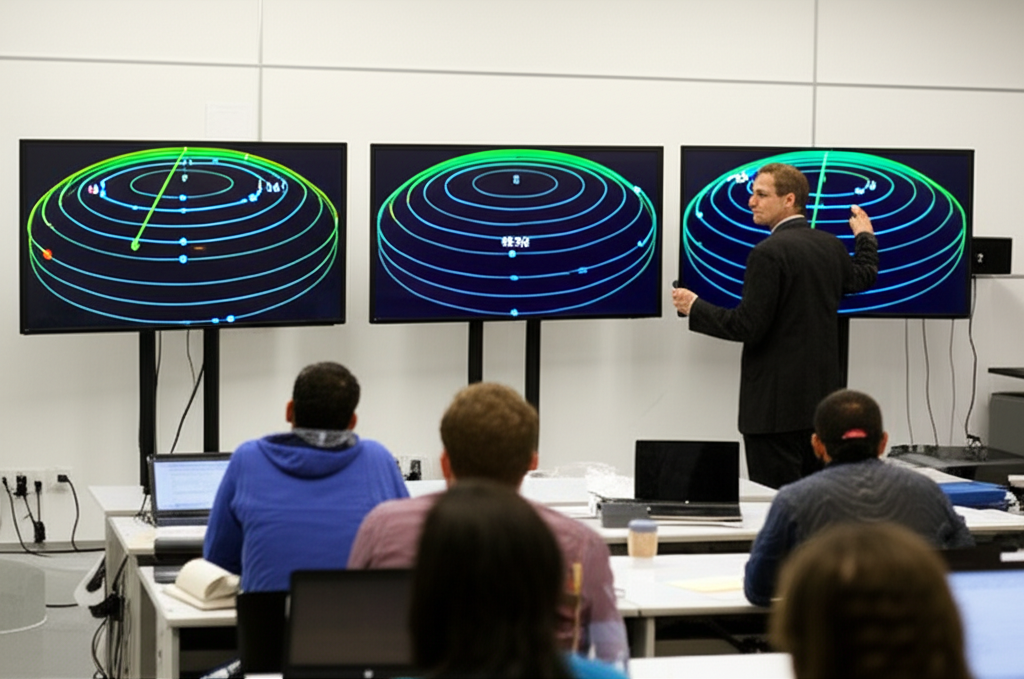
LEO, MEO and GEO orbits course
- Format: Hybrid
- Duration: 3 months
- Hours: 300 H
- Language: English / Spanish
- Registration date: 23-10-2026
- Start date: 12-12-2026
- Available places: 2
425 $
Competencies and results
What you will learn
1. Domain of LEO, MEO and GEO Orbits: Trajectory and Applications
Here is the requested content:
- Understand the characteristics of LEO (Low Earth Orbit), MEO (Medium Earth Orbit), and GEO (Geostationary Orbit).
- Study the trajectory of satellites in each type of orbit, including their orbital parameters (altitude, inclination, eccentricity).
- Identify the specific applications of LEO, MEO, and GEO orbits in areas such as communications, Earth observation, navigation, and science.
- Evaluate the technical challenges associated with each type of orbit, such as space management, atmospheric drag, and radiation.
- Analyze the launch systems and orbital maneuvers required to access each type of orbit.
2. In-depth Analysis of Earth Orbits: LEO, MEO and GEO
- Understand the characteristics of Earth orbits: LEO (Low Earth Orbit), MEO (Medium Earth Orbit), and GEO (Geostationary Orbit).
- Study the trajectories and key orbital parameters of each orbit type.
- Analyze the advantages and disadvantages of each orbit based on specific applications.
- Explore the effects of the atmosphere and other environmental factors on LEO orbits.
- Identify the challenges of MEO orbits and their use in navigation systems.
- Evaluate the applications of GEO orbits, including telecommunications and Earth observation.
- Explore the planning and design of space missions, considering the appropriate orbit.
- Use software tools and simulations to analyze and model orbits.
3. Comprehensive user-oriented design and validation (from modeling to manufacturing)
You will learn to integrate the entire product development process, from initial model conception to final validation, applying user-centered methodologies. You will develop skills in parametric design, ergonomics, simulation, sustainable materials, 3D visualization, and manufacturing management, ensuring efficient, safe solutions that meet current industry standards.
4. Expert Navigation in Orbits: LEO, MEO and GEO
4. Expert Navigation in Orbits: LEO, MEO, and GEO
Mastery of the fundamentals of LEO (Low Earth Orbit), MEO (Medium Earth Orbit), and GEO (Geostationary Orbit).
Calculation and analysis of orbital trajectories, including the determination of key parameters such as altitude, inclination, and eccentricity.
Understanding of the forces acting on satellites in orbit, including Earth’s gravity, solar radiation pressure, and atmospheric drag.
Study of satellite navigation and attitude control systems, including the use of gyroscopes, accelerometers, and solar sensors.
Implementation of orbital maneuvering strategies, such as orbit changes, rendezvous, and re-entry.
Analysis of radio frequency signal propagation in space, including the Attenuation, delay, and polarization.
Knowledge of international regulations and standards related to space management and the safety of orbital operations.
Use of orbital simulation software for the design and analysis of space missions.
5. Satellite Orbits: LEO, MEO and GEO - Fundamentals and Practice
5. Satellite Orbits: LEO, MEO, and GEO – Fundamentals and Practice
- Understand the fundamental characteristics of LEO (Low Earth Orbit), MEO (Medium Earth Orbit), and GEO (Geostationary Orbit).
- Identify the key differences between LEO, MEO, and GEO orbits in terms of altitude, speed, orbital period, and applications.
- Study the basic concepts of orbital mechanics, including Kepler’s laws and the equation of motion.
- Analyze the factors that influence the selection of a satellite orbit, such as mission purpose, geographic coverage, and communication requirements.
- Explore the technologies used for launching and positioning satellites in different orbits.
- Learn about Attitude and Orbit Control Systems (AOCS) and their importance in maintaining the position and orientation of satellites.
satellites.
Become familiar with satellite communication systems and their operation in different frequency bands.
Investigate the applications of LEO, MEO, and GEO orbits in areas such as Earth observation, communications, navigation, and scientific research.
Perform practical exercises and simulations to better understand theoretical concepts and apply acquired knowledge.
Analyze the challenges and future trends in the field of satellite orbits, including the development of new technologies and space management.
6. Comprehensive Orbit Exploration: LEO, MEO and GEO
6. Comprehensive Orbit Exploration: LEO, MEO, and GEO
- Understand the characteristics and applications of LEO (low Earth orbit), MEO (medium Earth orbit), and GEO (geostationary orbit).
- Analyze the advantages and disadvantages of each orbit based on the mission and use.
- Study the factors that influence orbit selection, including coverage, signal delay, lifespan, and cost.
- Identify the key elements of orbit navigation and control in each orbit type.
- Explore the implications of space radiation and other adverse environments in different orbits.
- Evaluate the technologies and challenges associated with launching, operating, and dismantling satellites in LEO, MEO, and GEO.
- Analyze the aspects of space sustainability and orbital debris mitigation in each orbit.
Who this program is for:
LEO, MEO and GEO orbits course
- Engineers with degrees in Aerospace, Mechanical, Industrial, Automation, or other related disciplines.
- Industry experts from OEMs of rotorcraft/eVTOL aircraft, maintenance, repair, and overhaul (MRO) companies, consulting firms, and technology centers.
- Professionals focused on areas such as Flight Testing, aeronautical certification, avionics, control systems, and flight dynamics, who wish to deepen their knowledge.
- Officials from regulatory bodies and authorities, as well as professionals Involved in Urban Air Mobility (UAM) and eVTOL projects, seeking to strengthen their compliance skills.
Recommended prerequisites: A solid foundation in aerodynamics, control systems, and structures is recommended. Language proficiency: Advanced fluency in Spanish and English (B2+/C1). Bridging tracks are available for those who require them.
- Standards-driven curriculum: you will work with CS-27/CS-29, DO-160, DO-178C/DO-254, ARP4754A/ARP4761, ADS-33E-PRF from the first module.
- Accreditable laboratories (EN ISO/IEC 17025) with rotor bench, EMC/Lightning pre-compliance, HIL/SIL, vibrations/acoustics.
- Evidence-oriented TFM: safety case, test plan, compliance dossierand operational limits.
- Mentored by industry: teachers with experience in rotorcraft, tiltrotor, eVTOL/UAM and flight test.
- Flexible modality (hybrid/online), international cohorts and support from SEIUM Career Services.
- Ethics and security: safety-by-design approach, cyber-OT, DIH and compliance as pillars.
1.1 Introduction to Orbits: Definition and Types
1.2 Fundamental Concepts: Gravity, Orbital Speed, Altitude
1.3 LEO (Low Earth Orbit) Orbits: Characteristics and Examples
1.4 MEO (Medium Earth Orbit) Orbits: Characteristics and Examples
1.5 GEO (Geostationary Orbit) Orbits: Characteristics and Examples
1.6 Common Applications: Communication Satellites, Earth Observation, Navigation
1.7 Factors Influencing Orbit Selection
1.8 Advantages and Disadvantages of LEO, MEO, and GEO
1.9 Introduction to Terminology: Right Ascension, Declination, Orbital Period
1.10 Introductory Exercises: Calculating Orbital Altitude
2.2 Fundamentals of Earth Orbits: Introduction to LEO, MEO, and GEO
2.2 Orbital Parameters: Keplerian Elements and Their Significance
2.3 LEO Orbits: Characteristics, Applications, and Challenges
2.4 MEO Orbits: Characteristics, Applications, and Challenges
2.5 GEO Orbits: Characteristics, Applications, and Challenges
2.6 Orbit Selection: Factors Influencing Orbital Choice
2.7 Orbital Perturbations: Effects and Considerations
2.8 Orbital Simulation Software: Introduction and Practice
2.9 Specific Applications: Case Studies of LEO, MEO, and GEO
2.20 Future Trends: Innovations and Evolution in Earth Orbits
3.3 Fundamentals of Orbits: LEO, MEO, and GEO
3.2 Characteristics of Orbits: Altitude, Speed, Period
3.3 Applications of LEO Orbits: Earth Observation, Communications
3.4 Applications of MEO Orbits: Navigation, Research
3.5 Applications of GEO Orbits: Telecommunications, Meteorology
3.6 Design of Orbital Trajectories: Orbital Transfers
3.7 Factors Affecting Orbits: Disturbances, Atmospheric Drag
3.8 Satellite Propulsion Systems: Types and Operation
3.9 Satellite Navigation Techniques: Position Determination
3.30 Introduction to Satellite Operation and Mission Control
4.4 Global Positioning Systems (GPS) and Their Operation in Orbit
4.2 Orbital Navigation: Trajectory Determination and Propagation
4.3 Attitude and Orbit Control Techniques (AOCS) in Satellites
4.4 Error Analysis and Correction in Navigation Systems
4.5 Data and Sensor Integration for Precise Navigation
4.6 Orbital Navigation Software and Algorithms
4.7 Navigation by Satellite Data Exchange
4.8 Navigation in Highly Dynamic and Disturbed Environments
4.9 Simulation and Testing of Navigation Systems
4.40 Case Studies: Applications of Orbital Navigation in Real Missions
5.5 Fundamentals of Earth Orbits: LEO, MEO, GEO
5.5 Characteristics and Properties of LEO Orbits
5.3 Characteristics and Properties of MEO Orbits
5.4 Characteristics and Properties of GEO Orbits
5.5 Applications of LEO Orbits: Earth Observation, Communication
5.6 Applications of MEO Orbits: Navigation, Communication
5.7 Applications of GEO Orbits: Telecommunications, Meteorology
5.8 Orbital Design: Selection and Considerations
5.9 Orbital Propagation and Perturbations
5.50 Introduction to Satellite Navigation
6.6 Introduction to Earth Orbits: LEO, MEO, and GEO
6.2 Essential Orbital Parameters: Semi-Major Axis, Eccentricity, Inclination
6.3 Orbital Mechanics: Kepler’s Laws and Orbital Motion
6.4 LEO Orbits: Characteristics, Applications, and Advantages
6.5 MEO Orbits: Characteristics, Applications, and Advantages
6.6 GEO Orbits: Characteristics, Applications, and Advantages
6.7 Key Differences between LEO, MEO, and GEO
6.8 Mission Design: Orbit Selection
6.9 Impact of the Atmosphere and Orbital Perturbations
6.60 Case Studies: Specific Applications
- Hands-on methodology: test-before-you-trust, design reviews, failure analysis, compliance evidence.
- Software (depending on licenses/partners): MATLAB/Simulink, Python (NumPy/SciPy), OpenVSP, SU2/OpenFOAM, Nastran/Abaqus, AMESim/Modelica, acoustics tools, planning toolchains DO-178C.
- SEIUM Laboratories: scale rotor bench, vibrations/acoustics, EMC/Lightning pre-compliance, HIL/SIL for AFCS, data acquisition with strain gauging.
- Standards and compliance: EN 9100, 17025, ISO 27001, GDPR.
Capstone-type projects
- Orbital Simulation: Design, analysis, and optimization of LEO, MEO, and GEO trajectories for satellites.
- Mission Design: Orbit selection, coverage analysis, and link budgeting for specific applications.
- Navigation and Control: Development of algorithms for precise navigation and attitude control in different orbits.
- Simulation and Validation: Creation of orbital simulators and validation of satellite systems.
- Orbital Modeling: Simulation and analysis of LEO, MEO, and GEO trajectories.
- Satellite Mission Design: Orbital selection, planning, and optimization.
- Satellite Navigation and Control: Algorithms and techniques for orbital positioning.
- Satellite Applications: Analysis of use cases (communications, Earth observation).
- Orbital Simulation: LEO, MEO, and GEO modeling; ephemeris prediction and perturbation analysis.
- Satellite Mission Design: Orbit selection; link budgeting and mission planning.
- Satellite Navigation: Attitude Determination and Control System (ADCS) algorithms and orbital maneuvers.
- Visualization Software: Interface development for tracking and analyzing orbital data.
- Orbit Simulation: LEO, MEO, and GEO modeling; orbital analysis tools.
- Satellite Design: Orbit selection, mission analysis, and payload requirements.
- Navigation and Control: Attitude Determination and Control (ADCS) algorithms.
Admissions, fees, and scholarships
- Profile: Background in Computer Engineering, Mathematics, Statistics, or related fields; practical experience in NLP and valued information retrieval systems.
- Documentation: Updated CV, academic transcript, SOP/statement of purpose, project examples or code (optional).
- Process: Application → Technical evaluation of profile and experience → Technical interview → Review of case studies → Final decision → Enrollment.
- Fees:
- Single payment: 10% discount.
- Payment in 3 installments: No fees; 30% upon registration + 2 equal monthly payments of the remaining 35%.
Monthly payment: available with a 7% commission on the total; annual review.
Scholarships: based on academic merit, financial need, and promoting inclusion; agreements with companies in the sector for partial or full scholarships.
See “Calendar & Calls for Applications,” “Scholarships & Grants,” and “Fees & Financing” in the SEIUM mega-menu.
Do you have any questions?
Our team is ready to help you. Contact us, and we will respond as soon as possible.
F. A. Q
Frequently asked questions
Yes, we have international certification
Yes: experimental models, real data, applied simulations, professional environments, real case studies.
It is not mandatory. We offer leveling tracks and tutoring.
Completely. It covers e-propulsion, integration, and emerging regulations (SC-VTOL).
Recommended. There are also internal challenges and consortiums.
Yes. Online/hybrid modality with planned labs and visa support (see “Visa & Residence”).