

International Standards Course for Tunnels (PIARC, NFPA)
About our
The International Tunnel Standards Course (PIARC, NFPA) provides comprehensive training in the essential standards for the design, construction, operation, and maintenance of tunnels. It addresses standards such as those of the World Road Association (PIARC) and the National Fire Protection Association (NFPA), covering key aspects such as fire safety, ventilation, lighting, signaling, and control systems. It focuses on the practical application of these standards to ensure safety and efficiency in underground environments, preparing participants for roles such as tunnel engineers, project managers, and safety specialists.
The course delves into risk analysis, fire mitigation strategies, escape and evacuation systems, and compliance with international safety codes. Furthermore, it explores the latest technologies and best practices in tunnel management, including infrastructure monitoring and control. Participants gain a comprehensive understanding of the regulations, enabling them to apply effective and safe solutions in tunnel projects globally.
Target keywords (natural occurrences in the text): tunnel regulations, PIARC, NFPA, fire safety, tunnel ventilation, tunnel engineering, tunnel management, tunnel safety, international standards.
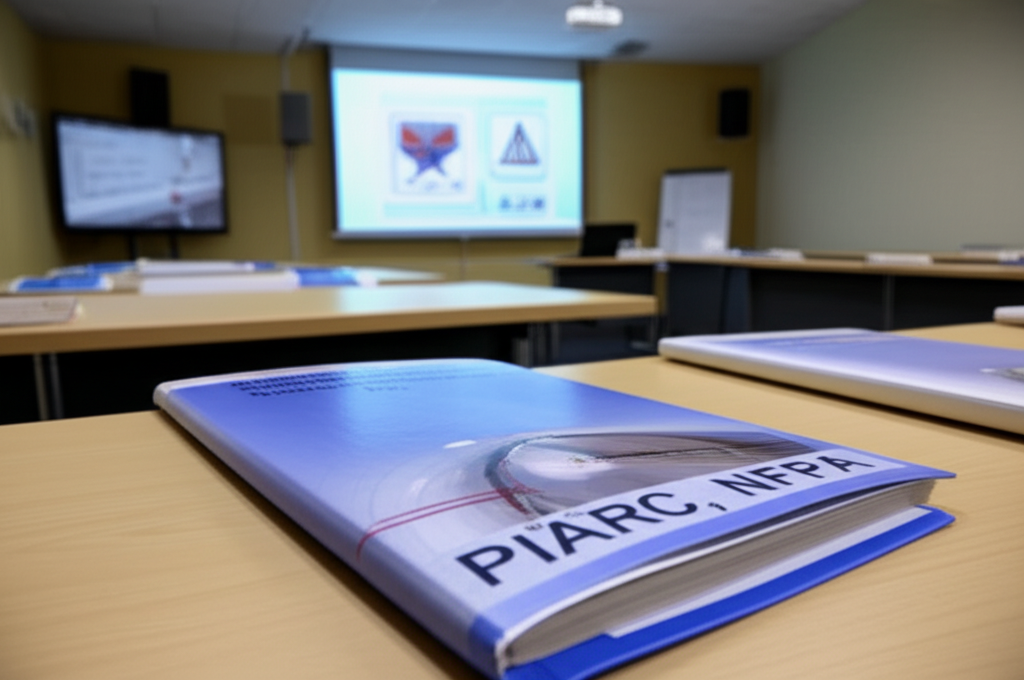
International Standards Course for Tunnels (PIARC, NFPA)
- Format: Online
- Duration: 3–5 weeks
- Hours: 300 H
- Language: English / Spanish
- Credits: 60 ECTS
- Registration date: 23-10-2026
- Start date: 12-12-2026
- Available places: 5
399 $
Competencies and results
What you will learn
1. Mastery of International Standards in Tunnels: PIARC and NFPA
-
Identify and apply PIARC (World Road Association) and NFPA (National Fire Protection Association) standards specific to tunnels.
-
Interpret and apply the safety and design requirements established in international standards for tunnels.
-
Understand inspection and maintenance procedures based on PIARC and NFPA.
-
Evaluate tunnel infrastructure considering international regulations.
-
Implement risk management strategies in accordance with PIARC and NFPA standards.
2. Expert Implementation of International Standards for Tunnels (PIARC and NFPA)
- Understand and apply key international standards, including PIARC and NFPA, for tunnel safety and efficiency.
- Interpret and apply the design and construction requirements specified in PIARC and NFPA.
- Analyze and evaluate the specific risks associated with tunnels, such as fire, ventilation, and evacuation.
- Ensure the correct implementation of fire safety systems, including detection, suppression, and passive fire protection.
- Manage and optimize tunnel ventilation to control air quality and safety.
- Plan and execute effective evacuation protocols, considering various emergency situations.
- Perform inspections and preventive maintenance in accordance with standards to ensure long-term operability and safety.
- Apply innovative technologies and solutions to improve tunnel safety and efficiency, aligned with PIARC and NFPA.
- Comply with the legal and regulatory requirements related to the construction, operation, and maintenance of tunnels.
NFPA.
3. Comprehensive user-oriented design and validation (from modeling to manufacturing)
You will learn to integrate the entire product development process, from initial model conception to final validation, applying user-centered methodologies. You will develop skills in parametric design, ergonomics, simulation, sustainable materials, 3D visualization, and manufacturing management, ensuring efficient, safe solutions that meet current industry standards.
4. Master's Degree in International Tunnel Standards (PIARC and NFPA)
4. **Master’s Degree in International Tunnel Standards (PIARC and NFPA)**
- Interpret and apply PIARC and NFPA standards in the design, construction, and operation of tunnels.
- Understand fire safety and ventilation standards in tunnels, according to PIARC and NFPA.
- Evaluate lighting, signaling, and communication systems in tunnels, in accordance with international standards.
- Analyze emergency management and evacuation plans in tunnels, following PIARC and NFPA guidelines.
- Study the structure and behavior of concrete in tunnels, including aspects of durability and protection.
- Identify the risks associated with tunnel construction and operation, and apply mitigation measures.
- Master tunnel inspection and maintenance techniques, based on PIARC and NFPA recommendations.
- Become familiar with the latest technologies and trends in tunnel construction and operation.
- Develop leadership and project management skills in the field of tunnels.
- Create strategies for sustainability and energy efficiency in tunnel design and operation.
5. Comprehensive Interpretation of International Standards for Tunnels: PIARC and NFPA
5. Comprehensive Interpretation of International Tunneling Standards: PIARC and NFPA
Understand the structure and purpose of PIARC and NFPA tunneling standards.
Identify the key safety elements covered in both standards.
Analyze the design, construction, and operation requirements for tunnels according to PIARC and NFPA.
Interpret risk management procedures and emergency plans.
Apply the standards to practical scenarios, including fire, ventilation, and evacuation.
Evaluate the differences and similarities between PIARC and NFPA, adapting best practices.
Master the technical terminology and fundamental concepts associated with tunnel safety.
Incorporate the latest updates and amendments to the standards.
6. Specialized Application of International Standards in Tunnels: PIARC and NFPA
6. **Specialized Application of International Standards for Tunnels: PIARC and NFPA**
Understand the fundamentals and application of PIARC (World Road Association) and NFPA (National Fire Protection Association) standards for tunnel safety.
Analyze the specific design and construction requirements for tunnels according to PIARC and NFPA, including ventilation, lighting, signage, fire detection and suppression systems, and evacuation routes.
Evaluate the risks associated with tunnels, such as fires, floods, collisions, and structural failures, and apply the corresponding mitigation measures according to the standards.
Master tunnel safety management procedures, including emergency plans, drills, staff training, and coordination with emergency services.
Become familiar with the latest technologies and advancements in tunnel safety, such as traffic control systems, environmental monitoring, and incident detection.
Interpret and apply PIARC and NFPA standards in practice through case studies and real-world examples from existing tunnels.
Develop skills for the inspection, maintenance, and safety assessment of tunnels, ensuring compliance with regulations and the protection of lives and property.
Who this program is for:
International Standards Course for Tunnels (PIARC, NFPA)
- Engineering professionals and technicians involved in the construction, operation, and maintenance of tunnels.
- Civil engineers, road engineers, and other engineering professionals working on tunnel infrastructure projects.
- Personnel from construction, consulting, management, and tunnel operating companies.
- Health, safety, and environmental managers in tunnels.
- Technicians and managers responsible for tunnel maintenance and inspection.
- Firefighters, emergency personnel, and security forces working in tunnels.
- Public administration and regulatory body officials responsible for tunnel safety.
**Recommended Requirements:** Basic knowledge of civil, mechanical, or electrical engineering. Language level **ES/EN** B1/B2.
- Standards-driven curriculum: you will work with CS-27/CS-29, DO-160, DO-178C/DO-254, ARP4754A/ARP4761, ADS-33E-PRF from the first module.
- Accreditable laboratories (EN ISO/IEC 17025) with rotor bench, EMC/Lightning pre-compliance, HIL/SIL, vibrations/acoustics.
- Evidence-oriented TFM: safety case, test plan, compliance dossierand operational limits.
- Mentored by industry: teachers with experience in rotorcraft, tiltrotor, eVTOL/UAM and flight test.
- Flexible modality (hybrid/online), international cohorts and support from SEIUM Career Services.
- Ethics and security: safety-by-design approach, cyber-OT, DIH and compliance as pillars.
Module 1 — Introduction to PIARC and NFPA Standards
1.1 Origins and Purpose of PIARC and NFPA
1.2 Structure and Organization of PIARC and NFPA
1.3 Key Terminology in Tunnel Standards
1.4 Areas Covered by PIARC and NFPA: Design, Construction, Operation
1.5 Interrelationship between PIARC and NFPA: Similarities and Differences
1.6 Importance of International Standards in Tunnel Safety
1.7 Historical Context and Evolution of PIARC and NFPA Standards
1.8 The Role of Standards in Tunnel Risk Mitigation
1.9 Introduction to Key PIARC and NFPA Documents
1.10 Case Studies: Initial Application of Standards
2.2 Introduction to PIARC and NFPA Standards: Scope and Objectives
2.2 Structure and Organization of PIARC Standards: Key Components
2.3 Structure and Organization of NFPA Standards: Key Components
2.4 Interpretation of Tunnel Safety Requirements According to PIARC
2.5 Interpretation of Tunnel Safety Requirements According to NFPA
2.6 Tunnel Design and Construction: PIARC and NFPA Requirements
2.7 Ventilation and Fire Control Systems: PIARC and NFPA Requirements
2.8 Lighting and Signaling Systems: PIARC and NFPA Requirements
2.9 Practical Application of the Standards: Case Studies
2.20 Implementation of Emergency Plans and Risk Management
3.3 PIARC and NFPA Foundations: Origins and Scope
3.2 PIARC and NFPA Structure and Organization: Key Guidelines and Documents
3.3 Essential Terminology in Tunnel Standards: Crucial Definitions
3.4 Tunnel Safety Requirements according to PIARC and NFPA: Design and Operation
3.5 Tunnel Ventilation and Smoke Control: Standards and Practices
3.6 Tunnel Fire Detection and Suppression Systems: Standards
3.7 Tunnel Lighting and Signaling: Regulatory Criteria
3.8 Tunnel Risk Assessment and Management: PIARC and NFPA Methodologies
3.9 Case Studies: Application of PIARC and NFPA in Real-World Projects
3.30 Comparison: Similarities and Differences between PIARC and NFPA
4.4 International Regulatory Framework: Introduction to PIARC and NFPA
4.2 Fundamental Principles of Tunnel Safety: Overview
4.3 Design and Construction according to PIARC and NFPA: Key Aspects
4.4 Tunnel Ventilation Systems: Standards and Applications
4.5 Fire Detection and Suppression Systems: Regulatory Requirements
4.6 Tunnel Lighting and Signaling: International Guidelines
4.7 Emergency Management and Rescue in Tunnels: Protocols and Procedures
4.8 Risk Assessment and Mitigation: Regulatory Compliance
4.9 Documentation and Quality Control: PIARC and NFPA Standards
4.40 Case Studies: Practical Application of the Standards
5.5 PIARC and NFPA Foundations: Context and Scope
5.5 PIARC and NFPA Structure and Organization
5.3 Key Principles in PIARC: Safety, Operation, and Maintenance
5.4 Key Principles in NFPA: Design and Fire Protection
5.5 Intersection and Complementarity: PIARC and NFPA
5.6 Document Interpretation: Manuals, Codes, and Standards
5.7 Practical Application: Case Studies and Real-World Examples
5.8 Interpretation Tools: Glossaries and Resources
5.9 Common Challenges: Interpretation Errors and Prevention
5.50 Continuous Updating: Regulatory Changes and Adaptation
6.6 Introduction to the Practical Application of PIARC and NFPA in Tunnels
6.2 Selection and Adaptation of Standards According to Tunnel Type
6.3 Design and Evaluation of Ventilation Systems According to PIARC and NFPA
6.4 Implementation of Fire Detection and Suppression Systems (PIARC and NFPA)
6.5 Operational Safety Management and Emergency Plans (PIARC and NFPA)
6.6 Application of Standards to Tunnel Lighting and Signage
6.7 Case Studies: Implementation Analysis in Real Tunnels
6.8 Audits and Verification of Regulatory Compliance
6.9 Optimizing Safety and Efficiency Through Standards
6.60 Integration of Standards into Tunnel Maintenance and Operation
- Hands-on methodology: test-before-you-trust, design reviews, failure analysis, compliance evidence.
- Software (depending on licenses/partners): MATLAB/Simulink, Python (NumPy/SciPy), OpenVSP, SU2/OpenFOAM, Nastran/Abaqus, AMESim/Modelica, acoustics tools, planning toolchains DO-178C.
- SEIUM Laboratories: scale rotor bench, vibrations/acoustics, EMC/Lightning pre-compliance, HIL/SIL for AFCS, data acquisition with strain gauging.
- Standards and compliance: EN 9100, 17025, ISO 27001, GDPR.
Capstone-type projects
- Tunnel X Study: PIARC/NFPA analysis for ventilation, safety, and fire detection.
- Integrated Design: Regulatory implementation in 3D tunnel design/simulation.
- Risk Assessment: NFPA/PIARC application in critical scenarios (fires, floods).
- Regulatory Audit: Review and compliance with PIARC/NFPA in existing tunnels.
- Simulation: CFD/FEM modeling in tunnels, PIARC/NFPA regulatory validation.
- Contingency Plan: Development of PIARC/NFPA protocols for emergencies.
- Comparative Analysis: PIARC/NFPA regulatory differences/similarities; Case study.
- Automation: PIARC/NFPA integration in SCADA systems for tunnel control.
- Safe Tunnel Design: PIARC/NFPA assessment; risk analysis; ventilation, lighting, fire protection systems.
- Design Optimization: PIARC/NFPA compliance; material selection; fire simulation.
- Tunnel Emergency Management: PIARC/NFPA protocols; evacuation, rescue, communication.
- Tunnel Safety Audit: PIARC/NFPA verification; improvement plan; gap analysis.
- Tunnel Safety Assessment v.1.0: Analysis and application of PIARC and NFPA standards for design and operation.
- Tunnel Emergency Plan: Implementation of protocols based on PIARC and NFPA for rescue and safety.
- Tunnel Modeling v.2.0: Simulation and optimization of systems (ventilation, lighting) according to PIARC and NFPA.
- Tunnel Safety Audit: Compliance assessment and recommendations according to PIARC and NFPA.
- Tunnel Safety Simulation: PIARC and NFPA analysis; fire and evacuation scenarios.
- Ventilation System Design: Calculation and optimization; regulatory compliance (PIARC/NFPA).
- Lighting and Signage Evaluation: Implementation according to standards; visibility and safety.
- Emergency Response Plan: PIARC/NFPA protocols; drills and training.
Admissions, fees, and scholarships
- Profile: Background in Computer Engineering, Mathematics, Statistics, or related fields; practical experience in NLP and valued information retrieval systems.
- Documentation: Updated CV, academic transcript, SOP/statement of purpose, project examples or code (optional).
- Process: Application → Technical evaluation of profile and experience → Technical interview → Review of case studies → Final decision → Enrollment.
- Fees:
- Single payment: 10% discount.
- Payment in 3 installments: No fees; 30% upon registration + 2 equal monthly payments of the remaining 35%.
Monthly payment: available with a 7% commission on the total; annual review.
Scholarships: based on academic merit, financial need, and promoting inclusion; agreements with companies in the sector for partial or full scholarships.
See “Calendar & Calls for Applications,” “Scholarships & Grants,” and “Fees & Financing” in the SEIUM mega-menu.
Do you have any questions?
Our team is ready to help you. Contact us, and we will respond as soon as possible.
F. A. Q
Frequently asked questions
Yes, we have international certification
Yes: experimental models, real data, applied simulations, professional environments, real case studies.
It is not mandatory. We offer leveling tracks and tutoring.
Completely. It covers e-propulsion, integration, and emerging regulations (SC-VTOL).
Recommended. There are also internal challenges and consortiums.
Yes. Online/hybrid modality with planned labs and visa support (see “Visa & Residence”).