

IMA architectures course (ARINC 653)
About our
The IMA Architectures (ARINC 653) course focuses on the design and implementation of integrated avionics processing (IMA) systems using the ARINC 653 standard. This course explores software architecture, including application partitioning, resource management, and inter-partition communication. It focuses on the application of ARINC 653 to ensure safety and performance in critical aircraft systems, covering topics such as task scheduling, memory management, and inter-partition communication. Participants will gain practical knowledge of real-time operating systems (RTOS) and tools for aeronautical software development and verification. The course offers an in-depth understanding of certification requirements and best practices for IMA system development, preparing participants for roles such as aeronautical software engineers, IMA system architects, and safety analysts. It provides hands-on experience using development tools and environments to create ARINC 653-compliant systems, strengthening professionals’ ability to design and deploy safe and reliable avionics systems.
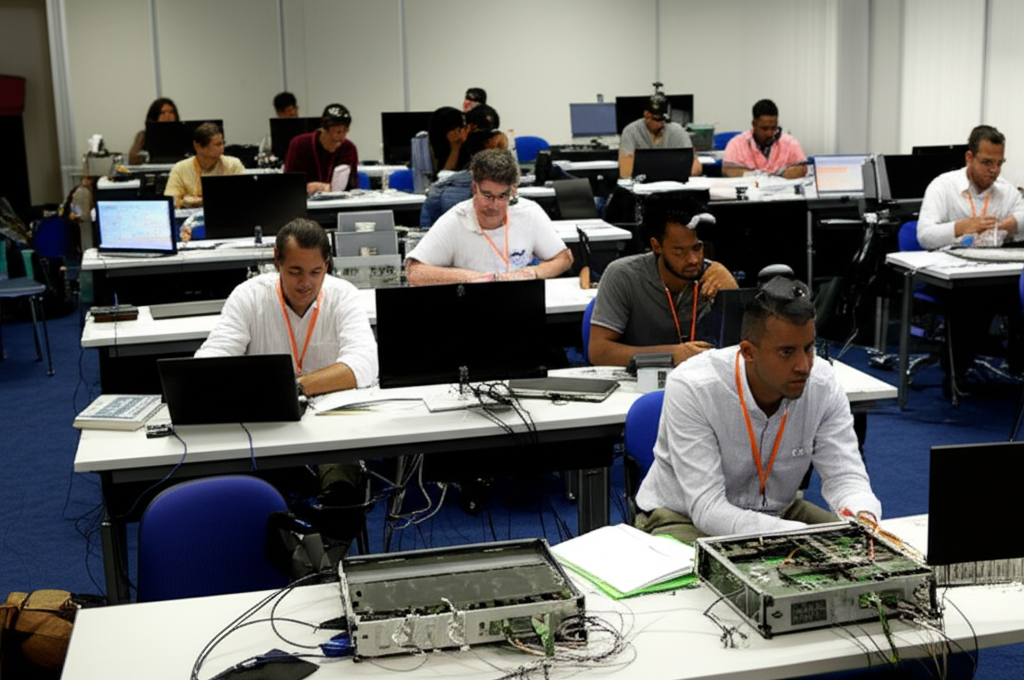
IMA architectures course (ARINC 653)
- Format: Hybrid
- Duration: 3 months
- Hours: 300 H
- Language: English / Spanish
- Registration date: 23-10-2026
- Start date: 12-12-2026
- Available places: 3
697 $
Competencies and results
What you will learn
1. Mastery of IMA Architectures (ARINC 653): Fundamentals and Applications
-
Understand the key concepts of Integrated Modular Avionics (IMA) architectures and their relevance in the aeronautics industry.
-
Explore the ARINC 653 standards, including their structure, functions, and objectives.
-
Identify the main components of an IMA architecture and their interactions.
-
Analyze resource partitioning in IMA systems: CPU, memory, and peripherals.
-
Study time management and synchronization functions in ARINC 653.
-
Learn about inter-partition communication and error management.
-
Evaluate the advantages and disadvantages of IMA architectures compared to traditional systems.
-
Apply acquired knowledge to practical cases and implementation examples.
-
Become familiar with the tools and technologies used in the development of ARINC 653 systems.
-
Understand the software development lifecycle for IMA systems.
-
Know the relevant standards and certifications for ARINC 653-based systems.
2. Construction and Optimization of IMA Systems (ARINC 653)
-
Understand the architecture and fundamental principles of Integrated Modular Avionics (IMA) systems.
-
Master the ARINC 653 specification and its key functions for partitioning and resource management.
-
Learn about building robust and isolated execution environments in IMA systems.
-
Study inter-partition communication mechanisms and task synchronization.
-
Explore tools and techniques for performance optimization in IMA systems.
-
Analyze safety and certification aspects applicable to ARINC 653 systems.
-
Practice deploying and implementing applications in a simulated or real ARINC 653 environment.
-
Evaluate and troubleshoot issues in IMA systems, including error management and recovery.
-
Become familiar with the latest trends and technologies in the field of IMA systems.
-
Develop skills to design, implement, and maintain high-performance ARINC 653 IMA systems.
3. Comprehensive User-Oriented Design and Validation (From Modeling to Manufacturing)
You will learn to integrate the entire product development process from model conception to final validation, applying user-centered methodologies. You will develop skills in parametric design, ergonomics, simulation, sustainable materials, 3D visualization, and manufacturing management, ensuring efficient, safe solutions aligned with current industrial standards.
4. IMA Architectures (ARINC 653): Advanced Insights and Professional Development
-
Understand Integrated Modular Avionics (IMA) architecture and the ARINC 653 standard.
-
Study key concepts of partitioning and isolation in IMA.
-
Analyze resource management (CPU, memory, network) within an IMA system.
-
Master tools and techniques for software development in IMA environments.
-
Learn about IMA system certification and safety requirements.
-
Explore case studies and practical implementation examples of IMA.
-
Acquire knowledge about the future evolution of IMA architectures.
-
Delve deeper into application development for IMA systems.
-
Understand testing and verification strategies specific to IMA.
-
Become familiar with relevant regulations and standards for IMA.
IMA Architectures (ARINC 653): Design, Implementation, and Evaluation
-
Understand the fundamentals of Integrated Modular Avionics (IMA) architectures based on ARINC 653.
-
Master the concepts of partitioning and isolation in IMA environments.
-
Design efficient and robust IMA systems, considering real-time and safety requirements.
-
Implement applications on IMA platforms using development and simulation tools.
-
Evaluate the performance and reliability of implemented IMA systems.
-
Learn about resource management in IMA architectures, including CPU, memory, and network.
-
Analyze the interaction between different modules and applications in an IMA environment.
-
Study safety and certification considerations for IMA systems.
-
Explore practical cases and case studies of IMA implementations in the aeronautics industry.
-
Acquire knowledge about the latest trends and developments in the field of IMA architectures.
6. IMA Architectures (ARINC 653): Analysis, Development, and Validation
-
Understand Integrated Modular Avionics (IMA) architecture and the ARINC 653 standard.
-
Analyze the principles of partitioning and isolation in IMA environments.
-
Learn key concepts of task scheduling, management, and programming in IMA systems.
-
Develop skills in designing and developing applications for IMA environments.
-
Become familiar with development tools and environments for IMA.
-
Conduct testing and validation of IMA applications, including partition verification and resource management.
-
Study the different abstraction layers and services offered by ARINC 653, including memory management, inter-partition communication, and time management.
-
Analyze case studies and implementation examples of IMA systems in the aeronautics industry.
-
Acquire knowledge about IMA system certification according to industry standards and regulations.
Who this program is for:
IMA architectures course (ARINC 653)
-
Graduated engineers in Aerospace, Mechanical, Industrial, Automatic Control, or related disciplines.
-
Technical and management personnel from aircraft manufacturers (OEMs), with a focus on rotorcraft/eVTOL, as well as staff from Maintenance, Repair, and Overhaul (MRO) organizations, aeronautical consulting firms, and technology center professionals.
-
Professionals in fields such as Flight Testing, aeronautical certification, avionics systems, aircraft control, and flight dynamics who wish to deepen their knowledge and specialize in IMA architectures (ARINC 653).
-
Regulators, aeronautical authority personnel, and professional profiles focused on the development and operation of Urban Air Mobility (UAM) and electric vertical takeoff and landing (eVTOL) vehicles who need to acquire solid competencies in compliance and regulatory fulfillment.
-
Recommended requirements: Prior knowledge in fundamental areas of aeronautical engineering—such as aerodynamics, systems control, and structures—is recommended. English language proficiency equivalent to B2+ or C1 (according to the Common European Framework of Reference for Languages) is required. If necessary, we offer bridging tracks to help align foundational knowledge.
-
Standards-driven curriculum: you will work with CS-27/CS-29, DO-160, DO-178C/DO-254, ARP4754A/ARP4761, and ADS-33E-PRF from the very first module.
-
Accreditable laboratories (EN ISO/IEC 17025) featuring rotor test rig, EMC/Lightning pre-compliance, HIL/SIL, and vibration/acoustics.
-
Evidence-oriented Master’s Thesis (TFM): safety case, test plan, compliance dossier, and operating limits.
-
Industry mentorship: faculty with proven track records in rotorcraft, tiltrotor, eVTOL/UAM, and flight testing.
-
Flexible modality (hybrid/online), international cohorts, and dedicated support from SEIUM Career Services.
-
Ethics and safety: safety-by-design approach, OT cybersecurity, IHL (International Humanitarian Law), and compliance as core pillars.
1.1. Evolution of aeronautical electronic architectures from federated systems toward integrated modular architectures (IMA)
1.2. Principles of aeronautical function integration on shared computing platforms
1.3. Concept of Integrated Modular Avionics (IMA), operational advantages, and implementation challenges
1.4. Introduction to the ARINC 653 standard and its role in high-criticality avionics systems
1.5. Spatial and temporal separation as fundamental safety principles in IMA architectures
1.6. Applications of IMA and ARINC 653 in commercial, military, and aerospace systems
2.1. Partitioning model in ARINC 653 systems and isolation between critical applications
2.2. Partition, process, task, and shared resource management within an IMA platform
2.3. Time scheduling, execution windows, and deterministic allocation of computing resources
2.4. ARINC 653 operating system services: process management, communication, and memory
2.5. Error handling, operational states, and recovery mechanisms within partitions
2.6. Design of independent aeronautical applications within a common IMA infrastructure
3.1. Inter-partition communication models in ARINC 653 systems
3.2. Communication channels, sampling ports, and queuing ports for information exchange
3.3. Avionics module integration via digital aeronautical networks
3.4. Interfaces between applications, operating system, and hardware in IMA architectures
3.5. Critical data management, synchronization, and information consistency across systems
3.6. Design of secure, deterministic, and fault-tolerant communication architectures
4.1. Aeronautical software development lifecycle applied to IMA systems
4.2. Software engineering processes according to aeronautical certification standards
4.3. Development of partitioned applications and management of functional and safety requirements
4.4. Software verification, validation, and testing on ARINC 653 platforms
4.5. Safety analysis, criticality levels, and relationship with standards such as DO-178C
4.6. Technical documentation, traceability, and necessary evidence for aeronautical certification
5.1. Principles of safety-by-design in integrated aeronautical electronic systems
5.2. Risk analysis, failure modes, and effects analysis (FMEA/FMEA-like) in IMA systems
5.3. Fault tolerance through redundancy, isolation, and recovery mechanisms
5.4. Protection against software errors, hardware faults, and functional degradation
5.5. Cybersecurity applied to IMA platforms and protection of critical systems
5.6. Assessment of availability, maintainability, and reliability in integrated architectures
6.1. Requirements analysis for the design of an aeronautical IMA platform
6.2. Partition definition, resource allocation, and system temporal scheduling
6.3. Inter-application communication design utilizing ARINC 653 services
6.4. Development of integration strategies, functional testing, and system validation
6.5. Safety, certifiability, and aeronautical compliance assessment
6.6. Development of a complete IMA architecture practical case study based on ARINC 653, including partition definition, communications, resource management, and a verification plan
-
Hands-on methodology: test-before-you-trust, design reviews, failure analysis, compliance evidence.
-
Software (subject to licensing/partnerships): MATLAB/Simulink, Python (NumPy/SciPy), OpenVSP, SU2/OpenFOAM, Nastran/Abaqus, AMESim/Modelica, acoustics tools, DO-178C planning toolchains.
-
SEIUM Laboratories: scaled rotor test rig, vibrations/acoustics, EMC/Lightning pre-compliance, HIL/SIL for AFCS, data acquisition with strain gauging.
-
Standards and compliance: EN 9100, 17025, ISO 27001, GDPR.
Capstone-type projects
-
IMA Simulation: Simulated IMA system development; resource partitioning; process management.
-
ARINC 653 Implementation: Application design; module development; interoperability testing.
-
IMA Validation: ARINC 653 compliance verification; performance analysis; safety evaluation.
-
IMA Simulation: Simulated IMA system development; resource partitioning; process management.
-
ARINC 653 Implementation: Application design; module development; interoperability testing.
-
IMA Validation: ARINC 653 compliance verification; performance analysis; safety evaluation.
- Advanced IMA Simulation: ARINC 653 Modular Avionics System Design.
- Critical Application Development: Implementation of Essential Control Functions.
- Verification and Validation: Comprehensive Performance and Safety Testing.
-
Aircraft IMA System: Partition Design and Simulation.
-
ARINC 653 RTOS Development: Implementation on Specific Hardware.
-
SIL/HIL Validation: Verification of Critical Modules.
-
DO-160 Testing: Planning and Execution.
-
IMA System for Flight Control (ARINC 653): Design and implementation of critical modules (sensors, actuators, task management) with resource partitioning, considering DO-178C certification.
Admissions, fees, and scholarships
-
Profile: Degree in Computer Engineering, Mathematics, Statistics, or related fields; hands-on experience in NLP and information retrieval systems appreciated.
-
Documentation: Updated CV/Resume, academic transcripts, SOP/statement of purpose, project samples or code repositories (optional).
-
Process: Application → technical profile and experience evaluation → technical interview → case study review → final decision → enrollment.
-
Fees:
-
Single payment: 10% discount.
-
3-installment payment: Interest-free; 30% upon registration + 2 equal monthly payments of the remaining 35%.
-
Monthly payment: Available with a 7% surcharge on the total amount; annual review.
-
-
Scholarships: Awarded based on academic merit, financial need, and diversity/inclusion initiatives; agreements with sector companies for partial or full scholarships.
-
Consult: “Calendar & Deadlines,” “Scholarships & Financial Aid,” and “Fees & Financing” in the SEIUM mega-menu.
Do you have any questions?
Our team is ready to help you. Contact us, and we will respond as soon as possible.
F. A. Q
Frequently asked questions
Yes, we have international certification.
Yes: experimental models, real data, applied simulations, professional environments, real case studies.
No, it is not mandatory. We offer leveling tracks and personalized tutoring.
Absolutely. It covers e-propulsion, integration, and emerging regulations (SC-VTOL).
Recommended. There are also internal challenges and consortium projects.
Yes. Online/hybrid modality with planned laboratory sessions and visa support (see “Visa & Residence”).