

Hyperspectral payloads course
About our
The Hyperspectral Payloads course explores the theory and practice of hyperspectral image data acquisition and processing. The course focuses on target detection, material classification, and environmental analysis, using specialized software and advanced algorithms. It covers everything from calibration and atmospheric correction to applications in fields such as precision agriculture, pollutant detection, and geological analysis, preparing participants to handle hyperspectral data in diverse applications.
Participants will learn to design and configure hyperspectral image acquisition systems, apply preprocessing techniques, and implement classification and analysis algorithms.
A solid foundation in spectroscopy and sensor technology is provided, with a focus on results interpretation and data validation. The course culminates in practical projects where acquired knowledge is applied to real-world case studies, developing skills for research and analysis of hyperspectral data.
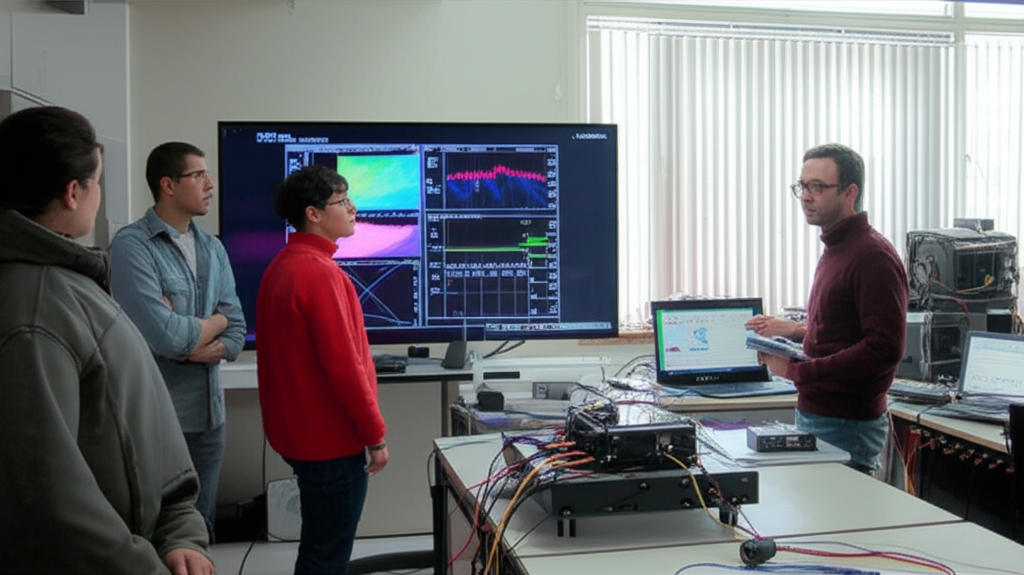
Hyperspectral payloads course
- Format: Hybrid
- Duration: 3 months
- Hours: 300 H
- Language: English / Spanish
- Registration date: 23-10-2026
- Start date: 12-12-2026
- Available places: 2
499 $
Competencies and results
What you will learn
1. Analysis, processing and applications of hyperspectral data
Here is the requested content:
-
Identification and classification of objects and materials from spectral data.
-
Hyperspectral data preprocessing techniques for noise and artifact correction.
-
Application of supervised and unsupervised classification algorithms for hyperspectral image analysis.
-
Extraction of geospatial and temporal information from hyperspectral data for environmental monitoring and resource management.
-
Use of specialized software for processing and analyzing hyperspectral data (ENVI, etc.).
1. Comprehensive Mastery of Hyperspectral Analysis for Effective Implementations
-
Identify and understand the key techniques of hyperspectral analysis, including data acquisition, preprocessing, and analysis.
-
Apply hyperspectral analysis in various implementation areas, such as object detection, material classification, and quality assessment.
-
Develop the ability to design and implement hyperspectral analysis-based solutions to address specific problems.
-
Evaluate the accuracy and reliability of results obtained through hyperspectral analysis.
-
Understand the challenges and limitations of hyperspectral analysis in different scenarios.
-
Apply hyperspectral analysis for environmental monitoring, precision agriculture, natural resource detection, and maritime safety.
-
Analyze and evaluate case studies and practical examples of successful implementations of hyperspectral analysis.
-
Learn to effectively communicate the results and conclusions derived from hyperspectral analysis.
Master the use of specialized tools and software for processing and interpreting hyperspectral data.
3. Comprehensive user-oriented design and validation (from modeling to manufacturing)
You will learn to integrate the entire product development process, from initial model conception to final validation, applying user-centered methodologies. You will develop skills in parametric design, ergonomics, simulation, sustainable materials, 3D visualization, and manufacturing management, ensuring efficient, safe solutions that meet current industry standards.
4. Information Extraction and Key Applications from Hyperspectral Data
4. Information Extraction and Key Applications of Hyperspectral Data
- Identification and characterization of unique spectral signatures.
- Preprocessing techniques for atmospheric and geometric correction.
- Classification and segmentation methods for hyperspectral images.
- Extraction of geochemical and material composition information.
- Applications in anomaly detection and environmental monitoring.
- Analysis of spectral variability for change identification.
- Use of machine learning algorithms for data interpretation.
- Integration of hyperspectral data with other information sources.
5. Development of Skills in the In-Depth Interpretation of Hyperspectral Data
5. Development of Skills in the In-Depth Interpretation of Hyperspectral Data
- Identify and understand the fundamental characteristics of hyperspectral data.
- Apply preprocessing techniques for atmospheric and geometric correction of data.
- Use classification and object detection algorithms in hyperspectral images.
- Analyze and interpret reflectance spectra for material identification.
- Implement principal component analysis (PCA) and spectral mixture analysis (SMA) methods.
- Apply machine learning techniques for the classification and segmentation of hyperspectral data.
- Evaluate the accuracy and reliability of the results obtained.
- Use specialized software for the processing and analysis of hyperspectral data.
- Develop skills for interpreting results in different contexts.
- Understand the applications of hyperspectral remote sensing in diverse fields such as agriculture, the environment, and security.
6. Integration and Strategic Use of Hyperspectral Payloads
Here is the requested content:
6. Integration and Strategic Use of Hyperspectral Payloads
- Identification and characterization of unique spectral signatures across a wide range of targets.
- Application of hyperspectral image processing techniques for the detection and classification of objects and materials.
- Development of strategies for the acquisition and calibration of hyperspectral data, ensuring the accuracy and reliability of the information.
- Implementation of advanced algorithms for the extraction of relevant information, such as the chemical composition, structure, and physical state of the targets.
- Integration of hyperspectral data with other information sources, such as geospatial data and multispectral sensors, for a more comprehensive analysis.
- Use of specialized software and analysis tools for the processing and interpretation of hyperspectral data.
- Application of Hyperspectral data in diverse areas, including environmental remote sensing, precision agriculture, surveillance, and security.
Evaluation of the advantages and limitations of hyperspectral payloads in different scenarios and applications.
Who this program is for:
Hyperspectral payloads course
- Graduates in Aerospace Engineering, Naval Engineering, Oceanography, Environmental Engineering, or disciplines related to marine environmental observation.
- Professionals from marine prospecting companies, oceanographic research, environmental consulting, or government organizations who work with marine data.
- Marine scientists, marine geologists, marine biologists, and remote sensing experts interested in hyperspectral data analysis.
- Data analysts, software developers, and specialists in GIS professionals who wish to expand their skills in processing marine hyperspectral data.
Recommended qualifications: Basic knowledge of physics, mathematics, statistics, and programming; prior experience with satellite data or remote sensing; B2+/C1 level of English. Supporting materials will be provided to help students reach the required level.
- Standards-driven curriculum: you will work with CS-27/CS-29, DO-160, DO-178C/DO-254, ARP4754A/ARP4761, ADS-33E-PRF from the first module.
- Accreditable laboratories (EN ISO/IEC 17025) with rotor bench, EMC/Lightning pre-compliance, HIL/SIL, vibrations/acoustics.
- Evidence-oriented TFM: safety case, test plan, compliance dossierand operational limits.
- Mentored by industry: teachers with experience in rotorcraft, tiltrotor, eVTOL/UAM and flight test.
- Flexible modality (hybrid/online), international cohorts and support from SEIUM Career Services.
- Ethics and security: safety-by-design approach, cyber-OT, DIH and compliance as pillars.
1.1 Fundamentals of Hyperspectral Remote Sensing: Principles and Characteristics
1.2 Hyperspectral Data Capture and Acquisition: Sensors and Platforms
1.3 Data Preprocessing: Calibration, Atmospheric Correction, and Georeferencing
1.4 Spectral Analysis: Spectral Signatures and Material Identification
1.5 Naval Applications: Object Detection, Water Analysis, and Coastal Monitoring
1.6 Software and Tools for Hyperspectral Analysis: Introduction
1.7 Introduction to Hyperspectral Information Databases
1.8 Introduction to Data Applications in Naval Research
1.9 Principles of Calibration and Data Classification
1.10 Case Studies: Real-World Applications in the Maritime Environment
2.2 Fundamentals of Hyperspectral Analysis Implementation
2.2 Methodologies for Effective Hyperspectral Analysis
2.3 Selection and Preparation of Hyperspectral Data
2.4 Tools and Software for Hyperspectral Analysis
2.5 Workflow Design for Hyperspectral Analysis
2.6 Validation and Verification of Hyperspectral Analysis Results
2.7 Case Studies: Successful Implementations of Hyperspectral Analysis
2.8 Common Challenges and Solutions in Implementation
2.9 Integrating Hyperspectral Analysis into Real-World Projects
2.20 Best Practices and Future Considerations in Implementation
3.3 Preprocessing and Atmospheric Correction in Hyperspectral Data
3.2 Advanced Spectral Unmixing Techniques
3.3 Classification of Hyperspectral Images with Supervised Algorithms
3.4 Classification of Hyperspectral Images with Unsupervised Algorithms
3.5 Detection of Anomalies and Objects of Interest in Hyperspectral Data
3.6 Analysis of Temporal Changes in Hyperspectral Data
3.7 Modeling and Simulation of Hyperspectral Data
3.8 Applied Dimensionality Reduction Methods
3.9 Visualization and Representation Techniques for Hyperspectral Data
3.30 Validation and Evaluation of the Quality of Results
4.4 Fundamentals of Hyperspectral Information Extraction
4.2 Preprocessing Techniques for Information Extraction
4.3 Classification and Segmentation Methods for Hyperspectral Images
4.4 Spectral Mixture Analysis and Endmember Decomposition
4.5 Detection and Characterization of Objects with Hyperspectral Data
4.6 Specific Applications: Identification of Materials and Objects
4.7 Extraction of Geochemical and Biological Features
4.8 Integration of Hyperspectral Data with Other Information Sources
4.9 Evaluation of Accuracy and Validation of Results
4.40 Case Studies: Real-World Applications of Hyperspectral Information Extraction
5.5 Introduction to Hyperspectral Data and Its Relevance
5.5 Principles of Spectroscopy and Remote Sensing
5.3 Data Acquisition: Platforms and Sensors
5.4 Data Formats and Basic Preprocessing
5.5 Initial Applications and Practical Examples
5.5 Preprocessing Techniques: Calibration and Atmospheric Correction
5.5 Principal Component Analysis (PCA) and Dimensionality Reduction
5.3 Supervised and Unsupervised Classification Methods
5.4 Image Processing: Enhancement and Filtering
5.5 Tools and Software for Data Analysis
3.5 Advanced Classification Methods
3.5 Anomaly Detection and Spectral Change
3.3 Applied Machine Learning Techniques
3.4 Modeling Spectral Mixtures
3.5 Time Series and Hyperspectral Data Analysis
4.5 Extraction of Spectral Signatures and Features
4.5 Detection and mapping of specific objects and materials
4.3 Estimation of biophysical and geochemical parameters
4.4 Analysis of reflectance and emissivity images
4.5 Applications in different domains: agriculture, environment, etc.
5.5 Interpretation of Spectra and Spectral Bands
5.5 Identification of Patterns and Trends
5.3 Evaluation of Data and Results Quality
5.4 Sensitivity and Uncertainty Analysis
5.5 Effective Presentation and Communication of Results
6.5 Types of Hyperspectral Payloads and Their Characteristics
6.5 Integration of Payloads on Different Platforms (Airborne, Land-Based, Marine)
6.3 Mounting and Calibration Considerations
6.4 Mission Planning and Data Acquisition
6.5 Interfaces and Communication with Support Systems
7.5 Configuration and Control of Hyperspectral Payloads
7.5 Operation of Payloads in Different Environmental Conditions
7.3 Power Management and Data Storage
7.4 Maintenance and Basic Troubleshooting
7.5 Security Protocols and Best Practices
8.5 Specific Applications of Hyperspectral Payloads in the Naval Sector
8.5 Mission Design and Analysis Strategies
8.3 Evaluation of the feasibility and profitability of the applications
8.4 Presentation of results and recommendations
8.5 Future trends and development of new applications
6. Introduction to Hyperspectral Analysis
6.6 Fundamentals of hyperspectral analysis: concept, advantages, and challenges.
6.2 Hyperspectral data acquisition: platforms and sensors.
6.3 Data preprocessing: atmospheric correction and radiometric calibration.
6.4 Initial applications: examples in various disciplines.
6.5 Tools and software for hyperspectral analysis.
2. Mastering Hyperspectral Analysis
2.6 Supervised and unsupervised classification techniques.
2.2 Principal component analysis (PCA) and dimensionality reduction.
2.3 Methods for detecting anomalies and spectral changes.
2.4 Selection and extraction of spectral features.
2.5 Evaluation and validation of results.
3. Advanced Hyperspectral Techniques
3.6 Spectral modeling: spectral mixing methods. 3.2 Hyperspectral Image Analysis with Machine Learning
3.3 Deep Learning Applications in Hyperspectral Analysis
3.4 Techniques for Fusion of Hyperspectral Data with Other Sources
3.5 Development of Custom Algorithms
4. Key Information Extraction
4.6 Identification of Materials and Objects Using Spectral Data
4.2 Estimation of Physical and Chemical Properties from Hyperspectral Data
4.3 Detection and Monitoring of Changes Over Time
4.4 Analysis of Spatial and Temporal Variability
4.5 Development of Thematic Maps and Derived Products
5. Hyperspectral Data Interpretation
5.6 Principles of Spectroscopy and Spectral Signatures
5.2 Interpretation of Complex Spectral Signatures
5.3 Analysis of Uncertainty and Data Quality 5.4 Visualization and presentation of results.
5.5 Case studies and results analysis.
6. Integration of Strategic Payloads
6.6 Types of hyperspectral payloads and their characteristics.
6.2 Selecting the appropriate payload for the application.
6.3 Mission planning and flight design.
6.4 Integrating the payload with different platforms (airborne, ground-based, etc.).
6.5 Considerations for payload calibration and validation.
7. Skills in Hyperspectral Payloads
7.6 Payload configuration and control.
7.2 Real-time data acquisition and processing.
7.3 Data management and storage.
7.4 Payload maintenance and calibration.
7.5 Troubleshooting.
8. Exploring Hyperspectral Payloads
8.6 Advanced Applications of Hyperspectral Payloads
8.2 Development of New Techniques and Analysis Methods
8.3 Future Trends in Hyperspectral Technology
8.4 Case Studies and Success Stories
8.5 Research and Development of New Sensors and Platforms
- Hands-on methodology: test-before-you-trust, design reviews, failure analysis, compliance evidence.
- Software (depending on licenses/partners): MATLAB/Simulink, Python (NumPy/SciPy), OpenVSP, SU2/OpenFOAM, Nastran/Abaqus, AMESim/Modelica, acoustics tools, planning toolchains DO-178C.
- SEIUM Laboratories: scale rotor bench, vibrations/acoustics, EMC/Lightning pre-compliance, HIL/SIL for AFCS, data acquisition with strain gauging.
- Standards and compliance: EN 9100, 17025, ISO 27001, GDPR.
Capstone-type projects
- Coastal Water Analysis: Identification of pollutants and sediments, classification of marine vegetation.
- Maritime Surveillance: Detection of illegal vessels, monitoring of routes and traffic patterns.
- Environmental Monitoring: Assessment of the health of marine ecosystems, detection of oil spills.
- Mapping and Topography: Creation of detailed maps of the seabed, analysis of coastal changes.
- Coastal Mapping: Analysis of underwater vegetation and detection of pollutants.
- Vessel Identification: Classification and tracking of vessels using spectral imaging.
- Resource Management: Assessment of the health of marine ecosystems and wave detection.
- Environmental Monitoring: Detection of oil spills and analysis of water quality.
- Marine Threat Detection: Hyperspectral analysis for the identification of vessels and submerged artifacts.
- Marine Pollution Analysis: Identification and mapping of oil spills and waste.
- Coastal Navigation and Cartography: Creation of bathymetric maps and recognition of changes in the coastline.
- Marine Biodiversity Monitoring: Monitoring of coral reefs and underwater ecosystems.
- Naval Spectral Analysis: Detection of hull anomalies and marine pollutants.
- Coastal Mapping: Classification of vegetation and sediments, and assessment of the health of the coastal ecosystem.
- Vessel Detection: Identification and tracking of vessels, including classification and analysis of their activity.
- Resource Management: Monitoring and analysis of water quality and environmental impact assessment.
Admissions, fees, and scholarships
- Profile: Background in Computer Engineering, Mathematics, Statistics, or related fields; practical experience in NLP and valued information retrieval systems.
- Documentation: Updated CV, academic transcript, SOP/statement of purpose, project examples or code (optional).
- Process: Application → Technical evaluation of profile and experience → Technical interview → Review of case studies → Final decision → Enrollment.
- Fees:
- Single payment: 10% discount.
- Payment in 3 installments: No fees; 30% upon registration + 2 equal monthly payments of the remaining 35%.
Monthly payment: available with a 7% commission on the total; annual review.
Scholarships: based on academic merit, financial need, and promoting inclusion; agreements with companies in the sector for partial or full scholarships.
See “Calendar & Calls for Applications,” “Scholarships & Grants,” and “Fees & Financing” in the SEIUM mega-menu.
Do you have any questions?
Our team is ready to help you. Contact us, and we will respond as soon as possible.
F. A. Q
Frequently asked questions
Yes, we have international certification
Yes: experimental models, real data, applied simulations, professional environments, real case studies.
It is not mandatory. We offer leveling tracks and tutoring.
Completely. It covers e-propulsion, integration, and emerging regulations (SC-VTOL).
Recommended. There are also internal challenges and consortiums.
Yes. Online/hybrid modality with planned labs and visa support (see “Visa & Residence”).