

Ground segment course in satellites
About our
The Ground Segment in Satellites course provides specialized training in the ground segment necessary for the operation and control of satellites. It focuses on the planning, implementation, and operation of ground stations, including telemetry, tracking, and control (TT&C) systems. Topics such as antennas, radio frequency (RF), communication protocols, data processing, and mission control, essential for bidirectional communication with satellites, are covered.
The course offers practical knowledge in the use of simulation software, laboratory equipment, and signal analysis tools. The ground station architectures, communications security, and space regulations are explored. Participants will acquire skills to diagnose and troubleshoot problems in the ground segment, ensuring the correct reception and transmission of data.
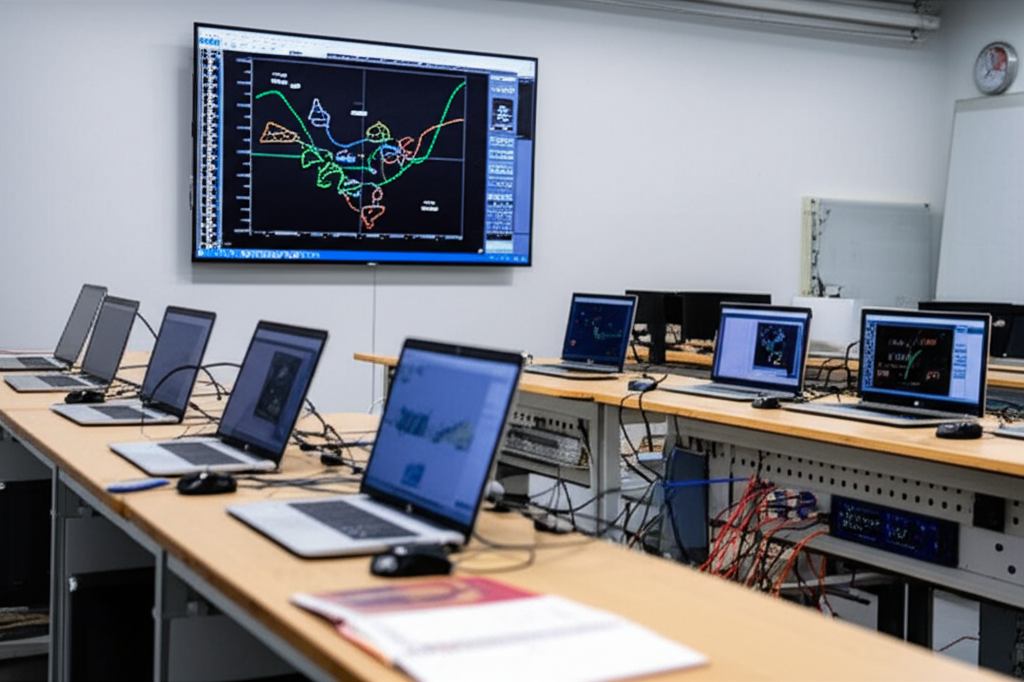
Ground segment course in satellites
- Format: Hybrid
- Duration: 3 months
- Hours: 300 H
- Language: English / Spanish
- Registration date: 23-10-2026
- Start date: 12-12-2026
- Available places: 3
780 $
Competencies and results
What you will learn
1. **Expert Mastery of the Satellite Terrestrial Segment: Fundamentals and Advanced Operations**
- Identify and analyze the key components of satellite ground stations, including antennas, amplifiers, and signal processing equipment.
- Master the modulation, multiplexing, and multiple access techniques used in satellite communications.
- Study the different types of orbits and their impact on the coverage, latency, and performance of satellite links.
-
Learn to calculate link parameters, including free space loss, antenna gain, and received power.
- Analyze the effects of signal propagation in the terrestrial environment, such as rain attenuation, atmospheric absorption, and fading.
Understand the architecture and fundamental principles of terrestrial satellite communication systems.
Implement satellite communication protocols, including TCP/IP and other link layer protocols.
Configure and operate test and measurement equipment for satellite link evaluation.
Explore advanced applications of terrestrial satellite technology, such as telemetry, remote control, and resource management.
Investigate future trends in the terrestrial satellite segment, including new technologies and ongoing innovations.
2. **Architecture and Operations of the Satellite Ground Segment: A Comprehensive Journey**
2. **Satellite Ground Segment Architecture and Operations: A Comprehensive Journey**
- Understand the structure of the satellite ground segment: ground stations, control centers, and communication networks.
- Identify the key components of ground stations: antennas, RF systems, tracking systems, and telemetry.
- Analyze satellite communication protocols and standards: TDMA, FDMA, CDMA, and multiple access technologies.
- Evaluate the ground segment network architecture: routing, switching, and transport protocols.
- Master satellite network management and control techniques: monitoring, resource management, and troubleshooting.
- Explore ground segment applications in different industries: telecommunications, Earth observation, navigation, and defense.
- Become familiar with ground segment security aspects: encryption, authentication, and prevention of interference.
Study international regulations and standards in the satellite sector: ITU, FCC, and other regulatory bodies.
Analyze current challenges and future trends in the terrestrial segment: increased traffic, new technologies, and the expansion of the satellite constellation.
3. Comprehensive user-oriented design and validation (from modeling to manufacturing)
You will learn to integrate the entire product development process, from initial model conception to final validation, applying user-centered methodologies. You will develop skills in parametric design, ergonomics, simulation, sustainable materials, 3D visualization, and manufacturing management, ensuring efficient, safe solutions that meet current industry standards.
4. **Satellite Terrestrial Segment: Fundamentals, Applications and Implementation Strategies**
4. **Satellite Ground Segment: Fundamentals, Applications, and Implementation Strategies**
- Understand the fundamentals of satellite communication and ground segment architecture.
- Identify and analyze the key components of the ground segment, including ground stations, antennas, and control systems.
- Explore the different frequency bands used in satellite communications and their implications for ground segment design.
- Study the applications of the satellite ground segment in various sectors, such as telecommunications, navigation, Earth observation, and defense.
- Analyze the challenges and technical solutions related to the acquisition, processing, and distribution of satellite data.
- Evaluate implementation strategies for the ground segment, including the planning, design, construction, and operation of ground stations.
- Learn about the international standards and regulations governing the operation of the ground segment satellite.
Develop skills in managing projects related to the terrestrial segment, including risk management, resource planning, and cost control.
Become familiar with emerging trends in the terrestrial segment, such as miniaturization, automation, and the use of artificial intelligence.
Study successful case studies of terrestrial segment implementation in different applications and regions.
5. **Excellence in Terrestrial and Satellite Segment: From Theory to Professional Practice**
Here is the content you will learn, optimized for SEO and following your guidelines:
5. **Excellence in Terrestrial and Satellite Segment: From Theory to Professional Practice**
* Understand and master the fundamentals of satellite signal reception and transmission in the terrestrial segment.
* Analyze ground station infrastructure, including antennas, tracking systems, and signal processing equipment.
* Study and apply error correction and modulation/demodulation techniques to optimize signal quality.
* Evaluate the performance of satellite links, considering factors such as atmospheric attenuation, noise, and interference.
* Implement satellite communication protocols, including the management of multiple access protocols.
* Design and optimize terrestrial segment networks for different applications, such as communications, navigation, and Earth observation.
* Learn to use specialized software for the simulation and analysis of terrestrial satellite systems.
* Acquire skills in problem-solving and troubleshooting terrestrial segment systems.
* Become familiar with satellite industry regulations and standards.
* Develop practical projects and case studies to apply acquired knowledge to real-world situations.
6. **Land and Satellite Segment: Analysis, Configuration and Management of Critical Infrastructures**
6. **Satellite Ground Segment: Analysis, Configuration, and Management of Critical Infrastructure**
Identification and evaluation of the key components of a satellite ground segment.
In-depth understanding of satellite signals and their communication protocols.
Analysis of the network architectures and topologies used in the ground segment.
Configuration and optimization of ground stations, including antennas and RF systems.
Management of network infrastructure, security, and cybersecurity in the ground segment.
Implementation and maintenance of satellite monitoring and control systems.
Analysis of satellite data for specific applications, such as communications, navigation, and Earth observation.
Troubleshooting and troubleshooting of ground segment systems.
Compliance with the Regulations and standards of the satellite industry.
Development of project management skills in the context of the terrestrial satellite segment.
Who this program is for:
Ground segment course in satellites
- Engineers with degrees in Telecommunications, Electronics, Aeronautical, or disciplines related to the space sector.
- Technicians and professionals from satellite operators, telecommunications service providers, and software development companies for the terrestrial segment.
- Personnel involved in satellite network management, mission control, systems engineering, and ground station operations.
- Analysts and personnel from R&D departments interested in delving deeper into satellite communications and signal processing technologies.
Recommended requirements: Basic knowledge of telecommunications, signal processing, and networks; English at a minimum level B2. Supplementary materials are provided to improve proficiency.
- Standards-driven curriculum: you will work with CS-27/CS-29, DO-160, DO-178C/DO-254, ARP4754A/ARP4761, ADS-33E-PRF from the first module.
- Accreditable laboratories (EN ISO/IEC 17025) with rotor bench, EMC/Lightning pre-compliance, HIL/SIL, vibrations/acoustics.
- Evidence-oriented TFM: safety case, test plan, compliance dossierand operational limits.
- Mentored by industry: teachers with experience in rotorcraft, tiltrotor, eVTOL/UAM and flight test.
- Flexible modality (hybrid/online), international cohorts and support from SEIUM Career Services.
- Ethics and security: safety-by-design approach, cyber-OT, DIH and compliance as pillars.
Module 1 — Fundamentals of the Satellite Terrestrial Segment
1.1 Principles of Satellite Communications: Introduction to the Terrestrial Segment
1.2 Key Components of the Terrestrial Segment: Antennas, Modems, and Control Systems
1.3 Types of Earth Stations: Fixed, Mobile, and Portable
1.4 Satellite Network Topologies: Point-to-Point, Point-to-Multipoint, and Mesh
1.5 Introduction to Satellite Links: Uplink, Downlink, and Transponders
1.6 Essential Technical Parameters: EIRP, G/T, C/N, and Bandwidth
1.7 Fundamentals of Digital Modulation and Demodulation
1.8 Channel Coding and Error Control
1.9 Interference and Mitigation in the Terrestrial Segment
1.10 International Regulations and Standards: ITU, FCC, and ETSI
2. **Expert Mastery of the Satellite Ground Segment: Fundamentals and Advanced Operations**
2.2 Fundamentals of satellite communication: Introduction to satellite systems and their components.
2.2 Ground segment architecture: Design and key components.
2.3 Ground stations: Types, functions, and configuration.
2.4 Uplinks and downlinks: Transmission and reception principles.
2.5 Satellite communication protocols: Modulation, coding, and multiplexing.
2.6 Ground station operations: Tracking, telemetry, and control.
2.7 Ground antennas: Design, alignment, and performance.
2.8 Ground segment testing and measurements: Signal analysis and troubleshooting.
2.9 Ground segment security: Encryption, authentication, and data protection.
2.20 Case study: Design and operation of a basic ground station.
2. **Architecture and Operations of the Terrestrial-Satellite Segment: A Comprehensive Journey**
2.2 Essential Components of the Terrestrial Segment: Review and Further Exploration
2.2 Design of Terrestrial-Satellite Networks: Topologies and Considerations
2.3 Resource Management: Bandwidth, Power, and Access Time
2.4 Network Operations: Monitoring, Administration, and Control
2.5 Multiple Access Techniques: FDMA, TDMA, and CDMA
2.6 Satellite Network Protocols: TCP/IP, UDP, and Specific Protocols
2.7 Integration with Terrestrial Networks: Connectivity and Interoperability
2.8 Satellite Network Security: Threats and Countermeasures
2.9 Performance Analysis: Optimization and Troubleshooting
2.20 Case Study: Designing a Satellite Network for a Specific Application
3. **Master’s Degree in Terrestrial Satellite Segment: Design, Implementation, and Strategic Optimization**
3.2 System Requirements: Analysis and Specification
3.2 System Design: Architecture and Component Selection
3.3 Ground Station Implementation: Installation and Configuration
3.4 Integration and Testing: Verification and Validation
3.5 Performance Optimization: Techniques and Strategies
3.6 Capacity Management: Resource Planning and Allocation
3.7 Quality Management: Quality Control and Assurance
3.8 Project Management: Planning, Execution, and Control
3.9 Costs and Budgets: Estimation and Expense Control
3.20 Case Study: Design and Implementation of an Advanced Satellite Network
4. **Ground-to-Satellite Segment: Fundamentals, Applications, and Implementation Strategies**
4.2 Introduction to satellite applications: Communication, navigation, and Earth observation.
4.2 Communication applications: Telephony, data, and video.
4.3 Navigation applications: GPS, Galileo, and other systems.
4.4 Earth observation applications: Remote sensing and meteorology.
4.5 Implementation strategies: Selection of satellites and ground stations.
4.6 Network planning: Coverage, capacity, and performance.
4.7 Ground station design: Requirements and configurations.
4.8 Implementation and commissioning: Installation and configuration.
4.9 Operation and maintenance: Monitoring and management.
4.20 Case study: Implementation of a satellite network for a specific application.
5. **Excellence in the Terrestrial and Satellite Segment: From Theory to Professional Practice**
5.2 Review of Fundamentals: Key Concepts and Terminology
5.2 Advanced Systems Design: Techniques and Tools
5.3 High-Performance Ground Station Operations: Professional Practices
5.4 Interference Management: Mitigation Techniques
5.5 Spectrum Optimization: Efficient Use of Bandwidth
5.6 Security and Protection: Threats and Advanced Countermeasures
5.7 Performance Analysis: Metrics and Tools
5.8 Troubleshooting: Diagnosing and Solving Complex Problems
5.9 Future Trends: Technological Advancements and Emerging Applications
5.20 Case Study: Design and Operation of a High-Performance Satellite Network
6. **Ground and Satellite Segment: Analysis, Configuration, and Management of Critical Infrastructure**
6.2 Introduction to Critical Infrastructure: Definition and Characteristics
6.2 Vulnerabilities of the Ground Segment: Threats and Risks
6.3 Risk Analysis: Assessment and Mitigation
6.4 Secure System Design: Architecture and Components
6.5 Secure System Configuration: Best Practices
6.6 Security Management: Policies and Procedures
6.7 Incident Response Plan: Detection and Recovery
6.8 Business Continuity: Planning and Preparedness
6.9 Regulatory Compliance: Standards and Regulations
6.20 Case Study: Design and Management of a Critical Satellite Infrastructure
7. **In-Depth Exploration of the Satellite Terrestrial Segment: Key Principles, Technologies, and Applications**
7.2 Principles of Satellite Communication: An Advanced Review
7.2 Access Technologies: OFDM, DVB-S2X, and More
7.3 Modulation and Coding Technologies: Recent Advances
7.4 Antenna Technologies: High-Performance Antennas and Arrays
7.5 Satellite Broadband Applications: Internet, IoT, and M2M
7.6 Low-Latency Applications: Real-Time Communications
7.7 Earth Observation Applications: Sensors and Data Processing
7.8 New Constellations and Mega-Constellations: Challenges and Opportunities
7.9 Integration with Emerging Technologies: 5G, AI, and Cloud Computing
7.20 Case Study: Implementing an Innovative Satellite Solution
8. **Specialization in Terrestrial and Satellite Segment: Analysis, Design, and Operation of Advanced Systems**
8.2 Advanced Requirements Analysis: Definition and Specification.
8.2 Design of Complex Systems: Architecture and Modeling.
8.3 Selection of High-Performance Components: Evaluation and Comparison.
8.4 Design of Antennas and RF Systems: Simulations and Measurements.
8.5 Implementation of Advanced Systems: Integration and Testing.
8.6 Operation of Complex Systems: Monitoring and Control.
8.7 Performance Optimization: Advanced Techniques.
8.8 Solving Complex Problems: Analysis and Diagnosis.
8.9 Research and Development: Future Trends and Emerging Technologies.
8.20 Case Study: Design and Operation of a State-of-the-Art Satellite System.
3.3 Introduction to the Architecture and Design of the Terrestrial Satellite Segment
3.2 Infrastructure Planning and Design: Terrestrial Antennas and Control Stations
3.3 Equipment Selection and Optimization: Modems, Amplifiers, and RF Systems
3.4 Satellite Link Management: Link Parameters, Availability, and Link Margin
3.5 Communication Protocols and Networks: TCP/IP, Routing, and Quality of Service (QoS)
3.6 Remote Monitoring and Control: SNMP, Network Management Systems (NMS)
3.7 Traffic Analysis and Bandwidth Optimization: Compression, Prioritization, and QoS
3.8 Terrestrial Segment Security: Encryption, Authentication, and Protection Against Interference
3.9 Implementation of Backup and Disaster Recovery Systems
3.30 Strategies Optimization for Operational Efficiency and Cost Reduction
4.4 Fundamentals of the Terrestrial Satellite Segment: Introduction and Principles
4.2 Key Components of the Terrestrial Segment: Ground Stations and Networks
4.3 Applications of the Terrestrial Segment: Navigation, Communications, and Observation
4.4 Data Structures and Communication Protocols in the Terrestrial Segment
4.5 Management and Control Systems for the Terrestrial Segment
4.6 Implementation of Terrestrial Satellite Networks: Design and Configuration
4.7 Implementation and Deployment Strategies for the Terrestrial Segment
4.8 Challenges and Solutions in the Terrestrial Segment: Interference and Degradation
4.9 Case Studies: Real-World Applications of the Terrestrial Segment
4.40 Future Trends in the Terrestrial Segment: Innovation and Development
5.5 Introduction to the Satellite Terrestrial Segment: Overview and Key Components
5.5 Operating Principles: Antennas, Transceivers, and Control Systems
5.3 Signal and Link Analysis: Parameters, Signal Power, and Quality
5.4 Earth Stations: Design, Configuration, and Operation
5.5 Access Technologies: FDMA, TDMA, and CDMA in the Terrestrial Segment
5.6 Satellite Networks: Topologies, Protocols, and Traffic Management
5.7 Terrestrial Segment Applications: Communications, Navigation, and Observation
5.8 Terrestrial Segment Security: Encryption, Authentication, and Protection
5.9 Regulations and Standards: Industry Compliance
5.50 Future Trends: Innovation and Development in the Terrestrial Segment
6.6 Requirements Analysis and Infrastructure Design
6.2 Risk and Vulnerability Assessment in the Land Segment
6.3 Security and Protection System Design
6.4 Configuration and Management of Critical Communications Networks
6.5 Monitoring and Control of Key Infrastructure
6.6 Availability and Resilience Management
6.7 Emergency Planning and Response
6.8 Performance and Efficiency Optimization
6.9 Auditing and Regulatory Compliance
6.60 Case Studies and Best Practices
- Hands-on methodology: test-before-you-trust, design reviews, failure analysis, compliance evidence.
- Software (depending on licenses/partners): MATLAB/Simulink, Python (NumPy/SciPy), OpenVSP, SU2/OpenFOAM, Nastran/Abaqus, AMESim/Modelica, acoustics tools, planning toolchains DO-178C.
- SEIUM Laboratories: scale rotor bench, vibrations/acoustics, EMC/Lightning pre-compliance, HIL/SIL for AFCS, data acquisition with strain gauging.
- Standards and compliance: EN 9100, 17025, ISO 27001, GDPR.
Capstone-type projects
- Satellite Traffic Analysis and Simulation: Scenario modeling, route optimization, resource management.
- Satellite Network Design: Infrastructure planning, equipment selection, performance evaluation.
- Satellite Protocol Implementation: Configuration, security, communication troubleshooting.
- Satellite Network Monitoring and Management: Fault detection, performance analysis, network optimization.
- Simulation and Analysis of Satellite Networks: Design, implementation, and optimization of a simulated satellite network, including traffic, latency, and performance analysis.
- Development of Satellite Applications: Creation of an application that uses satellite data (e.g., GPS, imagery) for a specific purpose.
- Analysis of Satellite Security Vulnerabilities: Research and proposal of solutions to mitigate threats in satellite communications.
“`html
- Satellite Network Modeling and Simulation: Scenario design, performance optimization, and traffic analysis.
- Terrestrial Segment Security and Cybersecurity: Vulnerability assessment, protocol implementation, and incident response.
- Remote Control System Design and Implementation: Interface development, command management, and telemetry.
- Satellite Link Optimization: Loss analysis, propagation modeling, and mitigation strategies.
“
- Satellite Network Analysis: Network design and simulation, bandwidth optimization, traffic analysis.
- Platform Implementation: Ground station configuration and management, telemetry, remote control.
- Satellite Security: Cybersecurity in satellite systems, encryption protocols, threat detection.
- Geospatial Data Analysis: Data processing, GIS applications, satellite image analysis.
Admissions, fees, and scholarships
- Profile: Background in Computer Engineering, Mathematics, Statistics, or related fields; practical experience in NLP and valued information retrieval systems.
- Documentation: Updated CV, academic transcript, SOP/statement of purpose, project examples or code (optional).
- Process: Application → Technical evaluation of profile and experience → Technical interview → Review of case studies → Final decision → Enrollment.
- Fees:
- Single payment: 10% discount.
- Payment in 3 installments: No fees; 30% upon registration + 2 equal monthly payments of the remaining 35%.
Monthly payment: available with a 7% commission on the total; annual review.
Scholarships: based on academic merit, financial need, and promoting inclusion; agreements with companies in the sector for partial or full scholarships.
See “Calendar & Calls for Applications,” “Scholarships & Grants,” and “Fees & Financing” in the SEIUM mega-menu.
Do you have any questions?
Our team is ready to help you. Contact us, and we will respond as soon as possible.
F. A. Q
Frequently asked questions
Yes, we have international certification
Yes: experimental models, real data, applied simulations, professional environments, real case studies.
It is not mandatory. We offer leveling tracks and tutoring.
Completely. It covers e-propulsion, integration, and emerging regulations (SC-VTOL).
Recommended. There are also internal challenges and consortiums.
Yes. Online/hybrid modality with planned labs and visa support (see “Visa & Residence”).