

Fixed-wing drone course
About our
The Fixed-Wing Drone Course provides comprehensive training in the design, operation, and maintenance of fixed-wing drones, focusing on the application of advanced technologies for mapping, inspection, and precision agriculture. The course covers everything from aerodynamics and propulsion to flight control systems, mission planning, and current regulations. It includes flight and simulation training to gain experience in drone operation and data processing, preparing you for professional applications in various industries. The program stands out for its practical approach, including the construction and tuning of drone models, as well as the use of specialized software for image analysis and 3D model generation. It delves into aspects such as meteorology, aviation safety, and autonomous flight techniques, ensuring comprehensive training tailored to the demands of the job market. The course encourages participation in real-world projects, fostering the development of skills necessary for drone pilots, maintenance technicians, and data analysts, boosting their performance in sectors such as surveying, agriculture, and industrial inspection.
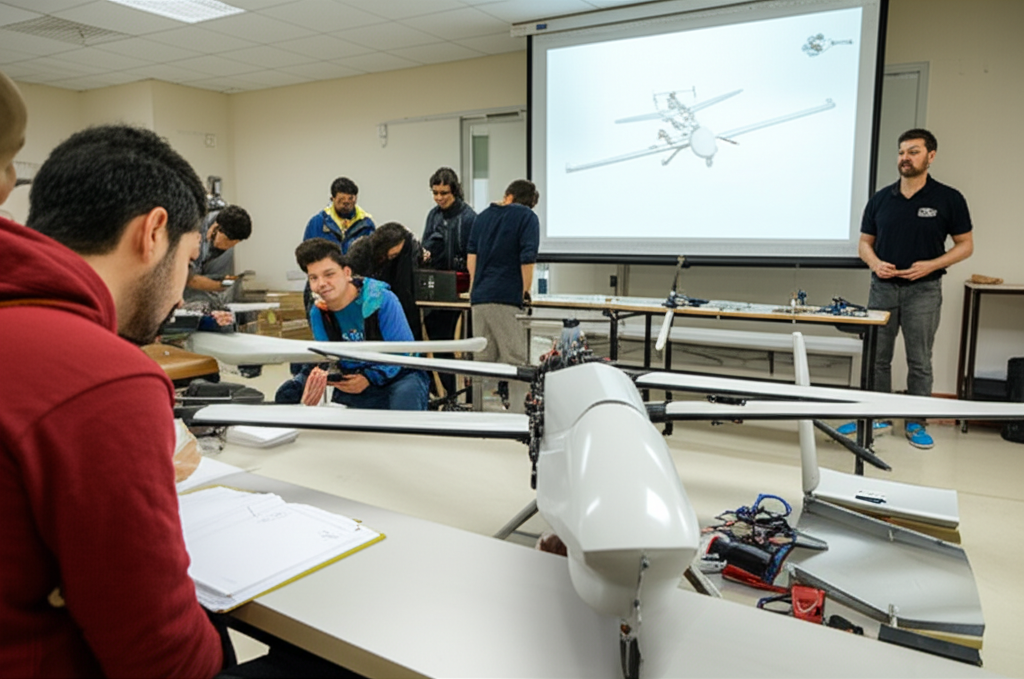
Fixed-wing drone course
- Format: Hybrid
- Duration: 3 months
- Hours: 300 H
- Language: English / Spanish
- Registration date: 23-10-2026
- Start date: 12-12-2026
- Available places: 2
249 $
Competencies and results
What you will learn
1. Flight Mastery and Operations of Fixed-Wing Drones
- Planning and execution of missions with fixed-wing drones, including route and point of interest selection.
- Configuration and calibration of flight systems, including flight control, GPS, and inertial navigation systems (INS).
- Advanced piloting techniques, such as takeoffs and landings in adverse conditions, formation flying, and special maneuvers.
- Acquisition and analysis of aerial data using specialized sensors, such as multispectral cameras and LiDAR.
- Legislation and regulations applicable to fixed-wing drone flight, including permits, restrictions, and safety.
- Preventive and corrective maintenance of fixed-wing drones, including the identification and resolution of common problems.
- Techniques for analyzing data obtained by fixed-wing drones, including image processing and 3D model generation.
- Operations in diverse environments and weather conditions, including wind, rain, and low visibility.
- Communication and radiocommunications applied to fixed-wing drone operations, including the use of frequencies and protocols.
- Specific applications of fixed-wing drones in various industries, such as agriculture, infrastructure inspection, and surveillance.
2. Design, Construction and Optimization of Fixed-Wing Drones
- Detailed aerodynamic design of fixed-wing drones, including airfoil selection and performance analysis.
- Construction of fixed-wing drones using advanced composite materials (carbon fiber, fiberglass) and manufacturing techniques.
- Principles of flight stability and control, including the design of control surfaces and automatic flight control systems (autopilot).
- Selection and integration of propulsion systems (electric motors, propellers) and power management (batteries, charging systems).
- Design and optimization of the drone’s structure to withstand aerodynamic and environmental loads, using finite element analysis (FEA).
- Navigation, flight planning, and remote control, including the use of GPS, inertial sensors, and communication systems.
- Legislation and regulations applicable to the operation of fixed-wing drones, including safety considerations and Responsibility.
Design optimization to improve energy efficiency, range, and flight autonomy.
Integration of payloads (cameras, sensors) and data acquisition systems.
Analysis and mitigation of risks related to drone flight, including component failures and adverse weather conditions.
3. Comprehensive user-oriented design and validation (from modeling to manufacturing)
You will learn to integrate the entire product development process, from initial model conception to final validation, applying user-centered methodologies. You will develop skills in parametric design, ergonomics, simulation, sustainable materials, 3D visualization, and manufacturing management, ensuring efficient, safe solutions that meet current industry standards.
4. Navigation, Planning and Execution of Fixed-Wing Missions
- Principles of air and maritime navigation applied to fixed-wing aircraft.
- Detailed planning of air missions, including the selection of optimal routes, altitude, and speed.
- Mapping techniques and use of navigation instruments.
- Dead reckoning, radio navigation, and satellite navigation (GNSS) procedures.
- Interpretation and application of aeronautical and maritime navigation charts.
- Aeronautical and maritime communication techniques, including the use of radio and other communication systems.
- Execution of flight missions, including takeoff, landing, and in-flight navigation.
- Adaptation to different weather conditions and their impact on navigation and flight planning.
- Crew resource management and decision-making in emergency situations.
- Aircraft safety concepts and maritime, including accident prevention and risk management.
Application of aviation and maritime navigation regulations and standards.
5. Evaluation and Calibration of Fixed-Wing Systems
- Identify and evaluate the failure modes associated with aerodynamic couplings in fixed-wing systems, including flap-lag-torsion, whirl flutter, and the effects of fatigue on critical components.
- Apply finite element analysis (FEA) and dimensioning techniques to fixed-wing structures made of composite materials, paying particular attention to laminate design, structural joint types, and bonded joints.
- Integrate and apply damage tolerance methodologies, including the use of non-destructive testing (NDT) such as ultrasonic testing (UT), radiography (RT), and thermography, for the inspection and evaluation of the structural integrity of fixed wings.
6. Optimization and Management of Propulsion Systems for Fixed-Wing Drones
- Identify and understand the fundamental principles of propulsion systems for fixed-wing drones.
- Evaluate and optimize the efficiency of the motors and propellers used in drones.
- Analyze the different types of propulsion systems, including internal combustion and electric motors.
- Diagnosticate and troubleshoot common problems in propulsion systems, such as motor or propeller failures.
- Manage and maintain propulsion systems to ensure their optimal performance and durability.
- Understand the regulations and standards applicable to drone propulsion systems.
- Apply optimization techniques to maximize drone performance and flight autonomy.
- Use simulation tools and specialized software for the analysis and design of propulsion systems.
- Integrate propulsion systems with other drone components.
drone, such as avionics and control systems.
Evaluate the environmental impact of propulsion systems and consider sustainable options.
Design and build custom propulsion systems for fixed-wing drones.
Perform tests and performance evaluations of propulsion systems.
Analyze flight data to identify areas for improvement in propulsion system performance.
Maintain accurate records of propulsion system maintenance and repair activities.
Adapt propulsion systems to different flight conditions and operating environments.
Understand the safety aspects related to drone propulsion systems.
Apply project management methodologies for the development and implementation of propulsion systems.
Collaborate with multidisciplinary teams for the design and integration of systems. propulsion.
Stay up-to-date with the latest trends and advancements in drone propulsion systems technology.
Develop problem-solving skills to identify and resolve complex issues in propulsion systems.
Who this program is for:
Fixed-wing drone course
- Graduates in Aerospace Engineering, Mechanical Engineering, Industrial Engineering, Automation Engineering, or related fields.
- Professionals in OEM rotorcraft/eVTOL, MRO, consulting, and technology centers.
- Flight Testing, certification, avionics, control, and dynamics seeking specialization.
- Regulators/authorities and UAM/eVTOL professionals requiring compliance skills.
Recommended qualifications: based in Aerodynamics, control and structures; ES/EN B2+/C1. We offer bridging tracks if you need them.
- Standards-driven curriculum: you will work with CS-27/CS-29, DO-160, DO-178C/DO-254, ARP4754A/ARP4761, ADS-33E-PRF from the first module.
- Accreditable laboratories (EN ISO/IEC 17025) with rotor bench, EMC/Lightning pre-compliance, HIL/SIL, vibrations/acoustics.
- Evidence-oriented TFM: safety case, test plan, compliance dossierand operational limits.
- Mentored by industry: teachers with experience in rotorcraft, tiltrotor, eVTOL/UAM and flight test.
- Flexible modality (hybrid/online), international cohorts and support from SEIUM Career Services.
- Ethics and security: safety-by-design approach, cyber-OT, DIH and compliance as pillars.
1.1 Fundamentals of Fixed-Wing Aerodynamics
1.2 Principles of Stability and Control in Drones
1.3 Key Components of a Fixed-Wing Drone: Structure, Systems, and Sensors
1.4 Ground Station Configuration and Calibration
1.5 Safe Takeoff and Landing Procedures
1.6 Manual and Assisted Flight Techniques
1.7 Operations in Controlled and Restricted Environments
1.8 Safety and Risk Prevention Protocols
1.9 Aviation Legislation Applicable to Fixed-Wing Drones
1.10 Flight Practice: Exercises and Simulations
2.2 Fundamentals of Fixed-Wing Design: Aerodynamics, Structures, and Materials
2.2 Component Selection and Sizing: Wings, Fuselage, Stabilizers
2.3 Computer-Aided Design (CAD) for Fixed-Wing Drones
2.4 Manufacturing and Assembly of Fixed-Wing Drones: Methods and Techniques
2.5 Engine and Propeller Selection: Efficiency and Performance
2.6 Flight Control and Autopilot Systems: Integration and Configuration
2.7 Power and Energy Management Systems: Batteries and Electronics
2.8 Wind Tunnel Testing and CFD Simulation
2.9 First Flight and Design Adjustments
2.20 Design for Durability and Maintenance
3.3 Fundamental Principles of Fixed-Wing Flight
3.2 Legislation and Regulations for Drone Operations
3.3 Meteorology and its Effects on Drone Flight
3.4 Components and Systems of a Fixed-Wing Drone
3.5 Safety in Drone Operations
3.6 Takeoff and Landing Techniques
3.7 Flight in Different Environments and Conditions
3.8 Flight Planning and Telemetry Software
3.9 Communication and Remote Control Protocols
3.30 Troubleshooting and Emergency Situations
4.4 Fundamentals of Fixed-Wing Mission Planning: Key Concepts and Terminology
4.2 Target Selection and Areas of Interest: Definition and Prioritization
4.3 Data Collection and Environmental Analysis: Meteorology, Obstacles, and Constraints
4.4 Flight Route Design: Waypoint Planning and Trajectory Optimization
4.5 Safety Considerations: Contingency Planning and Risk Management
4.6 Flight Planning Software: Using Tools and Applications
4.7 Communication and Data Link Protocols: Establishment and Maintenance
4.8 Legal and Regulatory Aspects: Compliance with Regulations and Permits
4.9 Mission Simulation and Validation Practices: Pre-Flight Testing
4.40 Mission Execution and Control: Standard Operating Procedures
5.5 Principles of Fixed-Wing Flight: Lift, Drag, Thrust, and Weight
5.5 Components and Systems of Fixed-Wing Aircraft: Fuselage, Wings, Tail, Flight Controls, Landing Gear
5.3 Fixed-Wing Configuration and Design: Wing Types, Wingspan, Aspect Ratio, Dihedral
5.4 Fixed-Wing Engines and Propulsion Systems: Internal Combustion and Electric Engines
5.5 Flight Controls and Control Surfaces: Ailerons, Rudder, Elevator
5.6 Flight Instrumentation: Airspeed, Altitude, Heading, and Attitude Indicators
5.7 Flight Operations: Takeoff, Climb, Cruise, Descent, and Landing
5.8 Human Factors in Aviation: Situational Awareness and Decision Making
5.9 Aviation Law and Regulations
5.50 Safety in Fixed-Wing Drone Operations
6.6 Internal Combustion vs. Electric Engines: A Comparison of Propulsion Systems
6.2 Propeller and Engine Selection and Sizing
6.3 Energy Management Systems: Batteries and Thermal Management
6.4 Powerplant Design and Configuration: Optimization for Efficiency and Performance
6.5 Aircraft Fuels and Alternative Fuels
6.6 Propulsion Control Systems: Governors and Power Management
6.7 Testing and Calibrating Fixed-Wing Propulsion Systems
6.8 Propulsion System Maintenance and Troubleshooting
6.9 Integrating Propulsion Systems with Avionics
6.60 Future Trends in Propulsion for Fixed-Wing Drones
- Hands-on methodology: test-before-you-trust, design reviews, failure analysis, compliance evidence.
- Software (depending on licenses/partners): MATLAB/Simulink, Python (NumPy/SciPy), OpenVSP, SU2/OpenFOAM, Nastran/Abaqus, AMESim/Modelica, acoustics tools, planning toolchains DO-178C.
- SEIUM Laboratories: scale rotor bench, vibrations/acoustics, EMC/Lightning pre-compliance, HIL/SIL for AFCS, data acquisition with strain gauging.
- Standards and compliance: EN 9100, 17025, ISO 27001, GDPR.
Capstone-type projects
- Flight Data Analysis: Identifying areas for improvement in performance and efficiency.
- Modeling and Simulation: Creating predictive models for aerodynamic optimization and fuel consumption.
- Field Testing: Validating improvements through testing and post-flight data analysis.
- Technical Report: Documenting findings, methodologies, and recommendations.
- Design and Analysis: CFD modeling for aerodynamic optimization; flight simulation and validation.
- Control Systems: Autopilot development; flight testing and fine-tuning.
- Performance and Efficiency: Flight data analysis; energy consumption optimization.
“`html
- Flight Evaluation: Flight data analysis, route optimization, and fuel efficiency.
- Sensor Integration: Flight and sensor data analysis for mission optimization.
- Simulation and Testing: Advanced simulations and testing to improve fixed-wing performance.
“`
- Performance Optimization: Aerodynamic and structural analysis; flight testing and simulation; parameter tuning.
- Flight Management: Autonomy, routes, sensors; data and telemetry evaluation; failure analysis.
- Continuous Improvement: Iterative design; systems integration; overall performance optimization.
Admissions, fees, and scholarships
- Profile: Background in Computer Engineering, Mathematics, Statistics, or related fields; practical experience in NLP and valued information retrieval systems.
- Documentation: Updated CV, academic transcript, SOP/statement of purpose, project examples or code (optional).
- Process: Application → Technical evaluation of profile and experience → Technical interview → Review of case studies → Final decision → Enrollment.
- Fees:
- Single payment: 10% discount.
- Payment in 3 installments: No fees; 30% upon registration + 2 equal monthly payments of the remaining 35%.
Monthly payment: available with a 7% commission on the total; annual review.
Scholarships: based on academic merit, financial need, and promoting inclusion; agreements with companies in the sector for partial or full scholarships.
See “Calendar & Calls for Applications,” “Scholarships & Grants,” and “Fees & Financing” in the SEIUM mega-menu.
Do you have any questions?
Our team is ready to help you. Contact us, and we will respond as soon as possible.
F. A. Q
Frequently asked questions
Yes, we have international certification
Yes: experimental models, real data, applied simulations, professional environments, real case studies.
It is not mandatory. We offer leveling tracks and tutoring.
Completely. It covers e-propulsion, integration, and emerging regulations (SC-VTOL).
Recommended. There are also internal challenges and consortiums.
Yes. Online/hybrid modality with planned labs and visa support (see “Visa & Residence”).