

FAA Part 107 course for drones
About our
The FAA Part 107 Drone Course prepares participants to obtain drone pilot certification under the Federal Aviation Administration (FAA) regulations. This course covers essential knowledge of flight regulations, aviation safety, meteorology, navigation, aeronautical chart interpretation, and drone operations. It emphasizes safety and compliance with regulations for aerial operations, including crucial aspects of flight preparation and mission planning.
The program ensures that participants understand the importance of safety, the responsibility of drone operation, and applicable laws. The training provides the necessary preparation to pass the FAA exam, enabling individuals to operate drones commercially. It also includes instruction on flight hazards, human factors, and emergency situations, fostering the competence and confidence of drone pilots.
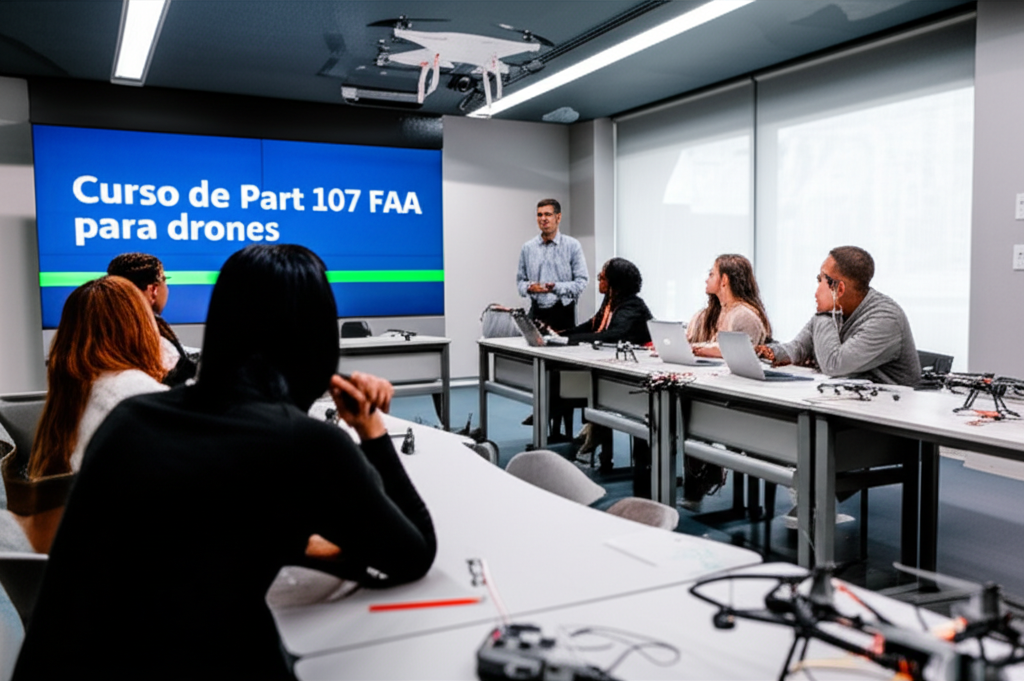
FAA Part 107 course for drones
- Format: Hybrid
- Duration: 3 months
- Hours: 300 H
- Language: English / Spanish
- Registration date: 23-10-2026
- Start date: 12-12-2026
- Available places: 3
425 $
Competencies and results
What you will learn
1. Complete Mastery of the FAA Part 107 Drone Exam.
- Understand FAA regulations for operating drones safely and legally.
- Master the key concepts covered in Part 107 of the Exam, including:
- FAA Regulations.
- Registration and Certification Requirements.
- Operating Procedures.
- Weather Conditions.
- Aircraft Performance.
- Human Factors.
- Operational Safety.
- Risk Management.
- Pass the FAA Part 107 Exam.
- Acquire the knowledge necessary to obtain drone pilot certification.
- Operate drones responsibly and efficiently.
- Navigate
- Safely navigate the airspace.
- Understand the limitations of drones and how to overcome them.
- Apply the knowledge gained in real-world situations.
- Stay up-to-date on the latest regulations and advancements in drone technology.
2. Pass Exam Part 107: Pilot Drones Legally and Successfully.
- Understand Federal Aviation Administration (FAA) regulations for operating drones commercially.
- Master essential aeronautical terminology for drone operation, including unmanned aircraft system (UAS) classification and specific regulations (Part 107).
- Analyze weather conditions and their impact on drone flight, including interpreting reports and forecasts.
- Study safety procedures for drone operation, including accident prevention and emergency management.
- Learn to plan flights safely and efficiently, considering factors such as airspace, obstacles, and lines of sight.
- Understand drone flight navigation and control systems, including GPS and positioning systems.
- Prepare for the FAA Part 107 exam, including practice with sample questions and simulations.
- Understand the responsibilities of the Pilot in Command (PIC) and the limitations of drone operation.
- Explore the different applications of drones in various sectors, such as agriculture, construction, and inspection.
- Become familiar with best practices for drone operation and equipment maintenance.
3. Comprehensive user-oriented design and validation (from modeling to manufacturing)
You will learn to integrate the entire product development process, from initial model conception to final validation, applying user-centered methodologies. You will develop skills in parametric design, ergonomics, simulation, sustainable materials, 3D visualization, and manufacturing management, ensuring efficient, safe solutions that meet current industry standards.
4. Comprehensive Preparation for FAA Part 107 Certification: Drone Flight and Operation.
4. Comprehensive Preparation for FAA Part 107 Certification: Drone Flight and Operation
Mastery of Aviation Law: Gain a thorough understanding of FAA Part 107, including regulations, operational limitations, and remote pilot responsibilities.
Navigation and Flight Planning: Learn to interpret aeronautical charts, calculate safe routes, altitudes, and distances, and plan efficient and safe flight missions.
Aeronautical Meteorology: Acquire knowledge of weather conditions, interpret weather reports, and how they affect drone flight.
Technical Knowledge of Drones: Become familiar with the structure, components, control systems, maintenance, and operation of different types of drones.
Flight Safety: Apply rigorous safety practices, including pre-flight inspections, risk assessment, and emergency procedures.
Special Operations: Understand operations in controlled airspace, emergency handling, and operations in diverse environments.
Aerial Photography and Videography: Learn basic photography and videography techniques to capture high-quality images with drones.
FAA Part 107 Exam: Intensive exam preparation, including mock exams and review of all key topics.
Communications and Radio: Master radio communication procedures, including communication with air traffic controllers.
5. Become a Certified Drone Pilot Part 107: Master the Sky and Air Law.
5. **Become a Part 107 Certified Drone Pilot: Master the Skies and Air Law**
In this comprehensive course, you will prepare to obtain your Federal Aviation Administration (FAA) Part 107 certification and become a competent and safe drone pilot. You will learn to:
1. **Drone Aviation Fundamentals:**
* Understand key aviation terminology and concepts, specifically as applied to drones (UAS).
* Become familiar with different airspace classes and how to legally navigate them.
* Identify and mitigate the risks associated with drone flight.
2. **Applicable Air Law:**
* Master FAA Part 107 regulations, including rules of operation, restrictions, and exemptions.
* Interpret and apply federal and local laws related to drone flight. * Understand the responsibilities and obligations of a certified drone pilot.
3. **Meteorology for Drone Pilots:**
* Interpret weather reports and forecasts to make safe flight decisions.
* Understand the climatic factors that affect drone performance and safety.
* Evaluate the impact of wind, visibility, temperature, and humidity on flight operations.
4. **Drone Operations and Procedures:**
* Plan safe and efficient flight missions.
* Conduct pre-flight inspections and verify the aircraft’s condition.
* Operate drones safely and responsibly in different environments.
* Implement emergency and incident response procedures.
5. **Aircraft Performance and Limitations:**
* Understand the performance of different types of drones.
* Understand the operational limits of drones.
* Calculate weight and balance.
6. **Air Safety:**
* Implement safety protocols to prevent accidents and collisions.
* Communicate effectively with other pilots and air traffic control (when necessary).
* Maintain a safe and aware flight environment.
7. **Maintenance and Operations:**
* Perform basic maintenance and troubleshoot drones.
* Manage battery power and ensure uninterrupted operations.
* Record and maintain accurate flight logs.
8. **Technical Aspects of Drones:**
* Familiarize yourself with drone technology, including flight control systems, GPS, and sensors.
* Understand how drones operate and how they communicate with the pilot and ground support systems.
* Explore the different applications of drones in various industries.
9. **Part 107 Exam Preparation:**
* Review and refresh the key topics covered in the course.
* Take practice exams to familiarize yourself with the exam format and content.
* Develop effective strategies to pass the Part 107 exam and earn your certification.
10. **Real-World Applications:**
* Explore the diverse uses of drones in industries such as agriculture, construction, filmmaking, and more.
* Understand the business opportunities and regulations related to commercial drone operations.
6. Pass the FAA Part 107 Exam: Master Guide for Successful Drone Pilots.
6. Pass the FAA Part 107 Exam: A Master Guide for Successful Drone Pilots
- Part 107 Exam Fundamentals: Learn the structure, key topics, and requirements for passing the FAA exam.
- FAA Regulations: Understand the rules and laws governing drone operations in U.S. airspace.
- Meteorology: Learn to interpret weather reports, forecasts, and how weather conditions affect drone flights.
- Air Navigation: Master the principles of navigation, including map reading, route planning, and hazard identification.
- Flight Procedures: Become familiar with standard operating procedures, including communicating with air traffic controllers and responding to incidents. to emergencies.
- Human Factors: Understand how human factors, such as stress and fatigue, can affect the safety of drone flights.
- Aircraft Performance: Learn about the performance limits of drones, including maximum takeoff weight, speed, and altitude.
- Airspace Operations: Learn how to operate drones in different types of airspace, including controlled, uncontrolled, and special airspace.
- Operational Safety: Master essential safety practices, including pre-flight inspection, risk mitigation, and emergency response.
- Legislation and Regulations: Delve into the specific laws and regulations governing drone operations, including privacy, ownership, and insurance.
Who this program is for:
FAA Part 107 course for drones
- Drone pilots and operators who wish to obtain FAA Part 107 certification.
- Individuals interested in starting a professional career in the drone industry.
- Business owners and entrepreneurs looking to use drones for their business operations.
- Professionals in sectors such as agriculture, construction, inspection, and photography who wish to incorporate the use of drones into their work.
- Standards-driven curriculum: you will work with CS-27/CS-29, DO-160, DO-178C/DO-254, ARP4754A/ARP4761, ADS-33E-PRF from the first module.
- Accreditable laboratories (EN ISO/IEC 17025) with rotor bench, EMC/Lightning pre-compliance, HIL/SIL, vibrations/acoustics.
- Evidence-oriented TFM: safety case, test plan, compliance dossierand operational limits.
- Mentored by industry: teachers with experience in rotorcraft, tiltrotor, eVTOL/UAM and flight test.
- Flexible modality (hybrid/online), international cohorts and support from SEIUM Career Services.
- Ethics and security: safety-by-design approach, cyber-OT, DIH and compliance as pillars.
1.1 Aviation Legislation: Laws and regulations applicable to drones.
1.2 Airspace Structure: Airspace classification and control.
1.3 FAA Part 107 Regulations: Requirements and restrictions for operating drones.
1.4 Fundamental Aerodynamics: Basic principles of flight and lift.
1.5 Drone Components: Identification and function of drone parts.
1.6 Human Factors: Safety and error prevention in operation.
1.7 Basic Meteorology: Interpretation of weather reports and their impact on flight.
1.8 Navigation and Flight Planning: How to plan safe flight missions.
1.9 Detection and Avoidance Systems: Safety and technology considerations.
1.10 Emergency Procedures: How to act in the event of failures and critical situations.
2.2 Earth’s Atmosphere: Layers and Characteristics
2.2 Atmospheric Pressure: Concepts and Measurements
2.3 Temperature: Factors and Variations
2.4 Humidity: Cloud Formation and Precipitation
2.5 Winds: Causes, Patterns, and Effects on Flight
2.6 Air Masses and Fronts: Identification and Prediction
2.7 Weather Systems: Lows, Highs, and Storms
2.8 Meteorological Information: Sources and Interpretation (METAR, TAF, etc.)
2.9 Effects of Weather on Drone Flight: Risks and Mitigation
2.20 Aviation Safety: Decision Making and Meteorological Planning
3.3 Federal Aviation Regulations Part 307: Fundamentals and Scope
3.2 Airspace Classification and Structure according to the FAA
3.3 Restrictions and Exceptions: Drone Operations
3.4 Visibility, Weather Conditions, and Visual Flight
3.5 Flight Rules and Maneuvers: How to Operate Safely
3.6 Responsibilities of the Pilot in Command and Remote Crew
3.7 Emergencies and Flight Safety Procedures
3.8 Drone Inspection and Maintenance: Regulatory Compliance
3.9 Rights and Obligations: Applicable Aviation Law
3.30 Required Documentation and Flight Logs
4.4 Flight Planning: Key Factors
4.2 FAA Regulations for Drone Operations
4.3 Meteorology for Drone Pilots
4.4 GPS Navigation and Positioning
4.5 Emergency Procedures and Air Safety
4.6 Airspace Limitations and Permits
4.7 Operations in Different Environments: Rural, Urban, etc.
4.8 Pre-flight Inspection and Drone Maintenance
4.9 Specific Legislation and Regulations
4.40 Case Studies: Analysis of Real Operations
5.5 Aviation Laws and Regulations
5.5 Airspace Structure
5.3 Flight Restrictions
5.4 Aeronautical Meteorology
5.5 Aircraft Performance and Limitations
5.6 Human Factors
5.7 Operating Procedures
5.8 Aviation Safety
5.9 Navigation and Cartography
5.50 Remote Flight and Drone Technologies
6.6 Effective Study Strategies
6.2 Time Management During the Exam
6.3 Identifying and Analyzing Trick Questions
6.4 Mock Exams and Feedback
6.5 Memorization and Recall Techniques
6.6 Staying Calm and Focused
6.7 Analyzing the Most Challenging Areas of the Exam
6.8 Additional Resources and Support Tools
6.9 Planning for Success: Before, During, and After the Exam
6.60 Final Tips for Passing
- Hands-on methodology: test-before-you-trust, design reviews, failure analysis, compliance evidence.
- Software (depending on licenses/partners): MATLAB/Simulink, Python (NumPy/SciPy), OpenVSP, SU2/OpenFOAM, Nastran/Abaqus, AMESim/Modelica, acoustics tools, planning toolchains DO-178C.
- SEIUM Laboratories: scale rotor bench, vibrations/acoustics, EMC/Lightning pre-compliance, HIL/SIL for AFCS, data acquisition with strain gauging.
- Standards and compliance: EN 9100, 17025, ISO 27001, GDPR.
Capstone-type projects
- Professional Aerial Inspection: Infrastructure Analysis with Drones (Bridges, Buildings).
- Aerial Mapping and Topography: Creation of Precise 3D Models and Maps with Drones.
- Aerial Photography and Videography: Production of High-Quality Audiovisual Content with Drones.
- Precision Agriculture: Crop Monitoring and Plant Health Analysis with Drones.
- Part 107 Domain: Drills, aviation legislation, meteorology.
- Flight Planning: Mapping, NOTAMs, airspace, safety.
- Drone Operations: Inspection, photography, filming, agriculture, construction.
- Risk Assessment: Hazard mitigation, site safety, communication.
- Flight Planning: Routes, NOTAMs, meteorology, airspace.
- Drone Operations: Inspections, photography, mapping, safety.
- Legislation and Regulations: Part 107, registration, liability.
- Risk Analysis: Mitigation, emergency procedures.
- Exam Simulations: Practice, review, final assessment.
- Autonomous Piloting: Route design and simulation; obstacle avoidance; flight data analysis.
- Aircraft Law: Creation of operating manuals; Part 107 regulatory compliance; safety audits.
- Maintenance and Repair: Tool selection; troubleshooting; drone fleet management.
Admissions, fees, and scholarships
- Profile: Background in Computer Engineering, Mathematics, Statistics, or related fields; practical experience in NLP and valued information retrieval systems.
- Documentation: Updated CV, academic transcript, SOP/statement of purpose, project examples or code (optional).
- Process: Application → Technical evaluation of profile and experience → Technical interview → Review of case studies → Final decision → Enrollment.
- Fees:
- Single payment: 10% discount.
- Payment in 3 installments: No fees; 30% upon registration + 2 equal monthly payments of the remaining 35%.
Monthly payment: available with a 7% commission on the total; annual review.
Scholarships: based on academic merit, financial need, and promoting inclusion; agreements with companies in the sector for partial or full scholarships.
See “Calendar & Calls for Applications,” “Scholarships & Grants,” and “Fees & Financing” in the SEIUM mega-menu.
Do you have any questions?
Our team is ready to help you. Contact us, and we will respond as soon as possible.
F. A. Q
Frequently asked questions
Yes, we have international certification
Yes: experimental models, real data, applied simulations, professional environments, real case studies.
It is not mandatory. We offer leveling tracks and tutoring.
Completely. It covers e-propulsion, integration, and emerging regulations (SC-VTOL).
Recommended. There are also internal challenges and consortiums.
Yes. Online/hybrid modality with planned labs and visa support (see “Visa & Residence”).