

Drone course for urban delivery
About our
The Urban Delivery Drone Course focuses on training participants to operate and manage drone delivery systems in urban environments. It covers route planning, current legislation, and the maintenance of unmanned aerial vehicles (UAVs). The course includes the study of sensors, telemetry, and air safety, preparing participants to develop efficient and safe operations by integrating GPS technology and anti-collision systems. It emphasizes the application of knowledge to last-mile logistics and drone fleet optimization.
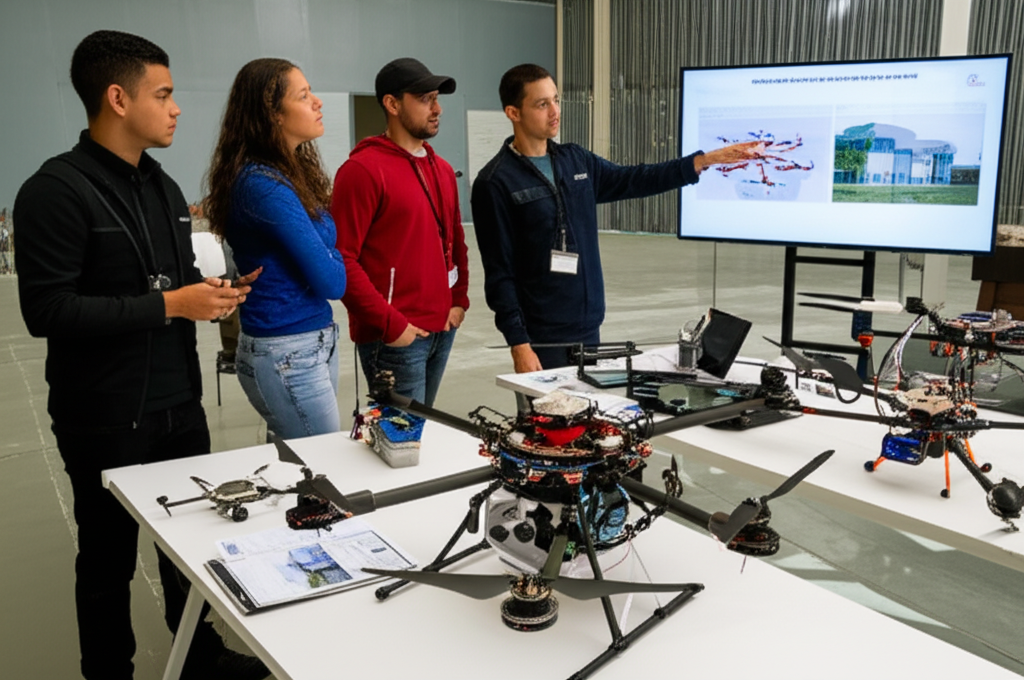
The course offers hands-on experience in flight simulators and the operation of commercial drones. Students learn to use flight planning software and analyze performance data. The goal is to train drone pilots, fleet managers, and maintenance technicians, contributing to the growth of the drone delivery industry and complying with aviation regulations.
Drone course for urban delivery
- Format: Hybrid
- Duration: 3 months
- Hours: 300 H
- Language: English / Spanish
- Registration date: 23-10-2026
- Start date: 12-12-2026
- Available places: 3
780 $
Competencies and results
What you will learn
1. **Route Optimization and Delivery Management with Urban Drones**
-
Plan and design optimized flight routes for drone deliveries, considering factors such as distance, air traffic, urban obstacles, and legal restrictions.
-
Use specialized software and route planning tools to simulate and evaluate different scenarios, selecting the most efficient and safe route.
-
Implement drone-based delivery management systems, including real-time tracking, flight scheduling, payload management, and customer coordination.
-
Apply optimization techniques to minimize operating costs, maximize efficiency, and reduce delivery time in urban environments.
-
Understand current regulations and standards related to drone flights in urban areas, ensuring legal compliance and operational safety.
Evaluate and select the most suitable types of drones and equipment for delivery operations, considering payload capacity, flight autonomy, and environmental conditions.
Manage the logistics of drone deliveries, including the storage, packaging, and transport of products, ensuring their integrity and security.
Analyze the risks associated with drone delivery operations, such as accidents, technical failures, and interference, implementing mitigation and prevention measures.
Develop strategies for communication and interaction with clients, providing accurate information on the status of deliveries and resolving any problems or concerns.
Explore the latest trends and advancements in drone technology and urban delivery management, identifying opportunities for innovation and continuous improvement.
2. **Autonomous Navigation and Air Logistics for Efficient Deliveries**
- Master the fundamentals of autonomous navigation, including Global Positioning Systems (GNSS), inertial sensors, and data fusion algorithms.
- Understand the principles of optimized air route planning for deliveries, considering airspace restrictions, obstacles, and weather conditions.
- Study air logistics management, encompassing inventory management, shipment tracking, route optimization, and coordination with drone and other aerial vehicle operators.
- Analyze the regulations and standards related to the operation of unmanned aircraft (UAVs) and air delivery in different jurisdictions.
- Apply risk and safety analysis techniques to ensure the safe and efficient operation of air delivery systems.
- Explore emerging technologies in the field of air delivery, such as artificial intelligence (AI), machine learning, and robotics, and their impact on efficiency and sustainability.
- Evaluate the economic and environmental viability of air delivery solutions, considering factors such as operating costs, carbon footprint, and community impact.
- Develop practical skills in using simulation and route planning software to optimize air delivery operations.
- Understand the challenges and opportunities of integrating air delivery into the existing transportation system, including collaboration with logistics companies and regulatory authorities.
3. Comprehensive user-oriented design and validation (from modeling to manufacturing)
You will learn to integrate the entire product development process, from initial model conception to final validation, applying user-centered methodologies. You will develop skills in parametric design, ergonomics, simulation, sustainable materials, 3D visualization, and manufacturing management, ensuring efficient, safe solutions that meet current industry standards.
4. **Analysis and Simulation of Drone Delivery Systems**
4. **Analysis and Simulation of Drone Delivery Systems**
Identify and evaluate the critical components of drone delivery systems.
Understand the aerodynamics and flight dynamics of drones.
Model and simulate drone performance in different delivery scenarios.
Analyze the influence of external factors such as wind and payload on flight stability and efficiency.
Study optimal route planning techniques for drone delivery, considering geographical and operational constraints.
Evaluate the control and navigation systems used in drones to ensure accurate and safe delivery.
Analyze and simulate propulsion and power systems, including flight efficiency and autonomy.
Explore the regulations and standards related to drone operation for goods delivery.
Apply simulation tools and specialized software for the analysis of drone delivery systems.
Evaluate the economic feasibility and benefits of implementing drone delivery systems in different industries.
5. **Drone Delivery Strategies: Planning and Execution in Urban Environments**
5. **Drone Delivery Strategies: Planning and Execution in Urban Environments**
- Design safe and efficient flight routes, considering current regulations and the specific risks of the urban environment.
- Select and configure suitable drones for delivery, evaluating factors such as payload capacity, autonomy, and resistance to environmental conditions.
- Implement air traffic management systems for drones, including the coordination of multiple devices and collision avoidance.
- Develop safety protocols for drone operations in urban areas, addressing aspects such as privacy, data protection, and emergency response.
- Analyze and mitigate the risks associated with drone delivery, including assessing impacts on infrastructure, public safety, and regulatory compliance.
- Optimize drone delivery processes, from receiving and preparing packages to The final delivery to the recipient.
Use simulation and modeling tools to evaluate the performance of drone delivery operations in different urban scenarios.
Understand the legal and regulatory aspects governing drone operations in urban environments, including permits, licenses, and flight limitations.
Explore current and future trends in drone technology and its application in goods delivery.
Apply project management principles to plan, execute, and control large-scale drone delivery projects.
6. **Analysis of Critical Components and Flight Dynamics in Delivery Drones**
6. **Analysis of Critical Components and Flight Dynamics in Delivery Drones**
- Identify and evaluate aerodynamic and structural couplings, including flap-lag-torsion, that influence flight stability and control.
- Understand and mitigate the risk of aeroelastic instabilities such as whirl flutter, which can compromise structural integrity.
- Analyze the fatigue resistance of critical components, predicting structural failures due to cyclic loading.
- Apply structural dimensioning and design techniques to composite structures to optimize the strength-to-weight ratio.
- Evaluate the strength and durability of bonded joints and structural connections using finite element (FE) analysis.
- Implement damage tolerance methodologies to ensure operational safety in the face of potential structural damage.
- Apply non-destructive testing (NDT) techniques, such as ultrasonic testing (UT), radiography (RT), and thermography, for the inspection and evaluation of component integrity.
Who this program is for:
Drone course for urban delivery
- Professionals with experience in areas such as logistics, transportation, and urban distribution, interested in implementing drones for delivery.
- Entrepreneurs and startups focused on the development and operation of drone delivery services, seeking to acquire specific knowledge.
- Technicians and staff from courier and parcel delivery companies who wish to update their skills and adapt to new delivery technologies.
- Commercial drone pilots seeking to expand their knowledge and obtain specialized certifications in urban delivery.
- Standards-driven curriculum: you will work with CS-27/CS-29, DO-160, DO-178C/DO-254, ARP4754A/ARP4761, ADS-33E-PRF from the first module.
- Accreditable laboratories (EN ISO/IEC 17025) with rotor bench, EMC/Lightning pre-compliance, HIL/SIL, vibrations/acoustics.
- Evidence-oriented TFM: safety case, test plan, compliance dossierand operational limits.
- Mentored by industry: teachers with experience in rotorcraft, tiltrotor, eVTOL/UAM and flight test.
- Flexible modality (hybrid/online), international cohorts and support from SEIUM Career Services.
- Ethics and security: safety-by-design approach, cyber-OT, DIH and compliance as pillars.
1. 1 Route Optimization for Urban Drones: Algorithms and Metrics
2. 2 Strategic Planning of Drone Deliveries: Analysis of Urban Constraints
3. 3 Drone Fleet Management: Real-Time Monitoring and Control
4. 4 Design of Delivery Zones and Takeoff/Landing Points
5. 5 Integration with Order Management and Logistics Systems
6. 6 Urban Air Traffic Modeling and Flight Safety
7. 7 Cost-Benefit Analysis of Drone Delivery
8. 8 Case Study: Implementation of Efficient Routes in Real-World Environments
9. 9 Legal and Regulatory Aspects of Route Planning
10. 10 Emerging Technologies for Drone Route Optimization
2.2 Autonomous Navigation Systems: Principles and Technologies
2.2 Sensors and Perception Systems: LiDAR, Cameras, GPS
2.3 Route Planning and Autonomous Flight Management
2.4 Flight Control and Drone Stabilization
2.5 Obstacle Avoidance Algorithms
2.6 Real-Time Communication and Data Link
2.7 Air Traffic Management and Coordination of Multiple Drones
2.8 Simulation and Testing of Autonomous Navigation Systems
2.9 Failures and Contingencies: Backup and Safety Systems
2.20 Case Studies: Implementing Autonomous Navigation in Different Delivery Scenarios
3.3 Aircraft Design for Delivery: Drone Configuration and Aerodynamics
3.2 Component Selection: Motors, Propellers, Control Systems
3.3 Propulsion Systems: Batteries, Power Management
3.4 Airframe Design: Materials, Strength, Weight
3.5 Payload and Capacity: Cargo Compartment Design
3.6 Landing and Takeoff Station Design
3.7 Flight Route Planning: Software and Management Systems
3.8 Drone Operation: Safety and Maintenance Procedures
3.9 Legal and Regulatory Aspects: Regulatory Compliance
3.30 System Integration: Design Testing and Validation
4.4 Modeling and Simulation of Drone Delivery Systems: Introduction
4.2 Route Simulation and Flight Planning
4.3 Urban Environment Modeling: Obstacles and Weather Conditions
4.4 Performance Analysis: Payload, Distance, and Delivery Time
4.5 Collision Simulation and Operational Safety
4.6 Route Optimization: Routing Algorithms and Techniques
4.7 Drone Fleet Simulation: Coordination and Management
4.8 Cost-Benefit Analysis: Economic Simulation
4.9 Validation and Verification: Comparison with Real-World Data
4.40 Case Studies: Practical Applications and Results
5.5 Planning optimal drone routes in urban environments
5.5 Designing takeoff and landing zones (vertiports)
5.3 Airspace management and coordination with existing air traffic
5.4 Flight scheduling and task assignment
5.5 Safety considerations and risk management in delivery operations
5.6 Implementing drone control and tracking systems
5.7 Communication strategies and customer interaction management
5.8 Optimizing operational efficiency and reducing costs
5.9 Data analysis and performance metrics for continuous improvement
5.50 Adapting delivery strategies to different urban environments
6.6 Aerodynamics and Flight Principles of Delivery Drones
6.2 Motors and Propulsion Systems: Selection and Optimization
6.3 Structure and Materials: Lightweight and Robust Design
6.4 Flight Control Systems: Navigation and Stability
6.5 Sensors and Perception Systems: Safety and Obstacle Avoidance
6.6 Batteries and Power Management: Endurance and Efficiency
6.7 Payloads and Delivery Mechanisms: Design and Operation
6.8 Failure Analysis and Risk Mitigation: Flight Safety
6.9 Flight Dynamics and Modeling: Simulation and Testing
6.60 Drone Maintenance and Repair: Optimization and Costs
- Hands-on methodology: test-before-you-trust, design reviews, failure analysis, compliance evidence.
- Software (depending on licenses/partners): MATLAB/Simulink, Python (NumPy/SciPy), OpenVSP, SU2/OpenFOAM, Nastran/Abaqus, AMESim/Modelica, acoustics tools, planning toolchains DO-178C.
- SEIUM Laboratories: scale rotor bench, vibrations/acoustics, EMC/Lightning pre-compliance, HIL/SIL for AFCS, data acquisition with strain gauging.
- Standards and compliance: EN 9100, 17025, ISO 27001, GDPR.
Capstone-type projects
- Route Optimization: Intelligent algorithms, geolocation, urban traffic analysis.
- Autonomous Navigation: Sensors, computer vision, obstacle detection, flight planning.
- Drone Design: Payload, autonomy, energy efficiency, component selection.
- Simulation: 3D modeling, scenario simulation, performance analysis.
- Strategies: Delivery zones, optimized routes, fleet management, delivery times.
- Component Analysis: Motors, propellers, batteries, reliability, safety.
- Sustainability: Carbon footprint, noise, visual impact, life cycle analysis.
- Regulation: Regulations, permits, aviation safety, Privacy, risks.
- Drone Route Optimization: AI and algorithms; air traffic simulation and analysis; integration with delivery management systems.
- Autonomous Navigation: Computer vision; route planning; obstacle avoidance; precision landing system.
- Drone Design and Operation: Component selection; fleet design; flight simulations; cost and performance analysis.
- Analysis and Simulation: Modeling and simulation in specialized software; scenario evaluation; performance optimization.
- Delivery Strategies: Case study; route planning; delivery management; data simulation.
- Component Analysis: Flight dynamics; structural analysis; Fault detection and correction.
- Environmental Impact: Life cycle assessment; noise and emissions; sustainable materials; eco-design.
- Regulation and Compliance: Compliance with standards; security and data protection; risk planning.
- Drone Route Optimization: AI algorithms; urban air traffic simulation; cost-benefit analysis.
- Autonomous Navigation: Sensors, flight planning; obstacle avoidance; precise landing.
- Delivery System Design: Payload, autonomy, safety; structural analysis, testing.
- Simulation Analysis: Dynamic modeling, performance, scenario analysis.
- Delivery Strategies: Delivery zones, optimized routes, social impact.
- Critical Components: Motors, batteries, flight safety; failure analysis.
- Environmental Impact: Noise, emissions, sustainability; Eco-friendly alternatives.
- Regulation and Compliance: Drone legislation, permits, safety.
- Route Optimization: Heuristic algorithms; constraint analysis; urban scenario simulation.
- Autonomous Navigation: Sensors and perception; flight planning; obstacle avoidance.
- System Design: Drone selection; payload capacity; delivery stations.
- Simulation Analysis: Modeling and simulation; performance analysis; operational scenarios.
- Environmental Impact: Noise analysis; energy consumption; operational sustainability.
Admissions, fees, and scholarships
- Profile: Background in Computer Engineering, Mathematics, Statistics, or related fields; practical experience in NLP and valued information retrieval systems.
- Documentation: Updated CV, academic transcript, SOP/statement of purpose, project examples or code (optional).
- Process: Application → Technical evaluation of profile and experience → Technical interview → Review of case studies → Final decision → Enrollment.
- Fees:
- Single payment: 10% discount.
- Payment in 3 installments: No fees; 30% upon registration + 2 equal monthly payments of the remaining 35%.
Monthly payment: available with a 7% commission on the total; annual review.
Scholarships: based on academic merit, financial need, and promoting inclusion; agreements with companies in the sector for partial or full scholarships.
See “Calendar & Calls for Applications,” “Scholarships & Grants,” and “Fees & Financing” in the SEIUM mega-menu.
Do you have any questions?
Our team is ready to help you. Contact us, and we will respond as soon as possible.
F. A. Q
Frequently asked questions
Yes, we have international certification
Yes: experimental models, real data, applied simulations, professional environments, real case studies.
It is not mandatory. We offer leveling tracks and tutoring.
Completely. It covers e-propulsion, integration, and emerging regulations (SC-VTOL).
Recommended. There are also internal challenges and consortiums.
Yes. Online/hybrid modality with planned labs and visa support (see “Visa & Residence”).