

Cybersecurity course on UAVs
About our
The UAV Cybersecurity Course explores vulnerabilities and threats in drone systems, focusing on data protection, aircraft integrity, and operational security. It covers the implementation of cybersecurity measures, including cryptography, authentication, and access control, to mitigate risks such as denial-of-service attacks, drone hijacking, and data manipulation. The course covers topics such as communication networks, secure firmware, and communication protocols essential for the comprehensive protection of UAV systems. The program provides practical knowledge in the application of risk assessment tools and vulnerability analysis, and the implementation of firewalls and intrusion detection systems (IDS). Participants will learn to develop incident response strategies and comply with cybersecurity regulations specific to the drone industry. This program prepares professionals for roles such as security analysts, cybersecurity engineers, and critical infrastructure protection specialists, enhancing their ability to respond to digital threats in the UAV sector.
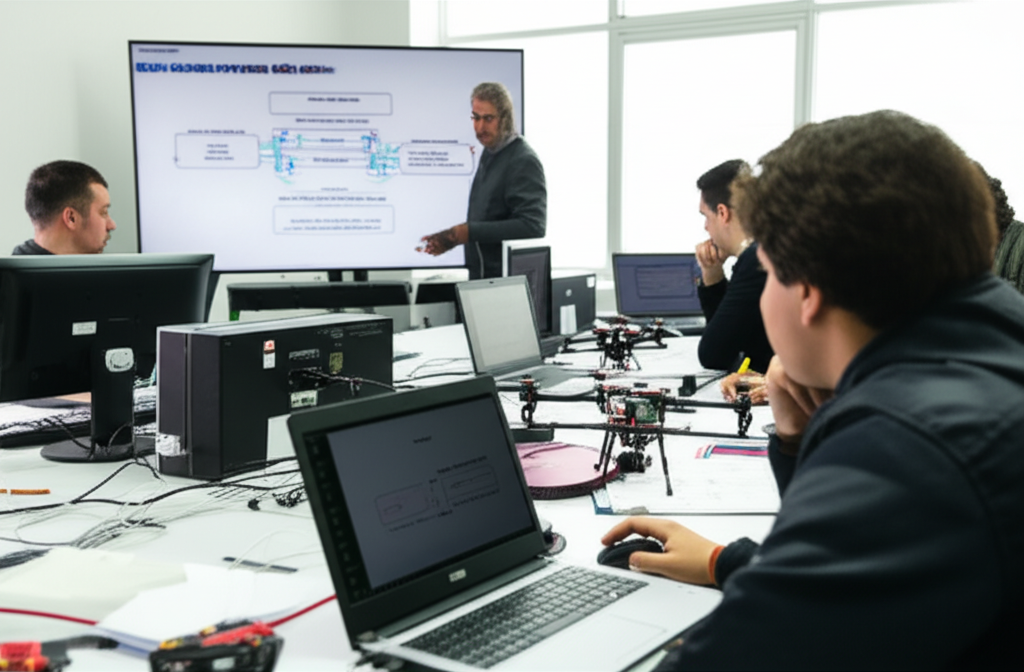
Cybersecurity course on UAVs
- Format: Hybrid
- Duration: 3 months
- Hours: 300 H
- Language: English / Spanish
- Registration date: 23-10-2026
- Start date: 12-12-2026
- Available places: 2
349 $
Competencies and results
What you will learn
1. Complete Mastery of Cybersecurity in Drones: Defense, Attack and Prevention.
- Identification and analysis of vulnerabilities in drone systems: hardware, software, and communications.
- Implementation of cybersecurity defense strategies: firewalls, intrusion detection systems (IDS/IPS), and data encryption.
- Attack techniques in controlled environments: reconnaissance, vulnerability exploitation, and penetration testing (pentesting).
-
Development of incident response plans: containment, eradication, recovery, and forensic analysis of compromised drones.
-
Regulatory framework and compliance: laws, standards, and best practices in drone cybersecurity.
-
Threat analysis and risk mitigation: identification of malicious actors, risk assessment, and design of mitigation strategies.
Cybersecurity tools and technologies for drones: security analysis software, simulation platforms, and specialized hardware.
Supply chain security: risk assessment in the development, manufacturing, and distribution of drones.
Cryptography applied to drones: use of encryption algorithms, digital signatures, and key management to protect the integrity and confidentiality of information.
Design and implementation of authentication and authorization systems: access control to drones and their systems.
2. Comprehensive Strengthening of Cybersecurity in Drones: Analysis, Protection and Response.
- Identify specific drone vulnerabilities at the hardware, software, and communications levels.
- Evaluate risk and threat analysis techniques applicable to drone systems.
- Implement protection strategies for drone infrastructure, including encryption, authentication, and access control.
- Develop security incident response plans, including detection, containment, eradication, and recovery.
- Utilize cybersecurity tools and techniques for the inspection and monitoring of drone systems.
- Understand current drone cybersecurity regulations and their impact on operations.
- Analyze different types of attacks targeting drones, including hijacking, denial-of-service, and data manipulation.
- Apply digital forensic analysis methods to investigate drone security incidents and recover data.
- Design and implement intrusion detection and prevention systems (IDS/IPS) for drone protection.
- Evaluate the security of drone wireless communications and implement measures to protect them against interception and attacks.
evidence.
3. Comprehensive user-oriented design and validation (from modeling to manufacturing)
You will learn to integrate the entire product development process, from initial model conception to final validation, applying user-centered methodologies. You will develop skills in parametric design, ergonomics, simulation, sustainable materials, 3D visualization, and manufacturing management, ensuring efficient, safe solutions that meet current industry standards.
4. Advanced Cybersecurity in UAVs: Detection, Forensic Analysis and Resilience.
4. Advanced Cybersecurity in UAVs: Detection, Forensics, and Resilience.
- Identify and understand the specific cybersecurity threats faced by Unmanned Aerial Vehicles (UAVs).
- Apply advanced intrusion detection techniques, including network traffic analysis, anomaly detection, and the use of AI-based detection systems.
- Perform digital forensics on UAVs, including data acquisition and preservation, image and video analysis, and the identification of malware and vulnerabilities.
- Develop strategies and measures to improve UAV resilience to cyberattacks, including the implementation of defense-in-depth systems, supply chain security management, and incident response planning.
- Master key tools and technologies for UAV cybersecurity, including firewalls, intrusion detection systems, forensic analysis software, and attack simulation tools.
- Evaluate and mitigate the Security risks in the design, development, and operation of UAVs.
Understand the regulatory frameworks and security standards related to UAVs and cybersecurity.
Apply cybersecurity best practices to UAVs, including authentication, authorization, encryption, and key management.
5. Cyber Protection of Drones: Implementation, Security and Anti-Hacking Shielding.
- Identify vulnerabilities in drone systems and cyber threats.
- Develop strategies for the secure deployment of drones in operational environments.
- Learn advanced security techniques to protect drones against cyberattacks.
- Implement anti-hacking shielding methods for the integrity of flight systems.
- Understand drone communication protocols and security measures.
- Analyze and mitigate the risks associated with unauthorized access and remote manipulation.
- Use specialized tools and software for the detection and prevention of cyberattacks on drones.
- Apply cybersecurity best practices in the design and operation of drones.
- Continuously evaluate and improve the security posture of drone systems.
- Comply with regulations and standards Cybersecurity measures applicable to the drone sector.
6. Drone Cyber Defense: Vulnerability Analysis, Protection and Recovery.
6. Drone Cyber Defense: Vulnerability Analysis, Protection, and Recovery
- Identification and analysis of vulnerabilities in drone systems: software, hardware, and communications.
- Risk analysis techniques and cyber threat assessment specific to drones.
- Implementation of protection and defense strategies: firewalls, intrusion detection systems (IDS), and encryption.
- Protection of drone firmware and operating systems against malicious attacks.
- Design and implementation of security measures in communications: secure protocols and interception prevention.
- Incident response and recovery techniques for cyberattacks: digital forensics, threat containment, and eradication.
- Penetration testing and ethical hacking of drone systems to identify and mitigate vulnerabilities.
- Legal framework and regulations on drone cybersecurity and data privacy.
Development of business continuity and cyber disaster recovery plans for drone operations.
Future trends in drone cyber defense: artificial intelligence, machine learning, and behavior-based security.
Who this program is for:
Cybersecurity course on UAVs
- Engineers with degrees in Aerospace, Mechanical, Industrial, Automation, or similar disciplines who wish to delve deeper into cybersecurity applied to UAVs.
- Professionals working in the OEM rotorcraft/eVTOL, MRO (Maintenance, Repair, and Overhaul) industry, or in consulting firms and technology centers involved in the development and operation of drones and unmanned aerial vehicles.
- Experts in areas such as Flight Testing, Aircraft Certification, Avionics, Systems Control, and Flight Dynamics professionals seeking specialization in UAV cybersecurity to protect their systems and operations.
Officials from Aeronautical Regulators and Authorities, as well as professionals involved in Urban Air Mobility (UAM)/eVTOL projects, who need to acquire knowledge and skills in regulatory compliance and drone cybersecurity.
Recommended Requirements: Basic knowledge of aerodynamics, systems control, and structures is recommended. A B2+ or C1 level of proficiency in Spanish or English (ES/EN) is required. Bridging tracks are available to help students achieve the necessary level of proficiency.
- Standards-driven curriculum: you will work with CS-27/CS-29, DO-160, DO-178C/DO-254, ARP4754A/ARP4761, ADS-33E-PRF from the first module.
- Accreditable laboratories (EN ISO/IEC 17025) with rotor bench, EMC/Lightning pre-compliance, HIL/SIL, vibrations/acoustics.
- Evidence-oriented TFM: safety case, test plan, compliance dossierand operational limits.
- Mentored by industry: teachers with experience in rotorcraft, tiltrotor, eVTOL/UAM and flight test.
- Flexible modality (hybrid/online), international cohorts and support from SEIUM Career Services.
- Ethics and security: safety-by-design approach, cyber-OT, DIH and compliance as pillars.
1.1 Drone Cybersecurity Fundamentals: Key Concepts and Terminology
1.2 Drone Architecture: Components, Systems, and Communication
1.3 Cyber Threats: Types of Attacks and Threat Vectors
1.4 Common Vulnerabilities: Hardware, Software, and Communication Protocols
1.5 Legal and Regulatory Framework: Cybersecurity Regulations for Drones
1.6 Introduction to Cryptography: Encryption and Authentication
1.7 Secure Communication Protocols: Implementation and Configuration
1.8 Risk Analysis: Threat Identification and Assessment
1.9 First Steps in Protection: Basic Security Measures
1.10 Case Studies: Drone Attacks and Lessons Learned
3.2 Introduction to Cyber Threats in Drones
3.2 Fundamentals of Drone Cybersecurity
3.3 Common Types of Cyberattacks on Drones
3.4 Vulnerability Analysis in Drone Systems
3.5 Cyber Risk Mitigation Strategies
3.6 Implementation of Security Countermeasures
3.7 Encryption and Authentication in Drones
3.8 Data Protection and Privacy in Drone Operations
3.9 Incident Response and Recovery
3.20 Regulatory Framework and Compliance
3.3 Drone Cybersecurity Fundamentals: Introduction
3.2 Drone Architecture: Vulnerable Components and Systems
3.3 Cyber Threats: Common Attacks and Vectors
3.4 Communication Protocols: Security and Risks
3.5 Encryption and Authentication: Data Protection and Access Control
3.6 Security Policies: Implementation and Management
3.7 Risk Assessment: Vulnerability Identification and Analysis
3.8 Mitigation Strategies: Protection and Defense
3.9 Incident Recovery: Planning and Response
3.30 Case Study: Analysis of Real Attacks and Lessons Learned
4.4 Principles of Forensic Analysis in UAV Systems
4.2 Collection and Preservation of Digital Evidence in Drones
4.3 Analysis of Flight Logs and Records
4.4 Identification and Analysis of Malware in UAVs
4.5 Data Recovery Techniques in Drones
4.6 Analysis of Drone Networks and Communications
4.7 Common Vulnerabilities and Exploitation in UAVs
4.8 Implementation of Resilience Strategies
4.9 Cyber Incident Response Plans for Drones
4.40 Case Studies: Forensic Analysis and Resilience in Real-World Scenarios
5.5 Introduction to Drone Legislation
5.5 Types of Drones and Their Applications
5.3 Legal Framework and National and International Regulations
5.4 Responsibilities and Obligations of Drone Operators
5.5 Required Licenses and Certifications
5.6 Privacy and Data Protection in the Context of Drones
5.7 Safety and Air Navigation Aspects
5.8 Regulations on the Use of Drones in Specific Environments
5.9 Legislation on the Use of Drones in Commercial Operations
5.50 Future of Drone Legislation
5.5 Identifying Cyber Threats in Drones
5.5 Vulnerability Analysis in Drone Systems
5.3 Denial-of-Service (DoS/DDoS) Attacks and Their Impact
5.4 Data Manipulation and Control Attacks
5.5 Risks of Communications and Signal Interception
5.6 Malware and Malicious Software Threats Drones
5.7 Social Engineering and Phishing Targeting Drone Operators
5.8 Risk Analysis and Threat Assessment
5.9 Information Gathering and Reconnaissance Techniques
5.50 Case Studies of Cyberattacks on Drones
3.5 Implementing Firewalls and Intrusion Detection Systems
3.5 Encrypting Data and Communications
3.3 Robust Authentication and Authorization
3.4 Role-Based Access Control (RBAC)
3.5 Updating and Managing Security Patches
3.6 Using Secure Software and Verifying Integrity
3.7 Secure Drone System Design
3.8 Implementing Secure Communication Protocols
3.9 Defense-in-Depth Strategies
3.50 Best Practices for Drone Cybersecurity
4.5 Intrusion Detection Techniques in Drone Systems
4.5 Log Collection and Analysis
4.3 Traffic Analysis Network and Anomaly Detection
4.4 Acquisition and Preservation of Digital Evidence
4.5 Malware Analysis on Drones
4.6 Forensic Analysis Techniques in Drone Systems
4.7 Data Recovery and Memory Analysis
4.8 Tools and Techniques for Drone Forensics
4.9 Incident Reporting and Forensic Documentation
4.50 Drone Forensics Case Studies
5.5 Security Planning and Implementation in Drone Design
5.5 Secure Configuration of the Operating System and Software
5.3 Implementation of Security Policies and Operating Procedures
5.4 Protecting Communication Between the Drone and the Control Station
5.5 Securing Data Storage and Transmission
5.6 Implementing Multi-Factor Authentication (MFA)
5.7 Ensuring Firmware and Software Integrity
5.8 Security Monitoring and Management
5.9 Penetration Testing and Security Assessment
5.50 Incident Response Plan Development
6.5 Incident Response Preparation and Planning
6.5 Cyber Incident Detection and Containment
6.3 Eradication and Recovery of the Affected System
6.4 Root Cause Analysis
6.5 System and Data Restoration
6.6 Operational Recovery
6.7 Incident Communication and Notification
6.8 Implementation of Corrective Actions
6.9 Incident Response Testing and Drills
6.50 Business Continuity and Resilience Management
7.5 Risk Assessment and Cyber Resilience Management
7.5 Design and Implementation of Advanced Intrusion Detection and Prevention Systems
7.3 Vulnerability Analysis and Advanced Penetration Testing
7.4 Implementation of Advanced Incident Response Techniques
7.5 Data Protection and Privacy in Drone Environments
7.6 Securing the Drone Supply Chain
7.7 Information Security Management in Drone Operations
7.8 Implementing Threat Intelligence in Drone Security
7.9 Legal Framework and Regulations on Drone Security at a Global Level
7.50 Future Trends and Challenges in Drone Cybersecurity
8.5 Drone Attack Techniques: Control Hacking, GPS Spoofing, etc.
8.5 Exploitation of hardware and software vulnerabilities
8.3 Social engineering attacks targeting drone operators
8.4 Proactive defense strategies against drone attacks
8.5 Implementation of advanced intrusion detection and prevention systems
8.6 Use of firewalls and anomaly detection systems
8.7 Malware analysis and forensic analysis techniques for drones
8.8 Design of protection and disaster recovery strategies
8.9 Attack simulation and penetration testing for security assessment
8.50 Development of a comprehensive and effective incident response plan
6.6 Identifying Vulnerabilities in Drone Systems: Hardware and Software.
6.2 Analysis of Wireless Communication Protocols in Drones: WiFi, Bluetooth, Radio Frequency.
6.3 Evaluating Data Transmission Security: Encryption and Authentication.
6.4 Studying Vulnerabilities in Drone Firmware: Updates and Patches.
6.5 Exploiting Open Ports and Services in Drones: Scanning and Exploitation.
6.6 Risk Analysis in Mobile Applications and Drone Control Software.
6.7 Drone Penetration Testing Methodologies: Ethical Hacking.
6.8 Forensic Analysis of Drone Systems: Digital Evidence.
6.9 Identifying Specific Cyber Threats to Drones: Malware and Attacks.
6.60 Preparation of Vulnerability Reports and Mitigation Recommendations.
- Hands-on methodology: test-before-you-trust, design reviews, failure analysis, compliance evidence.
- Software (depending on licenses/partners): MATLAB/Simulink, Python (NumPy/SciPy), OpenVSP, SU2/OpenFOAM, Nastran/Abaqus, AMESim/Modelica, acoustics tools, planning toolchains DO-178C.
- SEIUM Laboratories: scale rotor bench, vibrations/acoustics, EMC/Lightning pre-compliance, HIL/SIL for AFCS, data acquisition with strain gauging.
- Standards and compliance: EN 9100, 17025, ISO 27001, GDPR.
Capstone-type projects
- Drone Cybersecurity: Vulnerability Analysis, Defense Implementation, Penetration Testing, Incident Response.
- Cyber Protection: Data Encryption, Access Control, Threat Detection, Attack Recovery.
- Drone Resilience: Mitigation Strategies, Forensic Analysis, Business Continuity, Advanced Security.
- Drone Vulnerability Analysis: Identifying and mitigating risks in UAV systems.
- Firewall and IDS Implementation: Designing and implementing robust security solutions.
- Communication Encryption: Ensuring the confidentiality and integrity of transmitted data.
- Drone Forensics: Recovering and analyzing evidence in cyber incidents.
- Drone Cybersecurity: Vulnerability analysis, implementation of defense protocols, and incident response.
- Cyber Shielding: Creation of firewalls, intrusion detection systems (IDS/IPS), and advanced threat mitigation strategies.
- Drone Resilience: Design of secure architectures, forensic analysis, and recovery from attacks.
- Drone Cybersecurity: Vulnerability analysis, penetration testing, development of security protocols, and assessment of resilience against attacks.
- Protection Implementation: Design and deployment of intrusion detection systems, data encryption, and incident response strategies for UAVs.
- Forensic Analysis: Incident investigation, data recovery, and threat mitigation in drone systems.
Admissions, fees, and scholarships
- Profile: Background in Computer Engineering, Mathematics, Statistics, or related fields; practical experience in NLP and valued information retrieval systems.
- Documentation: Updated CV, academic transcript, SOP/statement of purpose, project examples or code (optional).
- Process: Application → Technical evaluation of profile and experience → Technical interview → Review of case studies → Final decision → Enrollment.
- Fees:
- Single payment: 10% discount.
- Payment in 3 installments: No fees; 30% upon registration + 2 equal monthly payments of the remaining 35%.
Monthly payment: available with a 7% commission on the total; annual review.
Scholarships: based on academic merit, financial need, and promoting inclusion; agreements with companies in the sector for partial or full scholarships.
See “Calendar & Calls for Applications,” “Scholarships & Grants,” and “Fees & Financing” in the SEIUM mega-menu.
Do you have any questions?
Our team is ready to help you. Contact us, and we will respond as soon as possible.
F. A. Q
Frequently asked questions
Yes, we have international certification
Yes: experimental models, real data, applied simulations, professional environments, real case studies.
It is not mandatory. We offer leveling tracks and tutoring.
Completely. It covers e-propulsion, integration, and emerging regulations (SC-VTOL).
Recommended. There are also internal challenges and consortiums.
Yes. Online/hybrid modality with planned labs and visa support (see “Visa & Residence”).