

MoTeC Software Course for Beginners
About our
MoTec Software Course for Beginners
This course introduces you to the fundamentals of MoTec software, an essential tool in the world of motorsports for data analysis and telemetry. It focuses on understanding data acquisition, interpreting key parameters such as RPM, speed, temperature, and pressure, and applying this knowledge to optimize vehicle performance. You will learn to navigate the interface, configure data channels, and generate graphs and reports useful for improving race strategy and vehicle performance.
This course provides a solid foundation for understanding how data collected in real time and during post-race analysis is used to make informed decisions about vehicle setup, driving style, and team strategy. It covers fundamental concepts such as sensor usage, calibration, and data visualization. The course is ideal for drivers, race engineers, mechanics, and anyone interested in learning more about data analysis to improve performance in motorsport.
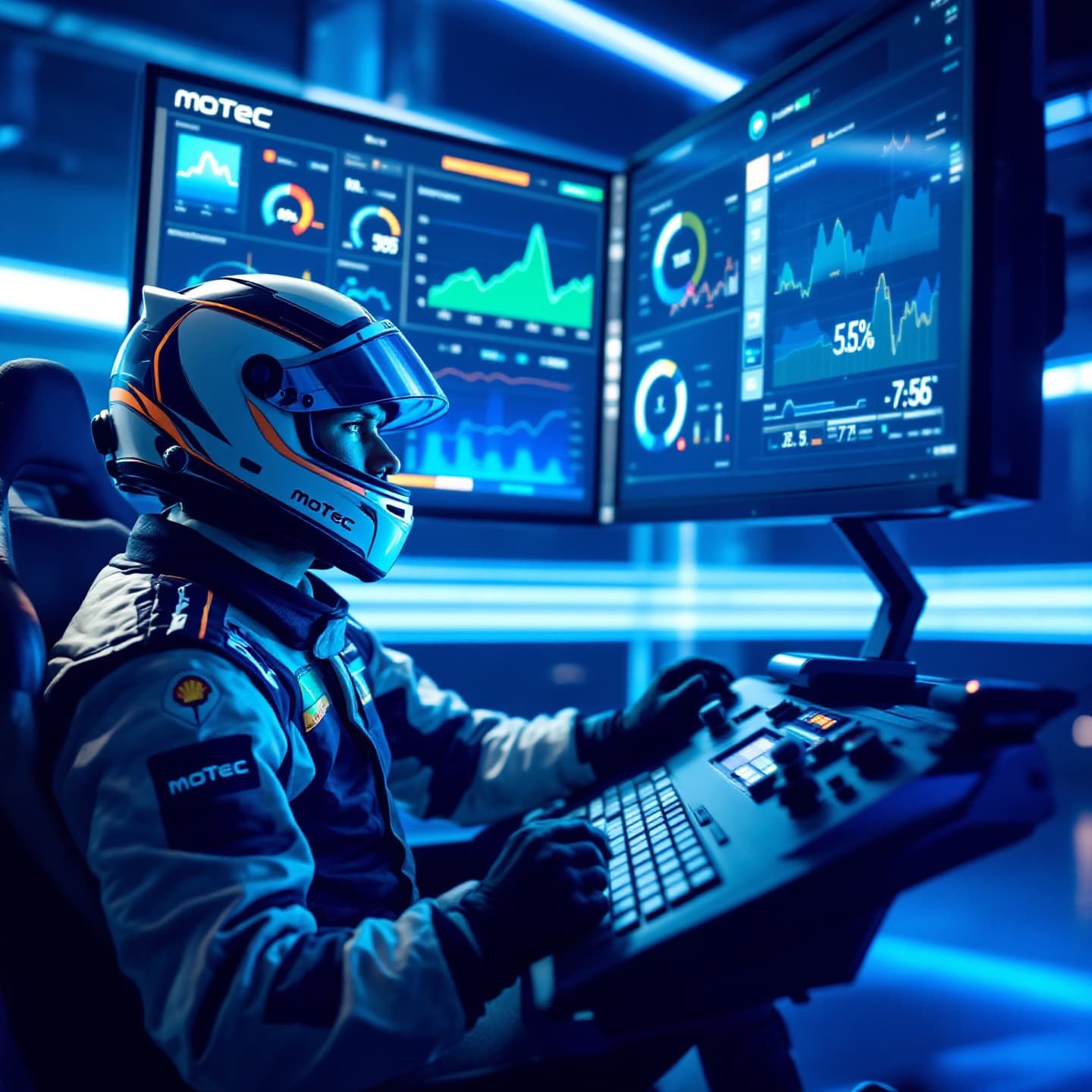
MoTeC Software Course for Beginners
- Format: Hybrid
- Duration: 3 months
- Hours: 300 H
- Language: English / Spanish
- Registration date: 23-10-2026
- Start date: 12-12-2026
- Available places: 3
620 $
Competencies and results
What you will learn
1. Complete Mastery of the MoTeC Platform: Fundamentals and Practical Applications
- Introduction to MoTeC and its Environment: Familiarization with the interface, navigation tools, and initial setup.
- Data Acquisition and Processing: Configuring channels, sensor types, sampling rates, and optimizing acquisition.
- Real-Time and Post-Processed Data Analysis: Using graphs, dashboards, and tables to visualize data; Filtering and smoothing techniques.
- Integration with Other Systems: MoTeC connects with external data acquisition systems, simulation software, and other tools.
Specific Sensor Analysis: Study of engine sensors, suspension sensors, brake sensors, and others; interpretation of signals.
Control Strategy Configuration: Creation and adjustment of engine maps, traction control, stability control, and shift strategies.
Troubleshooting and Diagnosis: Identification and resolution of faults in the engine, suspension system, brakes, and other components.
Performance Optimization: Advanced techniques to improve engine performance, fuel efficiency, and vehicle dynamics.
Practical Applications in Racing: Configuration and data analysis for circuit racing, rally, and other disciplines.
Practical Applications in Engineering: Data analysis for prototype development and validation, durability testing, and analysis of failures.
2. MoTeC Data Unlocking: Telemetry Analysis and Performance Optimization
Here is the SEO-optimized content for the course “Unlocking MoTeC Data: Telemetry Analysis and Performance Optimization”:
2. **Unlocking MoTeC Data: Telemetry Analysis and Performance Optimization**
You will learn to:
Optimize racing lines, braking points, and acceleration to improve lap times.
Identify areas for driver improvement, such as driving technique, tire management, and race strategy.
Generate reports and present data-driven findings to engineering teams and drivers.
Apply advanced data analysis strategies for problem-solving and informed decision-making.
Use MoTeC software to simulate vehicle performance and predict the effects of setup changes.
Fine-tune engine and electronics settings to maximize power and efficiency.
Optimize race strategy and tire management for maximum competitive advantage.
Implement a data-driven approach to vehicle development and continuous improvement. performance.
3. Comprehensive user-oriented design and validation (from modeling to manufacturing)
You will learn to integrate the entire product development process, from initial model conception to final validation, applying user-centered methodologies. You will develop skills in parametric design, ergonomics, simulation, sustainable materials, 3D visualization, and manufacturing management, ensuring efficient, safe solutions that meet current industry standards.
4. Unraveling the MoTeC Software: A Comprehensive Guide for Beginners in the World of Motorsports
4. **Unraveling MoTeC Software: A Comprehensive Guide for Beginners in the World of Motorsports**
- Introduction to MoTeC: Interface, Navigation, and Basic Configuration.
- Data Acquisition: Connecting and Configuring Sensors.
- Data Analysis: Interpreting Graphs and Tables; Anomaly identification.
Engine Setup: Adjustment of fuel parameters, ignition, and limiters.
Suspension Setup: Calibration of dampers and springs.
Transmission Setup: Optimization of gear ratios and differentials.
Advanced Analysis: Data correlation and performance analysis.
Race Strategies: Optimization of lap times and pit stop strategies.
Simulation and Modeling: Use of simulation tools within MoTeC.
Troubleshooting: Diagnosis and resolution of common engine and suspension problems.
5. MoTeC Advanced Data Analysis Strategies for Performance Improvement
- Delve deeper into the analysis of MoTeC telemetry data.
- Master the interpretation of acceleration, speed, and position data.
- Apply advanced techniques for engine performance analysis.
- Identify areas for improvement in fuel efficiency and power.
- Utilize MoTeC tools for race strategy optimization.
- Develop predictive models of vehicle performance.
- Interpret and utilize information from specific sensors to improve handling.
- Analyze and optimize the performance of brakes, suspension, and aerodynamics.
- Apply the acquired knowledge to the simulation of different race scenarios.
6. In-depth Introduction to MoTeC Software: Learning Curves and Setup
6. In-Depth Introduction to MoTeC Software: Learning Curves and Setup
Master the intuitive interface and essential functionalities of MoTeC.
Understand the structure and organization of data within the software.
Learn to navigate efficiently through the different modules and sections.
Configure and customize data visualization for effective analysis.
Import and export data from various sources compatible with MoTeC.
Apply filters and analysis tools to identify patterns and trends.
Master the use of advanced formulas and functions for calculating variables.
Create and customize graphs and charts for visual data presentation.
Perform performance analysis, including acceleration, braking, and top speed.
Optimize engine and transmission settings using the collected data.
Who this program is for:
MoTeC Software Course for Beginners
- Students and graduates of Aerospace Engineering, Mechanical Engineering, Industrial Engineering, Automation Engineering, or related disciplines.
- Professionals working in OEM rotorcraft/eVTOL (aircraft manufacturers), MRO (maintenance, repair, and overhaul), aeronautical consulting, or technology centers.
- Specialists in Flight Testing, aeronautical certification, avionics, control systems, and flight dynamics, seeking to enhance their knowledge.
- Personnel from aeronautical regulators/authorities and Profiles involved in the development of UAM/eVTOL (urban air mobility/electric vertical takeoff and landing vehicles) who need to acquire compliance skills.
Recommended requirements: A solid foundation in aerodynamics, control theory, and strength of materials/structures is advised. A B2+/C1 level of English/Spanish is required. We offer bridging tracks for those who need to reinforce their prior knowledge.
- Standards-driven curriculum: you will work with CS-27/CS-29, DO-160, DO-178C/DO-254, ARP4754A/ARP4761, ADS-33E-PRF from the first module.
- Accreditable laboratories (EN ISO/IEC 17025) with rotor bench, EMC/Lightning pre-compliance, HIL/SIL, vibrations/acoustics.
- Evidence-oriented TFM: safety case, test plan, compliance dossierand operational limits.
- Mentored by industry: teachers with experience in rotorcraft, tiltrotor, eVTOL/UAM and flight test.
- Flexible modality (hybrid/online), international cohorts and support from SEIUM Career Services.
- Ethics and security: safety-by-design approach, cyber-OT, DIH and compliance as pillars.
Module 1 — Mastering MoTeC: Fundamentals and Getting Started
1.1 Introduction to MoTeC: History, Purpose, and Applications in Motorsports
1.2 Installing and Configuring the MoTeC Software: Requirements and Getting Started
1.3 MoTeC User Interface: Navigation and Key Functions
1.4 Connecting and Configuring Hardware: Data Acquisition and Sensors
1.5 Data Acquisition Fundamentals: Channels, Sampling Rate, and Units
1.6 Creating Log Files: Initial Setup and Organization
1.7 Visualizing Basic Data: Graphs, Tables, and Dashboards
1.8 Getting Started with Data Analysis: Identifying Problems and Trends
1.9 Customizing the Interface: Configuring for Efficiency and Analysis
1.10 Practical Exercises: Collecting and Visualizing Basic Data
2.2 Introduction to MoTeC Telemetry Analysis
2.2 Data Import and Organization
2.3 Data Visualization: Graphs and Tables
2.4 Key Channel Analysis: Engine, Chassis, Tires
2.5 Problem and Anomaly Identification
2.6 Data Correlation: Causes and Effects
2.7 Filtering and Comparison Techniques
2.8 Performance Optimization: Strategies and Examples
2.9 Reporting and Results Presentation
2.20 Case Studies: Real-World Data Analysis
3.3 Introduction to Vehicle Optimization with MoTeC: Fundamental Concepts
3.2 Initial Configuration with MoTeC: Data Acquisition and Sensors
3.3 Basic Telemetry Analysis: Interpretation of Key Data
3.4 Tuning and Calibration with MoTeC: Engine Performance Improvement
3.5 Suspension Optimization: Dynamic Adjustments and Handling
3.6 Advanced Data Analysis: Identifying Areas for Improvement
3.7 Vehicle Setup Strategies: Adapting to Different Tracks
3.8 Advanced Telemetry: Creating Custom Graphs and Dashboards
3.9 Developing Performance Strategies: Improving Lap Times
3.30 Case Study: Practical Application of Optimization with MoTeC
4.4 Introduction to the MoTeC Interface and Basic Concepts
4.2 Navigation and Familiarization with Essential Functions
4.3 Importing and Viewing Telemetry Data
4.4 Initial Data Analysis: RPM, Speed, and Throttle Position
4.5 Creating Simple Graphs for Basic Analysis
4.6 Introduction to Channels and Key Parameters
4.7 Primary Filters and Visualization Tools
4.8 Getting Started with Dashboard Setup
4.9 Identifying Common Data Problems
4.40 Introduction to Reporting and Data Export
5.5 Introduction to MoTeC: Interface and Getting Started
5.5 Platform Setup: Creating Files and Projects
5.3 Exploring the User Interface: Essential Panels and Tools
5.4 Basic Sensor Configuration and Data Acquisition
5.5 Initial Data Logs: Recording and Initial Visualization
5.5 Introduction to Telemetry Analysis: Key Metrics and Their Importance
5.5 Data Analysis: Identifying Areas for Performance Improvement
5.3 Interpreting Graphs and Data Visualizations
5.4 Analyzing Different Variables: Engine, Chassis, and Tires
5.5 Performance Optimization: Strategies Based on Data Analysis
3.5 Advanced Vehicle Configuration in MoTeC
3.5 Optimizing Engine Configuration: Ignition and Fuel Adjustments
3.3 Suspension and Chassis Adjustments: Analysis and Improvements
3.4 Advanced Telemetry Strategies: Customizing and Filtering Data
3.5 Developing Strategies for Continuous Performance Improvement
4.5 MoTeC Software Fundamentals: Concepts Key
4.5 Navigating the Interface: Tools for Beginners
4.3 Data Acquisition: Setting Up and Troubleshooting Common Problems
4.4 Basic Data Analysis: Identifying Problems and Opportunities
4.5 Getting Started with Vehicle Setup
5.5 Advanced Data Analysis Strategies: Techniques and Tools
5.5 Correlation and Trend Analysis: Pattern Discovery
5.3 Data Filtering and Cleaning Techniques
5.4 Designing Data-Driven Performance Improvement Strategies
5.5 Interpreting and Communicating Results
6.5 Learning Curves in MoTeC: Overcoming Initial Challenges
6.5 Vehicle Tuning: Basic and Advanced Adjustments
6.3 Engine Optimization: Strategies and Techniques
6.4 Developing a Tuning Workflow
6.5 Troubleshooting Common Problems and Practical Tips
7.5 Detailed Data Analysis: Identifying Problems
7.5 Engine and Chassis Adjustments: Optimizing for Performance
7.3 Improving Vehicle Performance
7.4 Optimization Vehicle Configuration
7.5 Advanced Data Analysis Strategies
8.5 Advanced Optimization in MoTeC: Techniques and Strategies
8.5 In-Depth Data Analysis: Unlocking Hidden Potential
8.3 Strategies for Motorsport Excellence
8.4 Optimized Workflow
8.5 Developing Strategies for Continuous Improvement
6.6 Introduction to the Software: Interface and Getting Started
6.2 Learning Curves: Navigating the Software
6.3 Initial Setup: Basic Settings and Key Functions
6.4 Fundamental Data Analysis: Reading and Interpreting Basic Data
6.5 Setup: Initial Configuration for Data Acquisition
6.6 Visualization Tools: Initial Graphs and Tables
6.7 Creating Layouts: Customizing the Interface
6.8 Simple Mathematical Functions: Application and Use
6.9 Initial Settings: Data Interpretation and Vehicle Configuration
6.60 Troubleshooting: Common Errors and Solutions
- Hands-on methodology: test-before-you-trust, design reviews, failure analysis, compliance evidence.
- Software (depending on licenses/partners): MATLAB/Simulink, Python (NumPy/SciPy), OpenVSP, SU2/OpenFOAM, Nastran/Abaqus, AMESim/Modelica, acoustics tools, planning toolchains DO-178C.
- SEIUM Laboratories: scale rotor bench, vibrations/acoustics, EMC/Lightning pre-compliance, HIL/SIL for AFCS, data acquisition with strain gauging.
- Standards and compliance: EN 9100, 17025, ISO 27001, GDPR.
Capstone-type projects
- Telemetry Analysis: Simulation, calibration, and optimization of MoTeC data for performance.
- Configuration and Tuning: Practical implementation of MoTeC, advanced tuning, and performance analysis.
- Advanced Strategies: Application of techniques for performance improvement in different scenarios.
- Complete Mastery: Analysis and optimization of vehicles with a focus on automotive excellence.
- Data Analysis: Engine performance optimization with MoTeC telemetry.
- MoTeC Configuration: Map and parameter adjustment for maximum efficiency.
- Vehicle Optimization: Analysis and improvement of track performance.
- Advanced Strategies: Application of techniques to overcome challenges in competition.
- MoTeC Engine Optimization: Data analysis, configuration, and tuning to maximize power and efficiency.
- MoTeC Advanced Telemetry: Implementation and analysis of sensors to improve track performance.
- MoTeC Simulation and Calibration: Use of software to simulate scenarios and optimize vehicle settings.
- MoTeC Data Analysis: Vehicle performance optimization, fault diagnostics, and predictive simulation.
- MoTeC Advanced Configuration: Fine-tuning, motor mapping, and control strategies.
- Telemetry and Strategy: Real-time data collection, analysis, and visualization for on-track decision-making.
Admissions, fees, and scholarships
- Profile: Background in Computer Engineering, Mathematics, Statistics, or related fields; practical experience in NLP and valued information retrieval systems.
- Documentation: Updated CV, academic transcript, SOP/statement of purpose, project examples or code (optional).
- Process: Application → Technical evaluation of profile and experience → Technical interview → Review of case studies → Final decision → Enrollment.
- Fees:
- Single payment: 10% discount.
- Payment in 3 installments: No fees; 30% upon registration + 2 equal monthly payments of the remaining 35%.
Monthly payment: available with a 7% commission on the total; annual review.
Scholarships: based on academic merit, financial need, and promoting inclusion; agreements with companies in the sector for partial or full scholarships.
See “Calendar & Calls for Applications,” “Scholarships & Grants,” and “Fees & Financing” in the SEIUM mega-menu.
Do you have any questions?
Our team is ready to help you. Contact us, and we will respond as soon as possible.
F. A. Q
Frequently asked questions
Yes, we have international certification
Yes: experimental models, real data, applied simulations, professional environments, real case studies.
It is not mandatory. We offer leveling tracks and tutoring.
Completely. It covers e-propulsion, integration, and emerging regulations (SC-VTOL).
Recommended. There are also internal challenges and consortiums.
Yes. Online/hybrid modality with planned labs and visa support (see “Visa & Residence”).