

Two-stroke engine course: theory and maintenance
About our
Two-Stroke Engine Course: Theory and Maintenance
This course provides comprehensive training in the operation, diagnosis, and repair of two-stroke engines. It includes an in-depth study of the two-stroke cycle theory, combustion principles, and fuel and lubrication systems. It focuses on the application of preventive and corrective maintenance tools and techniques, including disassembly and assembly, measurements and adjustments, and troubleshooting. The course covers a wide range of applications, from motorcycles to outboard motors.
The program includes hands-on training with real engines, allowing students to gain experience in troubleshooting, component replacement, and tuning. Emphasis is placed on safety and the proper use of specialized tools. The training prepares individuals for roles such as maintenance technicians, engine mechanics, and equipment owners, enhancing their ability to maintain and repair these engines.
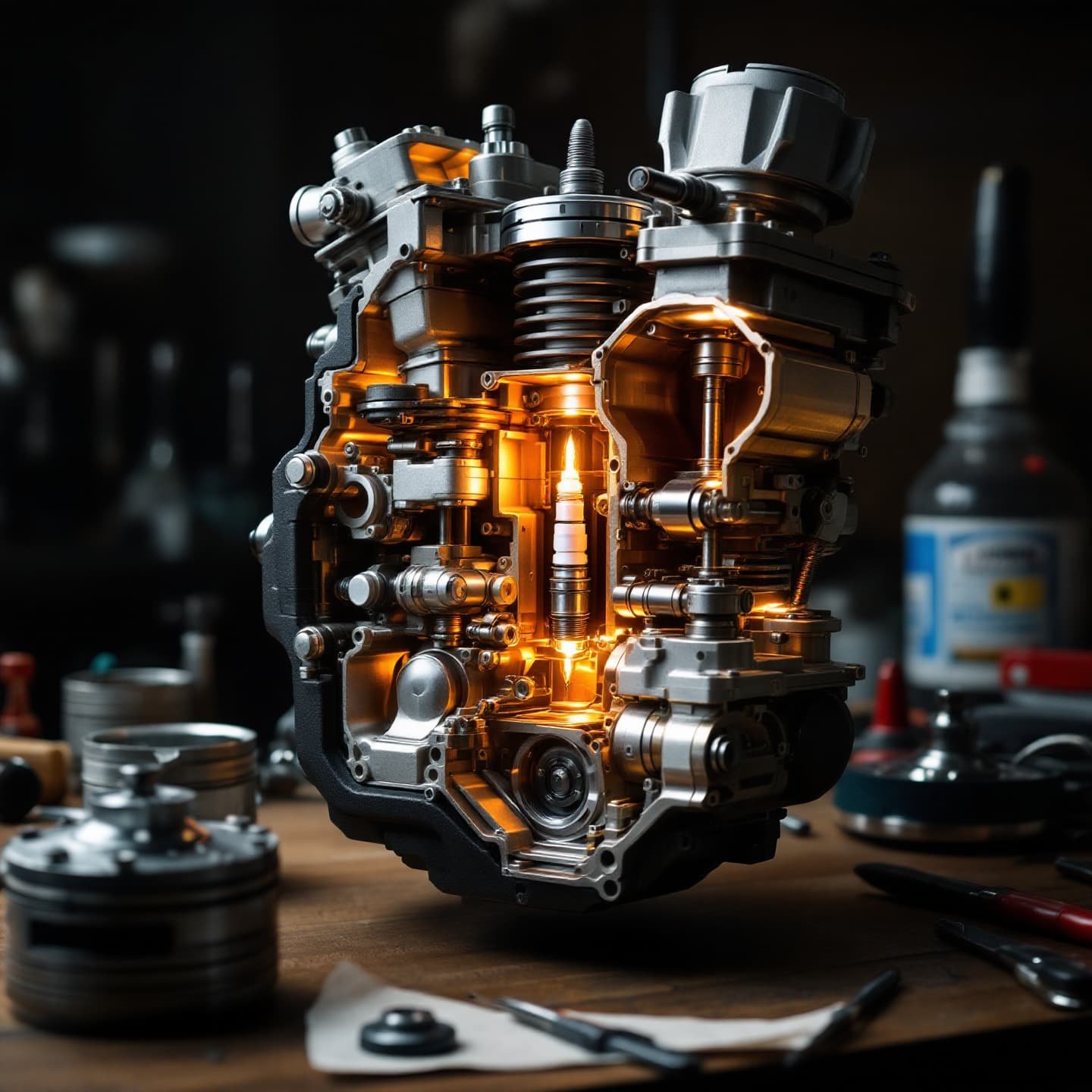
Two-stroke engine course: theory and maintenance
- Format: Hybrid
- Duration: 3 months
- Hours: 300 H
- Language: English / Spanish
- Registration date: 23-10-2026
- Start date: 12-12-2026
- Available places: 3
249 $
Competencies and results
What you will learn
1. Theory and Maintenance of Two-Stroke Engines: A Complete Course
- Fundamentals of Two-Stroke Engines: Understand the history, evolution, and basic operating principles of two-stroke engines.
- Operating Cycle: Analyze in detail the intake, compression, combustion, and exhaust cycles, identifying the key phases and their influence on performance.
- Main Components: Study the structure and function of each engine component, including the crankshaft, piston, cylinder, cylinder head, carburetor (or fuel injection system), spark plug, and exhaust system.
- Types of Two-Stroke Engines: Differentiate and compare the various types of two-stroke engines, such as port, reed, or rotary valve intake engines, and their specific applications.
- Lubrication Systems: Examine the different lubrication systems used in two-stroke engines, including mixed lubrication and separate lubrication, and understand their importance to engine life.
- Fuel System: Understand the Fuel system operation, including the carburetor (or fuel injection system), fuel tank, pump (if applicable), and filters, and learn to diagnose and troubleshoot related problems.
Ignition system: Study the ignition system, including the magneto or ignition coil, spark plug, and wiring, and learn to adjust and maintain the system for optimal performance.
Exhaust system: Analyze the design and operation of the exhaust system, including the muffler and tailpipe, and understand its impact on performance and compliance with environmental regulations.
Troubleshooting: Learn to identify and diagnose common two-stroke engine faults using diagnostic tools and following a systematic troubleshooting procedure.
Preventive maintenance: Establish a preventive maintenance program for two-stroke engines, including lubrication, cleaning, adjustment, and component replacement, to ensure reliable operation and extend engine life.
- Engine Repair: Acquire practical skills for repairing two-stroke engines, including disassembly, inspection, repair, and assembly of components, as well as performing tests and final adjustments.
- Tools and Equipment: Become familiar with the tools and equipment used for the maintenance and repair of two-stroke engines, including hand tools, measuring tools, and specialized equipment.
- Safety: Know and apply the relevant safety standards for working with two-stroke engines, including the use of personal protective equipment and accident prevention.
2. Comprehensive Mastery of Two-Stroke Engines: Theoretical and Practical Learning
Here is the requested content, respecting the specifications:
**What Will You Learn in the Comprehensive Two-Stroke Engine Mastery Course?**
1. **Fundamentals and Principles:**
* Understand the operating theory of two-stroke engines.
* Analyze thermodynamic cycles and their practical application.
* Identify and differentiate the key engine components.
* Study the different types of two-stroke engines and their applications.
2. **Engine Mechanics:**
* Learn about the design and construction of the crankshaft, piston, cylinder, and cylinder head.
* Analyze lubrication, cooling, and fuel delivery systems.
* Diagnose and troubleshoot common mechanical failures.
* Perform preventive and corrective maintenance on two-stroke engines.
3. **Ignition and Carburetion Systems:**
* Study electronic and magnetic ignition systems.
* Adjust and calibrate the carburetor to optimize performance. 4. **Optimization and Performance:**
* Understand the operation of reed and rotary valves.
* Analyze the influence of carburetion on power and emissions.
5. **Optimization and Performance:**
* Evaluate engine performance through measurements and tests.
* Identify ways to optimize engine power and efficiency.
* Analyze the influence of compression ratio and ignition timing.
* Study common modifications and improvements in two-stroke engines.
6. **Practical Exercises and Applications:**
* Disassemble, assemble, and repair two-stroke engines in practical settings.
* Use specialized tools and equipment for diagnosis and repair.
* Apply knowledge to different types of engines: motorcycles, chainsaws, boats, etc.
* Learn about safety and risk prevention when working with engines.
3. Comprehensive user-oriented design and validation (from modeling to manufacturing)
You will learn to integrate the entire product development process, from initial model conception to final validation, applying user-centered methodologies. You will develop skills in parametric design, ergonomics, simulation, sustainable materials, 3D visualization, and manufacturing management, ensuring efficient, safe solutions that meet current industry standards.
4. Intensive Course on Two-Stroke Engines: Theory, Operation and Maintenance
4. Intensive Course on Two-Stroke Engines: Theory, Operation, and Maintenance
Theoretical foundations of two-stroke engines: operating cycle, thermodynamic principles, and basic design.
Key components of two-stroke engines: cylinder, piston, connecting rod, crankshaft, cylinder head, carburetor or fuel injection system, and exhaust.
Intake, compression, combustion, exhaust, and scavenging processes in two-stroke engines.
Types of two-stroke engines: reed valve, rotary valve, and port transfer.
Fuel systems: carburetion and fuel injection in two-stroke engines.
Ignition systems: types, components, timing, and troubleshooting.
Lubrication systems: types, operation, and maintenance.
Operation and performance: factors influencing power and torque. Engine and efficiency.
Starting and stopping procedures for two-stroke engines.
Diagnosing common faults: starting problems, loss of power, overheating, excessive smoke, and abnormal noises.
Preventive maintenance: inspection, cleaning, adjustment, and replacement of components.
Disassembly and assembly procedures for two-stroke engines.
Measurement and verification techniques: compression, clearances, and component wear.
Tools and equipment used in the maintenance of two-stroke engines.
Safety standards: handling of fuels, lubricants, and tools.
Current legislation on pollutant emissions from two-stroke engines.
5. Two-Stroke Engines: In-depth Theory and Advanced Maintenance
5. Two-Stroke Engines: In-Depth Theory and Advanced Maintenance
- Fundamentals of two-stroke engine operating theory: operating cycles, timing diagrams, and thermodynamic processes.
- Design and construction of two-stroke engines: key components, materials, and common configurations.
- Combustion principles in two-stroke engines: fuel-air mixture, ignition, and combustion control.
- Lubrication systems in two-stroke engines: lubrication types, lubricant selection, and maintenance.
- Intake and exhaust systems in two-stroke engines: port design, resonance, and flow optimization.
- Troubleshooting two-stroke engines: identifying common problems, testing methods, and performance analysis.
- Preventive and corrective maintenance procedures for two-stroke engines: inspection, adjustment, repair, and component replacement.
- Techniques for measuring and evaluating the performance of two-stroke engines: compression testing, exhaust gas analysis, and efficiency assessment.
- Use of specialized tools and equipment for the maintenance of two-stroke engines.
- Safety standards and environmental regulations related to two-stroke engines.
6. Unraveling Two-Stroke Engines: Theory and Essential Maintenance
6. Unraveling Two-Stroke Engines: Theory and Essential Maintenance
- Fundamentals of two-stroke engine operating theory: understanding the operating cycle—intake, compression, combustion, and exhaust.
- Identifying and analyzing key components: cylinder, piston, connecting rod, crankshaft, ports, and spark plugs.
- Principles of two-stroke engine design and construction: materials, tolerances, and technical specifications.
- Diagnosing common faults: starting problems, power loss, overheating, and vibrations.
- Preventive maintenance procedures: inspection, cleaning, lubrication, and adjustments.
- Repair techniques: component disassembly and assembly, parts replacement, and engine rebuilding.
- Fuel systems: carburetion, fuel injection, and their different configurations.
- Ignition systems: types Ignition systems, components, and troubleshooting.
Exhaust systems: design, operation, and potential problems.
Performance measurement and analysis: compression, emissions, and engine efficiency.
Who this program is for:
Two-stroke engine course: theory and maintenance
- Engineers with degrees in Aerospace Engineering, Mechanical Engineering, Industrial Engineering, or related Automation fields.
- Professionals working in the aircraft manufacturing sector (OEM rotorcraft/eVTOL), maintenance, repair, and overhaul (MRO), consulting, or who work in technology centers focused on engines.
- Specialists in areas such as Flight Testing, aeronautical certification, avionics, flight control systems, and flight dynamics who wish to deepen their knowledge.
- Personnel from organizations Regulators, aeronautical authorities, and professionals involved in the development and regulation of urban air mobility (UAM) and eVTOL, who require compliance skills.
Recommended Requirements: A solid foundation in areas such as aerodynamics, control systems, and aircraft structures is recommended. A B2+ or C1 level of English is essential. We offer bridging track options for those who need to strengthen their existing knowledge.
- Standards-driven curriculum: you will work with CS-27/CS-29, DO-160, DO-178C/DO-254, ARP4754A/ARP4761, ADS-33E-PRF from the first module.
- Accreditable laboratories (EN ISO/IEC 17025) with rotor bench, EMC/Lightning pre-compliance, HIL/SIL, vibrations/acoustics.
- Evidence-oriented TFM: safety case, test plan, compliance dossierand operational limits.
- Mentored by industry: teachers with experience in rotorcraft, tiltrotor, eVTOL/UAM and flight test.
- Flexible modality (hybrid/online), international cohorts and support from SEIUM Career Services.
- Ethics and security: safety-by-design approach, cyber-OT, DIH and compliance as pillars.
Module 1 — Introduction to Two-Stroke Engines
1.1 Fundamentals of Two-Stroke Engines: Basic Operating Principles
1.2 Key Components of a Two-Stroke Engine and Their Functions
1.3 Operating Cycle: Intake, Compression, Combustion, and Exhaust
1.4 Types of Two-Stroke Engines: Applications and Variations
1.5 Advantages and Disadvantages of Two-Stroke Engines
1.6 Essential Tools and Equipment for Maintenance
1.7 Workplace Safety: Standards and Precautions
1.8 Introduction to Specific Technical Terminology
1.9 Identifying Common Failures and Preliminary Diagnosis
1.10 Course Overview and Expectations
2.2 Operating Principles: Two-Stroke vs. Four-Stroke Cycles
2.2 Main Components: Cylinder, Piston, Crankshaft, Connecting Rod, Carburetor/Fuel Injection
2.3 Intake and Exhaust: Ports and Valves, Scavenging Systems
2.4 Fuel-Air Mixture: Carburetion, Direct Injection, and Lubrication Systems
2.5 Ignition: Electronic Ignition Systems, Spark Plugs, and Gap
2.6 Cooling: Air-Cooled and Water-Cooled Systems
2.7 Lubrication: Mixed and Separate Lubrication Systems
2.8 Starting and Stopping: Starting Systems and Procedures
2.9 Basic Diagnostics: Identifying Common Faults
2.20 Safety: Safety Measures and Personal Protective Equipment
3.3 Fundamental Principles of Two-Stroke Engines
3.2 Key Components and Their Function
3.3 Operating Cycle: Intake, Compression, Power, and Exhaust
3.4 Lubrication: Types and Importance
3.5 Fuel Systems: Carburetors and Injection Systems
3.6 Ignition Systems: Components and Operation
3.7 Preventive Maintenance: Regular Inspections
3.8 Spark Plug and Filter Replacement
3.9 Carburetor Adjustment and Timing
3.30 Identifying and Troubleshooting Common Problems
4.4 Two-Stroke Engine Operating Principles
4.2 Key Components of the Two-Stroke Engine
4.3 Two-Stroke Engine Operating Cycle: Intake, Compression, Combustion, Exhaust
4.4 Lubrication and Cooling Systems
4.5 Common Failures and Diagnosis
4.6 Engine Disassembly Procedures
4.7 Disassembly Tools and Equipment
4.8 Component Inspection and Wear Measurements
4.9 Engine Reassembly and Testing
4.40 Preventive and Scheduled Maintenance
5.5 Fundamental Principles of Two-Stroke Engines: Otto Cycle, Key Components
5.5 Disassembly and Assembly: Essential Procedures and Tools
5.3 Fuel Systems: Carburetion and Injection Systems
5.4 Ignition Systems: Types, Diagnosis, and Repair
5.5 Lubrication Systems: Types, Lubricant Selection, and Maintenance
5.6 Advanced Diagnostics: Measurement Techniques and Fault Analysis
5.7 Predictive Maintenance: Condition Monitoring and Vibration Analysis
5.8 Repair of Critical Components: Crankshafts, Cylinders, and Pistons
5.9 High-Performance Two-Stroke Engines: Tuning and Modifications
5.50 Legislation and Regulations: Compliance with Environmental Regulations
6.6 Two-Stroke Engine Fundamentals: Operating Cycle, Key Components
6.2 Operating Principles: Intake, Compression, Power, Exhaust
6.3 Types of 2-Stroke Engines: Differences and Applications
6.4 Lubrication Systems: Methods and Maintenance
6.5 Fuel Systems: Carburetion and Optimization
6.6 Diagnosing Common Faults: Problems and Solutions
6.7 Preventive Maintenance: Routines and Scheduling
6.8 Basic Engine Disassembly and Assembly
6.9 Essential Maintenance Tools
6.60 Safety Measures and Recommendations
- Hands-on methodology: test-before-you-trust, design reviews, failure analysis, compliance evidence.
- Software (depending on licenses/partners): MATLAB/Simulink, Python (NumPy/SciPy), OpenVSP, SU2/OpenFOAM, Nastran/Abaqus, AMESim/Modelica, acoustics tools, planning toolchains DO-178C.
- SEIUM Laboratories: scale rotor bench, vibrations/acoustics, EMC/Lightning pre-compliance, HIL/SIL for AFCS, data acquisition with strain gauging.
- Standards and compliance: EN 9100, 17025, ISO 27001, GDPR.
Capstone-type projects
- Remote Diagnostics: 2-stroke engines, fault analysis, telemetry.
- Advanced Simulation: 3D modeling, CFD, component optimization.
- Predictive Maintenance: Sensors, vibration analysis, algorithms.
- Interactive Manuals: Augmented reality, step-by-step guides, troubleshooting.
- Fuel Optimization: 2-stroke engines, emissions analysis, efficiency.
- 2-Stroke Engine Diagnostics: Fault analysis; compression, carburetion, ignition.
- 2-Stroke Preventive Maintenance: Programming, lubrication, adjustments, spark plugs.
- 2-Stroke Optimization: Performance; fuel, exhaust, cooling.
- Design and Simulation: Engine performance optimization; fault analysis; predictive maintenance strategies.
- Advanced Diagnostics: Use of diagnostic tools; troubleshooting complex problems; fault identification.
- Specialized Maintenance: Detailed procedures; repair of critical components; regulatory compliance.
- Resource Management: Inventory optimization; cost control; maintenance planning.
- Advanced Diagnostics: Fault analysis and solutions for two-stroke engines.
- Simulation and Optimization: 3D modeling and performance analysis.
- Predictive Maintenance: Implementation of monitoring systems and sensors.
- Testing and Certification: Regulatory compliance and performance evaluation.
Admissions, fees, and scholarships
- Profile: Background in Computer Engineering, Mathematics, Statistics, or related fields; practical experience in NLP and valued information retrieval systems.
- Documentation: Updated CV, academic transcript, SOP/statement of purpose, project examples or code (optional).
- Process: Application → Technical evaluation of profile and experience → Technical interview → Review of case studies → Final decision → Enrollment.
- Fees:
- Single payment: 10% discount.
- Payment in 3 installments: No fees; 30% upon registration + 2 equal monthly payments of the remaining 35%.
Monthly payment: available with a 7% commission on the total; annual review.
Scholarships: based on academic merit, financial need, and promoting inclusion; agreements with companies in the sector for partial or full scholarships.
See “Calendar & Calls for Applications,” “Scholarships & Grants,” and “Fees & Financing” in the SEIUM mega-menu.
Do you have any questions?
Our team is ready to help you. Contact us, and we will respond as soon as possible.
F. A. Q
Frequently asked questions
Yes, we have international certification
Yes: experimental models, real data, applied simulations, professional environments, real case studies.
It is not mandatory. We offer leveling tracks and tutoring.
Completely. It covers e-propulsion, integration, and emerging regulations (SC-VTOL).
Recommended. There are also internal challenges and consortiums.
Yes. Online/hybrid modality with planned labs and visa support (see “Visa & Residence”).