

Basic stunt riding course
About our
The Basic Stunt Riding Course provides a fundamental introduction to stunt motorcycling, teaching the essential techniques for performing tricks such as wheelies, stoppies, and drifts. It focuses on developing motorcycle control skills, balance, and safety, including the proper use of protective gear and progressive training. This course is ideal for beginners interested in learning the basics of stunt riding safely and with control, paving the way for more advanced techniques.
Participants will learn about proper riding positions, stunt-specific acceleration and braking techniques, and motorcycle handling in different surface conditions. The importance of consistent practice and risk assessment is emphasized to minimize hazards. The course also covers basic motorcycle maintenance and understanding the most common modifications for stunt riding.
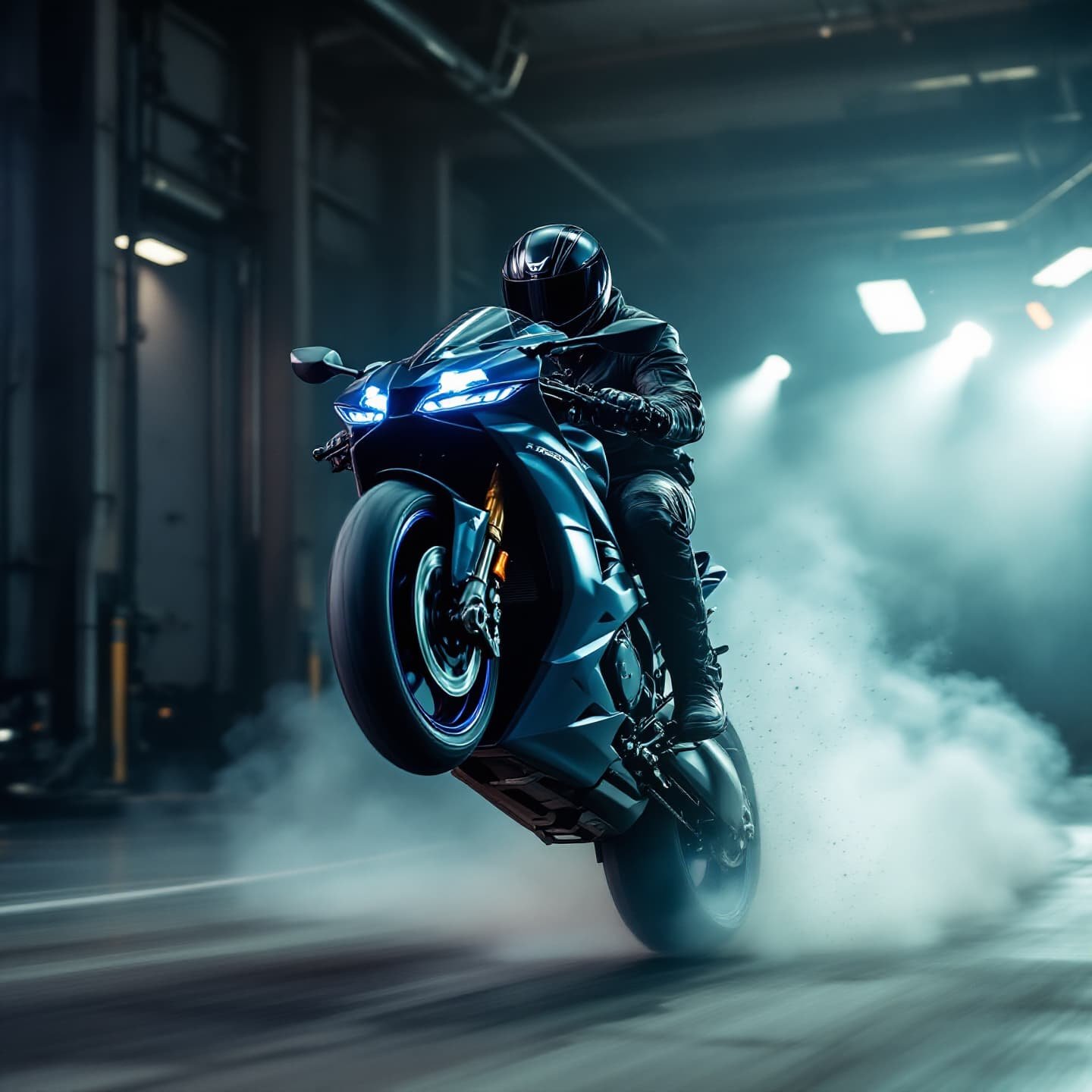
Basic stunt riding course
- Format: Hybrid
- Duration: 3 months
- Hours: 300 H
- Language: English / Spanish
- Registration date: 23-10-2026
- Start date: 12-12-2026
- Available places: 3
780 $
Competencies and results
What you will learn
1. Fundamental Mastery of Stunt Riding: Essential Techniques and Progression
- Control and Balance: Fundamentals of motorcycle handling, including posture, dynamic balance, and center of gravity management.
- Acceleration and Braking: Advanced acceleration and braking techniques for precise and safe control in various stunt riding maneuvers.
- Wheelies: Complete mastery of the wheelie, from the initial phase to variations such as long wheelies, slow wheelies, and trick wheelies.
- Stoppies: Perfecting the stoppie, including distance control, height, and creative variations.
- Drifts and Turns: Learning controlled drift techniques and tight turns to master the motorcycle in dynamic movements.
- Fundamental Tricks: Introduction and practice of basic tricks such as burnouts, donuts, and other essential maneuvers.
- Safe Progression: Gradual learning methodology, emphasizing safety and Risk prevention.
Motorcycle Preparation: Tips on modifying and configuring your motorcycle for stunt riding.
Routines and Combinations: Creating and performing stunt riding routines, combining different tricks and movements.
Physical and Mental Training: Developing the strength, endurance, and concentration necessary for stunt riding.
2. Unlock Stunt Riding: Fundamentals, Evolution, and Total Control
- Master the Fundamental Position: Balance and Control.
- Learn Acceleration and Braking Techniques for Stunt Riding.
- Develop Steering Skills and Basic Maneuvers.
- Understand the Importance of Safety and Equipment.
- Explore Wheeling Techniques: Mastery and Progression.
- Practice the Stoopie: Control and Management of the Front Brake.
- Introduction to Special Turns and Movements.
- Refine Body Control and Posture in Motion.
- Study Motorcycle Dynamics in Different Maneuvers.
- Analyze Countersteering Theory and its Application.
- Learn to Adapt to Different Surfaces and Conditions.
Develop reaction and problem-solving skills.
Learn advanced wheeling techniques: highchair and lowchair.
Practice extended and controlled stoopies.
Explore dynamic turns and maneuver combinations.
Understand the psychology of stunt riding: fear and confidence.
Implement training strategies for continuous improvement.
Develop stunt riding routines and combinations.
Learn to evaluate and improve personal performance.
Introduction to competition and performance.
3. Comprehensive user-oriented design and validation (from modeling to manufacturing)
You will learn to integrate the entire product development process, from initial model conception to final validation, applying user-centered methodologies. You will develop skills in parametric design, ergonomics, simulation, sustainable materials, 3D visualization, and manufacturing management, ensuring efficient, safe solutions that meet current industry standards.
4. Basic Stunt Riding: Master the Initial Maneuvers and Advance
4. Basic Stunt Riding: Master the Initial Maneuvers and Advance
- Motorcycle Control: Familiarization with the controls, balance, and basic stance for stunt riding.
- Wheelie: Fundamental technique, balance, and control of acceleration and rear brake.
- Stoppie: Mastery of the front brake, control of the balance point, and controlled descent.
- Donuts: 360-degree spins, throttle control, and clutch management to maintain the spin.
- Burnout: Creating smoke with the rear wheel, throttle control, and clutch management.
- Slow Turns: Techniques for performing tight turns at low speed, balance control, and steering.
- Transitions: Combining different maneuvers, fluidity of movement, and adaptation to the environment.
- Safety: Personal protective equipment, Safety and risk prevention measures.
Basic maintenance: Motorcycle inspection, tune-up, and care of key components.
Progression: Development of a personalized training plan and gradual advancement in maneuvers.
5. Fundamentals of Stunt Riding: Initial Learning and Progressive Development
5. Stunt Riding Fundamentals: Initial Learning and Progressive Development
Mastering basic posture and balance on the motorcycle: learning to control the center of gravity.
Essential acceleration and braking techniques for stunt riding.
Introduction to basic tricks: controlled wheelie, initial stoppie.
Training hand-eye coordination and throttle sensitivity.
Developing spatial and speed awareness, crucial for safety.
Practice on different surfaces: asphalt, concrete, and controlled terrain.
Learning clutch and gear shifting for trick control.
Introduction to controlled burnouts.
Safe progression in skill development: Gradually increasing complexity.
6. Basic Stunt Riding: Acquire Key Skills and Progress
6. Basic Stunt Riding: Acquire Key Skills and Progress
Motorcycle Control: Mastering balance, acceleration, and braking for precise maneuvers.
Basic Techniques: Learning to perform wheelies, stoppies, and controlled drifts.
Posture and Positioning: Optimizing body posture for improved maneuverability and control.
Clutch and Throttle Management: Developing sensitivity to control power and execute tricks.
Safety and Prevention: Understanding safety measures and risk assessment to minimize injuries.
Who this program is for:
Basic stunt riding course
- Motorcycle stunt riding enthusiasts with a basic level of experience.
- Motorcyclists who want to learn fundamental stunt riding techniques to improve their control and skills on the bike.
- People interested in motorcycle safety and handling in extreme situations, learning to control the machine in unconventional maneuvers.
- Motorcyclists looking for a fun and exciting experience, exploring the world of stunt riding safely and in a controlled manner.
- Standards-driven curriculum: you will work with CS-27/CS-29, DO-160, DO-178C/DO-254, ARP4754A/ARP4761, ADS-33E-PRF from the first module.
- Accreditable laboratories (EN ISO/IEC 17025) with rotor bench, EMC/Lightning pre-compliance, HIL/SIL, vibrations/acoustics.
- Evidence-oriented TFM: safety case, test plan, compliance dossierand operational limits.
- Mentored by industry: teachers with experience in rotorcraft, tiltrotor, eVTOL/UAM and flight test.
- Flexible modality (hybrid/online), international cohorts and support from SEIUM Career Services.
- Ethics and security: safety-by-design approach, cyber-OT, DIH and compliance as pillars.
1.1 Introduction to Stunt Riding: Origins and Evolution
1.2 Essential Safety Equipment
1.3 Motorcycle Selection and Preparation
1.4 Correct Position and Basic Control
1.5 Fundamental Balance Techniques
1.6 Throttle and Braking Control
1.7 Warm-up and Stretching Exercises
1.8 First Steps: Static and Dynamic Wheeling
1.9 Risk Prevention and Management
1.10 Basic Motorcycle Maintenance for Stunt Riding
2.2 Body Position and Static Balance on the Motorcycle
2.2 Throttle Control and Low-Speed Braking
2.3 Clutch Mastery and Friction Point
2.4 Basic Steering and Countersteering Techniques
2.5 Introduction to Wheelies: Control and Safety
2.6 First Steps in Stoppies: Controlled Braking
2.7 Agility and Handling Drills in Tight Spaces
2.8 Fundamentals of Motor Coordination and Proprioception
2.9 Motorcycle Preparation: Adjustments and Basic Maintenance
2.20 Accident Prevention and Safety Protocols
3.3 Introduction to Stunt Riding: Definition and Key Concepts
3.2 Essential Safety Equipment and Bike Preparation
3.3 Fundamental Position and Posture for Control
3.4 Dynamic Balance: Mastering Stability in Motion
3.5 Basic Wheelie: Technique, Throttle Control, and Balance
3.6 Rear Brake Control: Technique and Practice
3.7 Clutch Control: Technique and Practice
3.8 Progression: Combining Techniques and Fluidity
3.9 Tips for Safe Practice and Gradual Development
3.30 Bike Maintenance and Care for Stunt Riding
4.4 Introduction to Stunt Riding: What is it and why?
4.2 Essential Equipment and Safety
4.3 Posture and Balance: Key Fundamentals
4.4 Throttle and Clutch Control: Mastering the Bike
4.5 First Maneuvers: Acceleration, Braking, and Turning
4.6 Basic Control Techniques: Eye Contact, Weight Shifting, and Countersteering
4.7 Practice in a Safe Environment: Tips and Recommendations
4.8 Evaluating and Monitoring Progress
4.9 Introduction to Bike Modifications
4.40 Physical and Mental Preparation for Stunt Riding
5.5 Posture and Balance: Essential fundamentals for motorcycle control.
5.5 Throttle Control: Mastering the throttle and managing power.
5.3 Precise Braking: Essential braking techniques for stunt riding.
5.4 Clutch Control: Clutch management for speed and power control.
5.5 Initial Wheelie: First steps and basic front wheel control.
5.6 Stoppie: Braking and balance techniques for lifting the rear wheel.
5.7 580-Degree Turns: Mastering slow and fast turns.
5.8 Progression and Safety: Safety rules and gradual progression in learning.
5.9 Motorcycle Maintenance: Basic tips for motorcycle care and maintenance.
5.50 Practice and Repetition: The importance of consistent practice for improvement.
6.6 Initial Position and Balance on the Motorcycle
6.2 Throttle and Clutch Control
6.3 Braking Techniques and Steering Control
6.4 Mastering the Basic Wheelie: Balance and Control
6.5 Introduction to the Stopper: Control and Braking
6.6 Donut Techniques: Rotation and Control
6.7 Transitions and Combinations of Basic Maneuvers
6.8 Safety and Risk Prevention
6.9 Basic Motorcycle Maintenance
6.60 Progression and Skill Development
- Hands-on methodology: test-before-you-trust, design reviews, failure analysis, compliance evidence.
- Software (depending on licenses/partners): MATLAB/Simulink, Python (NumPy/SciPy), OpenVSP, SU2/OpenFOAM, Nastran/Abaqus, AMESim/Modelica, acoustics tools, planning toolchains DO-178C.
- SEIUM Laboratories: scale rotor bench, vibrations/acoustics, EMC/Lightning pre-compliance, HIL/SIL for AFCS, data acquisition with strain gauging.
- Standards and compliance: EN 9100, 17025, ISO 27001, GDPR.
Capstone-type projects
- Mastering Stunt Riding: Progression of essential techniques.
- Stunt Riding: Fundamentals, control, and evolution.
- Basic Stunt Riding Skills: Progressive leveling.
- Basic Stunt Riding: Initial maneuvers and advancement.
- Stunt Riding Fundamentals: Learning and development.
- Basic Stunt Riding: Key skills and progress.
- Basic Stunt Riding: Skills and motor development.
- Basic Stunt Riding: Skill development and control.
- Progressive Mastery: Techniques, Control, and Evolution of Stunt Riding.
- Solid Foundations: Key Skills and Development of Stunt Riding.
- Total Control: Initial, Advanced, and Progressive Maneuvers in Stunt Riding.
- Intensive Development: Basic Skills and Level Up in Stunt Riding.
- Stunt Riding Mastery: Fundamentals & Progression; Essential Techniques; Control & Evolution.
- Stunt Riding Skills: Basic Maneuvers; Initial Mastery; Progressive Development.
- Stunt Riding Evolution: Key Skills; Motor Skills; Total Control.
- Stunt Riding: Progression: Techniques, Evolution, Total Control, and Basic Skills.
- Stunt Riding: Fundamentals: Initial Maneuvers, Progressive Development, and Key Skills.
- Stunt Riding: Development: Skills, Motor Control, and Initial Skills.
Admissions, fees, and scholarships
- Profile: Background in Computer Engineering, Mathematics, Statistics, or related fields; practical experience in NLP and valued information retrieval systems.
- Documentation: Updated CV, academic transcript, SOP/statement of purpose, project examples or code (optional).
- Process: Application → Technical evaluation of profile and experience → Technical interview → Review of case studies → Final decision → Enrollment.
- Fees:
- Single payment: 10% discount.
- Payment in 3 installments: No fees; 30% upon registration + 2 equal monthly payments of the remaining 35%.
Monthly payment: available with a 7% commission on the total; annual review.
Scholarships: based on academic merit, financial need, and promoting inclusion; agreements with companies in the sector for partial or full scholarships.
See “Calendar & Calls for Applications,” “Scholarships & Grants,” and “Fees & Financing” in the SEIUM mega-menu.
Do you have any questions?
Our team is ready to help you. Contact us, and we will respond as soon as possible.
F. A. Q
Frequently asked questions
Yes, we have international certification
Yes: experimental models, real data, applied simulations, professional environments, real case studies.
It is not mandatory. We offer leveling tracks and tutoring.
Completely. It covers e-propulsion, integration, and emerging regulations (SC-VTOL).
Recommended. There are also internal challenges and consortiums.
Yes. Online/hybrid modality with planned labs and visa support (see “Visa & Residence”).