

Introduction to CAD modeling course for automotive parts
About our
The Introduction to CAD Modeling for Automotive Parts Course
This course provides a solid foundation in computer-aided design (CAD) specifically for the automotive industry. It covers the creation and modification of 3D part models, the use of specialized design tools, and an understanding of manufacturing principles. The course focuses on practical application for part design, preparing students for the use of leading software and participation in the vehicle development process.
It focuses on modeling automotive components, from individual parts to complex assemblies, with an emphasis on optimizing the design for production. It provides the necessary skills for interpreting technical drawings, selecting materials, and validating the design. The training prepares students for roles such as CAD designer, 3D modeler and automotive design technician, boosting employability in the sector.
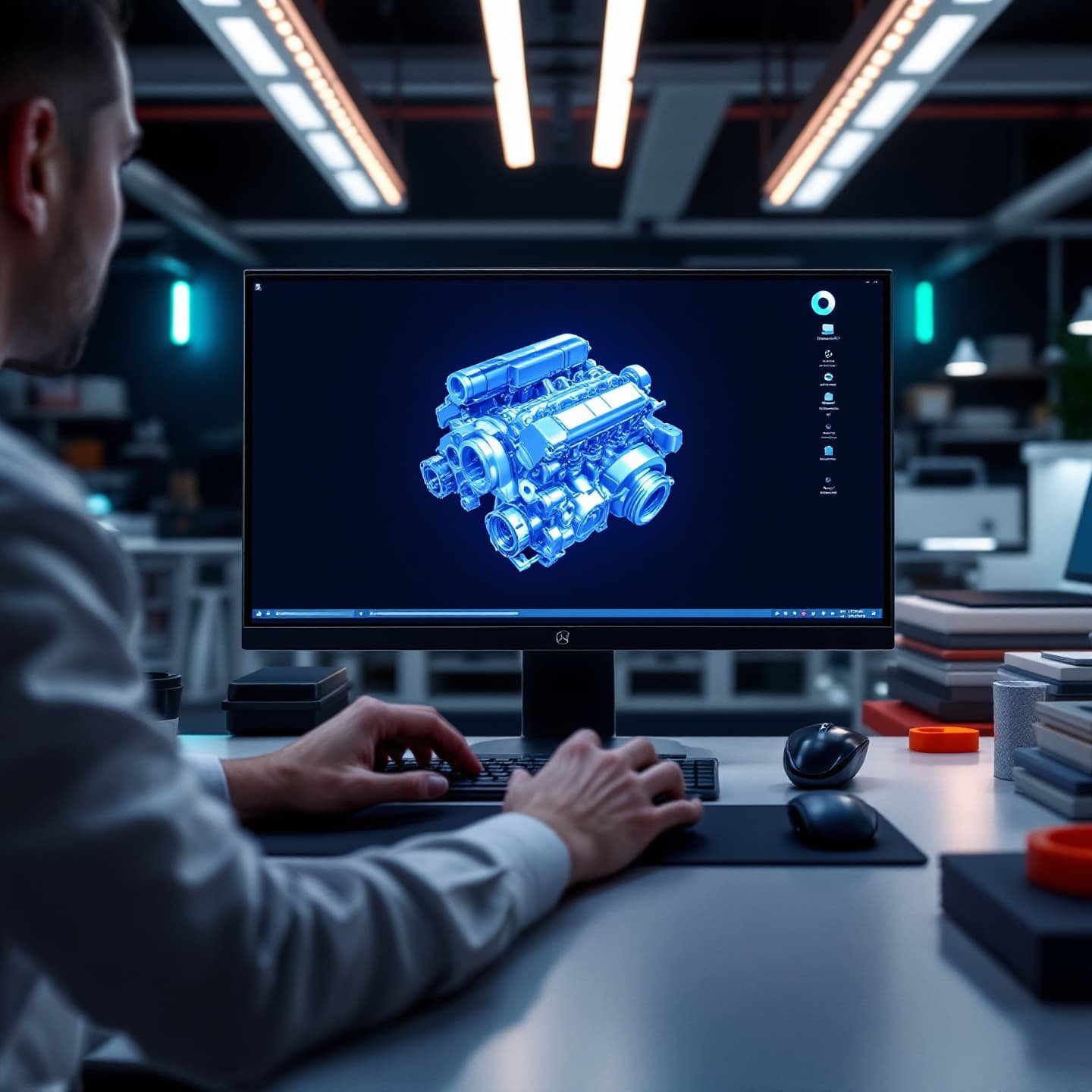
Introduction to CAD modeling course for automotive parts
- Format: Hybrid
- Duration: 3 months
- Hours: 300 H
- Language: English / Spanish
- Registration date: 23-10-2026
- Start date: 12-12-2026
- Available places: 3
349 $
Competencies and results
What you will learn
1. CAD Design of Automotive Parts: Mastery of 3D Modeling
- Master advanced 3D modeling of automotive parts using industry-leading CAD software.
- Apply generative design techniques to optimize part performance and efficiency.
- Create parametric models and complex assemblies for greater flexibility and accuracy.
- Understand and apply the principles of Design for Manufacturing (DFM) and Design for Assembly (DFA).
- Generate detailed technical drawings and accurate documentation for part production.
- Perform finite element analysis (FEA) simulations to evaluate the strength, durability, and behavior of parts under various conditions.
- Optimize part design to reduce weight, improve safety, and meet automotive industry regulations.
- Utilize collaboration and data management tools to work effectively in design teams.
- Integrate CAD design with other processes Engineering techniques, such as additive manufacturing (3D printing) and CNC machining.
Develop a solid understanding of automotive industry materials, manufacturing processes, and standards.
2. CAD Modeling of Automotive Components: Fundamentals and Applications
- Master the fundamentals of computer-aided design (CAD) and its application in the automotive industry.
- Understand and apply the principles of CAD modeling for the creation of automotive components, from individual parts to complex assemblies.
- Learn to use specialized CAD software for vehicle design, including tools for modeling surfaces, solids, and assemblies.
- Explore different CAD modeling techniques, such as parametric modeling, direct modeling, and surface modeling, and know when and how to apply each one.
- Acquire skills for creating detailed and accurate technical drawings, including views, sections, dimensions, and tolerances.
- Analyze and optimize automotive component designs using CAD analysis tools, such as finite element analysis (FEA).
- Understand and apply automotive industry standards and norms in CAD design and modeling.
Explore the different manufacturing technologies for automotive components and how CAD design relates to them, including 3D printing and CNC machining.
Develop problem-solving and critical thinking skills in the context of automotive component CAD design and modeling.
Learn to work in a team and effectively communicate CAD designs using collaboration and presentation tools.
3. Comprehensive user-oriented design and validation (from modeling to manufacturing)
You will learn to integrate the entire product development process, from initial model conception to final validation, applying user-centered methodologies. You will develop skills in parametric design, ergonomics, simulation, sustainable materials, 3D visualization, and manufacturing management, ensuring efficient, safe solutions that meet current industry standards.
4. Automotive CAD Design: Introduction to Modeling and Development of Parts
- Fundamentals of Automotive CAD Design: Understanding the interface and essential tools.
- Automotive Part Modeling: Creating accurate 3D models of components.
- Assembly Design: Assembling parts to form functional vehicle models.
- Parametric Modeling Techniques: Using parameters to easily modify designs.
- Creating Technical Drawings: Generating detailed 2D drawings for manufacturing.
- Introduction to Simulation and Analysis: Evaluating the performance of designed parts.
- Modeling Complex Surfaces: Mastering the creation of aerodynamic shapes.
- Design Optimization: Improving the efficiency and functionality of parts.
- Part Development Principles: Material and manufacturing considerations.
- Applications of CAD Design in the Automotive Industry: Practical examples and case studies of study.
5. CAD Modeling in Automotive: Design of Parts and Components
- Master automotive-specific CAD (Computer-Aided Design) software, such as CATIA, SolidWorks, or similar.
- Create accurate 3D models of vehicle parts and components, from individual parts to complex assemblies.
- Understand and apply automotive industry design standards and norms.
- Perform design analysis and virtual simulation to optimize the performance, safety, and efficiency of designs.
- Design and model different types of automotive components, including bodies, chassis, engines, and transmission systems.
- Use CAD tools to create detailed technical drawings for manufacturing.
- Apply advanced CAD modeling techniques, such as complex surfaces, parametric assemblies, and plastic part design.
- Manage CAD design projects, from initial concept to final production.
Learn about the materials used in the automotive industry and how they influence the design of parts.
Integrate CAD models with other software systems used in vehicle development, such as CAM (Computer-Aided Manufacturing) and CAE (Computer-Aided Engineering) systems.
6. CAD Modeling for Automotive: Creation and Analysis of Parts
6. CAD Modeling for Automotive: Part Creation and Analysis
Master the design of automotive parts using specialized CAD software.
Create accurate and detailed 3D models of vehicle components.
Apply advanced modeling techniques, including complex surfaces and solids.
Perform simulations of part assembly and fit.
Analyze the functionality and performance of modeled parts.
Optimize designs for manufacturing and regulatory compliance.
Generate technical documentation, such as drawings and bills of materials.
Understand the principles of additive manufacturing (3D printing) and its application in automotive engineering.
Use finite element analysis (FEA) tools to evaluate the strength and durability of parts.
Apply knowledge of materials and processes to manufacturing to select the appropriate materials and optimize the designs.
Who this program is for:
Introduction to CAD modeling course for automotive parts
- Engineers with degrees in Mechanical Engineering, Industrial Engineering, Automotive Design, or related vehicle design fields.
- Professionals working in the automotive industry, including automotive manufacturers (OEMs), component suppliers, and design firms.
- Product designers, design engineers, and CAD modelers who wish to enhance their skills in automotive part modeling.
- Students and recent graduates seeking a solid introduction to CAD modeling and aspiring to work in the automotive sector.
Recommended requirements: Basic knowledge of technical drawing and familiarity with computer use. No prior experience with specific CAD software is required.
- Standards-driven curriculum: you will work with CS-27/CS-29, DO-160, DO-178C/DO-254, ARP4754A/ARP4761, ADS-33E-PRF from the first module.
- Accreditable laboratories (EN ISO/IEC 17025) with rotor bench, EMC/Lightning pre-compliance, HIL/SIL, vibrations/acoustics.
- Evidence-oriented TFM: safety case, test plan, compliance dossierand operational limits.
- Mentored by industry: teachers with experience in rotorcraft, tiltrotor, eVTOL/UAM and flight test.
- Flexible modality (hybrid/online), international cohorts and support from SEIUM Career Services.
- Ethics and security: safety-by-design approach, cyber-OT, DIH and compliance as pillars.
Module 1 — Introduction to 3D Modeling in Automotive Engineering
1.1 Introduction to CAD modeling and its importance in the automotive industry
1.2 CAD software: tool selection and comparison
1.3 CAD software interface and navigation
1.4 Creating 2D sketches: fundamentals and techniques
1.5 Extrusion and revolution: creating basic 3D shapes
1.6 Introduction to Boolean operations: union, subtraction, and intersection
1.7 Designing simple parts: practical exercises
1.8 Model management fundamentals: organization and naming conventions
1.9 Introduction to design documentation: drawings and views
1.10 Examples of 3D modeling applications in automotive engineering
2.2 Introduction to CAD Modeling in Automotive Components
2.2 CAD Design Fundamentals: Tools and Concepts
2.3 3D Modeling of Components: Shafts, Supports, and Structures
2.4 Assembly Design: Part Interaction and Functionality
2.5 Design of Standard Parts: Screws, Nuts, and Fasteners
2.6 Modeling of Engine Components: Block, Crankshaft, Pistons
2.7 Suspension System Design: Shock Absorbers and Springs
2.8 Braking System Design: Discs, Calipers, and Pads
2.9 CAD Design Analysis: Interference Checking and Optimization
2.20 Documentation of CAD Models: Drawings and Technical Specifications
3.3 Introduction to CAD Design in Automotive: Key Concepts
3.2 CAD Software: Selection and Familiarization
3.3 Modeling Automotive Parts: Creating 3D Geometries
3.4 Component Assembly: Creating Complex Models
3.5 Surface Design: Aesthetics and Functionality
3.6 Simulation and Analysis: Design Validation
3.7 Design for Manufacturing: Considerations and Optimization
3.8 Technical Documentation: Drawings and Specifications
3.9 Vehicle Interior Design: Ergonomics and Aesthetics
3.30 Trends in Automotive CAD Design: Innovation and the Future
4.4 Fundamentals of Automotive CAD Design: Introduction to 3D Modeling
4.2 CAD Software: Selection and Familiarization
4.3 User Interface (UI) and User Experience (UX) Design in Automotive
4.4 Modeling Simple Parts: Principles and Techniques
4.5 Component Assembly: Creating Sub-Assemblies
4.6 Chassis and Body Design: First Steps
4.7 Design Documentation: Drawings and Specifications
4.8 Rendering and Visualization: Presenting CAD Models
4.9 Introduction to Simulation in Automotive Design
4.40 Trends in Automotive CAD Design
5.5 Fundamentals of CAD Design in Automotive Engineering
5.5 Introduction to CAD Software: Interface and Tools
5.3 Principles of 5D and 3D Modeling
5.4 Design Concepts: Types of Parts and Components
5.5 Standards and Regulations in Automotive Design
5.6 Importance of CAD Design in the Automotive Industry
5.5 Basic 3D Modeling: Extrusion, Revolve, Sweep
5.5 Surface Modeling: Advanced Techniques
5.3 Component Assembly: Relationships and Constraints
5.4 Design of Standard Components: Screws, Nuts, etc.
5.4 5.5 Creating Virtual Prototypes
5.6 Applications of 3D Modeling in Different Automotive Systems
3.5 Design for Manufacturing (DFM)
3.5 Part Optimization: Weight, Strength, Durability
3.3 Force and Stress Analysis (FEA)
3.4 Parametric Design: Flexibility and Adaptability
3.5 Tolerances and Fits: Ensuring Assembly
3.6 Design Validation: Simulation and Virtual Testing
4.5 Introduction to CAD Modeling of Complex Parts
4.5 Part Development: Workflow and Methodology
4.3 Body Design: Concepts and Challenges
4.4 Interior Design: Components and Ergonomics
4.5 Design Documentation: Drawings and Technical Specifications
4.6 CAD Design Project Management
5.5 Part Design: Material Selection and Properties
5.5 Component Creation: Engine, Transmission, Suspension
5.3 Mold and Tooling Design for Manufacturing
5.4 Part Integration: Assembly and Connections
5.5 Design for Assembly (DFA)
5.6 Design Evaluation: Virtual Testing and Validation
6.5 Tolerance Analysis and Tolerance Stacking
6.5 Finite Element Analysis (FEA): Fundamentals
6.3 Motion and Kinematic Simulation
6.4 Computational Fluid Dynamics (CFD)
6.5 Results Analysis and Decision Making
6.6 Analysis-Based Design Optimization
7.5 3D Design of Engine Components
7.5 3D Design of Suspension Systems
7.3 3D Design of Braking Systems
7.4 3D Design of Electrical and Electronic Systems
7.5 3D Design of Interiors and Exteriors
7.6 Virtual Integration and Assembly of Components
8.5 Part Design Specifics: Bodywork, Chassis, Interiors
8.5 Focus on the Aesthetics and Functionality of Design
8.3 User-Centered Design
8.4 Rapid Prototyping Design
8.5 Design for Sustainability and the Environment
8.6 Design Management and Team Collaboration
6.6 Introduction to CAD Design in Automotive: Key Concepts
6.2 Automotive-Specific CAD Software: Tools and Functionalities
6.3 3D Component Modeling: Advanced Techniques
6.4 Part Design: Principles and Applications in Automotive Engineering
6.5 Structural and Performance Analysis: CAD Simulation
6.6 Design Optimization: Techniques for Improving Efficiency
6.7 Creating Virtual Prototypes: Assembly and Validation
6.8 Technical Documentation: Drawings and Specifications
6.9 Collaboration and Management of CAD Projects
6.60 Trends in Automotive CAD Design
- Hands-on methodology: test-before-you-trust, design reviews, failure analysis, compliance evidence.
- Software (depending on licenses/partners): MATLAB/Simulink, Python (NumPy/SciPy), OpenVSP, SU2/OpenFOAM, Nastran/Abaqus, AMESim/Modelica, acoustics tools, planning toolchains DO-178C.
- SEIUM Laboratories: scale rotor bench, vibrations/acoustics, EMC/Lightning pre-compliance, HIL/SIL for AFCS, data acquisition with strain gauging.
- Standards and compliance: EN 9100, 17025, ISO 27001, GDPR.
Capstone-type projects
- CAD Design & Simulation: Comprehensive modeling of automotive components (engine, chassis, body) for optimization, stress analysis, and virtual testing.
- 3D Suspension Modeling: Design, simulation, and analysis of automotive components (CAD).
- Body Design: CAD modeling, aerodynamic optimization, and virtual testing.
- Engine Simulation: Parts design (CAD), performance and efficiency analysis.
- Disc Brakes: CAD modeling, structural and thermal analysis, and optimization.
- Impact Testing: CAD design, collision simulation, and safety analysis.
- 3D Modeling of an Automotive Engine: CAD design of key parts, performance optimization, and assembly simulation.
- Advanced 3D Modeling: CAD design of a complete automotive engine (block, cylinder head, pistons).
- Simulation and Analysis: CFD study of intake and exhaust flow, aerodynamic optimization.
- Component Integration: CAD assembly of a chassis, simulation of impacts and stresses.
- Design for Manufacturing: Design of parts for 3D printing and CNC machining.
Admissions, fees, and scholarships
- Profile: Background in Computer Engineering, Mathematics, Statistics, or related fields; practical experience in NLP and valued information retrieval systems.
- Documentation: Updated CV, academic transcript, SOP/statement of purpose, project examples or code (optional).
- Process: Application → Technical evaluation of profile and experience → Technical interview → Review of case studies → Final decision → Enrollment.
- Fees:
- Single payment: 10% discount.
- Payment in 3 installments: No fees; 30% upon registration + 2 equal monthly payments of the remaining 35%.
Monthly payment: available with a 7% commission on the total; annual review.
Scholarships: based on academic merit, financial need, and promoting inclusion; agreements with companies in the sector for partial or full scholarships.
See “Calendar & Calls for Applications,” “Scholarships & Grants,” and “Fees & Financing” in the SEIUM mega-menu.
Do you have any questions?
Our team is ready to help you. Contact us, and we will respond as soon as possible.
F. A. Q
Frequently asked questions
Yes, we have international certification
Yes: experimental models, real data, applied simulations, professional environments, real case studies.
It is not mandatory. We offer leveling tracks and tutoring.
Completely. It covers e-propulsion, integration, and emerging regulations (SC-VTOL).
Recommended. There are also internal challenges and consortiums.
Yes. Online/hybrid modality with planned labs and visa support (see “Visa & Residence”).