

Course on international space law
About our
The International Space Law Course explores the laws and regulations governing activities in outer space, including the exploration, exploitation, and peaceful use of space. Key international treaties, such as the Outer Space Treaty, are examined, and relevant national legislation is analyzed. The course addresses crucial issues such as international responsibility for damage caused by space objects, the regulation of geostationary orbit, ownership of space resources, and space security. The importance of space law for the sustainability of space activities and conflict prevention is emphasized. The program aims to train professionals skilled in areas such as space law, space resource management, space policy, and space diplomacy. The program delves into the practical application of space law, including specific cases, discussions on new space technologies and their legal implications, and policy development. It explores the relationships between space law and other disciplines such as space science, aerospace engineering, and international politics, seeking a comprehensive understanding of the space ecosystem. It also analyzes the challenges posed by space commerce, space mining, and space tourism. This training prepares professionals for roles such as space law specialists, legal advisors in space companies, and officials of international organizations involved in space regulation.
Target keywords (natural occurrences in the text): space law, international space law, international treaties, space exploration, peaceful use of space, international responsibility, space legislation, space diplomacy, space commerce, space mining.
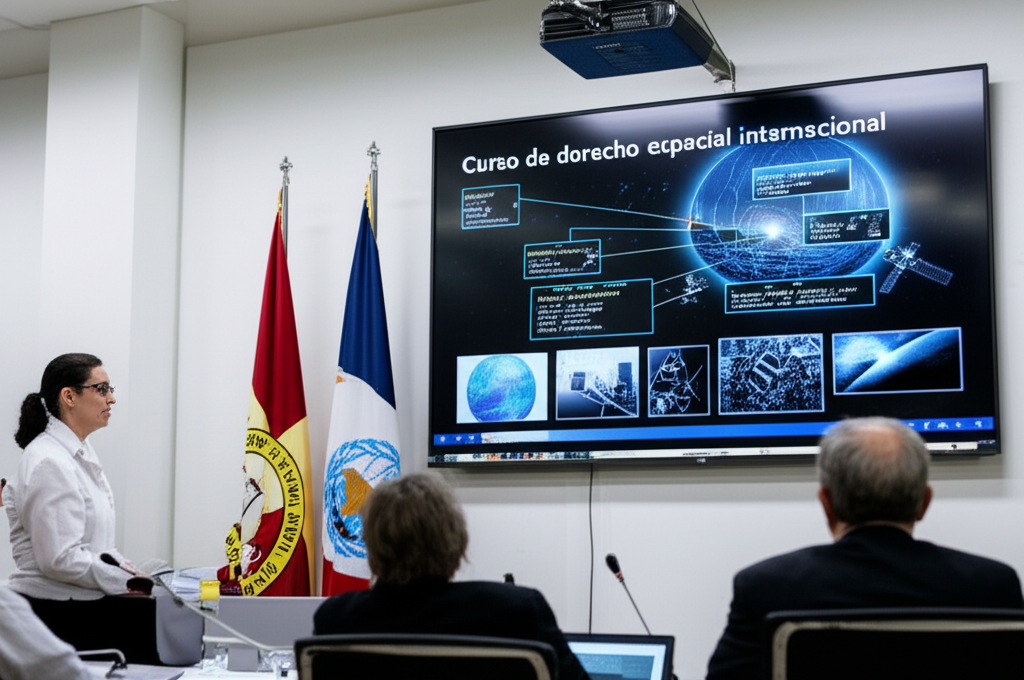
Course on international space law
- Format:
- Duration:
- Hours: 300 H
- Language:
- Credits:
- Registration date: 23-10-2026
- Start date: 12-12-2026
- Available places: 5
799 $
Competencies and results
What you will learn
1. Global Domain: Foundations and Challenges of International Space Law
- Understand the evolution of International Space Law and its normative sources.
- Identify the fundamental principles governing activities in outer space.
- Analyze the existing legal framework on the exploration and use of space, including the Moon and other celestial bodies.
- Evaluate current and future challenges to International Space Law, such as sustainability, militarization, and ownership.
- Study international regulations on liability for damage caused by space objects.
- Explore the legal regimes on the use of space resources and their economic implications.
- Examine disputes and conflicts in space, and the mechanisms for their resolution.
- Investigate the impact of new space technologies on International Space Law.
- Analyze national space regulations and their relationship to international space law.
- Consider the role of international organizations in regulating space activities.
international.
2. Legal Exploration of Space: Learning International Space Law
- Understand the foundations of International Space Law and its sources.
- Analyze the Outer Space Treaty of 1967 and its implications.
- Study the regulation of activities in space, including the launch, use, and return of space objects.
- Identify responsibilities and international liability for damage caused by space activities.
- Explore the regulations on the use of space resources, such as asteroid mining.
- Analyze the legal framework for space security and the fight against space debris.
- Evaluate the legal challenges posed by new space technologies, such as artificial intelligence.
- Learn about the relevant international institutions and organizations in the field of Space Law.
3. Comprehensive user-oriented design and validation (from modeling to manufacturing)
You will learn to integrate the entire product development process, from initial model conception to final validation, applying user-centered methodologies. You will develop skills in parametric design, ergonomics, simulation, sustainable materials, 3D visualization, and manufacturing management, ensuring efficient, safe solutions that meet current industry standards.
4. Stellar Governance: A Course in International Space Law
4. Stellar Governance: A Course in International Space Law
- Understand the foundations of International Space Law: history, principles, and sources.
- Analyze the 1967 Outer Space Treaty and other key treaties related to space activity.
- Evaluate jurisdiction and control in outer space: states, international organizations, and private entities.
- Study international responsibility for damage caused by space objects and activities in space.
- Explore the legal framework for the use of space resources and property in space.
- Examine the regulation of launch activities and commercial space operations.
- Analyze the governance of space security, including the prevention of militarization and protection against threats.
- Understand the law applicable to lunar exploration, the exploration of Mars, and other celestial bodies.
- To study dispute resolution in the space domain and the mechanisms for enforcing the law.
- To evaluate the role of international organizations, such as the UN, in space governance.
5. Cosmic Jurisprudence: Deciphering International Space Law
5. Cosmic Jurisprudence: Deciphering International Space Law
- Identify the foundations of International Space Law.
- Understand the guiding principles of the exploration and use of outer space.
- Analyze the Outer Space Treaty and other relevant legal instruments.
- Evaluate jurisdiction and responsibility in space activities.
- Study the legal framework of intellectual property in the space context.
- Examine regulations on the use of space resources.
- Explore the legal challenges related to space security and defense.
- Discuss the role of international organizations in space law.
- Analyze practical cases and controversies in the field of Space Law.
- Project the future evolution of Space Law in light of advancements technological.
6. Navigating Laws: A Comprehensive Course in International Space Law
6. Navigating Laws: A Comprehensive Course in International Space Law
- Foundations of International Space Law: Explore the legal foundations governing activities in outer space, including treaties, conventions, and fundamental principles.
- Regulation of Space Activities: Analyze national and international legislation regulating the launch and operation of satellites, lunar and planetary exploration, and other space activities.
- Legal Framework for the Use of Space: Examine the laws related to the use of space resources, satellite communication, navigation, and Earth observation.
- Liability and Damages in Space: Understand the rules on legal liability for damages caused by space objects, including identifying responsibilities and compensation mechanisms.
- Space Environmental Law: Explore the laws and regulations that protect the space environment, such as pollution prevention and space debris management.
- International Cooperation in Space: Analyzes the international agreements and organizations that promote cooperation in the exploration and use of space, including the role of space agencies and private companies.
- Challenges and Future of Space Law: Evaluates the emerging legal challenges related to the proliferation of satellites, space tourism, asteroid mining, and other technological developments, and the future prospects of space law.
Who this program is for:
Course on international space law
- Legal professionals, legal advisors, and lawyers specializing in or interested in space law.
- Government officials and staff of international organizations involved in the regulation and governance of outer space.
- University graduates in Law, International Relations, Political Science, or related disciplines who wish to specialize in international space law.
- Researchers and academics interested in the research and study of the legal framework governing space activities.
- Standards-driven curriculum: you will work with CS-27/CS-29, DO-160, DO-178C/DO-254, ARP4754A/ARP4761, ADS-33E-PRF from the first module.
- Accreditable laboratories (EN ISO/IEC 17025) with rotor bench, EMC/Lightning pre-compliance, HIL/SIL, vibrations/acoustics.
- Evidence-oriented TFM: safety case, test plan, compliance dossierand operational limits.
- Mentored by industry: teachers with experience in rotorcraft, tiltrotor, eVTOL/UAM and flight test.
- Flexible modality (hybrid/online), international cohorts and support from SEIUM Career Services.
- Ethics and security: safety-by-design approach, cyber-OT, DIH and compliance as pillars.
Module 1 — Foundations and Challenges of International Space Law
1.1 Introduction to International Space Law: Origins and Evolution
1.2 Fundamental Principles: Non-appropriation, common benefit, exploration, and peaceful use
1.3 Key Treaties and Agreements: The Outer Space Treaty, the Agreement on the Rescue of Astronauts, the Liability Convention, the Registration Convention, and the Moon Agreement
1.4 Actors in Space: States, international organizations, private companies, and the role of collaboration
1.5 Contemporary Challenges: Militarization, space debris, resource exploitation, space tourism, and security
1.6 The Lawfulness of Space Use: Key concepts, rules, and limitations on space use
1.7 Global Space Governance: Regulatory bodies, international forums, and the search for a stable legal framework 1.8 The impact of space law on economic activity and technological development.
1.9 Emerging issues: Artificial intelligence in space, cybersecurity, and data protection.
1.10 Case studies: Analysis of disputes and relevant examples in the field of international space law.
2.2 Treaties and Fundamental Principles of Space Law
3.2 The Definition and Delimitation of Outer Space
4.3 Activities in Space: Exploration, Use, and Exploitation
5.4 Liability and Damages in Space
6.5 The Role of International Organizations
7.6 Legal Framework for Space Cooperation
8.7 Sustainability and Protection of the Space Environment
9.8 Dispute Resolution in Space
20.9 Current and Future Challenges of Space Law
22.20 Case Studies: Analysis of Space Disputes and Agreements
3.3 Treaties and Fundamental Principles of Space Law
3.2 The Definition of Outer Space and its Delimitation
3.3 Space Activities: Concepts and Legal Classifications
3.4 The Principle of Non-Appropriation and the Free Exploration of Space
3.5 Liability and Damages Caused by Space Activities
3.6 Registration of Objects Launched into Space
3.7 International Cooperation in Space Activities
3.8 The Legal Framework for Commercial Activities in Space
3.9 The Protection of the Space Environment
3.30 The Future of Space Law: Challenges and Perspectives
4.4 Fundamental Principles of Space Governance
4.2 International Treaties and Their Application in Space
4.3 The Role of International Organizations
4.4 Legal Framework for Space Activities
4.5 Liability and Damages in Space
4.6 The Military Use of Space: Challenges and Regulations
4.7 Space Ownership and Resources
4.8 The Future of Space Governance
4.9 Conflict Resolution in Space
4.40 Emerging Challenges and Future Perspectives
5.5 Principles of Jurisdiction in Space
5.5 Relevant International Treaties and Agreements
5.3 Law Enforcement in Outer Space
5.4 The Role of International Organizations
5.5 Dispute Resolution in Space
5.6 State Responsibility for Space Activities
5.7 Jurisdiction over Space Objects
5.8 Jurisdiction on the International Space Station
5.9 Implications of the Militarization of Space
5.50 Future Challenges in Space Jurisdiction
6.6 Treaties and Fundamental Principles of Space Law
6.2 Non-Appropriation and the Peaceful Use of Outer Space
6.3 International Responsibility for Damage Caused by Space Objects
6.4 Registration of Objects Launched into Outer Space
6.5 Regulation of State Activities in Space
6.6 The Legal Framework for the Exploration and Exploitation of Space Resources
6.7 The Issue of Weapons in Space and Space Security
6.8 Commercial Space Law: Satellites and Telecommunications
6.9 Legal Aspects of Space Navigation and Tourism
6.60 Challenges and Future Perspectives of International Space Law
- Hands-on methodology: test-before-you-trust, design reviews, failure analysis, compliance evidence.
- Software (depending on licenses/partners): MATLAB/Simulink, Python (NumPy/SciPy), OpenVSP, SU2/OpenFOAM, Nastran/Abaqus, AMESim/Modelica, acoustics tools, planning toolchains DO-178C.
- SEIUM Laboratories: scale rotor bench, vibrations/acoustics, EMC/Lightning pre-compliance, HIL/SIL for AFCS, data acquisition with strain gauging.
- Standards and compliance: EN 9100, 17025, ISO 27001, GDPR.
Capstone-type projects
- Legal Analysis: Space Treaties, State Responsibility, Space Resources.
- Policies: Regulation of Space Activities, Licensing, National Security.
- Space Commerce: Contracts, Intellectual Property, Insurance, Dispute Resolution.
- Challenges: Space Weapons, Space Debris, Lunar and Martian Exploration.
- Satellite Analysis: Orbital design, trajectory simulation, and mission planning.
- Space Legal Framework: Research on international treaties, litigation, and space ownership.
- Global Space Policy: Analysis of actors, regulation, and geopolitical challenges in space.
- Space Security: Defense against threats, space debris management, and cybersecurity.
- Legal Analysis of Satellites: Regulation of the ownership and use of satellite data.
- Regulatory Framework for Space Mining: Study of resource extraction rights.
- Space Law and Conflicts: Analysis of the legality of weapons and defense in space.
- Space Contracting: Model agreements and liability in launches.
- Protection of the Space Environment: Regulation of orbital debris and pollution.
- Analysis of Space Treaties: Comparing the effectiveness and shortcomings of international agreements.
- Case Studies: Analyzing legal disputes and challenges in current and future space activities.
- Simulations and Modeling: Developing legal and regulatory scenarios for space exploration and exploitation.
- Policy Proposals: Creating recommendations to improve international space law.
Admissions, fees, and scholarships
- Profile: Background in Computer Engineering, Mathematics, Statistics, or related fields; practical experience in NLP and valued information retrieval systems.
- Documentation: Updated CV, academic transcript, SOP/statement of purpose, project examples or code (optional).
- Process: Application → Technical evaluation of profile and experience → Technical interview → Review of case studies → Final decision → Enrollment.
- Fees:
- Single payment: 10% discount.
- Payment in 3 installments: No fees; 30% upon registration + 2 equal monthly payments of the remaining 35%.
Monthly payment: available with a 7% commission on the total; annual review.
Scholarships: based on academic merit, financial need, and promoting inclusion; agreements with companies in the sector for partial or full scholarships.
See “Calendar & Calls for Applications,” “Scholarships & Grants,” and “Fees & Financing” in the SEIUM mega-menu.
Do you have any questions?
Our team is ready to help you. Contact us, and we will respond as soon as possible.
F. A. Q
Frequently asked questions
Yes, we have international certification
Yes: experimental models, real data, applied simulations, professional environments, real case studies.
It is not mandatory. We offer leveling tracks and tutoring.
Completely. It covers e-propulsion, integration, and emerging regulations (SC-VTOL).
Recommended. There are also internal challenges and consortiums.
Yes. Online/hybrid modality with planned labs and visa support (see “Visa & Residence”).