

Course on Coastal Protection against Erosion
About our
The Coastal Erosion Protection Course provides comprehensive training in the design, implementation, and management of solutions to mitigate the effects of coastal erosion. It addresses key topics such as coastal geology, hydrodynamics, and risk analysis, preparing participants to assess and select the most appropriate protection strategies, including breakwaters, groynes, and beach restoration. It focuses on the application of numerical models and field studies to predict and control erosion, considering the impact of climate change and sea-level rise. The course offers practical experience in environmental impact assessments, the use of simulation tools, and the design of coastal protection projects. Participants will become familiar with environmental legislation and international best practices. This training prepares professionals such as coastal engineers, environmental managers, public works technicians, and environmental consultants, enabling them to develop sustainable and resilient solutions to coastal erosion.
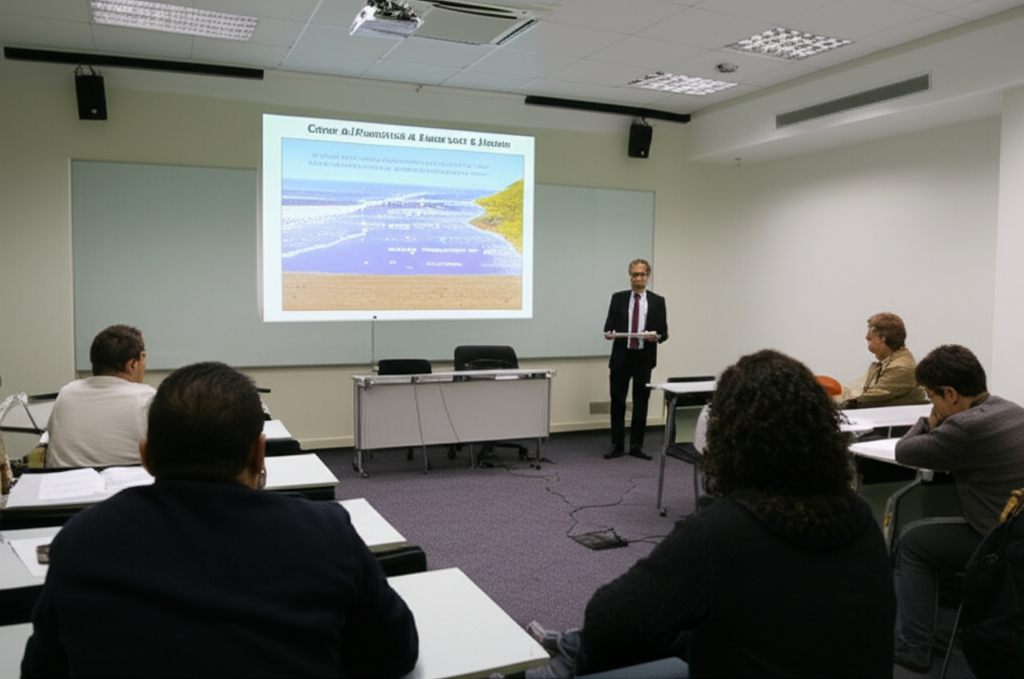
Course on Coastal Protection against Erosion
- Format: Online
- Duration: 3 months
- Hours: 300 H
- Language: English / Spanish
- Registration date: 23-10-2026
- Start date: 12-12-2026
- Available places: 3
425 $
Competencies and results
What you will learn
1. Coastal Erosion Management: Prevention, Analysis and Effective Strategies
- Identify and evaluate the factors causing coastal erosion, including waves, tides, currents, and climate change.
- Analyze coastal morphology and understand its evolution over time.
- Develop skills in interpreting geological, oceanographic, and climatic data for erosion prediction.
- Apply numerical modeling techniques to simulate coastal behavior and predict future scenarios.
- Design and implement erosion prevention strategies, including the construction of coastal protection structures such as breakwaters, groins, and seawalls.
- Evaluate the effectiveness of different types of coastal protection structures.
- Develop nature-based solutions for coastal erosion management, such as wetland restoration and dune reforestation.
- Understand and apply environmental and legal regulations related to erosion management Coastal.
- Manage erosion mitigation projects, including planning, design, implementation, and monitoring.
- Analyze case studies of successes and failures in coastal erosion management worldwide.
2. **Coastal Defense: Advanced Techniques and Integrated Solutions against Erosion**
- Understand the factors that cause coastal erosion: waves, ocean currents, tides, and extreme weather events.
- Identify and analyze the different types of coastal erosion: erosion of beaches, cliffs, dunes, and estuaries.
- Evaluate the risks associated with coastal erosion: loss of infrastructure, property damage, environmental impact, and risks to human life.
- Study traditional coastal protection techniques: walls, groins, breakwaters, and their effectiveness.
- Explore marine engineering solutions for coastal defense: design, construction, and maintenance of structures.
- Analyze the materials used in the construction of coastal defenses: concrete, steel, rock, geotextiles, and their durability.
- Learn about beach restoration techniques: sand replenishment, dune stabilization, and reforestation.
- Study nature-based solutions for coastal defense: mangroves, artificial reefs, and wetland restoration.
- Evaluate the environmental impact of different coastal defense solutions: effects on marine fauna and flora, and changes in the coastal landscape.
- Use modeling and simulation tools to predict coastal erosion and evaluate the effectiveness of implemented solutions.
- Understand the legislation and regulations related to coastal protection.
- Study case studies of successful coastal defense projects and their lessons learned.
- Learn about the latest technologies in coastal defense: drones, remote sensors, and monitoring systems.
- Develop skills for the planning, design, construction, and management of coastal defense projects.
- Analyze coastal resilience and strategies for adapting to climate change and sea-level rise.
3. Comprehensive user-oriented design and validation (from modeling to manufacturing)
You will learn to integrate the entire product development process, from initial model conception to final validation, applying user-centered methodologies. You will develop skills in parametric design, ergonomics, simulation, sustainable materials, 3D visualization, and manufacturing management, ensuring efficient, safe solutions that meet current industry standards.
4. **Coastal Protection: Innovative Strategies and Sustainable Erosion Management**
4. **Coastal Protection: Innovative Strategies and Sustainable Erosion Management**
- Evaluate the causes of coastal erosion: understand the natural (waves, tides, currents, climate) and anthropogenic (coastal development, climate change) factors that drive erosion.
- Identify and analyze coastal protection typologies: study the range of solutions, from hard structures (breakwaters, groynes, seawalls) to soft and nature-based solutions (beach restoration, dunes, mangroves).
- Master modeling and simulation techniques: apply hydrodynamic modeling tools (e.g., models based on the Saint-Venant equation) and sediment transport models to predict coastal evolution and the effectiveness of protection solutions.
- Design and dimension coastal protection structures: calculate hydrodynamic loads and select appropriate materials.
(concrete, rock, geotextiles) and dimension the structures to ensure their stability and durability.
Implement sustainable management strategies: integrate coastal erosion management with spatial planning, the protection of coastal ecosystems, and community participation.
Evaluate the environmental and economic impact: analyze the effects of shielding solutions on the environment, including ecosystem alteration, modification of ocean currents, and erosion in adjacent areas; assess the economic costs and benefits of different strategies.
Apply monitoring and maintenance techniques: implement monitoring systems to evaluate the performance of the structures and the evolution of the coastline; Develop preventive and corrective maintenance plans.
Manage coastal protection projects: manage the stages of a coastal protection project, from planning and design to construction, supervision, and post-construction evaluation.
Study international case studies: analyze successful and unsuccessful coastal protection projects in different parts of the world, learning from past experiences and adapting best practices to local conditions.
Integrate coastal resilience and adaptation to climate change: incorporate considerations of sea-level rise, the increased frequency and intensity of extreme events, and other effects of climate change into the design and management of coastal protection.
5. **Coastal Safeguard: In-depth Study, Strategic Protection and Erosion Control**
## What Will You Learn in Coastal Safeguarding: In-Depth Study, Strategic Protection, and Erosion Control?
1. **Fundamentals of Coastal Erosion:**
* Understand the natural and anthropogenic processes that cause coastal erosion.
* Identify risk factors and areas vulnerable to erosion.
* Analyze wave dynamics, ocean currents, and sediment transport.
2. **Study and Monitoring Techniques:**
* Apply research methodologies to assess coastal erosion.
* Use measurement tools, such as GPS, LiDAR, and photogrammetry, to obtain accurate data.
* Implement long-term monitoring systems to track shoreline evolution.
3. **Coastal Protection Strategies:**
* Evaluate different protection approaches, including hard and soft solutions.
* Design and construct protective structures, such as breakwaters, groins, and dikes.
* Implement sediment management techniques, such as dredging and beach replenishment.
4. **Strategic Erosion Control:**
* Develop integrated coastal management plans, considering environmental, economic, and social aspects.
* Establish regulations and policies for the sustainable use of the coastal zone.
* Promote community participation and environmental education in coastal protection.
5. **Modeling and Simulation:**
* Employ numerical models to simulate coastal erosion and evaluate the effectiveness of protection measures.
* Use specialized software to analyze hydrodynamics, sediment transport, and shoreline evolution.
* Interpret model results to optimize protection strategies.
6. **Innovative Materials and Technologies:**
* Explore the use of sustainable and environmentally friendly materials in the construction of coastal structures. * Investigate new technologies for erosion control, such as bioengineering and drainage systems.
* Evaluate the technical and economic feasibility of different innovative solutions.
6. **Coastal Fortification: Analysis, Design and Implementation of Anti-Erosion Solutions**
6. **Coastal Fortification: Analysis, Design, and Implementation of Anti-Erosion Solutions**
Understand the fundamentals of coastal erosion and its causes, including the influence of waves, tides, currents, and climate change.
Evaluate the impact of erosion on coastal infrastructure, ecosystems, and local communities.
Identify and analyze different types of anti-erosion solutions, including rigid structures (breakwaters, groins, retaining walls) and soft solutions (beach restoration, artificial dunes).
Conduct geotechnical and oceanographic studies to characterize the site and determine design conditions.
Design coastal protection structures using specialized software and considering aspects such as hydraulic stability, structural strength, and durability.
Analyze the economic and environmental aspects of different solutions, including construction costs, maintenance, and impact. in the environment.
Implement coastal fortification projects, including construction supervision, risk management, and compliance with environmental regulations.
Monitor the performance of coastal protection structures and evaluate their effectiveness over time.
Apply numerical modeling and simulation techniques to predict the behavior of structures and optimize their design.
Use Geographic Information System (GIS) tools for spatial analysis and management of coastal projects.
Who this program is for:
Course on Coastal Protection against Erosion
Civil, environmental, coastal, hydraulic, or related engineers.
Professionals from engineering and environmental consulting firms specializing in coastal protection.
Technicians and project managers in public organizations with responsibilities in coastal management and conservation.
Researchers and academics interested in coastal erosion and protection techniques.
**Recommended Requirements:** Basic knowledge of geology, hydrology, and environmental management. Proficiency in computer tools and modeling software. B2 level of Spanish/English. We offer additional resources if needed.
- Standards-driven curriculum: you will work with CS-27/CS-29, DO-160, DO-178C/DO-254, ARP4754A/ARP4761, ADS-33E-PRF from the first module.
- Accreditable laboratories (EN ISO/IEC 17025) with rotor bench, EMC/Lightning pre-compliance, HIL/SIL, vibrations/acoustics.
- Evidence-oriented TFM: safety case, test plan, compliance dossierand operational limits.
- Mentored by industry: teachers with experience in rotorcraft, tiltrotor, eVTOL/UAM and flight test.
- Flexible modality (hybrid/online), international cohorts and support from SEIUM Career Services.
- Ethics and security: safety-by-design approach, cyber-OT, DIH and compliance as pillars.
Module 1 — Coastal Erosion Management: Prevention, Analysis, and Effective Strategies
1.1 Introduction to Coastal Erosion: Definition, Causes, and Types
1.2 Coastal Risk and Vulnerability Analysis
1.3 Coastal Erosion Assessment Methods
1.4 Coastal Erosion Modeling and Simulation
1.5 Erosion Prevention: Strategies and Techniques
1.6 Adaptation Strategies and Integrated Coastal Management
1.7 Case Studies: Success Stories and Lessons Learned
1.8 Legislation and Regulatory Framework for Coastal Protection
1.9 Long-Term Coastal Erosion Monitoring and Assessment
1.10 Impact of Climate Change on Coastal Erosion
2.2 Definition and Types of Coastal Erosion
2.2 Causative Factors: Waves, Tides, Winds, and Sedimentation
2.3 Geological Processes and Coastal Geomorphology
2.4 Analysis Tools: Modeling, GIS, and Remote Sensing
2.5 Case Studies: Analysis of Specific Sites
2.6 Coastal Risk and Vulnerability Assessment
2.7 Design of Prevention Projects
2.8 Environmental Legislation and Regulations
2.2 Geotextiles and Geocells in Coastal Defense
2.2 Breakwaters: Design, Types, and Applications
2.3 Groynes: Strategies and Effectiveness
2.4 Retaining Walls: Materials and Construction
2.5 Bioengineering Techniques: Vegetation and Stabilization
2.6 Design of Integrated Defense Systems
2.7 Maintenance and Evaluation of Effectiveness
2.8 Implementation of Sustainable Technologies
3.2 Assessment Methods: Topographic and Bathymetric Surveys
3.2 Numerical Modeling and Erosion Simulation
3.3 Mitigation Strategies: Risk Reduction
3.4 Integrated Coastal Planning and Land Use Planning
3.5 Coastal Zone Management: Policies and Regulations
3.6 Restoration of Beaches and Coastal Dunes
3.7 Community Participation and Awareness
3.8 Continuous Monitoring and Evaluation
4.2 Innovative Materials: Self-Healing Concrete and Polymers
4.2 Advanced Structural Designs: Adaptive Systems
4.3 Nature-Based Protection: Ecosystem Solutions
4.4 Cost-Benefit Analysis of Strategies
4.5 Long-Term Sustainability Assessment
4.6 Project Design with a Focus on Resilience
4.7 Integrated Coastal Resource Management
4.8 Climate Change Adaptation
5.2 Detailed Investigation of Coastal Dynamics
5.2 Protection of Critical Infrastructure
5.3 Design of Long-Term Solutions
5.4 Strategic Intervention Strategies
5.5 Crisis Management and Emergency Response
5.6 Environmental Impact Assessment
5.7 Stakeholder Engagement
5.8 Post-Erosion Recovery Planning
6.2 Analysis of Geotechnical and Oceanographic Data
6.2 Material Selection and Structural Design
6.3 Implementation of Retaining Walls and Groynes
6.4 Construction of Breakwaters and Protection Systems
6.5 Soil Compaction and Stabilization Techniques
6.6 Supervision and Quality Control
6.7 Project and Budget Management
6.8 Maintenance and Repair of Structures
7.2 Field Research and Hydrodynamic Modeling
7.2 Marine Erosion Control Techniques
7.3 Restoration of Beaches and Coastal Habitats
7.4 Design and Construction of Marine Works
7.5 Monitoring and Evaluation of Results
7.6 Sediment Management and Dredging
7.7 Ecological Restoration of Coastal Zones
7.8 Environmental and Economic Sustainability
8.2 Analysis of Coastal Hazards and Vulnerabilities
8.2 Design of Combined Protection Systems
8.3 Implementation of Barriers and Defenses
8.4 Sedimentation and Water Flow Management
8.5 Environmental and Social Impact Assessment
8.6 Climate Change Adaptation Strategies
8.7 Monitoring and Maintenance of Structures
8.8 Planning for Coastal Resilience
3.3 Introduction to Coastal Erosion: Causes and Factors
3.2 Coastal Erosion Analysis Methodologies
3.3 Coastal Risk and Vulnerability Assessment
3.4 Prevention Techniques: Shoreline Management
3.5 Planning Strategies for Erosion Mitigation
3.6 Monitoring and Management of Coastal Change
3.7 Coastal Erosion Modeling and Simulation
3.8 Case Studies of Successful Prevention
2.3 Advanced Coastal Defense Techniques: Hard Structures
2.2 Design and Construction of Breakwaters and Groynes
2.3 Protection with Riprap and Retaining Walls
2.4 Implementation of Soft Structures: Artificial Beaches and Dunes
2.5 Hybrid Solutions for Coastal Defense
2.6 Analysis of the Stability of Coastal Structures
2.7 Environmental Considerations in Coastal Defense
2.8 Maintenance and Management of Coastal Defenses
3.3 Coastal Erosion Assessment Methods
3.2 Data Analysis and Geospatial Tools
3.3 Mitigation Strategies: Adaptation and Resilience
3.4 Long-Term Coastal Protection Planning
3.5 Socioeconomic Impact of Coastal Erosion
3.6 Integrating Coastal Management with Land-Use Planning
3.7 Financing and Sustainability of Mitigation Projects
3.8 Case Studies of Assessment and Mitigation
4.3 Innovative Coastal Protection Strategies
4.2 Emerging Materials and Technologies in Coastal Protection
4.3 Designing Sustainable and Low-Impact Solutions
4.4 Integrating Nature into Coastal Protection
4.5 Integrated Coastal Zone Management
4.6 Legal and Regulatory Framework for Coastal Protection
4.7 Cost-Benefit Analysis of Protection Strategies
4.8 Case Studies of Innovative Coastal Protection
5.3 In-Depth Study of Coastal Erosion: Processes and Dynamics
5.2 Strategic Protection: Defining Objectives and Priorities
5.3 Erosion Control: Techniques and Methodologies
5.4 Implementation of Early Warning Systems
5.5 Risk Management and Coastal Resilience
5.6 Legal and Regulatory Framework for Coastal Protection
5.7 Community Participation in Coastal Protection
5.8 Evaluation and Monitoring of Protection Strategies
6.3 Analysis of the Coastal Zone and its Characteristics
6.2 Design of Anti-Erosion Solutions: Selection of Techniques
6.3 Implementation of Coastal Protection Structures
6.4 Design and Construction of Protective Barriers
6.5 Integration of Nature-Based Solutions
6.6 Management and Maintenance of Anti-Erosion Structures
6.7 Economic and Financial Aspects of Projects
6.8 Case Studies: Examples of Design and Implementation
7.3 Study of Marine Erosion and its Effects
7.2 Erosion Control: Strategies and Techniques
7.3 Coastal Recovery: Ecosystem Restoration
7.4 Integrated Coastal Zone Management
7.5 Monitoring and Evaluation of recovery actions
7.6 Coastal protection legislation and policies
7.7 Project financing and sustainability
7.8 Marine restoration case studies
8.3 Analysis of coastal vulnerability and its causes
8.2 Erosion prevention: measures and strategies
8.3 Implementation of coastal shield solutions
8.4 Design and construction of coastal defenses
8.5 Integration of nature-based solutions
8.6 Sustainable coastal zone management
8.7 Economic and financial aspects of projects
8.8 Case studies of coastal shield implementation
4.4 Fundamentals of Coastal Protection: Key Principles and Concepts
4.2 Risk Identification and Assessment in Coastal Zones
4.3 Design of Barriers and Protective Structures
4.4 Innovative Materials for Coastal Defense
4.5 Advanced Construction and Anchoring Techniques
4.6 Sediment Management and Erosion Control
4.7 Sustainability and Environmental Compatibility in Coastal Protection
4.8 Monitoring and Maintenance of Protective Structures
4.9 Case Studies: Successful Implementation of Innovative Strategies
4.40 Legal and Regulatory Framework for Coastal Protection
5.5 Identifying the Causes of Coastal Erosion
5.5 Methods for Analyzing Coastal Erosion: Historical Data, Numerical Modeling
5.3 Coastal Risk and Vulnerability Assessment
5.4 Prevention Strategies: Integrated Coastal Management, Legislation, and Planning
5.5 Passive Protection: Restoration of Coastal Ecosystems
5.6 Design of Coastal Protection Structures: Basic Concepts
5.7 Monitoring and Assessment of Coastal Erosion
5.5 Coastal Defense Techniques: Breakwaters, Groynes, Dikes
5.5 Advanced Materials and Technologies for Coastal Defense
5.3 Design and Construction of Complex Coastal Protection Structures
5.4 Integrated Solutions: Combining Techniques and Approaches
5.5 Sediment Management and Coastal Dynamics
5.6 Maintenance and Rehabilitation of Coastal Defense Structures
5.7 Case Studies: Examples of Success and Failure
3.5 Detailed Assessment of Coastal Erosion: Methodologies and Tools
3.5 Environmental and Social Impact Analysis
3.3 Mitigation Strategies Soft and Hard Solutions
3.4 Coastal Protection Planning: Regulatory Frameworks
3.5 Cost-Benefit Assessment of Protection Strategies
3.6 Coastal Protection Project Management
3.7 Monitoring and Adaptation of Protection Strategies
4.5 Innovative Coastal Protection Strategies
4.5 Sustainable Materials and Technologies for Coastal Protection
4.3 Designing Environmentally Friendly Protection Solutions
4.4 Sustainable Coastal Erosion Management: Balancing Protection and Conservation
4.5 Climate Change Adaptation and Protection Solutions
4.6 Life Cycle Assessment of Protection Structures
4.7 Community Engagement in Coastal Protection Management
5.5 In-depth Study of Coastal Erosion: Geomorphology and Processes
5.5 Strategic Protection: Long-Term Planning
5.3 Erosion Control: Engineering Techniques and Coastal Management
5.4 Design and Construction of Coastal Protection Structures
5.5 Monitoring and Evaluation of the Effectiveness of Coastal Protection Structures Strategies
5.6 Disaster Management and Coastal Emergency Response
5.7 Legal and Regulatory Framework for Coastal Protection
6.5 Site Analysis and Design of Fortification Structures
6.5 Design of Breakwaters, Groynes, and Dikes
6.3 Materials and Construction Methods for Coastal Fortification
6.4 Implementation of Anti-Erosion Solutions: Best Practices
6.5 Environmental Aspects and Sustainability in Fortification
6.6 Maintenance and Management of Fortification Assets
6.7 Case Studies: Examples of Successful Design and Implementation
7.5 Study of Marine Dynamics and Erosive Processes
7.5 Marine Erosion Control: Techniques and Strategies
7.3 Recovery Techniques: Restoration of Beaches and Habitats
7.4 Design of Coastal Protection Structures that Promote Recovery
7.5 Sediment Management and Shoreline Management
7.6 Impact of Climate Change on Marine Erosion and Adaptation Strategies
7.7 Monitoring and Evaluation of Marine Restoration Projects
8.5 Coastal Risk and Vulnerability Analysis
8.5 Erosion Prevention: Integrated Coastal Planning and Management
8.3 Implementation of Solutions: Structures, Management Techniques, and Restoration
8.4 Design of Monitoring and Early Warning Systems
8.5 Climate Change Adaptation and Coastal Resilience
8.6 Resource Management and Community Engagement
8.7 Impact Assessment of Implemented Solutions
6.6 Introduction to Coastal Analysis: Fundamentals and Principles
6.2 Coastal Geomorphology: Study of Beaches and Cliffs
6.3 Erosion Factors: Waves, Tides, Wind, and Currents
6.4 Breakwater Design: Types, Materials, and Dimensions
6.5 Groyne Design: Functions, Configuration, and Evaluation
6.6 Protection with Walls: Types, Design, and Stability
6.7 Nature-Based Solutions: Dune and Mangrove Restoration
6.8 Cost-Benefit Analysis of Solutions
6.9 Hydrodynamic and Sediment Transport Modeling
6.60 Case Studies: Implementation of Successful Projects
- Hands-on methodology: test-before-you-trust, design reviews, failure analysis, compliance evidence.
- Software (depending on licenses/partners): MATLAB/Simulink, Python (NumPy/SciPy), OpenVSP, SU2/OpenFOAM, Nastran/Abaqus, AMESim/Modelica, acoustics tools, planning toolchains DO-178C.
- SEIUM Laboratories: scale rotor bench, vibrations/acoustics, EMC/Lightning pre-compliance, HIL/SIL for AFCS, data acquisition with strain gauging.
- Standards and compliance: EN 9100, 17025, ISO 27001, GDPR.
Capstone-type projects
- Coastal Analysis: Geological, hydrodynamic, and vulnerability studies; modeling and simulation.
- Solution Design: Barriers, groins, breakwaters; innovative materials and techniques.
- Sustainable Management: Environmental impact assessment; long-term planning and monitoring.
- Impact Analysis: Coastal erosion and vulnerability modeling.
- Solution Design: Protective structures, nature-based approaches.
- Coastal Planning: Management and resilience strategies.
- Case Study: Implementation of protective measures.
- Coastal Analysis: Erosion modeling, bathymetric studies, risk assessment.
- Strategies: Barrier design, soft/hard solutions, sustainable coastal management.
- Implementation: Monitoring, impact analysis, coastal erosion mitigation plans.
- Sustainability: Environmental impact assessment, resilient design, integrated management.
- Erosion Analysis: Hydrodynamic modeling; risk assessment; GIS.
- Strategies: Dike design; beach restoration; artificial barriers.
- Management: Coastal planning; monitoring; sustainability; climate adaptation.
- Implementation: Environmental impact assessment; permits; construction.
Admissions, fees, and scholarships
- Profile: Background in Computer Engineering, Mathematics, Statistics, or related fields; practical experience in NLP and valued information retrieval systems.
- Documentation: Updated CV, academic transcript, SOP/statement of purpose, project examples or code (optional).
- Process: Application → Technical evaluation of profile and experience → Technical interview → Review of case studies → Final decision → Enrollment.
- Fees:
- Single payment: 10% discount.
- Payment in 3 installments: No fees; 30% upon registration + 2 equal monthly payments of the remaining 35%.
Monthly payment: available with a 7% commission on the total; annual review.
Scholarships: based on academic merit, financial need, and promoting inclusion; agreements with companies in the sector for partial or full scholarships.
See “Calendar & Calls for Applications,” “Scholarships & Grants,” and “Fees & Financing” in the SEIUM mega-menu.
Do you have any questions?
Our team is ready to help you. Contact us, and we will respond as soon as possible.
F. A. Q
Frequently asked questions
Yes, we have international certification
Yes: experimental models, real data, applied simulations, professional environments, real case studies.
It is not mandatory. We offer leveling tracks and tutoring.
Completely. It covers e-propulsion, integration, and emerging regulations (SC-VTOL).
Recommended. There are also internal challenges and consortiums.
Yes. Online/hybrid modality with planned labs and visa support (see “Visa & Residence”).