

Coordination course between towers and ACC
About our
The Tower and ACC Coordination Course trains participants in the efficient management of air traffic, integrating communication and cooperation between tower controllers and area controllers (ACC). It focuses on optimizing traffic flow, resolving conflicts, and handling emergency situations through the use of radar systems, flight routing, and standardized communication procedures. Emphasis is placed on the application of air safety regulations and on improving situational awareness, crucial for the safety and efficiency of air operations.
The course provides tools and knowledge to improve inter-departmental coordination, real-time decision-making, and the management of complex air traffic situations, in compliance with aeronautical regulations and international standards. This training is essential for air traffic controllers, air traffic supervisors, and personnel involved in airspace management, contributing to safe and smooth air operations.
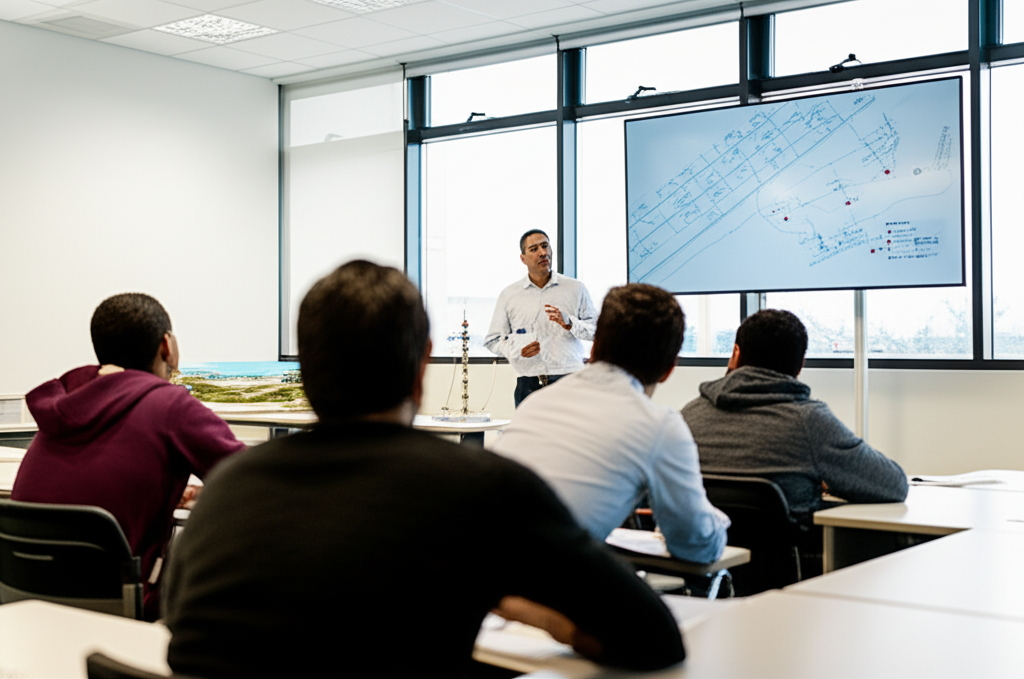
Coordination course between towers and ACC
- Format: Hybrid
- Duration: 3 months
- Hours: 300 H
- Language: English / Spanish
- Registration date: 23-10-2026
- Start date: 12-12-2026
- Available places: 3
399 $
Competencies and results
What you will learn
1. Effective Coordination: Towers and Area Control (ACC)
- Master communication in air traffic control environments, optimizing clarity and accuracy.
- Implement effective resource management strategies in high-demand and high-pressure situations.
- Learn to use advanced radar and navigation tools for aircraft identification and tracking.
- Develop skills in making quick and accurate decisions in complex air traffic control scenarios.
- Gain a thorough understanding of international and national air regulations.
- Analyze and manage traffic conflicts, prioritizing safety and efficiency.
- Gain practical experience through control tower and area control center simulations.
2. Performance Optimization: Rotor Design
- Analyze flap–lag–torsion couplings, whirl flutter and fatigue.
- Size laminates in composites, unions and bonded joints with FE.
- Implement damage tolerance and NDT (UT/RT/thermography).
3. Comprehensive user-oriented design and validation (from modeling to manufacturing)
You will learn to integrate the entire product development process, from initial model conception to final validation, applying user-centered methodologies. You will develop skills in parametric design, ergonomics, simulation, sustainable materials, 3D visualization, and manufacturing management, ensuring efficient, safe solutions that meet current industry standards.
4. Crucial Link: Towers and ACC
4. Crucial Link: Towers and ACC
- Identify and evaluate the structural response of towers to dynamic and static loads.
- Understand the design and construction of communication towers and similar structures.
- Analyze the key factors in tower design to optimize their performance and durability.
5. Unified Air Control: Towers and ACC
- Identify and understand the structure and function of Air Traffic Control Towers.
- Analyze the responsibilities and functions of Terminal Area Control (ACC).
- Master the communication and coordination procedures between the towers and the ACC.
- Study the air traffic regulations and standards related to unified air traffic control.
- Learn about the tools and technologies used in air traffic control, such as radar and communication systems.
- Develop skills for the effective management of air traffic flow, including conflict resolution.
- Understand the concepts of air safety and how they are applied in the towers and the ACC.
- Become familiar with emergency situations and response protocols in air traffic control.
- Study the different types of aircraft and their characteristics for better air traffic management.
- Apply the knowledge acquired through simulations and practical case studies.
6. Air Synergy: Towers and ACC
- Understand the operation and interaction of flight control systems in highly complex environments.
- Study the principles of airspace management and air traffic control (ACC).
- Analyze the responsibilities and functions of control towers and their impact on aviation safety.
- Identify and evaluate the factors that influence decision-making in critical aviation situations.
- Apply effective communication techniques in the context of air coordination and emergency management.
Who this program is for:
Coordination course between towers and ACC
- Graduates in Aerospace Engineering, Mechanical Engineering, Industrial Engineering, Automation Engineering, or related fields.
- Professionals in OEM rotorcraft/eVTOL, MRO, consulting, and technology centers.
- Flight Testing, certification, avionics, control, and dynamics seeking specialization.
- Regulators/authorities and UAM/eVTOL professionals requiring compliance skills.
Recommended requirements: foundation in aerodynamics and control and structures; ES/EN B2+/C1. We offer bridging tracks if you need them.
- Standards-driven curriculum: you will work with CS-27/CS-29, DO-160, DO-178C/DO-254, ARP4754A/ARP4761, ADS-33E-PRF from the first module.
- Accreditable laboratories (EN ISO/IEC 17025) with rotor bench, EMC/Lightning pre-compliance, HIL/SIL, vibrations/acoustics.
- Evidence-oriented TFM: safety case, test plan, compliance dossierand operational limits.
- Mentored by industry: teachers with experience in rotorcraft, tiltrotor, eVTOL/UAM and flight test.
- Flexible modality (hybrid/online), international cohorts and support from SEIUM Career Services.
- Ethics and security: safety-by-design approach, cyber-OT, DIH and compliance as pillars.
1.1 Principles of Air Coordination: ACC and Tower Fundamentals
1.2 Roles and Responsibilities: ACC and Tower Control
1.3 Effective Communication: Protocols and Standard Phraseology
1.4 Transfer of Control: Procedures and Techniques
1.5 Air Traffic Management: Key Concepts and Flows
1.6 Radar and Surveillance Systems: Use and Applications
1.7 Meteorological Information: Impact on Coordination
1.8 Human Factors: Communication and Teamwork
1.9 Emergency Situations: Procedures and Response
1.10 Tools and Technologies: Use in Air Coordination
2.2 Introduction to Rotor Design: Fundamental Principles
2.2 Rotor Aerodynamics: Detailed Analysis
3.3 Material Selection and Structural Design
4.4 Simulation and Performance Analysis: Specialized Software
5.5 Energy Efficiency Optimization: Blade Design
6.6 Vibration and Noise Control: Mitigation Strategies
7.7 Testing and Validation: Wind Tunnels and Test Flights
8.8 Rotor Design for Helicopters and Drones: Case Studies
9.9 Rotor Integration with the Propulsion System
20.20 Future Trends in Rotor Design
3.3 Introduction to Coordination: Tower and ACC Fundamentals
3.2 Airspace: Structure and Classification for Towers and ACCs
3.3 Communication Protocols: Standards in Towers and ACCs
3.4 Tools and Systems: Radar, Radio, and More in Towers and ACCs
3.5 Air Traffic Management: Flow Principles in Towers and ACCs
3.6 Air Safety: Priorities and Procedures in Towers and ACCs
3.7 Human Factors: Impact on Tower and ACC Coordination
3.8 Crisis Scenarios: Emergency Management in Towers and ACCs
3.9 Case Studies: Incident Analysis in Towers and ACCs
3.30 Legislation and Regulations: Regulatory Framework for Towers and ACCs
Module 2 — Performance Optimization: Rotor Design
2.3 Rotor Aerodynamics: Principles and Theories
2.2 Blade Design: Geometry and Materials
2.3 Computational Fluid Dynamics (CFD): Applications in Rotors
2.4 Rotor Structure: Design and Strength
2.5 Rotor Vibrations and Dynamics
2.6 Rotor Control: Mechanisms and Systems
2.7 Testing: Wind Tunnels and Flights
2.8 Rotor Performance: Metrics and Optimization
2.9 Advanced Rotor Design: Innovative Concepts
2.30 Cost and Manufacturing Considerations
Module 3 — Strategic Integration: Towers and ACCs
3.3 Strategic Planning: Overview of Towers and ACCs
3.2 Interoperability: Systems and Technologies in Towers and ACCs
3.3 Route Design: Efficiency and Safety in Towers and ACCs
3.4 Capacity Management: Traffic Flows in Towers and ACCs
3.5 Meteorology: Impact on Towers and ACCs
3.6 Incident Management: Procedures and Coordination in Towers and ACCs
3.7 Risk Assessment: Identification and Mitigation in Towers and ACCs
3.8 Regulatory Aspects: Compliance and Updates in Towers and ACCs
3.9 Decision Support Systems: Tools in Towers and ACCs
3.30 Future of Air Traffic Control: Trends and Challenges in Towers and ACCs
Module 4 — Crucial Link: Towers and ACCs
4.3 Voice-to-Ground Communication: Techniques and Protocols in Towers
4.2 Data Communication: Systems and Applications in ACCs
4.3 Information Exchange: Management in Towers and ACCs
4.4 Real-Time Coordination: Challenges and Solutions
4.5 Transfer of Control: Procedures and Responsibilities
4.6 Conflict Management: Resolution in Towers and ACCs
4.7 Emergency Situations: Coordination between Towers and ACCs
4.8 Documentation and Records: Importance and Management
4.9 Training and Simulation: Tower and ACC Practice
4.30 Case Studies: Critical Link Analysis in Towers and ACC
Module 5 — Unified Air Control: Towers and ACC
5.3 Unified Airspace Concepts: Overview
5.2 Technologies for Unified Control: Systems and Tools
5.3 Air Traffic Management: Implementation in Towers and ACC
5.4 Operational Coordination: Procedures and Protocols
5.5 Safety in Unified Air Control: Approaches and Best Practices
5.6 Capacity Management: Challenges and Solutions
5.7 Training and Education: Requirements for Unified Control
5.8 Regulatory Aspects: Adaptation and Compliance
5.9 Simulation and Testing: Validation of Unified Control
5.30 Future of Unified Air Control: Trends and Technologies
Module 6 — Air Synergy: Towers and ACC
6.3 Collaboration: Importance and Benefits in Towers and ACC
6.2 Effective Communication: Techniques and Strategies
6.3 Workload Management: Efficiency in Towers and ACC
6.4 Decision Making: Processes and Tools
6.5 Safety Culture: Promotion and Maintenance
6.6 Conflict Resolution: Strategies and Techniques
6.7 Continuous Improvement: Evaluation and Feedback
6.8 Leadership and Teamwork: Roles and Responsibilities
6.9 Scenario Simulation: Practice in Towers and ACC
6.30 Case Studies: Analysis of Air Synergy in Operations
Module 7 — Air Synchronization: Towers and Area Control (ACC)
7.3 Synchronization Principles: Fundamentals in Towers and ACC
7.2 Traffic Flows: Planning and Coordination
7.3 Sequence Management: Optimization in Towers and ACCs
7.4 Workload Distribution: Balancing in Towers and ACCs
7.5 Support Systems: Tools and Technologies
7.6 Communication and Coordination: Effective Strategies
7.7 Incident Management: Synchronized Procedures
7.8 Risk Assessment: Identification and Mitigation
7.9 Drills and Tests: Validating Synchronization
7.30 Case Studies: Synchronization Analysis in Operations
Module 8 — Harmonization of Operations: Towers and ACCs
8.3 Fundamentals of Harmonization: Objectives and Benefits
8.2 Operational Processes: Standardization and Efficiency
8.3 Information Exchange: Systems and Protocols
8.4 Conflict Management: Techniques and Strategies
8.5 Resource Optimization: Utilization in Towers and ACCs
8.6 Air Safety: Harmonized Approaches
8.7 Training and Development: Requirements and Best Practices
8.8 Regulatory Aspects: Compliance and Adaptation
8.9 Evaluation and Continuous Improvement: Metrics and Feedback
8.30 Case Studies: Analysis of Harmonization in Operations
4.4 Systems Interconnection: Towers and ACC
4.2 Information Flow: Towers and ACC
4.3 Communication Protocols: Towers and ACC
4.4 Incident Management: Towers and ACC
4.5 Real-Time Coordination: Towers and ACC
4.6 Emergency Communication: Towers and ACC
4.7 Decision Support Tools: Towers and ACC
4.8 Regulatory Framework: Towers and ACC
4.9 Training and Capacity Building: Towers and ACC
4.40 Case Studies: Towers and ACC
5.5 Rotor Design and Performance
5.5 eVTOL and UAM: Electric Propulsion, Multiple Rotors
3.3 Emerging Certification Requirements (SC-VTOL, Special Conditions)
4.4 Energy and Thermal in E-Propulsion (Batteries/Inverters)
5.5 Design for Maintainability and Modular Swaps
6.6 LCA/LCC in Rotorcraft and eVTOL (Footprint and Cost)
7.7 Operations & Vertiports: Airspace Integration
8.8 Data & Digital Thread: MBSE/PLM for Change Control
9.9 Tech Risk and Readiness: TRL/CRL/SRL
50.50 IP, Certifications, and Time-to-Market
55.55 Case Clinic: Go/No-Go with Risk Matrix
6.6 Introduction to Rotorcraft and ACC Operations
6.2 Coordination Principles: Towers and ACC
6.3 Effective Communication in Critical Environments
6.4 Airspace Conflict Identification and Management
6.5 Emergency and Response Procedures in Rotorcraft Operations
6.6 Air Traffic Control Support Tools and Technologies
6.7 Legal and Regulatory Aspects of Air Traffic Control Operations
2.6 Rotor Design Fundamentals
2.2 Rotor Aerodynamics: Key Principles
2.3 Blade Design and Rotor Geometry
2.4 Rotor Materials and Manufacturing
2.5 Rotor Structural Analysis and Durability
2.6 Performance Optimization: Key Factors
2.7 Rotor Simulation and Testing: Methodologies
3.6 Strategic Planning in Towers and ACC
3.2 Data and Systems Integration Information
3.3 Air Traffic Flow Management
3.4 Inter-Organizational Coordination
3.5 Decision Making in Dynamic Environments
3.6 Development of Strategic Scenarios and Simulations
3.7 Strategy Evaluation and Continuous Improvement
4.6 Importance of the Link: Towers and ACC
4.2 Communication and Data Transfer Protocols
4.3 Conflict Management and Problem Resolution
4.4 Real-Time Communication and Incident Response
4.5 Liaison Skills Training
4.6 Technology and Tools for Effective Liaison
4.7 Continuous Liaison Improvement: Evaluation and Feedback
5.6 Unified Air Control Concepts
5.2 Systems and Technology Integration
5.3 Airspace Management
5.4 Coordination Among Different Control Units
5.5 Standard Operating Procedures
5.6 Control Training Unified Air Operations
5.7 Regulatory and Safety Aspects
6.6 Definition and Benefits of Air Synergy
6.2 Roles and Responsibilities of Towers and ACC
6.3 Effective Coordination and Communication
6.4 Resource Management and Performance Optimization
6.5 Improving Air Safety
6.6 Tools and Technologies for Air Synergy
6.7 Case Studies and Best Practices
7.6 Importance of Air Synchronization
7.2 Tools and Techniques for Effective Synchronization
7.3 Time Management and Operation Sequence
7.4 Real-Time Communication and Coordination between Towers and ACC
7.5 Conflict Resolution and Decision Making
7.6 Synchronization Simulations and Tests
7.7 Evaluation and Continuous Improvement of Synchronization
8.6 Principles of Operational Harmonization
8.2 Roles and Responsibilities in Towers and ACC
8.3 Effective Coordination and Communication
8.4 Resource Management and Performance Optimization
8.5 Improvement of Air Safety
8.6 Implementation of Standards and Procedures
8.7 Evaluation and Continuous Improvement of Harmonization
- Hands-on methodology: test-before-you-trust, design reviews, failure analysis, compliance evidence.
- Software (depending on licenses/partners): MATLAB/Simulink, Python (NumPy/SciPy), OpenVSP, SU2/OpenFOAM, Nastran/Abaqus, AMESim/Modelica, acoustics tools, planning toolchains DO-178C.
- SEIUM Laboratories: scale rotor bench, vibrations/acoustics, EMC/Lightning pre-compliance, HIL/SIL for AFCS, data acquisition with strain gauging.
- Standards and compliance: EN 9100, 17025, ISO 27001, GDPR.
Capstone-type projects
- ACC Coordination: Design and simulation of procedures, conflict management, and area capacity.
- ACC Optimization: Capacity analysis, traffic modeling, and airflow improvement.
- ACC Integration: Development of integrated systems and advanced management tools.
- ACC Liaison: Communication protocols, interoperability, and safety standards.
- Air Control: Implementation of advanced technologies, simulation, and training.
- Air Synergy: Study of success stories and analysis of operational improvements.
- Synchronization: Creation of operating manuals.
- Harmonization: Standardization of procedures and optimization of resources.
- ACC & Towers: Traffic simulation, capacity analysis, flow optimization.
- Integration: Management system design, protocol validation, interoperability evaluation.
- Link: Secure communications implementation, latency analysis, performance testing.
- Air Traffic Control: User interface design, workload evaluation, scenario simulation.
- ACC Optimization: ACC modeling, simulation, capacity and flow analysis.
- Effective Coordination: Protocols, procedures, and training for ACC.
- Unified Air Control: Design of integrated systems for ACC.
- Air Synchronization: Implementation of synchronization tools for ACC.
- ACC/Tower – Strategic Coordination: Optimized flight route planning, delay reduction.
- ACC/Tower – Integration: Air Traffic Flow Management (ATFM) systems.
- ACC/Tower – Synergy: Emergency scenario simulations, resource management.
Admissions, fees, and scholarships
- Profile: Background in Computer Engineering, Mathematics, Statistics, or related fields; practical experience in NLP and valued information retrieval systems.
- Documentation: Updated CV, academic transcript, SOP/statement of purpose, project examples or code (optional).
- Process: Application → Technical evaluation of profile and experience → Technical interview → Review of case studies → Final decision → Enrollment.
- Fees:
- Single payment: 10% discount.
- Payment in 3 installments: No fees; 30% upon registration + 2 equal monthly payments of the remaining 35%.
Monthly payment: available with a 7% commission on the total; annual review.
Scholarships: based on academic merit, financial need, and promoting inclusion; agreements with companies in the sector for partial or full scholarships.
See “Calendar & Calls for Applications,” “Scholarships & Grants,” and “Fees & Financing” in the SEIUM mega-menu.
Do you have any questions?
Our team is ready to help you. Contact us, and we will respond as soon as possible.
F. A. Q
Frequently asked questions
Yes, we have international certification
Yes: experimental models, real data, applied simulations, professional environments, real case studies.
It is not mandatory. We offer leveling tracks and tutoring.
Completely. It covers e-propulsion, integration, and emerging regulations (SC-VTOL).
Recommended. There are also internal challenges and consortiums.
Yes. Online/hybrid modality with planned labs and visa support (see “Visa & Residence”).