

Business models course for drones
About our
The Business Models for Drones course explores strategies for developing and validating innovative business proposals in the drone sector. It addresses the creation of sustainable business models, from identifying market opportunities and defining value propositions to managing distribution channels and building customer relationships. It focuses on applying tools such as the Business Model Canvas, Lean Startup, and competitive analysis to assess the viability of projects in areas such as precision agriculture, infrastructure inspection, and goods delivery.
The course includes practical case studies and simulation exercises so that participants can apply the concepts learned in real-world scenarios. It focuses on developing skills in market analysis, financial planning, and risk management, as well as understanding the regulations and legal framework related to drone use. This training prepares entrepreneurs, consultants, and industry professionals to identify and capitalize on new business opportunities in the drone industry.
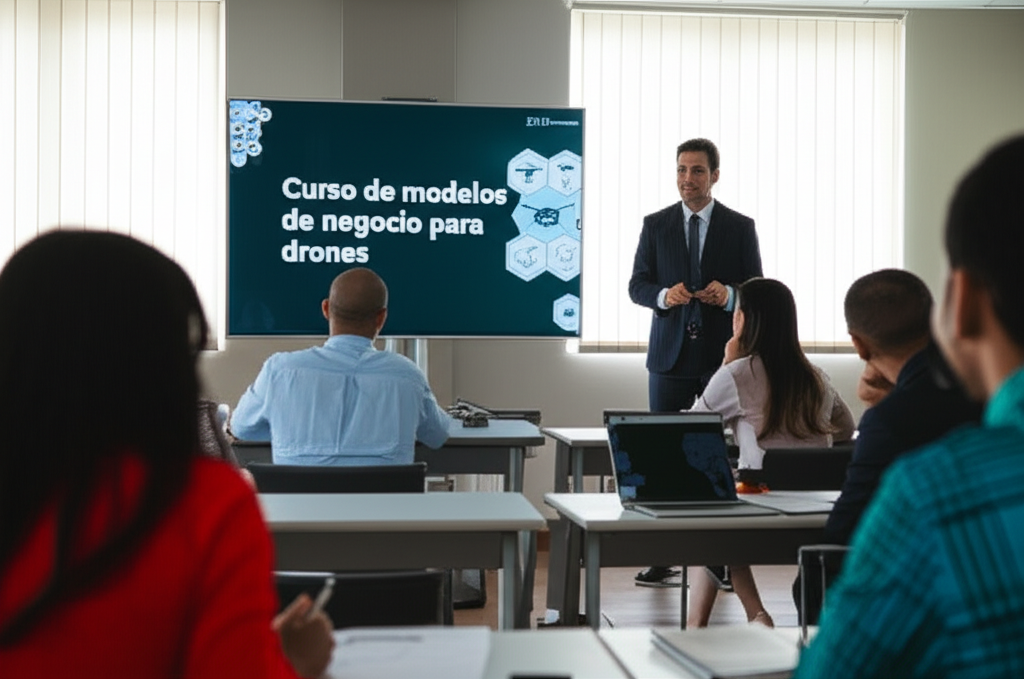
Business models course for drones
- Format: Hybrid
- Duration: 3 months
- Hours: 300 H
- Language: English / Spanish
- Registration date: 23-10-2026
- Start date: 12-12-2026
- Available places: 2
620 $
Competencies and results
What you will learn
1. Design and Validation of Business Models with Drones
## What will you learn in Designing and Validating Business Models with Drones?
- Identify and evaluate viable business opportunities using drones, considering market trends and current demand.
- Develop and apply business model design methodologies specific to the drone sector, including value proposition analysis, customer segments, distribution channels, and revenue streams.
- Conduct economic and financial feasibility analyses for drone business models, including estimating costs, revenues, and profitability.
- Master the tools and techniques for validating drone business models, such as surveys, interviews, experiments, and pilot tests.
- Analyze the competitive environment of the drone sector, including direct and indirect competitors, and develop differentiation and market positioning strategies.
- Understand and apply current regulations and standards in the drone sector, both nationally and internationally.
- Create functional prototypes and business models with drones, using specialized software and simulation tools.
Analyze success and failure cases of drone business models, identifying lessons learned and best practices.
Develop a comprehensive business plan for a specific drone model, including defining the marketing strategy, operational plan, and financial plan.
Present and defend the drone business model to investors and stakeholders, using effective communication skills and a compelling narrative.
2. Profitability and Scalability Analysis of Drone Projects
2. **Profitability and Scalability Analysis of Drone Projects**
- Identify and evaluate the key factors that drive the profitability of drone projects, including operating costs, service revenue, and return on investment (ROI).
- Develop cost-benefit analysis models for different types of drone applications, such as inspection, mapping, precision agriculture, and delivery.
- Understand strategies for scaling drone projects, including fleet optimization, geographic expansion, and service diversification.
- Analyze the drone market, including current and future trends, growth opportunities, and regulatory challenges.
- Evaluate different drone technologies, including flight characteristics, payload capacities, and software and hardware options.
- Apply data analysis techniques to optimize the performance of drone projects, including data collection, processing, and visualization data.
Develop business plans and marketing strategies for drone projects, including identifying potential clients, defining prices, and creating value propositions.
Evaluate the risks associated with drone projects, including technical, operational, and financial risks, and develop mitigation strategies.
Understand the legal and regulatory implications of drone projects, including safety regulations, flight restrictions, and licensing requirements.
Use specialized software tools for analyzing the profitability and scalability of drone projects, including spreadsheets, data analytics software, and fleet management platforms.
3. Comprehensive user-oriented design and validation (from modeling to manufacturing)
You will learn to integrate the entire product development process, from initial model conception to final validation, applying user-centered methodologies. You will develop skills in parametric design, ergonomics, simulation, sustainable materials, 3D visualization, and manufacturing management, ensuring efficient, safe solutions that meet current industry standards.
4. Revenue Stream Optimization and Market Assessment for Drones
4. Revenue Stream Optimization and Market Assessment for Drones
-
Identify and analyze potential revenue streams for drone operations, including services, data, and customized solutions.
-
Develop diversified revenue stream models, considering different pricing strategies and commission structures.
-
Conduct market analysis to assess the demand for drone services across various sectors and geographies.
-
Identify key competitors and analyze their business models, pricing, and marketing strategies.
-
Evaluate market size, growth trends, and expansion opportunities for drone operations.
-
Analyze regulatory, legal, and compliance factors that affect revenue generation and market access.
-
Develop effective marketing and sales strategies to promote drone services and attract potential clients.
Optimize the pricing and profitability of drone services, considering operating costs and market conditions.
Evaluate the impact of emerging technologies, such as artificial intelligence and machine learning, on revenue streams and market assessment.
Develop contingency plans and adaptation strategies to respond to changes in the market, regulations, and technologies.
5. Feasibility Analysis and Strategic Planning for Drone Businesses
5. Feasibility Analysis and Strategic Planning for Drone Businesses
-
Identify and evaluate the potential market for drone-based businesses, including competitive analysis and specific opportunities.
-
Develop a comprehensive business plan, including defining the value proposition, revenue model, and marketing strategy.
-
Conduct a financial feasibility analysis, including estimating costs, revenue, and projected profitability.
-
Understand and apply the relevant aviation regulations and standards for drone operations in different jurisdictions.
-
Manage the operational and safety risks associated with drone use, including flight planning and emergency management.
-
Select and configure the appropriate drone technology for the specific needs of the business, considering flight capabilities, sensors, and software.
Implement strategic planning strategies for business growth and expansion, including service diversification and adaptation to market trends.
Evaluate the environmental and social impact of drone use and develop sustainable practices to minimize negative effects.
Analyze case studies of successful drone businesses and extract lessons learned and best practices.
Develop communication and presentation skills to present business proposals and communicate results to clients and stakeholders.
6. Drone Business Model Structure: Analysis and Application
6. Drone Business Model Structure: Analysis and Application
- Identify and evaluate the key components of a drone business model, including value proposition, customer segments, distribution channels, customer relationships, revenue streams, key resources, key activities, key partners, and cost structure.
- Analyze different drone business models, such as package delivery, industrial inspection, precision agriculture, aerial photography and videography, security and surveillance, and mapping and surveying.
- Evaluate the feasibility and profitability of a drone business model through market analysis, competitive analysis, and the identification of opportunities and challenges.
- Develop a business plan for a drone business model, including defining objectives, strategies, tactics, budget, and financial projections.
- Learn about regulations and standards applicable to drone operation, as well as safety, privacy, and ethical considerations.
- Explore the Trends and technological advances in the drone sector and their impact on business models.
Who this program is for:
Business models course for drones
- Engineers with degrees in Aerospace Engineering, Mechanical Engineering, Industrial Engineering, Automation Engineering, or related fields.
- Drone industry professionals, including OEM aircraft manufacturers, maintenance, repair, and overhaul (MRO) companies, consulting firms, and technology center personnel.
- Specialists in technical areas such as flight testing, aeronautical certification, avionics, flight control, and flight dynamics who wish to deepen their knowledge.
- Personnel from Regulatory bodies and aeronautical authorities, as well as professionals involved in urban air mobility (UAM) and electric vertical takeoff and landing (eVTOL) projects seeking to acquire competencies in regulatory compliance.
Recommendations: Basic knowledge of aerodynamics, control systems, and structures is suggested. A B2+/C1 level of English or Spanish is required. Bridging tracks are offered to address any gaps in prior knowledge.
- Standards-driven curriculum: you will work with CS-27/CS-29, DO-160, DO-178C/DO-254, ARP4754A/ARP4761, ADS-33E-PRF from the first module.
- Accreditable laboratories (EN ISO/IEC 17025) with rotor bench, EMC/Lightning pre-compliance, HIL/SIL, vibrations/acoustics.
- Evidence-oriented TFM: safety case, test plan, compliance dossierand operational limits.
- Mentored by industry: teachers with experience in rotorcraft, tiltrotor, eVTOL/UAM and flight test.
- Flexible modality (hybrid/online), international cohorts and support from SEIUM Career Services.
- Ethics and security: safety-by-design approach, cyber-OT, DIH and compliance as pillars.
1.1 Fundamentals of the Drone Business Model: Definition and Key Components
1.2 Identifying the Ideal Customer and Segmenting the Drone Market
1.3 Value Proposition: How to Solve Problems with Drones
1.4 Designing the Business Model Canvas for Drones
1.5 Hypothesis Validation: Market Research and Surveys
1.6 Prototyping and Testing the Drone Business Model
1.7 Competitive Analysis and Market Positioning
1.8 Developing a Minimum Viable Product (MVP) for Drones
1.9 Distribution Channels and Communication Strategies
1.10 Evaluating and Adapting the Drone Business Model: Iteration and Continuous Improvement
2.2 Operational Costs: Detailed analysis of fixed and variable expenses for drone projects.
2.2 Return on Investment (ROI) Calculation: Key metrics for measuring project profitability.
2.3 Scalability: Strategies for efficiently expanding drone operations.
2.4 Break-Even Point Analysis: Determining the revenue needed to cover costs.
2.5 Key Performance Indicators (KPIs): Selection and monitoring of KPIs to measure project success.
2.6 Revenue Models: Diversifying revenue streams to maximize profitability.
2.7 Pricing Strategies: Defining competitive and profitable prices for drone services.
2.8 Cost Optimization: Identifying opportunities to reduce operating costs.
2.9 Case Studies: Analysis of real-world examples of profitable and scalable drone projects. 2.20 Risk Assessment: Identification and mitigation of financial and operational risks.
3.3 Diversified Revenue Models for Drone Operations
3.2 Strategic Pricing and Fee Structures for Drone Services
3.3 Digital Marketing and Promotion of Drone Services
3.4 Strategic Alliances and Collaborations in the Drone Sector
3.5 Revenue Generation through Drone Data and Analytics
3.6 Financial Sustainability and Recurring Business Models
3.7 Cross-Selling and Upselling of Drone Services
3.8 Development of Innovative Products and Services in the Drone Sector
3.9 Adapting to Market Trends and New Opportunities
3.30 Case Studies: Successful Monetization Strategies in the Drone Sector
4.4 Market Segmentation and Analysis of Potential Customers for Drones
4.2 Identification and Evaluation of Diversified Revenue Streams for Drone Projects
4.3 Pricing Analysis and Strategies for Drone Services and Products
4.4 Optimization of Distribution and Sales Channels for Drone Companies
4.5 Detailed Study of the Competitive Landscape in the Drone Sector
4.6 Evaluation of Market Trends and Emerging Opportunities for Drones
4.7 Implementation of Digital Marketing and Social Media Strategies for Drones
4.8 Key Performance Indicators (KPIs) to Measure Success in the Drone Market
4.9 Adaptation and Scalability of the Revenue Strategy in a Changing Environment
4.40 Case Studies: Analysis of Successful Revenue Models in the Drone Industry
5.5 Analysis of the drone market environment and opportunities
5.5 Defining the value proposition for drone businesses
5.3 Customer segmentation and buyer persona definition
5.4 Competitive analysis and strategic positioning
5.5 Design and development of drone business models
5.6 Planning the cost structure and revenue streams
5.7 Design and development of the marketing and sales plan
5.8 Planning drone operations and logistics
5.9 Risk management and contingency plan
5.50 Development of the financial plan and projections
6.6 Drone Business Models: Structure and Analysis
6.2 Key Elements of a Drone Business Model: Value Proposition, Customer Segment
6.3 Distribution and Communication Channels for Drone Companies
6.4 Revenue Streams and Cost Structure for Drone Businesses
6.5 Key Partnerships and Resources for Drone Business Operations
6.6 SWOT Analysis for Evaluating Drone Business Models
6.7 Ansoff Matrix Applied to Drone Companies
6.8 The Lean Startup Model in the Drone Sector
6.9 Competitive Analysis and Strategic Positioning
6.60 Case Studies of Success and Failure in Drone Business Models
- Hands-on methodology: test-before-you-trust, design reviews, failure analysis, compliance evidence.
- Software (depending on licenses/partners): MATLAB/Simulink, Python (NumPy/SciPy), OpenVSP, SU2/OpenFOAM, Nastran/Abaqus, AMESim/Modelica, acoustics tools, planning toolchains DO-178C.
- SEIUM Laboratories: scale rotor bench, vibrations/acoustics, EMC/Lightning pre-compliance, HIL/SIL for AFCS, data acquisition with strain gauging.
- Standards and compliance: EN 9100, 17025, ISO 27001, GDPR.
Capstone-type projects
- Drone Business Modeling: Analysis, validation, and optimization with a focus on profitability and scalability.
- Market Analysis and Monetization: Revenue strategies, feasibility assessment, and strategic planning.
- Financing and Growth: Business plans, structural analysis, and fundraising for drone ventures.
- Drone Viability: Market, Models, Finances, Strategic Plan.
- Drone Monetization: Revenue, Scalability, Sustainability, Evaluation.
- Drone Business: Design, Validation, Profitability, Growth.
- Drone Structure: Analysis, Application, Plans, Financing.
- Drone Business Plan: Market analysis, value proposition, revenue model, cost structure.
- Financing and Growth: Investment strategies, financial projections, scalability.
- Viability and Monetization: Profitability study, revenue stream optimization, sustainability.
- Drone Models: Design, validation, and risk analysis.
- Drone Fleet Management: route and logistics optimization; data analysis and KPIs.
- Risk Analysis: operational risk assessment and mitigation, regulatory compliance.
- Marketing Strategies: positioning, segmentation and sales channels, branding.
- Financial Modeling: projections, break-even point, and return on investment (ROI).
Admissions, fees, and scholarships
- Profile: Background in Computer Engineering, Mathematics, Statistics, or related fields; practical experience in NLP and valued information retrieval systems.
- Documentation: Updated CV, academic transcript, SOP/statement of purpose, project examples or code (optional).
- Process: Application → Technical evaluation of profile and experience → Technical interview → Review of case studies → Final decision → Enrollment.
- Fees:
- Single payment: 10% discount.
- Payment in 3 installments: No fees; 30% upon registration + 2 equal monthly payments of the remaining 35%.
Monthly payment: available with a 7% commission on the total; annual review.
Scholarships: based on academic merit, financial need, and promoting inclusion; agreements with companies in the sector for partial or full scholarships.
See “Calendar & Calls for Applications,” “Scholarships & Grants,” and “Fees & Financing” in the SEIUM mega-menu.
Do you have any questions?
Our team is ready to help you. Contact us, and we will respond as soon as possible.
F. A. Q
Frequently asked questions
Yes, we have international certification
Yes: experimental models, real data, applied simulations, professional environments, real case studies.
It is not mandatory. We offer leveling tracks and tutoring.
Completely. It covers e-propulsion, integration, and emerging regulations (SC-VTOL).
Recommended. There are also internal challenges and consortiums.
Yes. Online/hybrid modality with planned labs and visa support (see “Visa & Residence”).