

BIM Modeling Course in Railway Infrastructure
About our
The BIM Modeling in Railway Infrastructure course trains participants in the use of Building Information Modeling (BIM) for the design and management of railway projects. It focuses on the application of specialized BIM software to model tracks, stations, and tunnels, integrating geometric data, technical specifications, and construction schedules. It covers the creation of accurate 3D models, interference detection, and interdisciplinary collaboration, optimizing the project lifecycle.
The course provides practical knowledge in railway infrastructure design, cost analysis, and construction simulation, using computer-aided design (CAD) tools. Participants will learn to integrate GIS (Geographic Information Systems) data and generate detailed documentation for the construction and maintenance of railway infrastructure, improving efficiency and reducing errors.
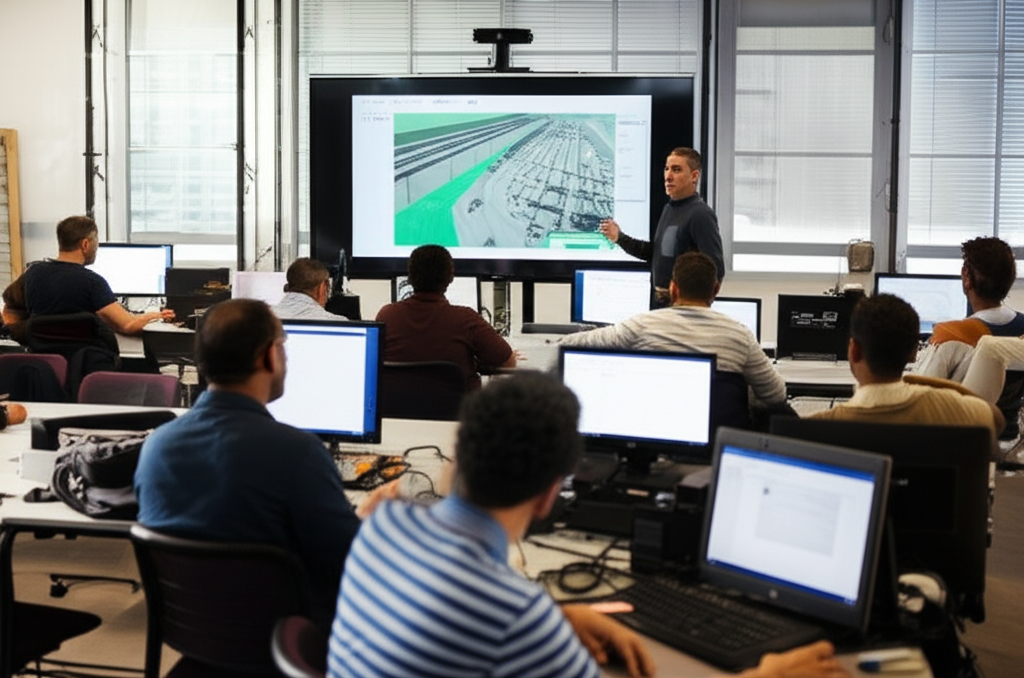
BIM Modeling Course in Railway Infrastructure
- Format: Online
- Duration: 3 months
- Hours: 300 H
- Language: English / Spanish
- Registration date: 23-10-2026
- Start date: 12-12-2026
- Available places: 3
620 $
Competencies and results
What you will learn
1. **Advanced BIM Modeling in Railway Infrastructure: Master Digital Design**
-
Master the fundamentals of digital design and BIM methodology applied to railway projects.
-
Use specialized BIM software for railway infrastructure, such as Revit, Civil 3D, and other specific plugins.
-
Perform clash detection and coordinate different design disciplines within the BIM model.
-
Simulate the railway infrastructure lifecycle, from planning and design to construction, operation, and maintenance.
-
Collaborate effectively in multidisciplinary teams using collaborative BIM platforms.
-
Optimize the design of railway infrastructure to improve efficiency, safety, and sustainability.
-
Integrate geospatial and topographic survey data into BIM models.
Interpret and apply relevant national and international technical standards and regulations for railway infrastructure.
Create and manage advanced BIM models, including the modeling of complex elements such as tracks, stations, tunnels, and bridges.
Generate detailed and accurate documentation from the BIM model, including drawings, technical specifications, and reports.
2. **BIM Optimization for Railways: From Design to Intelligent Construction**
Here’s a summary of what you’ll learn in the course:
- Understand the fundamentals of BIM (Building Information Modeling) and its specific application in railway projects.
- Master the use of specialized BIM software for the design, modeling, and management of railway projects.
- Learn to integrate geotechnical, topographic, and infrastructure data into BIM models.
- Model detailed railway components, including tracks, bridges, tunnels, stations, and signaling systems.
- Perform simulations and performance analyses using BIM models, such as structural and traffic analysis.
- Optimize railway design for energy efficiency and sustainability.
- Manage collaboration and communication among project stakeholders using BIM platforms.
- Use BIM for construction planning, resource management, and progress monitoring.
- Apply BIM for conflict detection and construction coordination, reducing errors and delays.
- Integrate construction data into the BIM model for the long-term maintenance and operation of railway assets.
3. Comprehensive user-oriented design and validation (from modeling to manufacturing)
You will learn to integrate the entire product development process, from initial model conception to final validation, applying user-centered methodologies. You will develop skills in parametric design, ergonomics, simulation, sustainable materials, 3D visualization, and manufacturing management, ensuring efficient, safe solutions that meet current industry standards.
4. **BIM in Railways: Modeling, Analysis and Management of the Infrastructure Life Cycle**
Here is the requested content:
4. **BIM in Railways: Modeling, Analysis, and Infrastructure Lifecycle Management**
Generate reports, documentation, and visualizations from BIM models.
Collaborate effectively with other professionals (engineers, architects, builders) using BIM platforms.
Implement data management and quality control strategies in railway BIM projects.
Become familiar with the relevant BIM regulations and standards for the railway sector.
Analyze the environmental impact of railway projects using BIM tools.
Optimize resource utilization and reduce costs in railway projects using BIM.
Use BIM for simulation and risk analysis in railway operation and maintenance.
5. **Railway BIM Modeling: 3D Design, Structural Analysis and Project Management**
- Master BIM software for the 3D design of railway infrastructure, including stations, tracks, and tunnels.
- Apply BIM tools for creating parametric models and managing project information.
- Perform structural analyses of railway elements using specialized software, such as bridges and platforms.
- Understand the principles of railway project management, including planning, monitoring, and cost control.
- Integrate BIM modeling with structural analysis to optimize the design and efficiency of railway projects.
- Use BIM for conflict detection and interdisciplinary coordination in complex railway projects.
- Generate detailed documentation and high-quality 3D visualizations for project communication and presentation.
- Learn to simulate the behavior of railway structures under different loads and environmental conditions.
- Apply BIM-based collaborative work methodologies to improve the efficiency and productivity of the project team.
- Use BIM for the lifecycle management of railway assets, from design to demolition.
6. **Railway BIM Modeling: Detailed Design and Project Optimization**
- Understand the fundamentals of Building Information Modeling (BIM) and its specific application in railway projects.
- Master specialized BIM software for railway design, including 3D modeling, planning, and documentation tools.
- Create detailed BIM models of railway infrastructure, such as tracks, stations, tunnels, and bridges, incorporating geometric, technical, and cost information.
- Apply advanced design techniques to optimize the efficiency, safety, and sustainability of railway projects.
- Perform simulations and performance analyses of BIM models to identify and resolve design problems, detect clashes, and optimize workflow.
- Integrate data from various disciplines (architecture, civil, mechanical, and electrical engineering) into the BIM model for effective collaboration and improved decision-making.
- Generate accurate and complete documentation, including drawings, reports, and technical specifications, directly from the BIM model.
- Use BIM modeling for the lifecycle management of railway assets, from design and construction to operation and maintenance.
- Analyze and understand the principles of interoperability and BIM standards, ensuring the compatibility of models with different platforms and formats.
- Explore practical cases and case studies of railway projects carried out with BIM, learning from best practices and common challenges.
BIM modeling.
Who this program is for:
BIM Modeling Course in Railway Infrastructure
- Civil Engineers, Roads and Canals Engineers, or related professionals with an interest in railway infrastructure modeling.
- Railway sector technicians and professionals (design, construction, maintenance) who wish to improve their BIM skills.
- Architects and engineers seeking to specialize in the application of BIM to railway projects.
- University students or recent graduates in civil engineering, architecture, or related fields, with an interest in BIM modeling.
- Standards-driven curriculum: you will work with CS-27/CS-29, DO-160, DO-178C/DO-254, ARP4754A/ARP4761, ADS-33E-PRF from the first module.
- Accreditable laboratories (EN ISO/IEC 17025) with rotor bench, EMC/Lightning pre-compliance, HIL/SIL, vibrations/acoustics.
- Evidence-oriented TFM: safety case, test plan, compliance dossierand operational limits.
- Mentored by industry: teachers with experience in rotorcraft, tiltrotor, eVTOL/UAM and flight test.
- Flexible modality (hybrid/online), international cohorts and support from SEIUM Career Services.
- Ethics and security: safety-by-design approach, cyber-OT, DIH and compliance as pillars.
Module 1 — Introduction to Railway BIM Modeling
1.1 BIM Fundamentals and its Application in Railway Projects
1.2 Introduction to BIM Modeling Software for Railway Infrastructure
1.3 Relevant BIM Standards and Regulations for the Railway Sector
1.4 BIM Workflows in Railway Projects: Design, Construction, and Management
1.5 Benefits and Advantages of BIM in the Railway Infrastructure Lifecycle
1.6 Key Concepts: LOD, LOI, COBie, and their Application in Railway Projects
1.7 Introduction to Interoperability and Data Exchange in BIM
1.8 The Role of BIM in Cost Optimization and Risk Reduction
1.9 Introduction to Collaboration and Communication in BIM Environments
1.10 Case Studies: Success Stories of BIM in Railway Projects
2.2 Introduction to BIM Modeling in Railway Infrastructure
2.2 BIM Software: Essential Tools and Platforms
2.3 Interface and Working Environment: Navigation and Customization
2.4 Creating 3D Models: Basic Infrastructure Elements
2.5 Railway Track Modeling: Design and Geometry
2.6 Station and Platform Design: Architectural Modeling
2.7 Bridge and Tunnel Modeling: Key Structural Elements
2.8 Data Import and Management: DWG, IFC, and Other Formats
2.9 BIM Collaboration: Teamwork and Coordination
2.20 Introduction to BIM Documentation: Drawings and Documents
3.3 Introduction to 3D Design in Railway Infrastructure
3.2 BIM Software for Railway Modeling
3.3 Creating 3D Terrain and Environment Models
3.4 Modeling Railway Tracks and Structures
3.5 Designing Tunnels and Bridges in BIM
3.6 Integrating Railway Components and Systems
3.7 Collision Analysis and Design Verification
3.8 Generating 2D Documentation and Drawings
3.9 Collaboration and Coordination in Railway BIM Projects
3.30 Project Presentation and 3D Visualization
4.4 Introduction to BIM in Railways: Fundamental Concepts and Methodology
4.2 3D Modeling of Railway Infrastructure: Key Elements and Tools
4.3 BIM Analysis and Simulation: Performance and Design Optimization
4.4 Railway Infrastructure Lifecycle Management with BIM
4.5 BIM Collaboration and Coordination: Workflows and Communication
4.6 Railway Station Design with BIM: Details and Specifications
4.7 Railway Project Management with BIM: Planning and Control
4.8 BIM Integration with Other Technologies: GIS, IoT, and Augmented Reality
4.9 BIM Standards and Regulations in the Railway Sector
4.40 Case Studies: Real-World Applications of BIM in Railway Projects
5.5 Introduction to BIM Modeling and its Application in Railways
5.5 BIM Software: Revit, Civil 3D, and Others
5.3 Interface and Navigation in BIM Software for Railway Design
5.4 Creation and Management of Basic 3D Models of Railway Elements
5.5 Track and Station Design: BIM Principles and Practice
5.6 Implementation of Data and Metadata in BIM Models
5.7 Collaboration in BIM Projects: Formats and Workflows
5.8 BIM Standards and Regulations Applied to Railway Infrastructure
5.9 Case Studies: Examples of Digital BIM Design in Railways
5.50 Introduction to Information Management and the BIM Lifecycle
5.5 Optimization Strategies in Railway BIM Projects
5.5 Interference Analysis and Collision Detection
5.3 Design Optimization for Construction and Assembly
5.4 Use of Structural Analysis Software in BIM
5.5 Generation of 5.6 Precise quantities and budgets
5.7 Optimization of work scheduling and planning
5.8 Integration of Lean Construction methodology in BIM
5.9 4D and 5D modeling for project control
5.10 Resource optimization and cost reduction
5.50 Success stories: BIM optimization in real railway projects
3.5 Detailed 3D design of railway infrastructure
3.5 Modeling of tracks, stations, and tunnels in BIM
3.3 Structural analysis and simulation of railway elements
3.4 Integration of geotechnical and topographic data
3.5 Simulation of train and system behavior
3.6 Visibility and safety analysis in stations
3.7 Life cycle assessment (LCA) in BIM railway projects
3.8 Information management and change control
3.9 Visualization and presentation of BIM projects
3.50 Implementation of the BIM methodology in railway design
4.5 Railway Infrastructure Lifecycle Management with BIM
4.5 As-Built Modeling and Digitization of Existing Assets
4.3 Predictive Maintenance and Asset Management
4.4 Integration of Sensor and IoT Data into BIM Models
4.5 Performance Analysis and Operational Optimization
4.6 Using BIM for Maintenance and Repair Planning
4.7 Integrating BIM with Asset Management Systems (EAM)
4.8 Information Management and Document Control
4.9 Improving Efficiency and Reducing Operating Costs
4.50 Future Trends: BIM and Smart Railway Infrastructure
5.5 Advanced 3D Design of Railway Elements
5.5 Structural Analysis with BIM Software: SAP5000, Robot Structural Analysis, etc.
5.3 Modeling Complex Components and Systems
5.4 Generating Accurate Construction Documentation
5.5 BIM Project Management: Scheduling and Cost Control
5.6 Collaboration and Communication in BIM Projects
5.7 Using BIM in Risk and Safety Management
5.8 4D and 5D Modeling: Construction Planning and Control
5.9 Integrating BIM with Project Management Systems (PMIS)
5.50 Case Studies: Successful Railway Projects with BIM
6.5 Detailed Design of Stations, Tracks, and Tunnels
6.5 Optimizing Design for Constructability and Erection
6.3 Value Analysis and Cost Optimization
6.4 Using Simulation and Analysis Tools
6.5 Implementing the BIM Methodology in the Design Phase
6.6 Optimizing Energy Efficiency and Sustainability
6.7 Information Management and Quality Control
6.8 Integrating BIM with Construction Management Systems (CIM)
6.9 Project Lifecycle Optimization
6.50 Case Studies: Railway Projects with Detailed BIM Design
7.5 Digital Design of Railway Infrastructure with BIM
7.5 Creation and Management of Detailed 3D Models
7.3 Data and Metadata Integration
7.4 Collaboration and Communication in BIM Projects
7.5 Infrastructure Lifecycle Management
7.6 As-Built Modeling and Asset Digitization
7.7 Predictive Maintenance and Asset Management
7.8 Integration with Asset Management Systems (EAM)
7.9 Performance Analysis and Operational Optimization
7.50 BIM and Smart Railway Infrastructure
8.5 Advanced Digital Modeling of Railway Elements
8.5 Integration of BIM with Project Management Systems
8.3 Planning and Scheduling of Railway Projects
8.4 Information Management and Quality Control
8.5 Risk Analysis and Safety in BIM Projects
8.6 4D and 5D Modeling for Project Control
8.7 Resource Optimization and Cost Reduction
8.8 Collaboration and Communication in Railway Projects
8.9 Integration of BIM with Construction Management Systems (CIM)
8.50 Case Studies: Comprehensive Management of Railway Projects with BIM
6.6 Introduction to Detailed BIM Design in Railways
6.2 Detailed 3D Modeling of Railway Tracks and Structures
6.3 Design of Railway Stations and Platforms
6.4 Modeling of Electrical and Signaling Systems
6.5 Integration of Geotechnical and Topographic Data
6.6 Interference and Collision Analysis in Design
6.7 Creation of Detailed Documentation and Construction Drawings
6.8 Design Optimization for Manufacturing and Construction
6.9 Management of BIM Model Information in the Design Phase
6.60 Case Studies: Detailed BIM Design in Railway Projects
- Hands-on methodology: test-before-you-trust, design reviews, failure analysis, compliance evidence.
- Software (depending on licenses/partners): MATLAB/Simulink, Python (NumPy/SciPy), OpenVSP, SU2/OpenFOAM, Nastran/Abaqus, AMESim/Modelica, acoustics tools, planning toolchains DO-178C.
- SEIUM Laboratories: scale rotor bench, vibrations/acoustics, EMC/Lightning pre-compliance, HIL/SIL for AFCS, data acquisition with strain gauging.
- Standards and compliance: EN 9100, 17025, ISO 27001, GDPR.
Capstone-type projects
- BIM Optimization in Railways: 3D design and modeling; structural analysis; collision detection; cost and time optimization.
- BIM Lifecycle Management: Creation and management of BIM models; railway asset management; integration with project management software.
- BIM Simulation: Construction simulation; performance analysis; design optimization.
- BIM and GIS Integration: Integration of BIM models with geospatial data; location and feasibility analysis.
- Integrated BIM Modeling: 3D design, structural analysis, and railway simulations.
- Lifecycle Management: BIM implementation for project optimization and management.
- Detailed Design: Advanced modeling, analysis, and optimization of railway infrastructure.
- BIM Design: Detailed 3D modeling of a railway station (structure, tracks, systems).
- BIM Analysis: Passenger flow simulation, structural and energy analysis.
- BIM Management: Creation of a project lifecycle model (4D/5D).
- Collaboration: Implementation of a collaborative BIM workflow.
- BIM Design in Railways: 3D modeling, structural analysis, and simulation.
- BIM Management: Project integration, design optimization, and construction.
- Life Cycle Analysis: Railway design, maintenance, and sustainability.
Admissions, fees, and scholarships
- Profile: Background in Computer Engineering, Mathematics, Statistics, or related fields; practical experience in NLP and valued information retrieval systems.
- Documentation: Updated CV, academic transcript, SOP/statement of purpose, project examples or code (optional).
- Process: Application → Technical evaluation of profile and experience → Technical interview → Review of case studies → Final decision → Enrollment.
- Fees:
- Single payment: 10% discount.
- Payment in 3 installments: No fees; 30% upon registration + 2 equal monthly payments of the remaining 35%.
Monthly payment: available with a 7% commission on the total; annual review.
Scholarships: based on academic merit, financial need, and promoting inclusion; agreements with companies in the sector for partial or full scholarships.
See “Calendar & Calls for Applications,” “Scholarships & Grants,” and “Fees & Financing” in the SEIUM mega-menu.
Do you have any questions?
Our team is ready to help you. Contact us, and we will respond as soon as possible.
F. A. Q
Frequently asked questions
Yes, we have international certification
Yes: experimental models, real data, applied simulations, professional environments, real case studies.
It is not mandatory. We offer leveling tracks and tutoring.
Completely. It covers e-propulsion, integration, and emerging regulations (SC-VTOL).
Recommended. There are also internal challenges and consortiums.
Yes. Online/hybrid modality with planned labs and visa support (see “Visa & Residence”).