

Basic flight simulation course
About our
The Basic Flight Simulation Course introduces the fundamental concepts of flight simulation using specialized software. It focuses on the design and operation of aircraft models, understanding the laws of physics and aerodynamics, and simulating different flight conditions, such as takeoff, landing, and maneuvers. Participants will learn to interpret flight data, modify simulation parameters, and analyze aircraft behavior in various scenarios.
The course provides a solid foundation for understanding flight, allowing practice in flight simulation and the development of essential aviation skills. It focuses on acquiring basic and practical knowledge, ideal for beginners and enthusiasts interested in the world of aviation. Realistic scenarios and intuitive tools are used, preparing participants for future training.
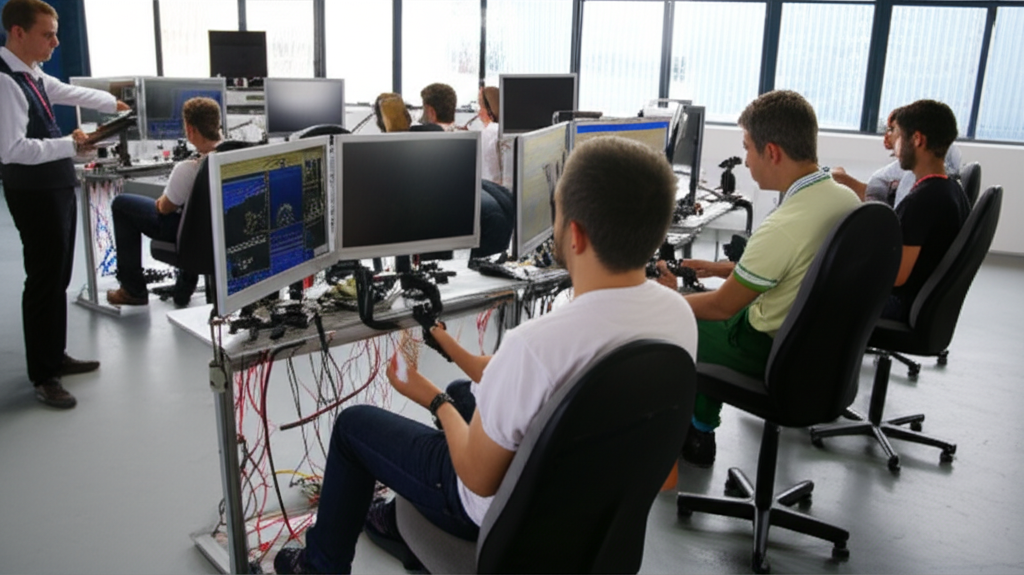
Basic flight simulation course
- Format: Hybrid
- Duration: 3 months
- Hours: 300 H
- Language: English / Spanish
- Registration date: 23-10-2026
- Start date: 12-12-2026
- Available places: 3
399 $
Competencies and results
What you will learn
1. Fundamentals of Flight: Control, Maneuvers and Basic Air Navigation
- Understand the basic principles of aerodynamics, including lift, drag, thrust, and weight.
- Master the primary flight controls: ailerons, elevator, and rudder, and their impact on aircraft movement.
- Execute basic aerial maneuvers such as climb, descent, turns, and straight and level flight.
- Interpret essential flight instruments: airspeed indicator, altimeter, artificial horizon, heading indicator, and variometer.
- Use aeronautical charts and visual navigation techniques to determine the aircraft’s position and heading.
- Apply standard air traffic control communication procedures with control towers and other pilots.
- Recognize and respond to common emergency situations, such as engine failure and loss of control.
- Understand human limitations in flight and measures to mitigate risks Associates.
Learn about basic aviation legislation and flight regulations.
Develop decision-making and critical judgment skills in the flight environment.
2. Helicopter Simulation: Dynamics, Stability and Fundamental Systems
- Master the principles of helicopter flight dynamics, including an understanding of aerodynamic and control forces.
- Study the longitudinal, lateral, and directional stability of helicopters, and how control systems affect aircraft behavior.
- Gain in-depth knowledge of fundamental helicopter systems, such as the main rotor, tail rotor, transmission systems, flight control systems, and power systems.
- Understand and simulate complex aerodynamic phenomena, including vortex analysis and three-dimensional flow simulation.
- Evaluate the dynamic response of helicopters to different flight conditions and maneuvers, using mathematical models and simulations.
- Explore the design and analysis of rotor blades, including airfoil selection and blade shape optimization.
- Apply helicopter simulation software to model and analyze the behavior of the
- Investigate helicopter simulation techniques, including model creation, parameter definition, and results interpretation.
- Learn to perform helicopter stability and control analysis, identifying potential problems and proposing solutions.
- Analyze the effects of couplings on aircraft behavior, including phenomena such as flap-lag-torsion, whirl flutter, and the impact of fatigue on components.
- Become familiar with composite materials and manufacturing techniques used in helicopter construction.
- Learn to dimension laminates in composites, joints, and bonded joints using finite element (FE) methods.
- Study damage tolerance methodologies and techniques for Non-destructive testing (NDT), such as UT/RT/thermography, for flaw detection and structural integrity assessment.
[ul]
3. Comprehensive user-oriented design and validation (from modeling to manufacturing)
You will learn to integrate the entire product development process, from initial model conception to final validation, applying user-centered methodologies. You will develop skills in parametric design, ergonomics, simulation, sustainable materials, 3D visualization, and manufacturing management, ensuring efficient, safe solutions that meet current industry standards.
4. Simulation Principles: Operations, Controls and Basic Flight Procedures
4. Simulation Principles: Operations, Controls, and Basic Flight Procedures
Comprehensive understanding of the fundamentals of flight simulation.
Analysis of the operating principles of flight control systems.
Mastery of standard flight simulation procedures, including takeoff, cruise, landing, and emergency situations.
Identification and application of key aerodynamic concepts in the simulated environment.
Exploration of the effects of environmental variables, such as wind and altitude, on flight performance.
Familiarization with basic and advanced flight instrumentation, including the use of multifunction displays.
Ability to interpret and respond to data provided by simulation systems.
Development of decision-making skills under pressure in simulated scenarios.
Understanding of the Limitations and capabilities of flight simulators.
Preparing for the transition to more complex flight simulators and, potentially, to real aviation.
5. Understanding Flight: Aerodynamics, Controls and Essential Systems
5. Understanding Flight: Aerodynamics, Controls, and Essential Systems
- Fundamental principles of aerodynamics: lift, drag, thrust, and weight.
- Airfoil theory: design, characteristics, and effects.
- Flight dynamics: static and dynamic stability, aircraft control.
- Flight control systems: primary and secondary control surfaces, actuation systems.
- Aircraft engines: operating principles, types, and propulsion systems.
- Air navigation: navigation principles, flight instruments, and navigation systems.
- Human factors in aviation: perception, decision-making, and risk management.
- Subsonic and supersonic aerodynamics: effects of airflow at different speeds.
- Study of aerodynamic forces: calculation and analysis of forces
- Aircraft Systems: Hydraulic, Electrical, Fuel, and Environmental Control Systems.
- Introduction to Aircraft Structure: Components, Materials, and Structural Design.
- Aeronautical Regulations: Regulations and Safety Standards.
6. Flight Simulation: Aerodynamics, Controls and Emergency Procedures
6. Flight Simulation: Aerodynamics, Controls, and Emergency Procedures
- Fundamental principles of aerodynamics applied to flight, including lift, drag, and thrust.
- Flight control: understanding the operation of ailerons, rudder, elevators, and flaps.
- Flight simulation: using specialized software to recreate aircraft behavior under different conditions.
- Emergency procedures: learning to respond to engine failure, loss of control, and other critical scenarios.
- Air navigation: basic navigation concepts, including flight planning and the use of navigation instruments.
- Aeronautical meteorology: interpreting weather reports and their impact on flight.
- Human factors in aviation: understanding the importance of crew resource management and decision-making under stress.
- Aircraft systems analysis: studying Propulsion, electrical, hydraulic, and fuel systems.
Application of flight simulators for training and skills assessment.
Aeronautical regulations: familiarization with the rules and regulations relevant to aviation safety.
Who this program is for:
Basic flight simulation course
- Students and graduates in Aeronautical Engineering, Aerospace Engineering, Mechanical Engineering, or related fields.
- Pilots, technicians, and professionals in the aeronautical industry (commercial, general, and military aviation) interested in improving their flying and navigation skills.
- Aviation enthusiasts and flight simulation enthusiasts who wish to acquire solid, practical knowledge in the field.
- Individuals who wish to prepare for future careers in the aeronautical industry, including air traffic controllers and flight dispatchers.
Recommended requirements: Basic knowledge of mathematics and physics; ES/EN intermediate level.
- Standards-driven curriculum: you will work with CS-27/CS-29, DO-160, DO-178C/DO-254, ARP4754A/ARP4761, ADS-33E-PRF from the first module.
- Accreditable laboratories (EN ISO/IEC 17025) with rotor bench, EMC/Lightning pre-compliance, HIL/SIL, vibrations/acoustics.
- Evidence-oriented TFM: safety case, test plan, compliance dossierand operational limits.
- Mentored by industry: teachers with experience in rotorcraft, tiltrotor, eVTOL/UAM and flight test.
- Flexible modality (hybrid/online), international cohorts and support from SEIUM Career Services.
- Ethics and security: safety-by-design approach, cyber-OT, DIH and compliance as pillars.
Module 1 — Fundamentals of Flight: Control, Maneuvers, and Basic Air Navigation
1.1 Principles of Aerodynamics: Lift, Drag, Thrust, and Weight
1.2 Flight Controls: Ailerons, Rudder, Elevators, and Flaps
1.3 Basic Maneuvers: Takeoff, Climb, Straight and Level Flight, Descent, and Landing
1.4 Aircraft Stability: Static and Dynamic, Longitudinal, Lateral, and Directional
1.5 Basic Air Navigation: Flight Instruments, Compass, and Map
1.6 Factors Affecting Flight: Wind, Altitude, and Temperature
1.7 Emergency Procedures: Engine Failure and Emergency Landings
1.8 Flight Regulations: Visual Flight Rules (VFR) and Instrument Flight Rules (IFR)
1.9 Aircraft Systems: Engine, Fuel, Avionics, and Landing Gear
1.10 Aviation Safety: Accident Prevention and Human Factors
3.2 Principles of Flight: Lift, Drag, Thrust, and Weight
3.2 Primary and Secondary Flight Controls
3.3 Static and Dynamic Stability
3.4 Emergency Procedures: Engine Failures, Emergency Landings
3.5 Human Factors in Aviation
3.6 Basic Navigation: Compass, Altimeter, Airspeed Indicator
3.7 Aeronautical Communication: Radio, Standard Phrases
3.8 Basic Aerodynamics: Airfoils, Angle of Attack
3.9 Interpreting Meteorological Reports
3.20 Air Regulations and Safety
3.3 Principles of Flight: Basic Aerodynamics and Lift
3.2 Flight Controls: Ailerons, Rudder, and Elevator
3.3 Static and Dynamic Stability: Fundamental Concepts
3.4 Emergency Procedures: Engine Failures and Landings
3.5 Basic Flight Instruments: Airspeed Indicator, Altimeter, and Compass
3.6 Basic Meteorology: Winds, Clouds, and Visibility
3.7 Human Factors: Situational Awareness and Decision Making
3.8 Basic Air Navigation: Waypoints and Flight Planning
3.9 Flight Safety: Accident Prevention and Risk Management
3.30 Aviation Legislation: Basic Rules and Regulations
4.4 Principles of Flight: Aerodynamic Fundamentals and Primary Controls
4.2 Stability and Control in the Simulator: Basic Axes and Movements
4.3 Flight Procedures: Simulated Start, Taxi, and Takeoff
4.4 Basic Maneuvers: Simulated Climbs, Descents, and Turns
4.5 Basic Navigation: Use of Instruments and Simulated Visual References
4.6 Aircraft Systems: Simulated Engines, Fuel, and Electrical Systems
4.7 Emergency Procedures: Simulated Failures and Reactions
4.8 Advanced Aerodynamics: Drag, Lift, and Wind Effects
4.9 Air Traffic Control: Simulated Communication and Basic Rules
4.40 Performance Evaluation: Flight Analysis and Skill Improvement
5.5 Principles of Lift and Aircraft Control
5.5 Basic Maneuvers: Climb, Descent, Turn
5.3 Visual Air Navigation and Basic Concepts
5.4 Flight Instruments and Their Initial Interpretation
5.5 Human Factors in Aviation and Safety
5.6 Basic Meteorology for Navigation
5.7 Elementary Flight Planning
5.8 Aeronautical Communication Procedures
5.5 Principles of Rotational Aerodynamics
5.5 Longitudinal, Lateral, and Directional Stability
5.3 Flight Control Systems in Helicopters
5.4 Main Components of the Helicopter and Their Operation
5.5 Rotor Dynamics and Ground Effect
5.6 Operation of Engines and Power Systems
5.7 Navigation and Communication Systems
5.8 Introduction to Helicopter Emergencies
3.5 Primary and Secondary Flight Controls
3.5 Static and Dynamic Stability of the Aircraft
3.3 Takeoff and Landing Procedures
3.4 Emergency Procedures: Engine Failures, Fires
3.5 Emergency Procedures: Loss of Control, Autorotation
3.6 Emergency Procedures: Forced Landing
3.7 Human Factors in Emergency Situations
3.8 Safety and Risk Prevention System
4.5 Simulator Power-On and Start-up
4.5 Familiarization with the Controls and Cockpit
4.3 Taxiing and Take-Off Procedures in the Simulator
4.4 Traffic Pattern Flight and Landing
4.5 Normal Flight Operations
4.6 Introduction to Simulator Communications
4.7 Introduction to Basic Flight Planning in the Simulator
4.8 Introduction to Simulated Emergencies and Procedures
5.5 Principles of Aerodynamics and Lift
5.5 Flight Controls and Their Effects
5.3 Propulsion Systems and Their Operation
5.4 Navigation and Communication Systems
5.5 Flight Instrument Systems
5.6 Systems of Electrical Power
5.7 Introduction to Hydraulic Systems
5.8 Introduction to Fuel Systems
6.5 Engine Failures and Procedures
6.5 Onboard Fires and Corrective Actions
6.3 Loss of Control and Recovery
6.4 Instrument System Failures
6.5 Navigation and Communication Emergencies
6.6 Emergency Landing Procedures
6.7 Human Factors and Decision Making in Emergencies
6.8 Simulation and Risk Management
7.5 Basic Aerodynamics and Lift
7.5 Flight Controls and Their Operation
7.3 Propulsion and Power Systems
7.4 Phases of Flight: Takeoff, Climb, Cruise
7.5 Phases of Flight: Descent, Approach, Landing
7.6 Initial Flight Procedures
7.7 Interpretation of Basic Instruments
7.8 Simplified Flight Planning
8.5 Advanced Aerodynamics and Lift
8.5 Flight Control and Stability characteristics
8.3 Interpretation of complex instruments
8.4 Advanced emergency procedures
8.5 Complex aircraft systems
8.6 Advanced navigation and communication
8.7 Human factors in simulations
8.8 Development of flight skills and decision-making
6.6 Flight Theory: Fundamental principles of lift and drag.
6.2 Flight Controls: How they work and how they affect the aircraft.
6.3 Aircraft Systems: Engines, instruments, and communication.
6.4 Emergency Procedures: Reactions to engine failures and other problems.
6.5 Stability and Control: How aircraft remain stable in flight.
6.6 Advanced Aerodynamics: Airflow, airfoils, and lift.
6.7 Air Navigation: Using maps, compasses, and GPS.
6.8 Human Factors: The impact of pilot decisions on flight.
6.9 Meteorology: How weather affects flight and how to interpret it.
6.60 Simulation Practice: Applying knowledge in simulated scenarios.
- Hands-on methodology: test-before-you-trust, design reviews, failure analysis, compliance evidence.
- Software (depending on licenses/partners): MATLAB/Simulink, Python (NumPy/SciPy), OpenVSP, SU2/OpenFOAM, Nastran/Abaqus, AMESim/Modelica, acoustics tools, planning toolchains DO-178C.
- SEIUM Laboratories: scale rotor bench, vibrations/acoustics, EMC/Lightning pre-compliance, HIL/SIL for AFCS, data acquisition with strain gauging.
- Standards and compliance: EN 9100, 17025, ISO 27001, GDPR.
Capstone-type projects
- Advanced Simulation Design: Aerodynamic modeling, control, and procedures for flight simulation.
- Systems Integration: Development and implementation of simulators based on flight principles and aircraft dynamics.
- Validation and Testing: Evaluation and verification of simulations, including emergency procedures.
- Advanced Helicopter Simulation: Modeling and Control
- Flight Control Systems Development: Design and Validation
- Flight Procedure Optimization: Analysis and Simulation
- Emergency Design and Simulation: Response and Mitigation
- Advanced Flight Simulation: Integrated aerodynamics, control, and procedures.
- Simulator Development: Design, implementation, and validation of flight systems.
- Performance Analysis: Evaluation of maneuvers, navigation, and air emergencies.
- Flight Simulation: Aerodynamics, Control, and Emergency Procedures.
- Simulator Development: Dynamics, Stability, and Systems.
- Flight Analysis: Maneuvers, Navigation, and Basic Procedures.
- Algorithm Implementation: Stability and Initial Procedures.
Admissions, fees, and scholarships
- Profile: Background in Computer Engineering, Mathematics, Statistics, or related fields; practical experience in NLP and valued information retrieval systems.
- Documentation: Updated CV, academic transcript, SOP/statement of purpose, project examples or code (optional).
- Process: Application → Technical evaluation of profile and experience → Technical interview → Review of case studies → Final decision → Enrollment.
- Fees:
- Single payment: 10% discount.
- Payment in 3 installments: No fees; 30% upon registration + 2 equal monthly payments of the remaining 35%.
Monthly payment: available with a 7% commission on the total; annual review.
Scholarships: based on academic merit, financial need, and promoting inclusion; agreements with companies in the sector for partial or full scholarships.
See “Calendar & Calls for Applications,” “Scholarships & Grants,” and “Fees & Financing” in the SEIUM mega-menu.
Do you have any questions?
Our team is ready to help you. Contact us, and we will respond as soon as possible.
F. A. Q
Frequently asked questions
Yes, we have international certification
Yes: experimental models, real data, applied simulations, professional environments, real case studies.
It is not mandatory. We offer leveling tracks and tutoring.
Completely. It covers e-propulsion, integration, and emerging regulations (SC-VTOL).
Recommended. There are also internal challenges and consortiums.
Yes. Online/hybrid modality with planned labs and visa support (see “Visa & Residence”).