

Airport emergency course
About our
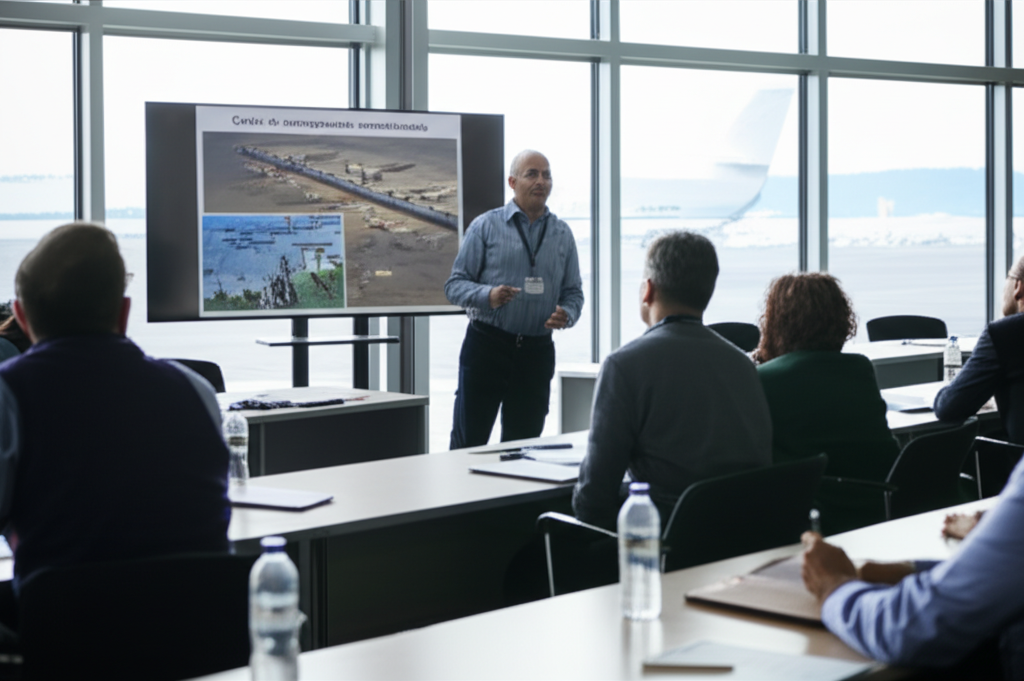
The Airport Emergency Course provides training in the management of critical incidents in aeronautical environments, including firefighting, aircraft rescue, and passenger evacuation. It imparts knowledge of safety protocols, first aid, and emergency team coordination, linking to regulations such as ICAO and local regulations. It focuses on managing adverse situations such as emergency landings, hazardous materials incidents, and crowd control, using crisis communication and response planning tools. The course offers hands-on training in simulated scenarios to develop skills in risk assessment, decision-making under pressure, and crisis leadership. The importance of inter-agency cooperation (firefighters, police, medical services) and the application of accident investigation techniques are emphasized. This training prepares professionals such as airport firefighters, security personnel, and operations personnel, improving emergency response capabilities and ensuring aviation safety.
Airport emergency course
- Format: Hybrid
- Duration: 3 months
- Hours: 300 H
- Language: English / Spanish
- Registration date: 23-10-2026
- Start date: 12-12-2026
- Available places: 3
799 $
Competencies and results
What you will learn
1. **Comprehensive Mastery of Airport Emergencies: Key Skills and Strategies**
- Identify and respond effectively to aviation incidents and accidents.
- Apply airport security and emergency management protocols.
- Coordinate rescue and salvage operations efficiently.
- Assess and manage risks in airport environments.
- Use specialized emergency equipment and tools.
- Communicate critical information clearly and accurately.
- Implement evacuation and casualty care strategies.
- Analyze the causes of aviation accidents and incidents.
- Comply with airport security regulations and standards.
- Participate in realistic drills and training exercises.
2. **In-Depth Rotor Analysis: Modeling, Performance, and Optimization**
- Advanced study of rotor dynamics, including vibration analysis, stability, and transient response.
- Numerical modeling and simulation of rotors using specialized software, encompassing finite element analysis (FEA) and boundary element methods (BEM).
- Detailed analysis of aerodynamic phenomena that affect rotor performance, such as lift, drag, and efficiency.
- Optimization of rotor design to improve performance, reduce noise, and minimize fuel consumption.
- Exploration of composite materials and their application in rotor manufacturing, with an emphasis on strength, stiffness, and durability.
- Evaluation of rotor lifespan and identification of failure mechanisms.
- Design of rotors for specific applications, such as wind turbines, helicopters, and aircraft.
- Understanding of regulations and standards Safety related to the design and operation of rotors.
Application of failure analysis and troubleshooting techniques to identify and solve problems in rotors.
Analysis of aeroelastic and aerodynamic couplings, including flutter and divergence.
Modeling and simulation of rotor-stator interaction in rotating machines.
3. Comprehensive user-oriented design and validation (from modeling to manufacturing)
You will learn to integrate the entire product development process, from initial model conception to final validation, applying user-centered methodologies. You will develop skills in parametric design, ergonomics, simulation, sustainable materials, 3D visualization, and manufacturing management, ensuring efficient, safe solutions that meet current industry standards.
4. **Excellence in Airport Emergencies: Comprehensive Training and Success Protocols**
4. **Excellence in Airport Emergencies: Comprehensive Training and Success Protocols**
- Master comprehensive airport emergency management, including planning, response, and recovery.
- Apply safety protocols and standard operating procedures (SOPs) to ensure the safety of operations.
- Assess and mitigate specific emergency risks, such as fires, aircraft accidents, and security threats.
- Effectively coordinate with multidisciplinary teams, including firefighters, medical personnel, law enforcement, and air traffic control.
- Utilize advanced tools and technologies for emergency detection, assessment, and response.
- Develop leadership and decision-making skills under pressure in crisis situations.
- Implement realistic training and simulation programs for staff preparedness.
- Understand and apply regulations and International regulations related to airport security.
Analyze incidents and accidents to identify root causes and prevent future emergencies.
Continuously improve protocols and procedures to ensure maximum efficiency and effectiveness in emergency response.
5. **Specialization in Airport Emergencies: Effective Preparation, Response and Recovery**
5. **Specialization in Airport Emergencies: Effective Preparation, Response, and Recovery**
Identification and assessment of specific risks in airport environments.
Development and implementation of comprehensive airport emergency plans.
Effective coordination with response teams, including firefighters, medical services, and authorities.
Incident management, from initial notification to resolution and post-incident analysis.
Search and rescue techniques in air emergency situations.
First aid and emergency medical care in the airport context.
Evacuation and safety protocols for passengers and personnel.
Investigation of air accidents and incidents.
Use of specialized equipment and technologies in airport emergencies.
Effective communication in crisis situations, including public information management.
Legal and regulatory framework related to airport security and emergency management.
Drills and practical exercises to strengthen emergency preparedness and response.
Implementation of post-emergency recovery strategies, including the restoration of airport operations.
Analysis of real-world airport emergency cases and lessons learned.
Adaptation of knowledge and skills to different types of airports and emergency situations.
6. **Airport Emergency Mastery: Expert Training for Crisis Management**
6. **Airport Emergency Management Expertise: Expert Training for Crisis Management**
- Comprehensive assessment and management of aircraft incidents and accidents.
- Application of airport emergency response protocols, including fires, collisions, and structural failures.
- Effective coordination of rescue teams, security, and airport personnel.
- Advanced first aid and medical care techniques in crisis situations.
- Risk analysis and airport security planning.
- Implementation of communication and information management systems in emergencies.
- In-depth knowledge of relevant aviation legislation and regulations.
- Simulation and training in realistic emergency scenarios.
- Development of leadership and decision-making skills under pressure.
- Post-incident assessment and continuous learning for safety improvement.
Who this program is for:
Airport emergency course
- Engineers with degrees in areas such as Aerospace Engineering, Mechanical Engineering, Industrial Engineering, Automation, or related disciplines.
- Specialists working in OEMs (Original Equipment Manufacturers) of rotorcraft/eVTOL aircraft, MROs (Maintenance, Repair, and Operations), consulting firms, and technology centers in the aeronautical sector.
- Professionals in the fields of Flight Testing, aeronautical certification, avionics, control systems, and flight dynamics who wish to deepen their knowledge.
- Staff from regulatory bodies and aeronautical authorities, as well as professionals linked to Urban Air Mobility (UAM) and eVTOL, who need to acquire skills in regulatory compliance.
Recommended requirements: Basic knowledge of aerodynamics, systems control, and structures is recommended. Fluency in Spanish or English at level B2+ or C1 is required. Bridging tracks are available for those who need them.
- Standards-driven curriculum: you will work with CS-27/CS-29, DO-160, DO-178C/DO-254, ARP4754A/ARP4761, ADS-33E-PRF from the first module.
- Accreditable laboratories (EN ISO/IEC 17025) with rotor bench, EMC/Lightning pre-compliance, HIL/SIL, vibrations/acoustics.
- Evidence-oriented TFM: safety case, test plan, compliance dossierand operational limits.
- Mentored by industry: teachers with experience in rotorcraft, tiltrotor, eVTOL/UAM and flight test.
- Flexible modality (hybrid/online), international cohorts and support from SEIUM Career Services.
- Ethics and security: safety-by-design approach, cyber-OT, DIH and compliance as pillars.
Module 2 — Comprehensive Mastery of Airport Emergencies: Key Skills and Strategies
2.1 Introduction to Airport Emergencies: Common Types and Scenarios
2.2 First Aid and Basic Life Support: Essential Techniques
2.3 Personal Protective Equipment (PPE) and Airport Security
2.4 Effective Communication in Emergency Situations
2.5 Coordination with Emergency Services: Fire Department, Ambulance, Police
2.6 Initial Scene Assessment and Victim Prioritization
2.7 Aircraft Firefighting Techniques
2.8 Aircraft Evacuation: Procedures and Strategies
2.9 Search and Rescue in Airport Environments
2.10 Crisis Management and Decision Making Under Pressure
Module 3 — In-Depth Rotor Analysis: Modeling, Performance, and Optimization
3.1 Principles Fundamentals of Rotor Aerodynamics
3.2 Rotor Modeling: Methods and Tools
3.3 Rotor Performance Analysis: Thrust, Power, and Efficiency
3.4 Rotor Blade Structure and Design
3.5 Flow Effects and Rotor Stability
3.6 Rotor Vibrations and Dynamics
3.7 Rotor Design Optimization
3.8 Computational Fluid Dynamics (CFD) Simulation and Analysis
3.9 Wind Tunnel Testing and Evaluation of Rotors
3.10 Advanced Applications and Future Trends in Rotor Technology
Module 4 — Master’s in Airport Response: Advanced Techniques for Critical Situations
4.1 Airport Emergency Planning and Preparedness
4.2 Incident Management and Incident Command Systems (ICS)
4.3 Rescue Victims in Complex Environments
4.4 Crowd Control and Passenger Management
4.5 Aircraft Fire Rescue Operations
4.6 Damage Assessment and Accident Analysis
4.7 Hazardous Materials (HAZMAT) Management at the Airport
4.8 Aircraft Accident Investigation: Techniques and Protocols
4.9 Media Communication and Public Relations in Crisis
4.10 Simulation Exercises and Large-Scale Drills
Module 5 — Excellence in Airport Emergencies: Comprehensive Training and Success Protocols
5.1 Applicable Aviation Legislation and Regulations
5.2 Airport Emergency Protocols: Design and Implementation
5.3 Emergency Notification and Communication Procedures
5.4 Training in the Use of Specialized Rescue Equipment
5.5 Risk Assessment and Vulnerability Analysis
5.6 Airport Security and Protection Management
5.7 Development of Training and Capacity Building Programs
5.8 Audits and Evaluations of Emergency Plans
5.9 Best Practices in Airport Emergency Management
5.10 Case Studies and Lessons Learned
Module 6 — Specialization in Airport Emergencies: Effective Preparedness, Response, and Recovery
6.1 Airport Risk Assessment and Mitigation
6.2 Disaster Contingency and Recovery Plans
6.3 Early Warning and Rapid Response Systems
6.4 Rescue Techniques in Collapsed Structures
6.5 Search and Rescue Operations in Adverse Conditions
6.6 Inter-institutional Coordination and Collaboration Protocols
6.7 Information Management and Communication in Crisis
6.8 Psychological Support for Victims and Emergency Personnel
6.9 Protocols Decontamination and Waste Management
6.10 Post-Emergency Rehabilitation and Recovery
Module 7 — Mastery of Airport Emergencies: Expert Training for Crisis Management
7.1 Leadership and Team Management in Emergency Situations
7.2 Strategic Decision Making Under Pressure
7.3 Resource Management and Logistics in Crisis
7.4 Negotiation and Conflict Resolution in Hostile Environments
7.5 Crisis Analysis and Threat Assessment
7.6 Crisis Communication and Public Opinion Management
7.7 Legal Aspects and Liability in Emergencies
7.8 Stress Management and Staff Well-being
7.9 Crisis Simulation and Decision-Making Exercises
7.10 Business Continuity Planning (BCP)
Module 8 — Excellence in Airport Emergencies: Protocols, Rescue, and Survival
8.1 Aircraft Rescue and Firefighting Protocols
8.2 Survival Techniques in Hostile Environments
8.3 Water and Terrain Rescue
8.4 Advanced First Aid and Prehospital Care
8.5 Use of Specialized Protective Equipment
8.6 Aircraft Evacuation and Passenger Safety
8.7 Mass Casualty Incident Management
8.8 Coordination with Helicopters and Other Aircraft
8.9 Analysis of Real-World Cases and Lessons Learned
8.10 Protocol Updates and Continuous Improvement
2.2 eVTOL and UAM: Electric Propulsion, Multiple Rotors
2.2 Emerging Certification Requirements (SC-VTOL, Special Conditions)
2.3 Energy and Thermal in E-Propulsion (Batteries/Inverters)
2.4 Design for Maintainability and Modular Swaps
2.5 LCA/LCC in Rotorcraft and eVTOL (Footprint and Cost)
2.6 Operations & Vertiports: Airspace Integration
2.7 Data & Digital Thread: MBSE/PLM for Change Control
2.8 Tech Risk and Readiness: TRL/CRL/SRL
2.9 IP, Certifications, and Time-to-Market
2.20 Case Study: Go/No-Go with Risk Matrix
3.3 Air Rescue Planning and Coordination
3.2 Risk Assessment and Safety in Rescue Operations
3.3 Extraction and Rescue Techniques in Hostile Environments
3.4 Use of Specialized Equipment for Air Rescue
3.5 First Aid and Medical Care in Emergency Scenarios
3.6 Communication and Crisis Management in Rescue Operations
3.7 Navigation and Orientation in Air Rescue Operations
3.8 Safety Protocols and Accident Prevention
3.9 Legal and Regulatory Aspects of Air Rescue
3.30 Simulation and Practical Training in Air Rescue
4.4 Initial Response and Scene Assessment Protocols
4.2 Communication and Coordination in Air Emergencies
4.3 Management of Critical Resources and Supplies
4.4 Evacuation and Rescue Protocols
4.5 First Aid and Emergency Medical Care
4.6 Accident Scene Security and Protection
4.7 Preliminary Investigation and Preservation of Evidence
4.8 Coordination with External Emergency Services
4.9 Communication Protocols with Passengers and Family Members
4.40 Air Emergency Simulation and Drills
5.5 Fundamentals of Airport Emergencies
5.5 Types of Air Emergencies and Their Classification
5.3 Structure and Organization of Response Teams
5.4 Communication and Coordination Protocols
5.5 First Aid and Basic Life Support in Aeronautical Environments
5.6 Introduction to Accident and Incident Investigation
5.7 Aeronautical Regulations and Their Application in Emergencies
5.8 Scenario Simulation and Practical Exercises
5.5 Principles of Rotor Aerodynamics
5.5 Design and Analysis of Rotor Airfoils
5.3 Rotor Modeling: Methods and Tools
5.4 Rotor Performance: Parameters and Metrics
5.5 Optimization of Rotor Design for Efficiency and Safety
5.6 Structural Analysis of Rotors
5.7 Flight Control Systems and Their Interaction with Rotors
5.8 Rotor testing and validation.
3.5 Aircraft firefighting techniques.
3.5 Rescue of people from aircraft crashes.
3.3 Hazardous materials management in air emergencies.
3.4 Aircraft evacuation: procedures and strategies.
3.5 Search and rescue techniques in airport environments.
3.6 Coordination with external emergency services.
3.7 Use of specialized air response equipment.
3.8 Incident analysis and lessons learned.
4.5 Airport emergency response planning.
4.5 Risk assessment and scenario analysis.
4.3 Airport security and safety protocols.
4.4 Crisis management and decision-making under pressure.
4.5 Crisis communication and reputation management. 4.6 Response protocols for different types of emergencies.
4.7 High-fidelity drills and training exercises.
4.8 Evaluation and continuous improvement of protocols.
5.5 Emergency preparedness: training and education.
5.5 Immediate response: alarm response and mobilization.
5.3 Situation assessment and initial decision-making.
5.4 Scene control and area security.
5.5 Rescue and salvage techniques.
5.6 First aid and emergency medical care.
5.7 Post-emergency recovery: investigation and analysis.
5.8 Psychological support for victims and response personnel.
6.5 Leadership and team management in crisis situations.
6.5 Effective communication and inter-institutional coordination.
6.3 Strategic and tactical decision-making.
6.4 Resource management and logistics in emergencies. 6.5 Information Management and Communication with the Media
6.6 Legal and Regulatory Framework for Crisis Management
6.7 Airport Business Continuity Planning
6.8 Evaluation and Improvement of Crisis Management Performance
7.5 Aircraft Rescue Equipment and Techniques
7.5 Survival in Hostile Environments: Water, Mountains, Desert
7.3 Advanced First Aid in Emergency Situations
7.4 Aircraft Evacuation and Emergency Procedures
7.5 Air Search and Rescue Protocols
7.6 Use of Personal Protective Equipment and Safety Techniques
7.7 Coordination with Search and Rescue Services
7.8 Survival Psychology and Stress Management
8.5 Aircraft Fire Response Protocols
8.5 Techniques for Rescuing Victims Trapped in Aircraft 8.3 Assessment and triage of victims in air emergencies.
8.4 First aid techniques and advanced life support.
8.5 Coordination of rescue teams and emergency services.
8.6 Use of personal protective equipment and safety gear.
8.7 Effective communication and information management.
8.8 Post-incident evaluation and improvement of protocols.
6.6 Introduction to Airport Emergency Management
6.2 Types of Airport Emergencies
6.3 Staff Roles and Responsibilities
6.4 First Aid and Medical Care
6.5 Communication and Coordination in Emergencies
6.6 Evacuation and Security Protocols
6.7 Use of Rescue and Firefighting Equipment
6.8 Initial Assessment and Decision-Making
6.9 Drills and Practical Exercises
6.60 Aviation Legislation and Regulations
2.6 Rotor Operating Principles
2.2 Rotor Aerodynamics: Lift and Drag
2.3 Rotor Modeling: Software and Tools
2.4 Performance Analysis: Efficiency and Stability
2.5 Rotor Blade Design and Optimization
2.6 Rotor Vibration and Noise Control
2.7 Rotor Materials and Manufacturing
2.8 Load Factors and Structural Design
2.9 Rotor Testing and Trials
2.60 Rotor Applications and Trends
3.6 Incident Assessment and Classification
3.2 Search and Rescue Techniques
3.3 Aircraft Fire Control
3.4 Hazardous Materials Management
3.5 Coordination with Emergency Services
3.6 Risk Assessment and Hazard Analysis
3.7 Advanced Communication Systems
3.8 Emergency Evacuation Strategies
3.9 Management of Mass Casualty Incidents
3.60 Accident and Incident Investigation
4.6 Protocol Development and Implementation
4.2 Resource Management and Logistics
4.3 Coordination with Authorities and Airlines
4.4 Personnel Training 4.5 Drills and simulation exercises.
4.6 Risk analysis and contingency planning.
4.7 Crisis management and media communication.
4.8 Scene protection and evidence preservation.
4.9 Protocol review and updates.
4.60 Performance evaluation and continuous improvement.
5.6 Emergency response planning.
5.2 Rapid and effective reaction techniques.
5.3 Organization of response teams.
5.4 Rescue and salvage procedures.
5.5 First aid and prehospital care.
5.6 Victim assessment and triage.
5.7 Damage control and risk mitigation.
5.8 Scene recovery and cleanup.
5.9 Psychological support and trauma management.
5.60 Post-incident reporting and analysis.
6.6 Leadership and Decision-Making in Crisis
6.2 Communication and Information Management
6.3 Managing Multidisciplinary Teams
6.4 Risk Assessment and Situation Analysis
6.5 Media Relations
6.6 Reputation Management and Crisis Communication
6.7 Post-Incident Recovery Planning
6.8 Legal Aspects and Civil Liability
6.9 Insurance and Claims Management
6.60 Real-World Case Analysis and Case Studies
7.6 Aircraft Rescue Equipment and Techniques
7.2 Survival in Hostile Environments
7.3 Search and Rescue on Land and Sea
7.4 Advanced First Aid and Emergency Medicine
7.5 Evacuation and Transport of the Injured
7.6 Fire and Explosion Protection
7.7 Life Support and Survival Systems 7.8 Descent and abseiling techniques.
7.9 Communication and coordination protocols.
7.60 Safety planning and risk prevention.
8.6 Action protocols in different scenarios.
8.2 Advanced rescue and salvage techniques.
8.3 Use of specialized rescue equipment.
8.4 Coordination with emergency and rescue teams.
8.5 Risk analysis and response planning.
8.6 Effective communication during rescue operations.
8.7 Scene management and crowd control.
8.8 First aid and emergency medical care.
8.9 Evacuation and transport of victims.
8.60 Incident investigation and analysis.
- Hands-on methodology: test-before-you-trust, design reviews, failure analysis, compliance evidence.
- Software (depending on licenses/partners): MATLAB/Simulink, Python (NumPy/SciPy), OpenVSP, SU2/OpenFOAM, Nastran/Abaqus, AMESim/Modelica, acoustics tools, planning toolchains DO-178C.
- SEIUM Laboratories: scale rotor bench, vibrations/acoustics, EMC/Lightning pre-compliance, HIL/SIL for AFCS, data acquisition with strain gauging.
- Standards and compliance: EN 9100, 17025, ISO 27001, GDPR.
Capstone-type projects
- Emergency simulation and management: scenarios, 3D modeling, resource optimization.
- SAR protocols: planning, deployment, coordination, and evaluation of operations.
- Risk analysis: hazard identification, assessment, and mitigation.
- Airport Emergency Simulation: Creation of realistic scenarios and response simulations to optimize protocols and staff training.
- Protocol Analysis: Evaluation of incident response, drills, and evacuation plans.
- Scenario Simulation: Implementation of realistic simulations of air emergencies.
- Crisis Management: Design of a comprehensive airport crisis management system.
- Incident Investigation: Case analysis and continuous improvement in air safety.
- SAR Simulation: 3D scenario modeling; search and rescue algorithms; visibility and coverage analysis.
- Navigation and Communications: Systems integration; link simulation; interference and security analysis.
- Airport Crisis Management: Response planning and simulation; team coordination; risk and resilience analysis.
Admissions, fees, and scholarships
- Profile: Background in Computer Engineering, Mathematics, Statistics, or related fields; practical experience in NLP and valued information retrieval systems.
- Documentation: Updated CV, academic transcript, SOP/statement of purpose, project examples or code (optional).
- Process: Application → Technical evaluation of profile and experience → Technical interview → Review of case studies → Final decision → Enrollment.
- Fees:
- Single payment: 10% discount.
- Payment in 3 installments: No fees; 30% upon registration + 2 equal monthly payments of the remaining 35%.
Monthly payment: available with a 7% commission on the total; annual review.
Scholarships: based on academic merit, financial need, and promoting inclusion; agreements with companies in the sector for partial or full scholarships.
See “Calendar & Calls for Applications,” “Scholarships & Grants,” and “Fees & Financing” in the SEIUM mega-menu.
Do you have any questions?
Our team is ready to help you. Contact us, and we will respond as soon as possible.
F. A. Q
Frequently asked questions
Yes, we have international certification
Yes: experimental models, real data, applied simulations, professional environments, real case studies.
It is not mandatory. We offer leveling tracks and tutoring.
Completely. It covers e-propulsion, integration, and emerging regulations (SC-VTOL).
Recommended. There are also internal challenges and consortiums.
Yes. Online/hybrid modality with planned labs and visa support (see “Visa & Residence”).