

Air cargo logistics course
About our
The Air Cargo Logistics Course offers a comprehensive immersion in the efficient and secure management of air freight. It focuses on the application of international regulations, air security procedures, and route and cost optimization, covering crucial aspects such as customs documentation, the handling of perishable and hazardous cargo, and the management of airport warehouses. Tools are provided for flight planning, airline negotiation, and shipment tracking, ensuring an efficient supply chain and compliance with IATA and ICAO regulations. This course provides practical experience in managing airport operations, including cargo packing and labeling, knowledge of air transport legislation, and the development of logistics optimization strategies. The training prepares individuals for roles such as air freight forwarders, logistics coordinators, and air transport analysts, enhancing employability in the transport and international trade industry.
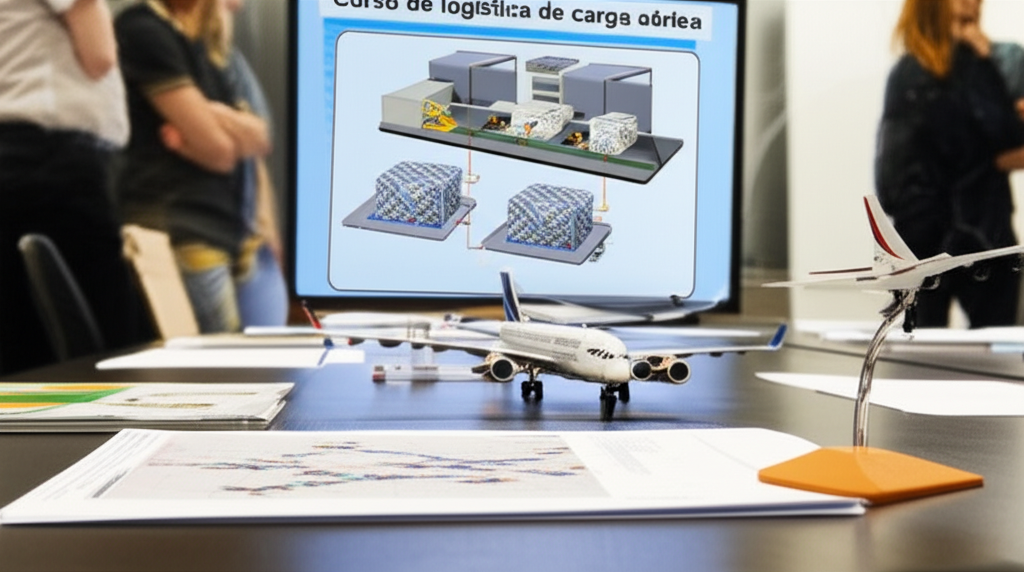
Air cargo logistics course
- Format: Hybrid
- Duration: 3 months
- Hours: 300 H
- Language: English / Spanish
- Registration date: 23-10-2026
- Start date: 12-12-2026
- Available places: 2
380 $
Competencies and results
What you will learn
1. Optimization of Logistics Operations in Air Cargo
- Identify and evaluate the key components of air cargo, including aircraft, infrastructure, and personnel.
- Apply inventory and warehousing management principles to optimize cargo handling.
- Design efficient air freight routes, considering factors such as distance, time, and cost.
- Implement risk management strategies to minimize cargo delays and damage.
- Utilize tracking and traceability technologies to monitor the movement of air cargo.
- Understand and comply with air cargo safety regulations and standards.
- Apply cost optimization techniques to air cargo operations.
- Develop communication and negotiation skills to interact with suppliers and customers.
- Analyze the environmental impact of air cargo operations and propose sustainable solutions.
- Utilize software tools and data analysis to improve Decision-making in air cargo logistics.
[ul]
2. Expert Mastery in Air Cargo Management: From Strategic Planning to Optimal Execution
- Strategic Air Cargo Planning: You will master the initial phases, from demand forecasting to route definition and aircraft selection.
- Route Optimization and Flight Scheduling: You will learn to use advanced tools and techniques for efficient route planning, considering factors such as weather, airspace restrictions, and fuel optimization.
- Cargo Management and Stowage: You will specialize in the correct distribution of cargo within the aircraft, ensuring flight stability and safety, and maximizing cargo capacity.
- Documentation and Regulatory Compliance: You will delve into the documentation required for air cargo transport, including knowledge of national and international regulations (IATA, ICAO) and compliance with them.
- Handling of Specialized Cargo: You will be trained in the safe and efficient handling of special cargo such as dangerous goods (DGR), live animals, perishables and valuables, among others.
- Technology and Cargo Management Systems: You will explore the use of modern software and systems for air cargo management, including tracking and tracing systems, inventory management, and process optimization.
- Air Cargo Risk and Security Analysis: You will develop skills to identify and assess the risks associated with air cargo transportation, implementing security measures to prevent incidents and ensure cargo integrity.
- Coordination with Agents and Operators: You will learn to manage relationships with freight forwarders, airlines, airport authorities, and other relevant stakeholders in the air cargo supply chain.
- Development of Continuous Improvement Strategies: You will acquire tools and knowledge to analyze and optimize air cargo management processes, implementing improvements that increase efficiency, reduce costs, and enhance customer satisfaction.
3. Comprehensive user-oriented design and validation (from modeling to manufacturing)
You will learn to integrate the entire product development process, from initial model conception to final validation, applying user-centered methodologies. You will develop skills in parametric design, ergonomics, simulation, sustainable materials, 3D visualization, and manufacturing management, ensuring efficient, safe solutions that meet current industry standards.
4. Specialization in Air Cargo Logistics: Processes, Regulations and Operational Efficiency
Here is the SEO-optimized content about what you will learn in the “Specialization in Air Cargo Logistics: Processes, Regulations, and Operational Efficiency” course:
4. Specialization in Air Cargo Logistics: Processes, Regulations, and Operational Efficiency
Supply chain analysis in air transport, from origin to final destination.
Application of technologies for cargo tracking and information management (RFID, warehouse management systems).
Development of skills for rate negotiation and supplier and customer relationship management.
Evaluation and improvement of operational efficiency, including key performance indicators (KPIs).
Study of practical cases and simulations for problem-solving and decision-making in real-world scenarios.
5. Advanced Strategies for Air Logistics: Maximizing Efficiency in Cargo Transport
- Master the complexities of strategic planning in air logistics, including optimal route selection and cargo capacity management.
- Gain in-depth knowledge of inventory management in the air transport sector, optimizing stock levels and minimizing storage and handling costs.
- Implement advanced air cargo optimization techniques, considering the weight, volume, and density of goods to maximize space efficiency and reduce transportation costs.
- Analyze and apply risk management strategies specific to air logistics, including delay mitigation, incident management, and loss prevention.
- Utilize cutting-edge technologies, such as transportation management systems (TMS), data analytics, and simulation tools, to improve decision-making and operational efficiency.
- Understand and apply international regulations and standards governing air logistics, ensuring compliance and safety in all aspects operations.
- Develop negotiation and relationship management skills with air transport service providers, airlines, and other key players in the supply chain.
6. Comprehensive Analysis of Air Logistics: Route Optimization and Risk Management
- Master the analysis of flight planning and scheduling, including optimizing air routes to minimize costs and delivery times.
- Evaluate and select the most suitable modes of air transport, considering factors such as cargo capacity, speed, and security restrictions.
- Understand the principles of inventory and warehousing management in the context of air logistics, including the handling of perishable and hazardous goods.
- Identify and analyze the risks inherent in air logistics operations, such as delays, cancellations, cargo damage, and adverse weather events.
- Apply risk management techniques to mitigate the impacts of identified risks, including obtaining insurance and developing contingency plans.
- Utilize technological tools and information systems to optimize air logistics management, such as shipment tracking and tracing systems and route simulation software.
- Analyze the relevant regulations and standards applicable to air logistics, including air transport laws and safety regulations.
Develop leadership and team management skills to efficiently direct and coordinate air logistics operations.
Evaluate and select air logistics service providers, including airlines, freight forwarders, and warehousing companies.
Analyze case studies and examples of best practices in air logistics management to apply knowledge to real-world situations.
Who this program is for:
Air cargo logistics course
- Logistics, transportation, and supply chain professionals with experience or interest in the air cargo sector.
- Freight forwarders, freight forwarders, and logistics operators who wish to expand their knowledge of air cargo management.
- Airline, airport, and ground handling company personnel who need to improve their efficiency and knowledge of air cargo logistics.
- Individuals seeking a professional development opportunity in the air cargo logistics sector.
- Standards-driven curriculum: you will work with CS-27/CS-29, DO-160, DO-178C/DO-254, ARP4754A/ARP4761, ADS-33E-PRF from the first module.
- Accreditable laboratories (EN ISO/IEC 17025) with rotor bench, EMC/Lightning pre-compliance, HIL/SIL, vibrations/acoustics.
- Evidence-oriented TFM: safety case, test plan, compliance dossierand operational limits.
- Mentored by industry: teachers with experience in rotorcraft, tiltrotor, eVTOL/UAM and flight test.
- Flexible modality (hybrid/online), international cohorts and support from SEIUM Career Services.
- Ethics and security: safety-by-design approach, cyber-OT, DIH and compliance as pillars.
Module 1 — Optimizing Air Cargo Logistics Operations
1.1 Introduction to Air Logistics: Overview and Current Trends
1.2 Air Cargo Market Structure: Key Players and Their Roles
1.3 Fundamental Principles of Air Route Planning
1.4 Types of Cargo Aircraft: Selection and Capacities
1.5 Essential Documentation in Air Cargo Transportation
1.6 International and National Regulations: Compliance and Standards
1.7 Loading and Unloading Processes: Efficiency and Safety
1.8 Airport Warehouse Management: Space Optimization
1.9 Handling Dangerous Goods: Regulations and Procedures
1.10 Emerging Technologies in Air Logistics: Automation and Digitalization
Module 2 — Air Cargo Planning and Strategy
2.2 Air Cargo Market Analysis: Trends and Opportunities
2.2 Defining Objectives and Scope of the Logistics Project
2.3 Selecting Strategic Routes and Destinations
2.4 Evaluating Airport Infrastructure
2.5 Designing the Air Transport Network
2.6 Selecting and Negotiating with Airlines and Suppliers
2.7 Estimating Costs and Budgets
2.8 Risk and Contingency Management
2.9 Cargo Capacity Planning
2.20 Developing an Implementation Plan
3.3 Air Route Network Analysis: Design and Optimization
3.2 Risk Assessment in the Air Supply Chain: Identification and Mitigation
3.3 Operational Risk Management: Emergency Prevention and Response
3.4 Route Optimization: Airline and Airport Selection
3.5 Cost-Benefit Analysis of Air Routes
3.6 Capacity and Congestion Management in Air Transport
3.7 Impact of Regulations on Route Planning
3.8 Air Cargo Tracking and Monitoring Technologies
3.9 Data Analysis for Air Route Decision Making
3.30 Route Disruption Recovery Strategies
4.4 Introduction to Air Cargo Regulations
4.2 International Regulatory Framework: IATA, ICAO, and other organizations
4.3 Key Documentation and Processes: Waybills, Manifests, and Labels
4.4 Air Cargo Security: Risk Prevention
4.5 Operational Efficiency in Air Cargo: KPIs and Continuous Improvement
4.6 Handling of Dangerous Goods (DGM): Regulations and Procedures
4.7 Air Supply Chain Management: Visibility and Traceability
4.8 Impact of Technology on Air Logistics: Automation and Digitalization
4.9 Compliance and Audits in Air Logistics
4.40 Case Studies: Efficiency Analysis and Regulatory Compliance
5. Fundamentals of Air Cargo Logistics
5.5 Definition and Scope of Air Cargo Logistics
5.5 Air Cargo Transportation Modes
5.3 Structure of the Air Cargo Industry: Airlines, Agents, Freight Forwarders
5.4 Essential Documentation in Air Transport: Air Waybills, Manifests
5.5 Types of Air Cargo: Perishables, Hazardous Materials, Valuables
5.6 International Regulations: IATA, ICAO, National Legislation
5.7 Key Terminology in Air Logistics
5.8 Impact of Technology on Air Logistics
5.9 Current and Future Trends in Air Cargo
5.50 Case Study: Introduction to Cargo Flight Operations
5. Strategic Air Cargo Planning
5.5 Air Cargo Market and Demand Analysis
5.6 Route and Destination Selection Strategic
5.3 Air Distribution Network Design
5.4 Planning Factors: Capacity, Frequency, and Aircraft Types
5.5 Capacity Management and Flight Scheduling
5.6 Alliance and Commercial Agreement Management
5.7 Cost Modeling and Budgeting in Air Logistics
5.8 Key Performance Indicators (KPIs) in Air Cargo
5.9 Risk Analysis and Contingency Planning
5.50 Implementation of an Air Cargo Strategic Plan
3. Routes and Risk Management in Air Logistics
3.5 Air Route Selection and Optimization
3.5 Factors Influencing Route Choice: Weather, Geopolitics, Infrastructure
3.3 Risk Assessment in Air Routes: Security, Delays, Natural Disasters
3.4 Operational and Financial Risk Management
3.5 Cargo Insurance and Coverage Air Cargo
3.6 Crisis Management and Emergency Protocols
3.7 Technologies for Monitoring and Tracking Cargo
3.8 Data Analysis and Risk Prediction
3.9 Implementation of a Risk Management System in Air Cargo
3.50 Case Study: Risk Analysis on a Specific Route
4. Regulations and Operational Efficiency in Cargo
4.5 International Regulations: IATA, ICAO, Customs Legislation
4.5 Regulatory Compliance: Documentation and Procedures
4.3 Hazardous Cargo Management: Classification, Packaging, and Transportation
4.4 Cargo Handling Efficiency: Standards and Best Practices
4.5 Process Optimization in Warehouses and Cargo Terminals
4.6 Automation and Process Optimization Technologies
4.7 Inventory Management and Loss Control
4.8 Design of Operational Efficiency Indicators (OEE)
4.9 Audits and Quality Control in Air Cargo
4.50 Implementation of Operational Efficiency Improvements
5. Optimization of Air Cargo Operations
5.5 Optimization of the Reservation and Loading Process
5.5 Overload Management and Aircraft Balancing
5.3 Efficient Loading and Unloading Techniques
5.4 Use of Cargo Equipment and Tools
5.5 Management of Cargo Terminals and Warehouses
5.6 Technology for Operations Optimization (WMS, TMS)
5.7 Reduction of Waiting and Handling Times
5.8 Fuel Efficiency Optimization
5.9 Implementation of a Continuous Improvement System
5.50 Success Stories in Air Cargo Optimization
6. Comprehensive Analysis of Air Logistics
6.5 Analysis of the Air Supply Chain
6.5 Supplier Evaluation and Selection of Strategic Partners
6.3 Integration of the Air Logistics with Other Modes of Transport
6.4 Total Cost of Ownership (TCO) Analysis
6.5 Sustainability and Corporate Social Responsibility in Air Logistics
6.6 Use of Big Data and Predictive Analytics in Logistics
6.7 Environmental Impact Assessment of Operations
6.8 Design of Sustainability Indicators
6.9 Implementation of Sustainable Practices
6.50 Case Study: Complete Air Supply Chain
7. Processes and Efficiency in Air Logistics
7.5 Design of Efficient Air Cargo Processes
7.5 Process Standardization
7.3 Automation of Repetitive Tasks
7.4 Use of Business Process Management (BPM) Technologies
7.5 Document Management and Traceability
7.6 Improved Communication and Collaboration
7.7 Implementation of Performance Indicators
7.8 Quality Control in Processes
7.9 Continuous Process Improvement
7.50 Case Study: Optimization of Specific Processes
8. Mastery of Air Cargo Processes
8.5 Review of all modules
8.5 Simulation of real-world cases
8.3 Discussion and analysis of the main challenges
8.4 Review of the Regulatory Framework
8.5 Data Analysis and Decision Making
8.6 Presentation of final projects
8.7 Discussion of current trends
8.8 Strategies for continuous improvement
8.9 Professional development opportunities
8.50 Conclusions and course closing
6.6 Air Route Evaluation: Optimization Factors
6.2 Risk Analysis: Identification and Classification
6.3 Route Design: Efficiency and Safety
6.4 Risk Management: Mitigation and Control
6.5 Tracking and Monitoring Technologies
6.6 Air Safety Regulations and Standards
6.7 Case Studies: Accident Analysis and Lessons Learned
6.8 Risk Analysis Tools: Software and Methodologies
6.9 Contingency Planning: Emergency Response
6.60 Logistics Optimization: Efficiency and Cost Reduction
- Hands-on methodology: test-before-you-trust, design reviews, failure analysis, compliance evidence.
- Software (depending on licenses/partners): MATLAB/Simulink, Python (NumPy/SciPy), OpenVSP, SU2/OpenFOAM, Nastran/Abaqus, AMESim/Modelica, acoustics tools, planning toolchains DO-178C.
- SEIUM Laboratories: scale rotor bench, vibrations/acoustics, EMC/Lightning pre-compliance, HIL/SIL for AFCS, data acquisition with strain gauging.
- Standards and compliance: EN 9100, 17025, ISO 27001, GDPR.
Capstone-type projects
- Predictive Analytics: Optimization of air freight routes and costs, a real-world case study.
- Simulation and Modeling: Design of an efficient air logistics system, KPIs, and scenarios.
- Risk Management: Assessment and mitigation of risks in the air supply chain.
- Regulatory Compliance: Auditing and improvement of air logistics processes.
- Route Optimization: Analysis of air routes, optimization of time and costs.
- Warehouse Management: Warehouse design, inventory management, and efficiency.
- Risk Analysis: Identification and mitigation of risks in the supply chain.
- Simulation and Modeling: Use of software to simulate and improve operations.
- Air Route Analysis: cost and time optimization, predictive modeling.
- Risk Management: risk assessment and mitigation in the supply chain.
- Operational Efficiency: implementation of KPIs and continuous improvement in operations.
- Regulatory Compliance: analysis and application of air cargo regulations.
- Air Route Optimization: Predictive analytics, risk management, fuel efficiency.
- Cargo Management: Automated systems, digital documentation, regulatory compliance.
- Cost Analysis: Financial modeling, fare optimization, profitability per route.
Admissions, fees, and scholarships
- Profile: Background in Computer Engineering, Mathematics, Statistics, or related fields; practical experience in NLP and valued information retrieval systems.
- Documentation: Updated CV, academic transcript, SOP/statement of purpose, project examples or code (optional).
- Process: Application → Technical evaluation of profile and experience → Technical interview → Review of case studies → Final decision → Enrollment.
- Fees:
- Single payment: 10% discount.
- Payment in 3 installments: No fees; 30% upon registration + 2 equal monthly payments of the remaining 35%.
Monthly payment: available with a 7% commission on the total; annual review.
Scholarships: based on academic merit, financial need, and promoting inclusion; agreements with companies in the sector for partial or full scholarships.
See “Calendar & Calls for Applications,” “Scholarships & Grants,” and “Fees & Financing” in the SEIUM mega-menu.
Do you have any questions?
Our team is ready to help you. Contact us, and we will respond as soon as possible.
F. A. Q
Frequently asked questions
Yes, we have international certification
Yes: experimental models, real data, applied simulations, professional environments, real case studies.
It is not mandatory. We offer leveling tracks and tutoring.
Completely. It covers e-propulsion, integration, and emerging regulations (SC-VTOL).
Recommended. There are also internal challenges and consortiums.
Yes. Online/hybrid modality with planned labs and visa support (see “Visa & Residence”).