
Aerospace Production Automation Course
About our
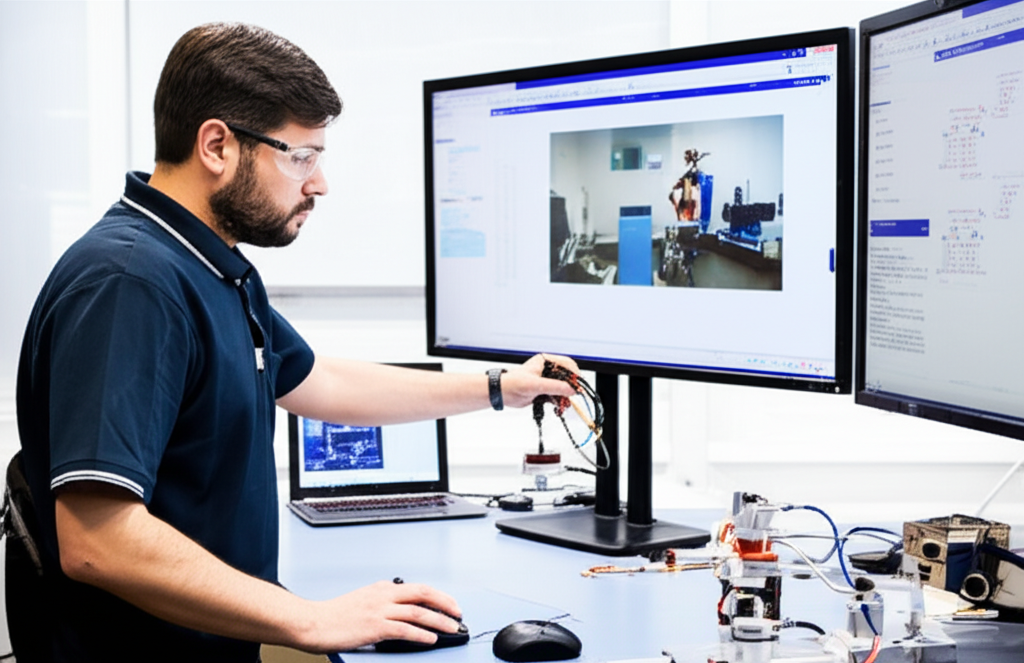
The Aerospace Production Automation Course focuses on the application of advanced technologies in the manufacturing and assembly of aerospace components. It includes the use of industrial robots, CNC systems, and numerical control processes to optimize efficiency and precision in production. Participants learn to implement machine vision systems, sensors, and intelligent automation to improve quality control and production management. The course explores robot programming techniques and the integration of computer-integrated manufacturing (CIM) systems, essential for the aerospace industry. The course provides hands-on experience in the design and operation of automated production lines, focusing on optimizing cycle times and reducing waste. Industrial safety regulations and aerospace industry standards, such as AS9100, are also covered. Graduates will be prepared for roles such as automation engineers, production technicians, robotics specialists, and manufacturing analysts, increasing competitiveness in the aerospace and defense industries.
Aerospace Production Automation Course
- Format: Hybrid
- Duration: 3 months
- Hours: 300 H
- Language: English / Spanish
- Registration date: 23-10-2026
- Start date: 12-12-2026
- Available places: 2
649 $
Competencies and results
What you will learn
1. Comprehensive Mastery of Automation in Aerospace Production
- Identify and analyze the automation systems used in aerospace production.
- Understand the integration of robotics and CNC systems in manufacturing processes.
- Evaluate the programming and control of industrial robots for specific tasks.
- Study the application of machine vision and sensors in automated quality control.
- Analyze the simulation and optimization of automated production processes.
- Apply simulation tools for the optimization of production lines.
- Implement Management Systems (MES) and their relationship to automation.
- Evaluate safety in automated production environments.
- Understand the aerospace industry standards and regulations for automation.
2. Performance Optimization and Modeling of Aerospace Rotors
- In-depth analysis of complex aeroelastic phenomena:
- Detailed evaluation of flap-lag-torsion couplings, essential for rotor stability.
- Comprehensive study of whirl flutter and its impact on structural integrity.
- Predictive analysis of fatigue, crucial for component lifespan.
- Master advanced structural design and analysis techniques:
- Precise dimensioning of laminates in composite materials, optimizing weight and strength.
- Detailed design and analysis of bonded joints and connections, using finite element (FE) analysis to ensure integrity.
- Apply cutting-edge methodologies in integrity management of rotor:
- Implementation of damage tolerance strategies to ensure safety in the presence of damage.
- Application of non-destructive testing (NDT), including UT/RT/thermography, for early defect detection.
3. Comprehensive user-oriented design and validation (from modeling to manufacturing)
You will learn to integrate the entire product development process, from initial model conception to final validation, applying user-centered methodologies. You will develop skills in parametric design, ergonomics, simulation, sustainable materials, 3D visualization, and manufacturing management, ensuring efficient, safe solutions that meet current industry standards.
4. Implementation and Management of Automated Systems in the Aerospace Industry
- Design and implementation of automated systems for aerospace manufacturing and assembly.
- Control of automated processes: programming of PLCs, robots, and machine vision systems.
- Integration of data management systems and real-time analytics to optimize production.
- Optimization of operational efficiency through automation: reduction of production costs and times.
- Predictive maintenance and fault diagnosis in automated systems: sensors and data analysis.
- Compliance with regulations and safety standards in aerospace automation.
- Application of artificial intelligence and machine learning for process optimization.
- Risk analysis and mitigation in the implementation of automated systems.
- Simulation and modeling of automated systems for design validation and optimization.
- Future trends in aerospace automation: robotics Collaborative design, 3D printing, and additive manufacturing.
5. Design and Automation of Processes in Aerospace Production
- Master the analysis of critical structural couplings: flap-lag-torsion, essential for aircraft stability and control; evaluation of the whirl flutter phenomenon, critical for rotors; and study of fatigue in aeronautical components under load cycles.
- Apply finite element (FE) methods for the design and dimensioning of key components: laminates in composites, optimizing strength and weight; structural joints, ensuring the integrity of the connections; and bonded joints, for proper adhesion and durability.
- Integrate advanced strategies to ensure the safety and performance of aeronautical structures: implement damage tolerance techniques to predict and mitigate failures; and apply NDT (UT/RT/thermography) for early defect detection and quality control.
6. Engineering and Optimization in the Automation of Aerospace Rotors
- In-depth analysis of rotor structural dynamics, including a detailed study of flap-lag-torsion couplings, crucial for stability, as well as the analysis of phenomena such as whirl flutter, a destructive vibration mode, and the assessment of fatigue, to ensure the service life of components.
- Master the dimensioning of aerospace structures, focusing on the use of composites. This includes the calculation of laminates, the design of joints and bonded joints, using Finite Element Analysis (FE) tools to simulate structural behavior under various loading conditions.
Applying advanced methodologies for structural integrity management, including the implementation of damage tolerance, to assess the structure’s capacity to withstand damage, and the use of non-destructive testing (NDT) techniques, such as Ultrasound (UT), Radiography (RT), and Thermography, to detect and evaluate defects without damaging the component.
Who this program is for:
Aerospace Production Automation Course
- Graduates in Aerospace Engineering, Mechanical Engineering, Industrial Engineering, Automation Engineering, or related fields.
- Professionals in OEM rotorcraft/eVTOL, MRO, consulting, and technology centers.
- Flight Testing, certification, avionics, control, and dynamics seeking specialization.
- Regulators/authorities and UAM/eVTOL professionals requiring compliance skills.
Recommended requirements: foundation in aerodynamics and control and structures; ES/EN B2+/C1. We offer bridging tracks if you need them.
- Standards-driven curriculum: you will work with CS-27/CS-29, DO-160, DO-178C/DO-254, ARP4754A/ARP4761, ADS-33E-PRF from the first module.
- Accreditable laboratories (EN ISO/IEC 17025) with rotor bench, EMC/Lightning pre-compliance, HIL/SIL, vibrations/acoustics.
- Evidence-oriented TFM: safety case, test plan, compliance dossierand operational limits.
- Mentored by industry: teachers with experience in rotorcraft, tiltrotor, eVTOL/UAM and flight test.
- Flexible modality (hybrid/online), international cohorts and support from SEIUM Career Services.
- Ethics and security: safety-by-design approach, cyber-OT, DIH and compliance as pillars.
2.1 Blade Theory and Computational Flow Analysis (CFD)
2.2 Aerodynamic Design of Rotors: Airfoil, Planform, Twist
2.3 Material Selection and Manufacturing (Composites)
2.4 Structural Analysis and Fatigue Strength
2.5 Performance Optimization: Efficiency, Noise, Vibration
2.6 Dynamic Modeling and Simulation of Rotors
2.7 Rotor Control and Stability
2.8 Wind Tunnel Testing and Validation
2.9 Rotor Design Methodology
2.10 Rotor Design Software Applications
3.1 Collaborative Robotics and Vision Systems
3.2 Automated Transport Systems (AGV, AMR)
3.3 Sensor and Actuator Integration
3.4 PLC Programming and Motion Control
3.5 Automated Manufacturing Cells
3.6 Flexible Production Line Design
3.7 Process Simulation and Optimization
3.8 Analysis 3.9 Lean Manufacturing and Automation
3.10 Implementing Industry 4.0 in Aerospace Manufacturing
4.1 Selecting and Evaluating Automation Technologies
4.2 Designing Custom Automated Systems
4.3 Hardware and Software Integration
4.4 Automation Project Management
4.5 Testing and Commissioning Systems
4.6 Predictive and Corrective Maintenance
4.7 Cybersecurity in Automated Systems
4.8 Systems Lifecycle Management
4.9 Training and Development of Personnel
4.10 Continuous Improvement and Performance Optimization
5.1 Design of Manufacturing Processes (DFM)
5.2 Selecting Equipment and Tools
5.3 Automating Assembly and Mounting
5.4 Automated Quality Control
5.5 Designing Ergonomic Workstations
5.6 Process Simulation and Optimization
5.7 Integrating Information Systems (MES, ERP)
5.1 Design of Manufacturing Processes (DFM)
5.2 Selecting Equipment and Tools
5.3 Automating Assembly and Mounting
5.4 Automated Quality Control
5.5 Designing Ergonomic Workstations
5.6 Process Simulation and Optimization
5.7 Integrating Information Systems (MES, ERP)
5.1 5.8 Capacity and Bottleneck Analysis
5.9 Welding and Joining Process Design
5.10 Automation of Painting and Coating Processes
6.1 Conceptual Rotor Design
6.2 Aerodynamic Optimization of Rotors
6.3 Structural Analysis and Validation
6.4 Rotor Control Systems
6.5 Rotor Modeling and Simulation
6.6 Automation System Integration
6.7 Material Selection and Use
6.8 Design of Automated Manufacturing Processes
6.9 Rotor Testing and Validation
6.10 Cost and Life Cycle Analysis
7.1 Needs and Requirements Analysis
7.2 Automated System Design
7.3 Equipment Selection and Integration
7.4 System Programming and Configuration
7.5 Commissioning and Testing
7.6 Performance Management and Optimization
7.7 Maintenance and Technical Support
7.8 Continuous Improvement and Upgrades
7.9 Quality Control and Safety
7.10 Project and Team Management
8.1 3D Rotor Modeling
8.2 Aerodynamic Performance Simulation
8.3 Structural and Dynamic Analysis
8.4 Design for Automated Manufacturing
8.5 Material and Process Selection
8.6 Sensor and Actuator Integration
8.7 Automated Quality Control
8.8 Design and Performance Optimization
8.9 Cost and Life Cycle Analysis
8.10 Rotor Validation and Testing
2.2 Principles of Automation and Control in the Aerospace Industry
2.2 Design of Automated Systems: Methodologies and Tools
2.3 Sensors and Actuators: Fundamentals and Applications
2.4 PLC Programming and Distributed Control Systems (DCS)
2.5 Industrial Robotics: Programming and Operation
2.6 Systems Integration: Communication and Industrial Protocols
2.7 Simulation and Modeling of Automated Processes
2.8 Data Management and Analysis in Automated Environments
2.9 Predictive and Corrective Maintenance of Automated Systems
2.20 Safety and Quality Standards in Aerospace Automation
3.3 Fundamentals of Aerospace Automation: History and Evolution
3.2 Design Principles for Automation: Flexibility and Scalability
3.3 Sensors and Actuators in Aerospace Production
3.4 Robotics in Aerospace Manufacturing: Types and Applications
3.5 Machine Vision Systems for Quality Control and Assembly
3.6 Programmable Logic Controllers (PLCs) and Their Applications
3.7 Human-Machine Interfaces (HMIs) and Process Monitoring
3.8 Simulation and Modeling of Automated Systems
3.9 Systems Integration: From Airframe to Aircraft
3.30 Case Studies: Automation in the Production of Aeronautical Components
2.3 Introduction to Rotor Aerodynamics: Basic Principles
2.2 Computational Modeling of Rotors: CFD and FEA 2.3 Aerodynamic Design of Rotor Blades: Performance Optimization
2.4 Structural Analysis of Rotors: Strength and Durability
2.5 Composite Materials in Rotors: Selection and Manufacturing
2.6 Design and Optimization of Rotor Control Systems
2.7 Noise Reduction Techniques in Rotors
2.8 Performance Analysis of Rotors under Different Flight Conditions
2.9 Multi-Objective Optimization Methods Applied to Rotors
2.30 Case Studies: Rotor Optimization in Helicopters and Drones
3.3 Lean Manufacturing and Automation: Waste Reduction
3.2 Six Sigma and Automation: Quality Control and Continuous Improvement
3.3 Flexible Manufacturing Systems (FMS) in the Aerospace Industry
3.4 Implementation of Collaborative Robotics (cobots)
3.5 Automation of Complex Assembly Processes 3.6 Integration of Manufacturing Execution Systems (MES).
3.7 Big Data and Predictive Analytics in Aerospace Manufacturing.
3.8 Cybersecurity in Automation Systems.
3.9 Digital Transformation in Aerospace Manufacturing.
3.30 Case Studies: Advanced Strategies in Aerospace Manufacturing.
4.3 Selection of Automated Systems: Criteria and Requirements.
4.2 Planning and Design of System Implementation.
4.3 Automation Project Management: Schedules and Budgets.
4.4 Integration of Automated Systems with Existing Systems.
4.5 Testing and Validation of Automated Systems.
4.6 Staff Training and Development.
4.7 Change Management in System Implementation.
4.8 Maintenance and Technical Support of Automated Systems.
4.9 Audits and Quality Control in Implementation. 4.30 Case Studies: Systems Management and Implementation
5.3 Mapping and Analysis of Aerospace Production Processes
5.2 Designing Optimized Processes for Automation
5.3 Process Simulation Tools: Flow Analysis
5.4 Automation of Cutting, Machining, and Forming Processes
5.5 Automation of Assembly Processes
5.6 Automation of Painting and Coating Processes
5.7 Design of Automated Production Cells
5.8 Software Development for Process Automation
5.9 Optimizing Efficiency and Productivity
5.30 Case Studies: Process Design and Automation
6.3 Engineering Principles in Rotor Design
6.2 Modeling and Simulation of Complex Rotor Systems
6.3 Structural Optimization of Rotors for Automation
6.4 Selection of Advanced Materials and Manufacturing Processes
6.5 Design of optimized rotor control systems.
6.6 Integration of sensor and actuator systems.
6.7 Rotor failure and reliability analysis.
6.8 Design and optimization of automated manufacturing processes.
6.9 Design of tools and fixtures for automation.
6.30 Case studies: rotor engineering and optimization.
7.3 Selection and evaluation of automated systems.
7.2 Detailed design of system implementation.
7.3 Optimization project management.
7.4 Integration of systems with existing infrastructure.
7.5 Testing and validation of optimized systems.
7.6 Performance measurement and analysis.
7.7 Implementation of continuous improvements.
7.8 Optimization of maintenance and reliability.
7.9 Strategies for cost reduction and increased productivity.
7.30 Case studies: implementation and optimization.
8.3 Introduction to Aerodynamics and Rotor Design
8.2 Rotor Modeling and Simulation
8.3 Material Selection and Manufacturing Processes
8.4 Automation in Rotor Manufacturing
8.5 Performance Analysis: Key Metrics
8.6 Design Optimization for Performance and Efficiency
8.7 Control and Automation System Design
8.8 Systems Integration and Performance Analysis
8.9 Life Cycle Assessment and Sustainability
8.30 Case Studies: Automation and Performance
4.4 Introduction to eVTOL and UAM: Electric Propulsion and Multiple Rotors
4.2 Emerging Certification Requirements (SC-VTOL, Special Conditions)
4.3 Energy and Thermal Management in E-Propulsion (Batteries and Inverters)
4.4 Design for Maintainability and Modular Interchangeability
4.5 Life Cycle Assessment (LCA) and Life Cycle Cost (LCC) in Rotorcraft and eVTOL
4.6 Operations and Vertiports: Airspace Integration
4.7 Data and Digital Threads: MBSE/PLM for Change Control
4.8 Technology Risk Assessment and Readiness: TRL/CRL/SRL
4.9 Intellectual Property, Certifications, and Time to Market
4.40 Case Study: Investment Decisions with a Risk Matrix
5.5 Design and Automation of Advanced Flight Control Systems
5.5 Integration of Sensors and Actuators in Automated Aerospace Systems
5.3 Optimization of Rotor Configuration for Efficiency and Automation
5.4 Design of Control Algorithms for Aircraft Stability and Performance
5.5 Simulation and Analysis of Automated Aerospace Production Systems
5.6 Selection and Application of Advanced Materials in Aerospace Automation
5.7 Implementation of Quality and Safety Standards in Automated Production
5.8 Design of Automated Workstations and Manufacturing Cells
5.9 Integration of Collaborative Robots and Machine Vision Systems
5.50 Risk Assessment and Mitigation Strategies in Automated Environments
6.6 Rotor Engineering Principles: Design and Analysis
6.2 Optimizing Rotor Aerodynamic Performance
6.3 Advanced Materials and Rotor Manufacturing
6.4 Integrating Control and Automation Systems in Rotors
6.5 Rotor Modeling and Simulation for Optimization
6.6 Structural Analysis and Durability of Rotors
6.7 Risk Assessment and Project Management in Rotor Automation
6.8 Testing and Validation of Automated Rotor Systems
6.9 Regulations and Safety Standards in Rotor Production
6.60 Case Study: Implementing Automation in Rotor Manufacturing
- Hands-on methodology: test-before-you-trust, design reviews, failure analysis, compliance evidence.
- Software (depending on licenses/partners): MATLAB/Simulink, Python (NumPy/SciPy), OpenVSP, SU2/OpenFOAM, Nastran/Abaqus, AMESim/Modelica, acoustics tools, planning toolchains DO-178C.
- SEIUM Laboratories: scale rotor bench, vibrations/acoustics, EMC/Lightning pre-compliance, HIL/SIL for AFCS, data acquisition with strain gauging.
- Standards and compliance: EN 9100, 17025, ISO 27001, GDPR.
Capstone-type projects
- Robotic Automation: Manufacturing cells; pick and place; machine vision.
- Process Simulation: Modeling and optimization; bottleneck analysis; Discrete Event Simulation (DES).
- Data Analysis: Machine learning; predictive analytics; supply chain optimization.
- Systems Design: Modular design; scalability; systems integration.
- Process Automation: Design, simulation, and validation of robotic cells; PLC/SCADA control.
- Performance Analysis: Flow simulation, CFD; design and material optimization.
- Systems Management: Implementation and maintenance of automated production lines.
- Rotor Engineering: Modeling, simulation, and optimization of rotors.
- RPA Automation: Process analysis; robot design and implementation.
- Manufacturing Simulation: Workflow optimization; robot simulation.
- Machine Vision: Quality inspection; defect detection.
- Digitalization: Digital twins; data integration; traceability.
- Process Automation: Production line design, robotics, simulation, and optimization.
- Production Management: Planning, quality control, inventory management, and optimization.
- Systems Design: Component selection, programming, testing, and validation.
- Data Analysis: Data collection, processing, visualization, and data-driven decision-making.
Admissions, fees, and scholarships
- Profile: Background in Computer Engineering, Mathematics, Statistics, or related fields; practical experience in NLP and valued information retrieval systems.
- Documentation: Updated CV, academic transcript, SOP/statement of purpose, project examples or code (optional).
- Process: Application → Technical evaluation of profile and experience → Technical interview → Review of case studies → Final decision → Enrollment.
- Fees:
- Single payment: 10% discount.
- Payment in 3 installments: No fees; 30% upon registration + 2 equal monthly payments of the remaining 35%.
Monthly payment: available with a 7% commission on the total; annual review.
Scholarships: based on academic merit, financial need, and promoting inclusion; agreements with companies in the sector for partial or full scholarships.
See “Calendar & Calls for Applications,” “Scholarships & Grants,” and “Fees & Financing” in the SEIUM mega-menu.
Do you have any questions?
Our team is ready to help you. Contact us, and we will respond as soon as possible.
F. A. Q
Frequently asked questions
Yes, we have international certification
Yes: experimental models, real data, applied simulations, professional environments, real case studies.
It is not mandatory. We offer leveling tracks and tutoring.
Completely. It covers e-propulsion, integration, and emerging regulations (SC-VTOL).
Recommended. There are also internal challenges and consortiums.
Yes. Online/hybrid modality with planned labs and visa support (see “Visa & Residence”).