

Aerospace finance course
About our
The Aerospace Finance Course explores the key financial aspects of the aerospace industry, covering topics such as financial modeling, investment analysis, and sector-specific risk management. It focuses on the evaluation of aerospace projects, from aircraft development to satellite manufacturing and airline management, linking finance with industry engineering, operations, and regulation. It includes the analysis of costs, budgets, and sources of financing, considering factors such as technological innovation and capital investment cycles. The course offers a comprehensive overview of aerospace finance, preparing participants for roles in financial management, investment analysis, consulting, and strategic planning, using advanced tools and relevant case studies. It focuses on financial decision-making in a complex and constantly evolving environment, where profitability, sustainability, and competitiveness are crucial to the success of aerospace companies. The key legislation and standards of the sector are addressed.
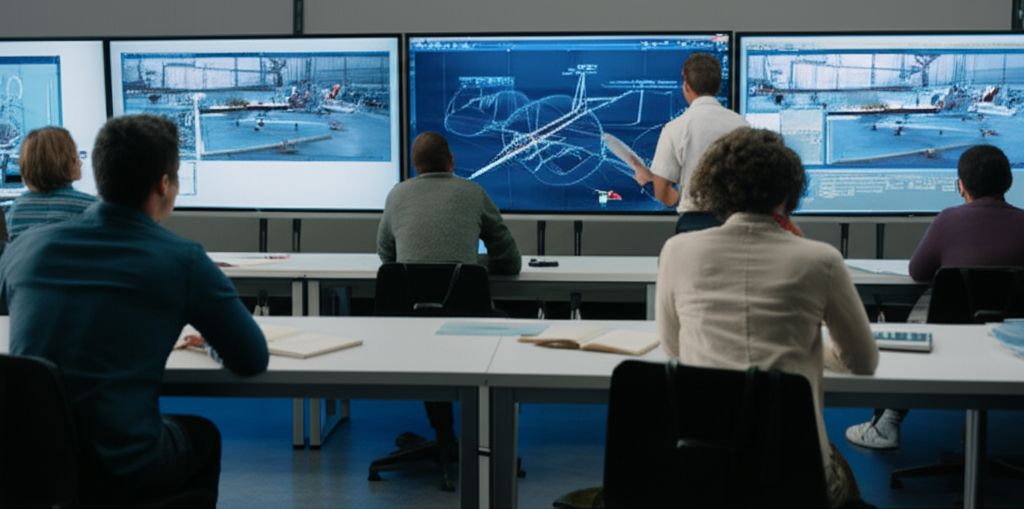
Aerospace finance course
- Format: Hybrid
- Duration: 3 months
- Hours: 300 H
- Language: English / Spanish
- Registration date: 23-10-2026
- Start date: 12-12-2026
- Available places: 2
399 $
Competencies and results
What you will learn
1. Financial Analysis and Investment Strategies in the Aerospace Industry
- Understand the fundamentals of financial analysis applied specifically to the aerospace industry.
- Evaluate and analyze the impact of financial decisions on projects and companies in the sector.
- Master the key tools and techniques for valuing aerospace companies.
- Study the different sources of financing available to the industry, including venture capital, debt, and government funding.
- Develop customized investment strategies, considering the unique risks and opportunities of the aerospace market.
- Learn to evaluate the economic viability of aerospace projects, from design to production and launch.
- Analyze case studies of successful and failed investments in the aerospace sector.
- Understand the regulatory framework and government policies that influence aerospace investments.
- Apply financial projection models to simulate scenarios and make informed investment decisions.
Acquire knowledge about financial risk management and hedging in the aerospace industry.
2. Financial Management and Strategic Decisions in the Aerospace Sector
- Understand the fundamentals of financial management specific to the aerospace sector.
- Analyze key financial statements and their interpretation for decision-making.
- Evaluate the financial performance of aerospace projects and companies.
- Develop valuation models for investments and mergers/acquisitions in the sector.
- Analyze the impact of financing on capital structure and the cost of capital.
- Understand financial risks and mitigation strategies in the aerospace sector.
- Make strategic decisions based on financial analysis and risk assessment.
- Evaluate the impact of technological innovation and market trends on financial management.
- Apply financial management tools and techniques for resource optimization and profitability.
- Understand the importance of financial sustainability in the sector long-term aerospace.
3. Comprehensive user-oriented design and validation (from modeling to manufacturing)
You will learn to integrate the entire product development process, from initial model conception to final validation, applying user-centered methodologies. You will develop skills in parametric design, ergonomics, simulation, sustainable materials, 3D visualization, and manufacturing management, ensuring efficient, safe solutions that meet current industry standards.
4. Budgetary Planning and Financial Control in Aviation
4. Budget Planning and Financial Control in Aviation
- Master the fundamentals of budget planning specific to the aviation sector.
- Understand cost analysis techniques and their application in commercial and general aviation.
- Learn to develop and manage detailed budgets for different operational areas and aviation projects.
- Evaluate cash flow and financial projections in the context of aviation, including revenue, expenses, and profitability.
- Use financial control tools to monitor budget performance and detect deviations.
- Apply key performance indicators (KPIs) to evaluate efficiency and profitability in aviation.
- Analyze the Financial risks associated with the aeronautical industry and develop mitigation strategies.
- Understand the impact of legislation and financial regulations on budget planning and financial control.
- Learn about best practices in cost accounting and financial management in the aeronautical sector.
- Prepare financial reports and profitability analyses for strategic decision-making.
5. Finance, Budgets and Cost Analysis in Aeronautical Engineering
5. Finance, Budgeting, and Cost Analysis in Aeronautical Engineering
- Understand the principles of **financial management** applied to aeronautical projects.
- Develop and manage detailed **budgets** for aeronautical engineering projects, considering all variables.
- Perform accurate **cost analyses**, including direct, indirect, and marginal costs throughout the aircraft lifecycle.
- Evaluate the **profitability and economic viability** of aeronautical projects using key performance indicators (KPIs).
- Apply **earned value management (EVM)** techniques for monitoring and controlling costs and schedules.
- Understand the **financial risks** inherent in the aeronautical industry and develop mitigation strategies.
- Use **financial simulation** tools and software for decision-making decisions.
- Analyze the **economic impact** of engineering decisions on project profitability.
- Interpret **financial statements** and relevant metrics for strategic decision-making.
- Master the application of **accounting and financial regulations** relevant to the aerospace industry.
6. Financial Optimization and Valuation of Aerospace Companies
6. Financial Optimization and Valuation of Aerospace Companies
- Understand the key concepts of financial optimization applied to the aerospace sector.
- Evaluate the capital structure and financial management of companies in the sector.
- Analyze the financial performance and profitability of aerospace projects.
- Apply business valuation techniques, including discounted cash flow (DCF) and multiples analysis.
- Understand the specific financial risks of the aerospace sector and how to manage them.
- Use financial tools and models for strategic decision-making.
- Identify investment and financing opportunities in the aerospace market.
- Interpret financial reports and analyze the economic situation of companies.
- Understand the financial regulations and standards relevant to the sector.
- Develop skills financial analysis and valuation for informed decision-making.
Who this program is for:
Aerospace finance course
- Graduates in Aerospace Engineering, Mechanical Engineering, Industrial Engineering, Automation Engineering, or related fields.
- Professionals in OEM rotorcraft/eVTOL, MRO, consulting, and technology centers.
- Flight Testing, certification, avionics, control, and dynamics seeking specialization.
- Regulators/authorities and UAM/eVTOL professionals requiring compliance skills.
Recommended requirements: foundation in aerodynamics and control and structures; ES/EN B2+/C1. We offer bridging tracks if you need them.
- Standards-driven curriculum: you will work with CS-27/CS-29, DO-160, DO-178C/DO-254, ARP4754A/ARP4761, ADS-33E-PRF from the first module.
- Accreditable laboratories (EN ISO/IEC 17025) with rotor bench, EMC/Lightning pre-compliance, HIL/SIL, vibrations/acoustics.
- Evidence-oriented TFM: safety case, test plan, compliance dossierand operational limits.
- Mentored by industry: teachers with experience in rotorcraft, tiltrotor, eVTOL/UAM and flight test.
- Flexible modality (hybrid/online), international cohorts and support from SEIUM Career Services.
- Ethics and security: safety-by-design approach, cyber-OT, DIH and compliance as pillars.
2.1 Fundamentals of Finance in the Aerospace Industry
2.2 Financial Statements: Analysis and Interpretation
2.3 Key Performance Indicators (KPIs) in the Aerospace Sector
2.4 Capital Structure and Financing of Aerospace Projects
2.5 Investment Decisions and Project Evaluation
2.6 Financial Risk Management in Aviation
2.7 Hedging and Risk Mitigation Strategies
2.8 Mergers and Acquisitions in the Aerospace Sector
2.9 Valuation Analysis of Aerospace Companies
2.10 Case Studies: Strategic and Financial Decisions
2.2 Fundamentals of Aerospace Financial Management
2.2 Financial Structure and Sources of Capital in the Aerospace Sector
2.3 Budgeting and Financial Planning in Aerospace Companies
2.4 Cost and Profitability Analysis in Aerospace Projects
2.5 Cash Flow and Working Capital Management
2.6 Financial Risk Assessment and Mitigation
2.7 Investment Decisions and Asset Valuation
2.8 Financial Statement Analysis and Key Performance Indicators (KPIs)
2.9 Financial Management in Operations and Maintenance
2.20 Growth and Financial Expansion Strategies
3.3 Aerospace Market: Trends and Investment Opportunities
3.2 Financial Statement Analysis in the Aerospace Industry
3.3 Financial Key Performance Indicators (KPIs)
3.4 Evaluation of Aerospace Investment Projects
3.5 Sources of Financing: Debt, Equity, and Grants
3.6 Risks and Mitigation in Aerospace Investments
3.7 Valuation Models for Aerospace Companies
3.8 Investment Strategies: Growth, Value, and Dividends
3.9 Scenario Analysis and Financial Sensitivity
3.30 Case Studies of Successful Aerospace Investments
2.3 Financial Structure and Organization of the Aerospace Sector
2.2 Strategic Decision-Making Based on Financial Data
2.3 Working Capital and Cash Flow Management
2.4 Pricing Policies and Profitability Strategies 2.5 Mergers and Acquisitions (M&A) in the Aerospace Industry
2.6 Financial Risk Management Strategies
2.7 Corporate Governance and Regulatory Compliance
2.8 Financial Planning and Control Tools
2.9 Impact of Regulations on Financial Management
2.30 Analysis of Strategic Financial Management Case Studies
3.3 Risk Identification and Assessment in Aeronautical Projects
3.2 Risk Modeling and Sensitivity Analysis
3.3 Risk-Adjusted Return on Capital (RAROC) Assessment
3.4 Sensitivity Analysis and Scenarios in Aerospace Projects
3.5 Insurance and Risk Coverage in the Industry
3.6 Geopolitical Risks and Their Impact on Projects
3.7 Learning Curve Analysis and Its Impact on Costs
3.8 Supply Chain Risk Management 3.9 Risk Management Tools and Specialized Software
3.30 Case Studies: Risk Management in Specific Projects
4.3 Principles of Budget Planning in Aviation
4.2 Preparing the Revenue and Expenditure Budget
4.3 Capital Budgeting and Investment Analysis
4.4 Budgetary Control and Variance Analysis
4.5 Activity-Based Costing (ABC) in Aviation
4.6 Budgetary Key Performance Indicators (KPIs)
4.7 Budget Planning Tools and Software
4.8 Operating and Financial Budgets in Airlines
4.9 Impact of Market Fluctuations on Budgets
4.30 Practical Case Studies in Aviation Budget Planning
5.3 Principles of Accounting and Finance in Aeronautical Engineering 5.2 Direct and Indirect Costs in Aeronautical Engineering
5.3 Design and Development Cost Analysis
5.4 Manufacturing and Maintenance Cost Management
5.5 Cost-Benefit Analysis in Engineering Projects
5.6 Cost Control in Aeronautical Engineering Projects
5.7 Cost Budgeting and Monitoring in Projects
5.8 Analysis of the Cost Structure of an Aircraft’s Life Cycle
5.9 Cost Analysis Tools in Engineering
5.30 Case Studies: Cost Analysis in Specific Projects
6.3 Valuation Models for Aerospace Companies
6.2 Valuation by Multiples and Discounted Cash Flow (DCF)
6.3 Analysis of Capital Structure and Cost of Capital
6.4 Mergers and Acquisitions (M&A) and Their Impact on Valuation 6.5 Valuation of intangible assets in the aerospace industry.
6.6 Financial optimization strategies.
6.7 Financial restructuring and value creation.
6.8 Valuation models specific to aerospace startups.
6.9 Impact of market trends on valuation.
6.30 Case studies in valuation and financial optimization.
7.3 Direct and indirect costs in aviation and space.
7.2 Budgeting space operations costs.
7.3 Cost management of launches and space missions.
7.4 Cost control in spacecraft development projects.
7.5 Life cycle analysis of space vehicle costs.
7.6 Cost reduction strategies in the space industry.
7.7 Cost accounting for space companies.
7.8 Impact of regulations on aviation and space costs.
7.9 Cost Control Tools and Software
7.30 Case Studies: Cost Analysis in Specific Projects
8.3 Building Financial Models in Excel and Specialized Software
8.2 Sensitivity Analysis and Scenarios in Financial Models
8.3 Evaluating the Economic Feasibility of Aerospace Projects
8.4 Break-Even Point and Profitability Analysis
8.5 Discounted Cash Flow (DCF) Modeling
8.6 Financing and Capital Structure Modeling
8.7 Risk Analysis and Monte Carlo Simulation
8.8 Business Valuation Modeling
8.9 Feasibility Analysis Tools for Aerospace Projects
8.30 Practical Cases in Financial Modeling and Feasibility Analysis
4.4 Financial Statement Analysis in the Aerospace Industry
4.2 Key Financial Ratios and Their Interpretation in the Sector
4.3 Cash Flow and Working Capital Management in Aerospace Projects
4.4 Profitability and Efficiency Analysis in Aerospace Companies
4.5 Valuation Models for Aerospace Companies
4.6 Investment and Financing Strategies in the Sector
4.7 Financial Risk Assessment and Mitigation in the Industry
4.8 Impact of Economic Policies on Aerospace Investments
4.9 Case Studies: Financial Analysis of Aerospace Companies
4.40 Trends and Challenges in Financial Analysis of the Sector
2.4 Strategic Financial Planning in the Aerospace Sector
2.2 Investment and Financing Decisions in Aerospace Projects
2.3 Financial Risk Management and Hedging in the Industry
2.4 Capital Structure and Financial Optimization in the Sector
2.5 Mergers and Acquisitions: Financial Analysis and Valuation
2.6 Governance Corporate and Risk Management in Aerospace Companies
2.7 Cost and Profitability Analysis in Aerospace Projects
2.8 Growth and Expansion Strategies in the Sector
2.9 Investment Decisions in Aerospace R&D and Technology
2.40 Case Studies: Financial Management in Aerospace Companies
3.4 Risk Identification and Assessment in Aerospace Projects
3.2 Sensitivity Analysis and Scenarios in Risk Assessment
3.3 Market, Credit, and Operational Risk Management
3.4 Simulation Models and Monte Carlo Analysis
3.5 Risk Assessment in the Aerospace Supply Chain
3.6 Insurance and Risk Management in the Sector
3.7 Technological and Innovation Risks in Projects
3.8 Impact of Regulation and Compliance on Risks
3.9 Case Studies: Risk Assessment in Aerospace Projects
3.40 Risk Mitigation and Resilience Strategies in the Sector
4.4 Budgeting and Management in the Aviation Sector
4.2 Budget Control and Variance Analysis
4.3 Direct and Indirect Costs in Air Operations
4.4 Profitability Analysis of Air Routes and Fleets
4.5 Pricing and Revenue Strategies in Aviation
4.6 Fuel and Aircraft Maintenance Cost Management
4.7 Capital Budgeting and Investment Decisions
4.8 Key Performance Indicators (KPIs) in Aviation
4.9 Case Study: Budget Planning in Airlines
4.40 Implementation of Budget Management Software
5.4 Cost Accounting and Costing Systems in Aeronautical Engineering
5.2 Cost Analysis of Design, Manufacturing, and Maintenance
5.3 Budgeting and Cost Control in Engineering Projects
5.4 Profitability Analysis of Aeronautical Engineering Projects
5.5 Product Lifecycle Cost Management
5.6 Material and Labor Costs Construction and overhead costs
5.7 Earned value analysis in engineering projects
5.8 Cost optimization in the supply chain
5.9 Case studies: cost analysis in engineering projects
5.40 Implementation of cost control systems
6.4 Valuation methods for aerospace companies
6.2 Discounted cash flow (DCF) analysis
6.3 Relative valuation and multiples analysis
6.4 Valuation of intangible assets in the sector
6.5 Optimization of capital structure and financing
6.6 Mergers and acquisitions (M&A) strategies
6.7 Synergy analysis and value creation
6.8 Financial restructuring and cost optimization
6.9 Case studies: valuation of aerospace companies
6.40 Trends and challenges in financial optimization
7.4 Direct and indirect costs in air and space operations
7.2 Budgeting and control Costs in Space Projects
7.3 Product Lifecycle Cost Management
7.4 Profitability Analysis of Aerospace Projects
7.5 Cost Management Strategies in the Sector
7.6 Launch and Space Operations Costs
7.7 Research and Development (R&D) Costs in the Sector
7.8 Key Performance Indicators (KPIs) in Aviation and Space
7.9 Case Studies: Cost Analysis in Aerospace Projects
7.40 Implementation of Cost Control Systems
8.4 Introduction to Financial Modeling in Aerospace Projects
8.2 Building Cash Flow Models
8.3 Sensitivity Analysis and Scenarios in Financial Models
8.4 Modeling Revenue and Expenses in Aerospace Projects
8.5 Evaluating the Economic Feasibility of Projects
8.6 Risk and Profitability Analysis in Projects
8.7 Financing and Capital Structure Modeling
8.8 Break-Even Point and Profitability Threshold Analysis
8.9 Case studies: Financial modeling of aerospace projects
8.40 Financial modeling tools and software
5. Financial Analysis and Investment Strategies in the Aerospace Industry
5.5 Aerospace Market Trends and Investment Opportunities
5.5 Business Model Evaluation in the Aerospace Industry
5.3 Analysis of Aerospace Companies’ Financial Statements
5.4 Investment Strategies in Sector Stocks and Bonds
5.5 Risk Assessment and Return on Investment (ROI)
5.6 Mergers and Acquisitions (M&A) in the Aerospace Sector
5.7 Financing Aerospace Projects: Debt and Equity
5.8 Sensitivity Analysis and Scenarios in Aerospace Investments
5.9 Impact of Innovation and Technology on Investments
5.50 Case Study: Analysis of Investments in Aerospace Companies
5. Financial Management and Strategic Decisions in the Aerospace Sector
5.5 Strategic Financial Planning in the Aerospace Sector
5.5 Capital Structure and Project Financing
5.3 Working Capital Management in Aerospace Companies
5.4 Investment Decisions and Long-Term Financing
5.5 Financial Risk Management in the Industry
5.6 Budgeting and Budgetary Control in Airlines
5.7 Cost and Profitability Analysis in Projects
5.8 Pricing Decisions and Revenue Strategies
5.9 Cash Flow Management and Resource Optimization
5.50 Case Study: Strategic Decisions in an Aerospace Company
3. Risk and Profitability Assessment in Aerospace Projects
3.5 Risk Identification and Assessment in Projects
3.5 Sensitivity Analysis and Risk Scenarios
3.3 Valuation Models for Aerospace Projects
3.4 Credit Risk Measurement and Management
3.5 Project Profitability Assessment
3.6 Financial Viability Analysis of Projects
3.7 Risk Mitigation Techniques
3.8 Insurance and Risk Coverage in the Sector
3.9 Risk and Return Analysis in Projects
3.50 Case Study: Risk Assessment in an Aerospace Project
4. Budget Planning and Financial Control in Aviation
4.5 The Budget Planning Process in Aviation
4.5 Preparation and Analysis of Operating Budgets
4.3 Budget Control and Variance Analysis
4.4 Capital Budgeting and Investment Evaluation
4.5 Cost Management in Air Operations
4.6 Profitability Analysis of Routes and Services
4.7 Financial Key Performance Indicators (KPIs)
4.8 Implementation of Budget Control Systems
4.9 Auditing and Regulatory Compliance in Aviation
4.50 Case Study: Budget Planning in an Airline
5. Finance, Budgeting, and Cost Analysis in Aeronautical Engineering
5.5 Life Cycle Costing (LCC) in Design and Production
5.5 Material and Manufacturing Cost Analysis
5.3 Budgeting for Aeronautical Engineering Projects
5.4 Research and Development (R&D) Cost Management
5.5 Profitability Analysis of Engineering Projects
5.6 Aircraft Maintenance and Repair Costs
5.7 Cost Optimization in Aircraft Design
5.8 Budgeting and Cost Control in Projects
5.9 Financial Risk Assessment in Engineering Projects
5.50 Case Study: Cost Analysis in an Aeronautical Engineering Project
6. Financial Optimization and Valuation of Aerospace Companies
6.5 Aerospace Company Valuation Methods
6.5 Discounted Cash Flow (DCF) Analysis
6.3 Valuation Based on Market Multiples
6.4 Capital Structure Optimization
6.5 Financing and Refinancing Strategies
6.6 Synergy Analysis in Mergers and Acquisitions
6.7 Shareholder Value Management
6.8 Financial Restructuring and Cost Optimization
6.9 Valuation Analysis of Companies in Crisis
6.50 Case Study: Valuation of an Aerospace Company
7. Finance, Budgeting, and Cost Control in Aviation and Space
7.5 Budgeting in the Aerospace Industry: Structure and Creation
7.5 Cost Control in Air and Space Operations
7.3 Profitability Analysis of Space Projects
7.4 Financial Modeling for Space Projects
7.5 Financial Risk Management in Projects
7.6 Capital Budgeting and Evaluation of Space Investments
7.7 Financing Space Projects: Sources and Strategies
7.8 Analysis of Launch Costs and Space Operations
7.9 Financial Key Performance Indicators (KPIs)
7.50 Case Study: Finance and Cost Control in a Space Mission
8. Financial Modeling and Feasibility Analysis in Aerospace Projects
8.5 Fundamentals of Financial Modeling
8.5 Building Financial Models for Projects
8.3 Scenario and Sensitivity Analysis
8.4 Financial Feasibility Assessment
8.5 Cash Flow Modeling and Profitability Analysis
8.6 Break-Even Point and Revenue Threshold Analysis
8.7 Risk Modeling and Monte Carlo Analysis
8.8 Investment Project Evaluation
8.9 Sensitivity Analysis and Scenario Simulation
8.50 Case Study: Financial Modeling of an Aerospace Project
6.6 Introduction to Financial Analysis in the Aerospace Industry
6.2 Key Financial Statements and Their Analysis
6.3 Industry-Specific Profitability and Efficiency Metrics
6.4 Cash Flow Analysis in Aerospace Projects
6.5 Financial Risk Assessment and Mitigation
6.6 Investment Strategies in Aerospace Assets
6.7 Sources of Financing and Capital Structure
6.8 Sensitivity Analysis and Scenarios in Projects
6.9 Impact of Financial Regulations on the Industry
6.60 Case Study: Financial Analysis of an Aerospace Company
2.6 Working Capital Management in the Aerospace Sector
2.2 Investment Decisions in Aerospace Projects
2.3 Assessment of Financial Risks and Opportunities
2.4 Short- and Long-Term Financing Strategies
2.5 Cost and Budget Management in Aerospace Projects
2.6 Analysis of Capital Structure and Its Impact
2.7 Mergers, Acquisitions, and Divestitures in the sector
2.8 Strategic pricing and profitability decisions
2.9 Impact of financial policies on competitiveness
2.60 Case study: Strategic decisions in an aerospace company
3.6 Identifying and assessing risks in aviation projects
3.2 Profitability analysis of aerospace projects
3.3 Risk modeling and sensitivity analysis
3.4 Financial risk management techniques
3.5 Assessment of operational and technical risks
3.6 Risk-adjusted return analysis
3.7 Insurance and hedging in the aerospace industry
3.8 Impact of exchange rates and interest rates
3.9 Risk assessment tools and software
3.60 Case study: Risk and profitability assessment in an aeronautical project
4.6 Budgeting and management in aviation
4.2 Budgetary control and variance analysis
4.3 Revenue and expense forecasting in aviation
4.4 Cash Flow and Working Capital Management
4.5 Analysis of Operating and Maintenance Costs
4.6 Capital Budgeting and Investment Decisions
4.7 Budget Planning Tools and Software
4.8 Key Performance Indicators (KPIs) in Aviation
4.9 Impact of Regulations on Budget Planning
4.60 Case Study: Budget Planning in an Airline
5.6 Fundamentals of Finance in Aeronautical Engineering
5.2 Cost Analysis in the Aircraft Life Cycle
5.3 Budgeting and Cost Control in Engineering Projects
5.4 Design, Manufacturing, and Maintenance Costs
5.5 Profitability Analysis of Engineering Projects
5.6 Cost Optimization Techniques
5.7 Financial Risk Management in Projects
5.8 Economic Feasibility Analysis of Projects
5.9 Impact of Technological Innovation on Costs
5.60 Case Study: Finance and Costs in a Design Project Aerospace
6.6 Methods for Valuing Aerospace Companies
6.2 Capital Structure Optimization
6.3 Value Creation Strategies in the Sector
6.4 Merger and Acquisition Analysis
6.5 Profitability and Growth Management
6.6 Operational Efficiency Optimization
6.7 Financing and Restructuring Strategies
6.8 Sensitivity Analysis and Financial Scenarios
6.9 Evaluating the Impact of Regulations
6.60 Case Study: Financial Optimization in an Aerospace Company
7.6 Finance in the Space Industry
7.2 Budgeting and Cost Control in Space Projects
7.3 Life Cycle Cost Analysis of Projects
7.4 Financial Modeling for Space Projects
7.5 Financial Risk Management in Space
7.6 Sources of Financing for Space Projects
7.7 Profitability and Investment Analysis in the Space Sector
7.8 Impact of Government Policies on Space Finance
7.9 Tools and Software for Space Financial Analysis
7.60 Case Study: Finance and Cost Control in a Space Project
8.6 Building Financial Models in the Sector
8.2 Feasibility Analysis of Aerospace Projects
8.3 Financial Projections and Scenario Analysis
8.4 Cost and Cash Flow Modeling
8.5 Sensitivity Analysis and Risk Assessment
8.6 Valuation of Companies and Projects
8.7 Financial Modeling Tools and Software
8.8 Validation and Presentation of Financial Models
8.9 Impact of Regulations on Financial Modeling
8.60 Case Study: Financial Modeling of an Aerospace Project
- Hands-on methodology: test-before-you-trust, design reviews, failure analysis, compliance evidence.
- Software (depending on licenses/partners): MATLAB/Simulink, Python (NumPy/SciPy), OpenVSP, SU2/OpenFOAM, Nastran/Abaqus, AMESim/Modelica, acoustics tools, planning toolchains DO-178C.
- SEIUM Laboratories: scale rotor bench, vibrations/acoustics, EMC/Lightning pre-compliance, HIL/SIL for AFCS, data acquisition with strain gauging.
- Standards and compliance: EN 9100, 17025, ISO 27001, GDPR.
Capstone-type projects
- Financial Modeling: Feasibility analysis of complex aerospace projects.
- Budgeting: Budget creation and control for the industry.
- Risk Analysis: Evaluation and mitigation of financial risks in projects.
- Business Valuation: Determination of the value of aerospace companies.
- Investment Analysis: Discounted cash flow modeling and evaluation of profitability metrics in aerospace projects.
- Risk Management: Identification, assessment, and mitigation of financial and operational risks in the sector.
- Budget Planning: Creation and analysis of budgets for aviation projects, including variance analysis.
- Cost Analysis: Implementation of activity-based costing systems to optimize profitability.
- Aerospace Investment Analysis: Financial modeling, risk assessment, and profitability analysis for a new aircraft development project.
- Budget Planning: Creation of a detailed budget and financial control for an airline, including sensitivity and scenario analysis.
- Aerospace Company Valuation: Evaluation of the valuation of a company in the sector, considering assets, liabilities, and financial projections.
- Aerospace Financial Analysis: Modeling, risk assessment, investment strategies, and profitability.
- Aviation Budgeting and Control: Planning, cost analysis, and financial optimization.
- Aerospace Company Valuation: Strategic decisions and financial management in the sector.
- Aerospace Project Feasibility: Simulation, budgeting, and finance for space and aviation.
Admissions, fees, and scholarships
- Profile: Background in Computer Engineering, Mathematics, Statistics, or related fields; practical experience in NLP and valued information retrieval systems.
- Documentation: Updated CV, academic transcript, SOP/statement of purpose, project examples or code (optional).
- Process: Application → Technical evaluation of profile and experience → Technical interview → Review of case studies → Final decision → Enrollment.
- Fees:
- Single payment: 10% discount.
- Payment in 3 installments: No fees; 30% upon registration + 2 equal monthly payments of the remaining 35%.
Monthly payment: available with a 7% commission on the total; annual review.
Scholarships: based on academic merit, financial need, and promoting inclusion; agreements with companies in the sector for partial or full scholarships.
See “Calendar & Calls for Applications,” “Scholarships & Grants,” and “Fees & Financing” in the SEIUM mega-menu.
Do you have any questions?
Our team is ready to help you. Contact us, and we will respond as soon as possible.
F. A. Q
Frequently asked questions
Yes, we have international certification
Yes: experimental models, real data, applied simulations, professional environments, real case studies.
It is not mandatory. We offer leveling tracks and tutoring.
Completely. It covers e-propulsion, integration, and emerging regulations (SC-VTOL).
Recommended. There are also internal challenges and consortiums.
Yes. Online/hybrid modality with planned labs and visa support (see “Visa & Residence”).