

Advanced propulsion refrigeration course
About our
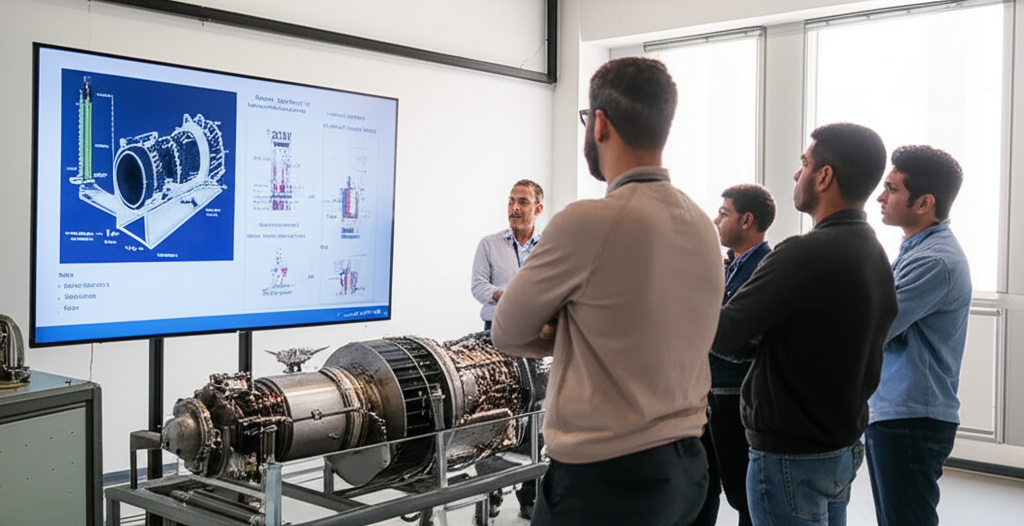
The Advanced Cooling in Propulsion course explores the latest techniques and technologies in high-efficiency cooling systems applied to propulsion engines, including gas turbines, rocket engines, and other propulsion systems. It focuses on optimizing fluid flow, heat exchange, and the use of advanced materials to improve performance and durability. Topics covered include convection cooling, evaporative cooling, and the design of thermal management systems, using CFD simulation tools and thermodynamic analysis for component design and optimization. The course provides a solid foundation in thermodynamics, heat transfer, and fluid mechanics, combined with practical application through case studies and design exercises. Participants will learn to apply this knowledge to improve the performance, efficiency, and safety of propulsion systems, considering environmental regulations and performance requirements. This training prepares professionals for roles such as engine design engineers, thermal systems specialists, and performance analysts in the aerospace and defense industry.
Advanced propulsion refrigeration course
- Format: Hybrid
- Duration: 3 months
- Hours: 300 H
- Language: English / Spanish
- Registration date: 23-10-2026
- Start date: 12-12-2026
- Available places: 2
349 $
Competencies and results
What you will learn
1. Expert Domain in Advanced Naval Refrigeration and Propulsion Systems
- Design, operation, and maintenance of complex marine refrigeration systems, including compressors, heat exchangers, and specialized refrigeration circuits.
- Troubleshooting and diagnosis of marine refrigeration systems, with an emphasis on energy efficiency and performance optimization.
- Principles of thermodynamics applied to marine refrigeration systems, including refrigeration cycle analysis and thermal load calculation.
- In-depth study of marine propulsion systems, encompassing diesel engines, gas turbines, electric propulsion systems, and hybrid combinations.
- Analysis of the efficiency and performance of marine propulsion systems, including fuel consumption, emissions, and vessel maneuverability.
- Evaluation of emerging technologies in marine propulsion systems, such as electric propulsion, the use of alternative fuels, and propellerless propulsion systems.
- Implementation of Strategies for the management and maintenance of marine refrigeration and propulsion systems, ensuring system availability and reliability.
Knowledge of marine industry regulations and standards related to refrigeration and propulsion, including safety and environmental regulations.
2. Optimization of Naval Refrigeration: An Advanced Course in Propulsion
-
Fundamentals of Marine Refrigeration: Understand the thermodynamic and heat transfer principles applied to refrigeration systems in naval environments.
-
Key Components: Explore in depth the study of compressors, condensers, evaporators, expansion valves, and other essential components of marine refrigeration systems, including their specific designs and functionalities.
-
Refrigeration Cycles: Analyze the most common refrigeration cycles used in naval applications, such as the vapor compression cycle and the absorption cycle, evaluating their advantages and disadvantages.
-
Design and Sizing: Learn to design and size refrigeration systems for different types of vessels and naval applications, considering factors such as thermal load, available space, and energy efficiency.
-
Refrigerants: Study the properties of the most commonly used refrigerants in the marine industry, including their environmental impact, compatibility with materials, and current regulations.
-
Thermal Management of Equipment: Acquire knowledge about the thermal management of critical onboard equipment and systems, such as engines, generators, and electronic equipment, to ensure their proper operation and extend their service life.
-
Control and Automation: Explore the control and automation systems used in marine refrigeration systems, including sensors, actuators, and programmable logic controllers (PLCs).
-
Maintenance and Repair: Learn how to perform preventive and corrective maintenance on marine refrigeration systems, including troubleshooting, component repair, and spare parts management.
- Maintenance and Repair:
-
Energy Efficiency: Analyze strategies to improve the energy efficiency of marine refrigeration systems, such as design optimization, the use of environmentally friendly refrigerants, and the implementation of heat recovery systems.
-
Regulations and Standards: Understand the international regulations and standards applicable to marine refrigeration systems, including regulations on safety, the environment, and energy efficiency.
3. Comprehensive user-oriented design and validation (from modeling to manufacturing)
You will learn to integrate the entire product development process, from initial model conception to final validation, applying user-centered methodologies. You will develop skills in parametric design, ergonomics, simulation, sustainable materials, 3D visualization, and manufacturing management, ensuring efficient, safe solutions that meet current industry standards.
4. Specialization in Naval Refrigeration: Advanced Propulsion and Efficiency
4. Specialization in Marine Refrigeration: Advanced Propulsion and Efficiency
consumption.
Explore the application of refrigeration in different areas of a ship, such as food storage, air conditioning systems, and special applications (e.g., cryogenics).
Analyze the relevant international regulations and standards for marine refrigeration, including SOLAS, MARPOL, and safety codes.
Understand the preventive and corrective maintenance techniques for marine refrigeration systems, including fault detection, repair, and spare parts management.
Evaluate the energy efficiency of refrigeration systems, applying analysis and optimization techniques to reduce fuel consumption and pollutant emissions.
Study the latest innovations in marine refrigeration, such as the use of alternative refrigerants, absorption refrigeration systems, and heat recovery technologies.
5. Advanced Naval Refrigeration: Propulsion, Design and Optimization
- Explore the thermodynamics of marine refrigeration systems, including complex and efficient refrigeration cycles.
- Study the principles of heat transfer in marine environments, considering corrosion and thermal insulation.
- Learn about the different types of refrigerants used in the marine industry, including their properties, environmental impact, and regulations.
- Analyze marine propulsion systems that involve refrigeration, such as diesel engines, gas turbines, and electric propulsion systems.
- Understand the design of marine refrigeration systems, including component selection, layout optimization, and integration with other onboard systems.
- Apply optimization techniques to improve the energy efficiency of marine refrigeration systems, reducing operating costs and the carbon footprint.
- Evaluate and select appropriate refrigeration equipment for specific marine applications, considering factors such as reliability, available space, and environmental conditions.
- Use Simulation and modeling tools to analyze the performance of marine refrigeration systems and predict their behavior under different operating conditions.
Master the maintenance and repair techniques for marine refrigeration systems, including fault detection, troubleshooting, and failure prevention.
Understand the international regulations and standards related to marine refrigeration, including safety, environmental impact, and energy efficiency.
6. Naval Propulsion Cooling: Advanced Design and Optimal Performance
- Understand the fundamentals of refrigeration in marine propulsion systems, including thermodynamic principles and heat transfer.
- Study the different types of marine refrigeration systems, such as seawater refrigeration, closed-loop refrigeration, and hybrid systems.
- Analyze the design and optimization of key components of refrigeration systems, including heat exchangers, pumps, piping, and valves.
- Evaluate the performance of marine refrigeration systems under various operating conditions, considering factors such as workload, vessel speed, and environmental conditions.
- Apply simulation and modeling techniques to analyze the behavior of refrigeration systems and optimize their design.
- Identify and troubleshoot common problems in marine refrigeration systems, such as corrosion, scaling, and component failures.
- Explore the latest technologies and trends in marine refrigeration, including the use of alternative refrigerants and refrigeration systems more efficient.
Learn to perform maintenance and repair on marine refrigeration systems, including troubleshooting and component repair.
Understand the relevant regulations and standards for marine refrigeration systems, including safety and environmental aspects.
Develop practical skills in the operation and maintenance of marine refrigeration systems through simulations and hands-on exercises.
Who this program is for:
Advanced propulsion refrigeration course
- Naval Engineers and professionals with related degrees who wish to specialize in advanced refrigeration systems applied to naval propulsion.
- Technicians and maintenance personnel from naval fleets, shipyards, and maritime service companies seeking to expand their knowledge of refrigeration.
- Naval propulsion system engineers and designers interested in the latest refrigeration technologies and performance optimization.
- Professionals in the naval industry, including those involved in the construction, operation, and maintenance of ships, who wish to enhance their skills and knowledge.
- Students of naval engineering and related fields seeking specialization in advanced refrigeration as part of their professional development.
Recommended Requirements: Basic knowledge of thermodynamics, heat transfer, and propulsion systems; ES/EN B1+/B2. We offer support material if needed.
- Standards-driven curriculum: you will work with CS-27/CS-29, DO-160, DO-178C/DO-254, ARP4754A/ARP4761, ADS-33E-PRF from the first module.
- Accreditable laboratories (EN ISO/IEC 17025) with rotor bench, EMC/Lightning pre-compliance, HIL/SIL, vibrations/acoustics.
- Evidence-oriented TFM: safety case, test plan, compliance dossierand operational limits.
- Mentored by industry: teachers with experience in rotorcraft, tiltrotor, eVTOL/UAM and flight test.
- Flexible modality (hybrid/online), international cohorts and support from SEIUM Career Services.
- Ethics and security: safety-by-design approach, cyber-OT, DIH and compliance as pillars.
1.1 Fundamentals of Refrigeration in Marine Propulsion Systems
1.2 Key Components of Marine Refrigeration Systems
1.3 Heat Transfer Principles Applied to Marine Propulsion
1.4 Refrigerants: Types, Properties, and Selection in Marine Environments
1.5 Vapor Compression Refrigeration Cycle: Analysis and Application
1.6 Importance of Refrigeration for Naval Efficiency and Reliability
1.7 Regulations and Standards in Marine Refrigeration
1.8 Safety in Marine Refrigeration Systems
1.9 Introduction to the Design of Marine Refrigeration Systems
1.10 Case Studies: Refrigeration Applications in Different Types of Vessels
2.2 Basic principles of thermodynamics applied to naval systems.
2.2 Vapor compression refrigeration cycle: operation and components.
2.3 Specific application in naval propulsion systems.
2.4 Importance of refrigeration for efficiency and safety.
2.5 Relevant regulations and standards for naval refrigeration.
2.6 Types of naval refrigeration systems and their uses.
2.7 Design and operation considerations in marine environments.
2.8 Comparison between traditional and advanced refrigeration systems.
2.2 Conduction, convection, and radiation in naval environments.
2.2 Heat transfer in heat exchangers: design and operation.
2.3 Heat loss analysis and optimization strategies.
2.4 Materials and thermal insulation in naval systems.
2.5 Heat transfer modeling and simulation.
2.6 Evaluation of the thermal performance of propulsion systems. 2.7 Influence of environmental factors on heat transfer.
2.8 Application of software tools for thermal analysis.
3.2 Types of compressors used in marine refrigeration systems.
3.2 Compressor selection and sizing.
3.3 Valves, piping, and other key components.
3.4 Oil separators and filters: functions and maintenance.
3.5 Sensors and controls in refrigeration systems.
3.6 Impact of components on system performance.
3.7 Failure analysis and component replacement strategies.
3.8 Latest innovations in refrigeration components.
4.2 Design of refrigeration systems for different types of marine propulsion.
4.2 Calculation of thermal loads and component selection.
4.3 Design of seawater and freshwater refrigeration systems.
4.4 Design of engine and equipment cooling systems. 4.5 Space, weight, and efficiency considerations in design.
4.6 Design of control and monitoring systems.
4.7 Use of design and simulation software.
4.8 Compliance with naval design regulations and standards.
5.2 Types of refrigerants used in naval systems: characteristics and properties.
5.2 Environmental impact of refrigerants: GWP and ODP.
5.3 Alternative refrigerants and their application in naval systems.
5.4 Selecting the appropriate refrigerant for each application.
5.5 Safe handling and storage of refrigerants.
5.6 Standards and regulations on refrigerants in the marine industry.
5.7 Designing systems for refrigerant compatibility.
5.8 Future trends in refrigerant development.
6.2 Techniques for diagnosing faults in refrigeration systems.
6.2 Identifying common problems: leaks, blockages, compressor failures.
6.3 Using diagnostic tools: pressure gauges, thermometers, analyzers.
6.4 Troubleshooting specific components.
6.5 Component repair and replacement procedures.
6.6 Data analysis and performance records.
6.7 Safety protocols during troubleshooting.
6.8 Continuous improvement and learning from recurring failures.
7.2 Preventive maintenance programs for marine refrigeration systems.
7.2 Periodic inspections and maintenance routines.
7.3 Cleaning and replacing critical components.
7.4 Managing oils and lubricants in refrigeration systems.
7.5 Calibrating and adjusting measuring instruments.
7.6 Documenting and recording maintenance.
7.7 Corrective maintenance: repairing and replacing components.
7.8 Continuous improvement of the maintenance program.
8.2 Energy Efficiency Analysis in Marine Refrigeration Systems
8.2 Strategies for System Performance Optimization
8.3 Implementation of Energy-Saving Technologies
8.4 Selection of High-Efficiency Components
8.5 Energy Demand Management and Control
8.6 Energy Consumption Monitoring and Analysis
8.7 Design of Heat Recovery Systems
8.8 Compliance with Energy Efficiency Regulations and Standards
3.3 Fundamentals of Thermodynamics Applied to Naval Systems
3.2 Refrigeration Cycles: Theory and Practice in Marine Environments
3.3 Key Components: Compressors, Condensers, Evaporators, and Valves
3.4 Refrigerant Analysis: Selection and Environmental Considerations
3.5 System Design: Equipment Sizing and Selection
3.6 Calculation of Thermal Loads on Ships
3.7 Instrumentation and Control of Naval Refrigeration Systems
3.8 Troubleshooting and Preventive Maintenance
3.9 Energy Efficiency Analysis and Optimization
3.30 Case Studies: Specific Applications on Different Types of Ships
4.4 Fundamentals of Marine Refrigeration System Design
4.2 Refrigerant Selection and Material Compatibility
4.3 Calculation of Thermal Loads in Propulsion Systems
4.4 Piping Design and Refrigerant Distribution
4.5 Key Components: Compressors, Condensers, and Evaporators
4.6 Control and Automation System Design
4.7 Optimizing Heat Exchange in Marine Environments
4.8 Safety and Regulatory Compliance Considerations
4.9 Design for Energy Efficiency and Sustainability
4.40 Case Studies: Design of Specific Systems
5.5 Maritime Legislation and International Regulations
5.5 Basic Concepts of Refrigeration and Thermodynamics
5.3 The Refrigeration Cycle: Principles and Naval Applications
5.4 Specific Regulatory Framework for Refrigeration Systems in Ships
5.5 Relevant Documentation and Certifications
5.6 Safety in Handling Refrigerants and Equipment
5.7 Pollution Prevention and Environmental Compliance
5.8 Audits and Inspections of Refrigeration Systems
5.5 Conduction, Convection, and Radiation in Naval Systems
5.5 Heat Exchangers: Types and Design for Propulsion
5.3 Analysis of Heat Transfer in Engines and Components
5.4 Thermal Insulation: Materials and Techniques in Marine Environments
5.5 Design of Systems to Minimize Heat Loss
5.6 Application of Heat Transfer Modeling and Simulation
5.7 Energy Efficiency Evaluation Based on Heat Transfer
5.8 Case Studies: Propulsion System Analysis
3.5 Types of Compressors Used in Marine Refrigeration
3.5 Compressor Selection and Sizing
3.3 Critical Components: Valves, Filters, and Separators
3.4 Pumps and Refrigerant Circulation Systems
3.5 Sensors and Controls in Refrigeration Systems
3.6 Component Protection and Safety
3.7 Preventive and Corrective Maintenance of Compressors
3.8 Common Failures and Troubleshooting of Components
4.5 Design of Refrigeration Systems for Different Types of Vessels
4.5 Design of Refrigeration Systems for Diesel Engines
4.3 Design of Refrigeration Systems for Electric Motors
4.4 Design of Refrigeration Systems for Liquefied Natural Gas (LNG)
4.5 Component Sizing and Equipment Selection
4.6 Piping Design and Refrigerant Distribution
4.7 Space, Weight, and Cost Considerations
4.8 Design Optimization for Energy Efficiency
5.5 Types of Refrigerants: Characteristics and Properties
5.5 Environmentally Friendly Refrigerants and Sustainable Alternatives
5.3 Environmental Impact of Refrigerants: GWP and ODP
5.4 Selecting the Right Refrigerant for Each Application
5.5 Refrigerant Compatibility with Materials and Equipment
5.6 Safe Handling and Storage of Refrigerants
5.7 Regulations on Refrigerant Use and Management
5.8 Impact of Refrigerants on Propulsion Efficiency
6.5 Troubleshooting Compressors and Components
6.5 Leak Detection and Methods Repair
6.3 Oil and Contaminant Analysis in Systems
6.4 System Performance Evaluation: Indicators and Measurements
6.5 Use of Advanced Diagnostic Tools
6.6 Troubleshooting Cooling Systems
6.7 Testing and Verification Procedures
6.8 Case Studies: Failure Analysis in Propulsion Systems
7.5 Preventive Maintenance: Programs and Routines
7.5 Corrective Maintenance: Repairs and Replacements
7.3 Cleaning and Purging Cooling Systems
7.4 Lubrication and Oil Management
7.5 Calibration of Sensors and Controls
7.6 System Performance Optimization
7.7 Maintenance Documentation and Records
7.8 Continuous Improvement and System Upgrades
8.5 Energy Efficiency Analysis in Naval Systems
8.5 Measuring and Monitoring Energy Consumption
8.3 Optimization of Refrigeration System Operation
8.4 Heat Recovery and Energy Utilization Systems
8.5 Implementation of Energy Saving Technologies
8.6 Emissions Reduction and Carbon Footprint
8.7 Case Studies: Implementation of Energy Improvements
8.8 Economic Considerations and ROI in Energy Efficiency
6.6 Design Principles for Marine Propulsion Cooling Systems
6.2 Selection and Sizing of Cooling Components
6.3 Thermal Load Analysis in Propulsion Systems
6.4 Optimizing Energy Efficiency in Marine Cooling
6.5 Design of Heat Exchangers for Marine Applications
6.6 Refrigerant Selection and Environmental Considerations
6.7 Design of Control and Monitoring Systems
6.8 Troubleshooting and Diagnosis in Cooling Systems
6.9 Maintenance and Performance Testing
6.60 Case Studies: Design and Optimization of Cooling Systems in Different Types of Vessels
- Hands-on methodology: test-before-you-trust, design reviews, failure analysis, compliance evidence.
- Software (depending on licenses/partners): MATLAB/Simulink, Python (NumPy/SciPy), OpenVSP, SU2/OpenFOAM, Nastran/Abaqus, AMESim/Modelica, acoustics tools, planning toolchains DO-178C.
- SEIUM Laboratories: scale rotor bench, vibrations/acoustics, EMC/Lightning pre-compliance, HIL/SIL for AFCS, data acquisition with strain gauging.
- Standards and compliance: EN 9100, 17025, ISO 27001, GDPR.
Capstone-type projects
“`html
- Cooling Optimization: CFD design, thermal analysis, system simulation.
- Propulsion Efficiency: System integration and improvement, advanced modeling.
- Diagnostics and Maintenance: Predictive strategies, failure analysis, performance optimization.
“
- Propulsion Efficiency: Performance analysis and improvement; Heat exchanger optimization; Energy loss reduction.
- Refrigeration Systems: Advanced system design; Fault diagnosis; Predictive and corrective maintenance.
- Modeling and Simulation: Fluid simulation; Thermodynamic analysis; Component optimization.
- CFD Design and Simulation: Optimization of cooling systems in marine propulsion.
- Efficiency Analysis: Performance evaluation and energy consumption reduction.
- Integration and Control: Design of advanced control systems for cooling.
- Testing and Validation: Bench testing and model validation.
“`html
- Cooling Optimization: CFD design, simulation, and analysis of cooling systems in naval propulsion.
- Thermal Analysis: Evaluation of heat transfer and energy efficiency in key components.
- 3D Modeling: Implementation of 3D models of cooling systems for optimization and simulation.
- Testing and Validation: Analysis of system performance using test data.
“`
Admissions, fees, and scholarships
- Profile: Background in Computer Engineering, Mathematics, Statistics, or related fields; practical experience in NLP and valued information retrieval systems.
- Documentation: Updated CV, academic transcript, SOP/statement of purpose, project examples or code (optional).
- Process: Application → Technical evaluation of profile and experience → Technical interview → Review of case studies → Final decision → Enrollment.
- Fees:
- Single payment: 10% discount.
- Payment in 3 installments: No fees; 30% upon registration + 2 equal monthly payments of the remaining 35%.
Monthly payment: available with a 7% commission on the total; annual review.
Scholarships: based on academic merit, financial need, and promoting inclusion; agreements with companies in the sector for partial or full scholarships.
See “Calendar & Calls for Applications,” “Scholarships & Grants,” and “Fees & Financing” in the SEIUM mega-menu.
Do you have any questions?
Our team is ready to help you. Contact us, and we will respond as soon as possible.
F. A. Q
Frequently asked questions
Yes, we have international certification
Yes: experimental models, real data, applied simulations, professional environments, real case studies.
It is not mandatory. We offer leveling tracks and tutoring.
Completely. It covers e-propulsion, integration, and emerging regulations (SC-VTOL).
Recommended. There are also internal challenges and consortiums.
Yes. Online/hybrid modality with planned labs and visa support (see “Visa & Residence”).