
Wind Tunnel Engineering, Scale Models, and Instrumentation
About our Wind Tunnel Engineering, Scale Models, and Instrumentation
Wind Tunnel Engineering, Scale Models and Instrumentation
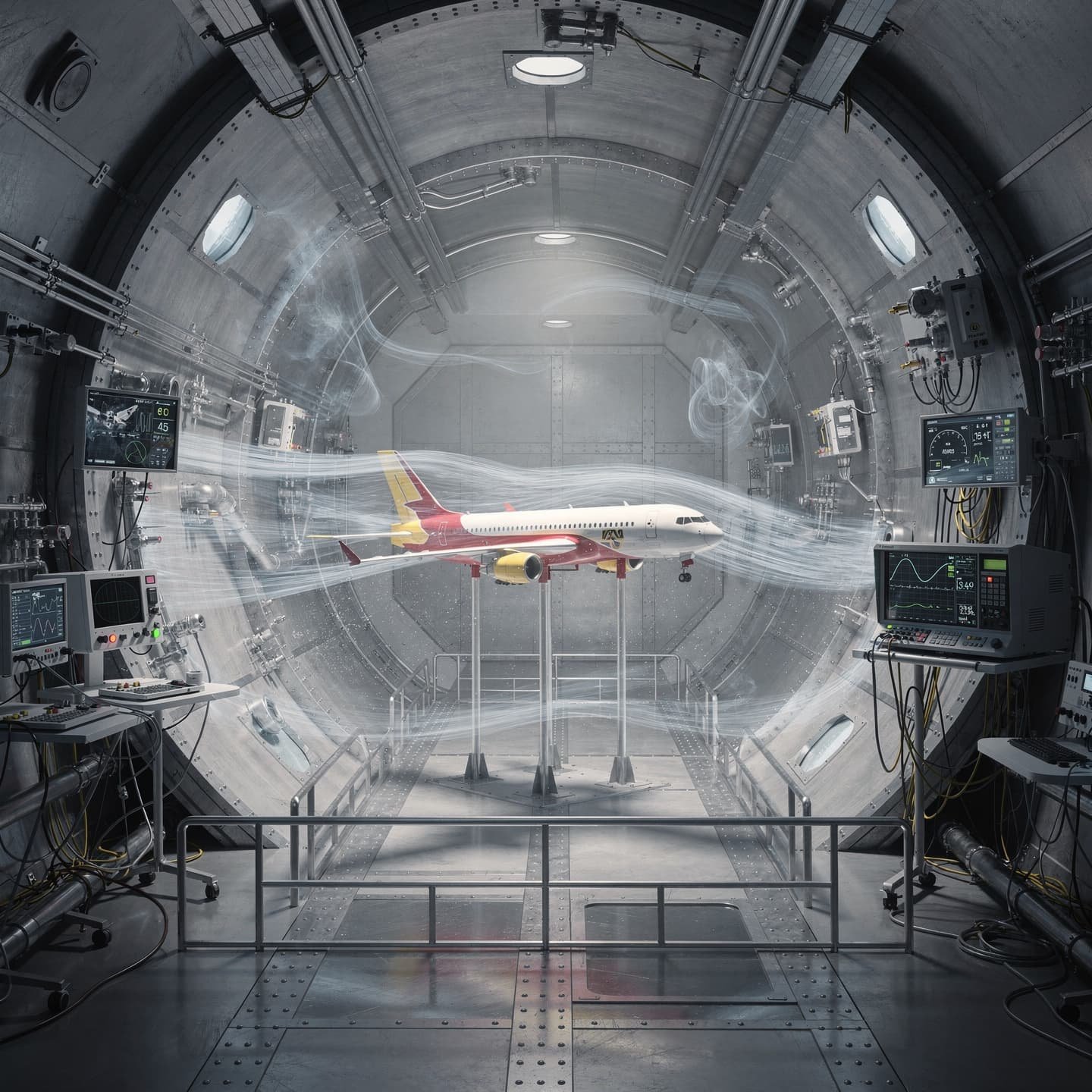
is fundamental for advanced development in aerodynamics, aeroelasticity, and dynamics/control of aircraft, employing techniques such as CFD, modal analysis, and signal acquisition systems on scale models for helicopters, eVTOL, and UAM platforms. These processes integrate the use of transonic and subsonic wind tunnels, combined with high-precision instrumentation to map aerodynamic forces and pressure fields, essential for validating numerical simulations and ensuring uncertainty reduction in aerospace design.
Laboratories are equipped with advanced HIL/SIL capabilities, real-time data acquisition, vibration and acoustic analysis, with rigorous traceability in accordance with applicable international regulations, including references to ARP4754A and ARP4761, as well as certification parameters adapted to EASA CS-27/CS-29 and FAA Part 27/29. The training qualifies professional profiles such as aerospace engineer, aeromechanical testing specialist, CFD analyst, certification engineer, and aeronautical instrumentation technician, strengthening the capacity for innovation and regulatory compliance in the industry.
Wind Tunnel Engineering, Scale Models, and Instrumentation
- Format:
- Duration:
- Time: 1900 H
- Practices: Consult
- Language:
- Credits:
- Registration date: 08-10-2026
- Start date: 02-12-2026
- Available places: 2
2,200 $
Skills and results
What you will learn
- Analyze flap–lag–torsion couplings, whirl flutter, and fatigue.
- Size laminates in composites, joints, and bonded joints with FE, with naval instrumentation for data acquisition.
- Apply damage tolerance and NDT (UT/RT/thermography) for defect detection and experimental validation.
2. Mastery of naval aerodynamic design and analysis: wind tunnels, scale models, and instrumentation.
- Analyze aeroelastic couplings and flutter, buffeting, and fatigue generated by fluid–structure interaction in wind tunnels and scale models.
- Size naval surfaces and profiles using scale models, scaling rules, and validation with FE to correlate loads and pressures.
- Implement instrumentation and experimental analysis with pressure sensors, anemometers, and PIV, complemented with NDT (UT/RT/thermography).
3. Comprehensive user-oriented design and validation (from modeling to manufacturing)
You will learn to integrate the entire product development process, from model conception to final validation, applying user-centered methodologies. You will develop competencies in parametric design, ergonomics, simulation, sustainable materials, 3D visualization, and manufacturing management, ensuring efficient, safe solutions aligned with current industry standards.
4. Naval engineering: wind tunnels, scale models, and instrumentation: design and analysis
- Analyze aero-hydrodynamic effects and aero-structural couplings in wind tunnels and scale models, including aeroelastic dynamics, resonances, and fatigue.
- Size laminates in composites, joints, and bonded joints in designs for scale models with FE.
- Implement test instrumentation and NDT (UT/RT/thermography) to ensure damage tolerance and sensor validation.
5. Scale modeling and instrumentation: Analysis and naval construction using wind tunnels
- Analyze bending–torsion couplings, flutter, and fatigue in scale naval models through wind tunnels and instrumentation.
- Size laminates in composites, joints, and bonded joints with FE.
- Implement damage tolerance and NDT (UT/RT/thermography).
6. Naval engineering expertise: wind tunnels, scale modeling, and instrumentation—design and analysis
- Analyze flap–lag–torsion couplings, whirl flutter, and fatigue.
- Size laminates in composites, joints, and bonded joints with FE.
- Implement damage tolerance and NDT (UT/RT/thermography).
Who this program is for:
Wind Tunnel Engineering, Scale Models, and Instrumentation
- Graduates in Aerospace Engineering, Mechanical, Industrial, Automation, or related fields.
- Professionals from aerodynamics laboratories, wind tunnels, scale models, technology centers.
- Professionals in wind tunnel testing, instrumentation, scale models, control, and dynamics seeking specialization.
- Regulators/authorities and profiles in testing regulations requiring competencies in compliance.
Recommended requirements: background in aerodynamics, control, and structures; ES/EN B2+/C1. We offer bridging tracks if you need them.
- Standards-driven curriculum: you will work with CS-27/CS-29, DO-160, DO-178C/DO-254, ARP4754A/ARP4761, ADS-33E-PRF from the very first module.
- Accreditable laboratories (EN ISO/IEC 17025) with rotor test bench, EMC/Lightning pre-compliance, HIL/SIL, vibration/acoustics.
- TFM oriented to evidence: safety case, test plan, compliance dossier, and operational limits.
- Industry mentoring: instructors with experience in rotorcraft, tiltrotor, eVTOL/UAM, and flight test.
- Flexible modality (hybrid/online), international cohorts, and support from SEIUM Career Services.
- Ethics and safety: safety-by-design approach, cyber-OT, DIH, and compliance as pillars.
1.1 Fundamentals of fluid dynamics and similarity for naval wind tunnels
1.2 Design, operation, and selection criteria for wind tunnels for scale models
1.3 Instrumentation in naval wind tunnels: pressure sensors, balances, PIV, and anemometry
1.4 Scale models and scaling criteria: Reynolds, Froude, and experimental validation
1.5 Preparation, manufacturing, and finishing of scale models for hydroaerodynamic testing
1.6 Test configuration: boundary conditions, speed, turbulence, and marine environment simulation
1.7 Post-processing analysis: extraction of hydrodynamic coefficients and uncertainty evaluation
1.8 Safety, calibration, traceability, and regulatory compliance in naval wind tunnels
1.9 Integration of MBSE and PLM for wind tunnel projects: change management and documentation
1.10 Case study: go/no-go and risk matrix for validation of a naval design in a wind tunnel
2.1 Naval aerodynamics design and fundamentals: concepts, Reynolds numbers, and scales
2.2 Wind tunnels for naval engineering: types, capabilities, and test conditions
2.3 Naval scale models: geometry, scaling criteria, and necessary corrections
2.4 Instrumentation in aerodynamic and hydrodynamic testing: sensors, DAQ, and calibration
2.5 Analysis of forces, moments, and aerodynamic coefficients for hulls and platforms
2.6 Integration of experimental testing with numerical simulations: CFD, MBSE, and validation
2.7 Experimental design methodologies in naval wind tunnels
2.8 Flow visualization and velocity measurement techniques: smoke, tufts, PIV, and hot-wire
2.9 Complementary tests and model validation: correlation between wind tunnels and real conditions
2.10 Case studies, quality standards, and safety considerations in naval aerodynamic design
3.1 Wind tunnel principles: flow, scaling, and similarity in naval applications
3.2 Naval scale modeling: methods, construction techniques, and validation
3.3 Wind tunnel instrumentation: force sensors, pressure sensors, and data acquisition
3.4 Experimental configuration: boundary conditions, Reynolds, and scaling in naval geometries
3.5 Naval aerodynamic analysis: interpretation of coefficients and performance trends
3.6 Experimental design for wind tunnels: DOE plans, replication, and variable control
3.7 Data management and MBSE in wind tunnels and naval modeling
3.8 Safety, calibration, and quality control in experimental testing
3.9 Practical cases of naval wind tunnels: validation and benchmarking
3.10 Reporting and transfer of results: visualization, reports, and recommendations
4.1 Context and objectives of wind tunnels in naval engineering
4.2 Principles of naval aerodynamics applied to hulls and structures
4.3 Configurations and types of wind tunnels: closed, open-circuit, walled, and recirculating
4.4 Scaling and similarity: Reynolds and Froude laws for scale models in nautical applications
4.5 Design and preparation of scale models for naval wind tunnels
4.6 Instrumentation and sensorization in wind tunnels: pressure sensors, force and moment sensors, accelerometers
4.7 Flow measurement and visualization techniques: pressure taps, tufts, smoke, PIV/LDV, and hot-wire anemometry
4.8 Experiment configuration: boundary conditions, angle of attack, yaw, speed, and Reynolds number
4.9 Data processing and uncertainty evaluation: post-processing, validation, and reporting
4.10 Ethical considerations, safety, and regulations for naval wind tunnel testing
5.1 Design and specification of wind tunnels and scale models for naval engineering
5.2 Construction of naval scale models and their experimental validation
5.3 Instrumentation in testing: sensors, data acquisition, and traceability
5.4 Wind tunnel data analysis and processing: noise reduction and extrapolation
5.5 Integration of aerodynamic and hydrodynamic testing in vessel design
5.6 Testing methodologies: replicability, uncertainties, and quality controls
5.7 Physical and numerical modeling: correlation between CFD and wind tunnel
5.8 Design for manufacturability and maintenance of models and test hardware
5.9 Wind tunnel project management: planning, costs, and schedule
5.10 Case study: go/no-go with risk matrix for wind tunnel and model projects
6.1 Fundamentals of naval aerodynamics: fluids, Navier–Stokes equations, and their relevance to vessel design
6.2 Wind tunnels in naval engineering: types, applications, and selection criteria
6.3 Scale models and similarity criteria: Reynolds, Froude, and Mach in naval environments
6.4 Instrumentation in testing: pressure sensors, anemometry, PIV, and data acquisition
6.5 Experimental design in wind tunnels: planning, variables, repetitions, and traceability
6.6 Test data analysis: processing, calibration, and uncertainties
6.7 Fluid-surface interactions in naval applications: roughness, textures, and aerodynamic effects
6.8 Construction of scale models: materials, finishes, and surface reproducibility
6.9 Safety, ethics, and laboratory management: standards, PPE, and waste handling
6.10 Practical project: definition of a wind tunnel experiment applied to a naval component
7.1 Fundamentals of naval aerodynamics and fluid dynamics
7.2 Introduction to wind tunnels: concepts, types, and applications
7.3 Design and construction of wind tunnels for naval use
7.4 Scale models: principles of physical simulation, scales, and similarity coefficients
7.7 Naval instrumentation in wind tunnels: sensors, actuators, and data acquisition
7.6 Experimental planning and factorial design in testing
7.7 Analysis of data and interpretation of aerodynamic coefficients (Cx, Cy, Cz, Cm, Cl, Cn)
7.8 Integration between wind tunnels and CFD/analytical simulations
7.9 Safety, calibration, and quality assurance in wind tunnel testing
7.10 Case study: go/no-go with risk matrix for a wind tunnel test
8.1 Introduction to Naval Instrumentation: scope, objectives, and relationship with wind tunnels, scale models, and their instrumentation
8.2 Instrumentation system architecture: sensors, actuators, data acquisition, and communications
8.3 Fundamentals of naval metrology: precision, accuracy, uncertainty, calibration, and traceability
8.4 Wind tunnels in naval instrumentation: principles, typologies, and experiment configuration
8.5 Scale models: construction, scaling, simulation, and measurement validation
8.6 Instrumentation for aero-naval testing: force, moment, pressure, and flow rate measurements
8.7 Experimental design and test plan: variables, sampling, replication, and condition control
8.8 Data and process management: MBSE/PLM, traceability, change control, and documentation
8.9 Safety, standards, and ethics in naval instrumentation: regulations, compliance, and best practices
8.10 Case studies and exercises: campaign configuration, data analysis, and results reporting
9.1 Fundamentals of scaling in naval engineering: principles and applications
9.2 Wind tunnels for naval modeling: design and construction
9.3 Naval instrumentation: technologies and methodologies for precise analysis
9.4 Scale model analysis: techniques and best practices
9.5 Design and construction of naval models: procedures and controls
9.6 Wind tunnel instrumentation: data capture and monitoring
9.7 Validation and analysis of results in naval engineering: data interpretation
9.8 Innovations in wind tunnels and scale modeling: trends and future research lines
9.9 System integration: modeling, instrumentation, and analysis in naval projects
9.10 Case studies: practical application in real wind tunnel and naval modeling projects
10.1 Principles of naval modeling and scaling: physical similarity, Reynolds and Froude criteria, wind tunnel scales, and flotation testing
10.2 Naval scale models: design, material selection, surface finish, and instrumentation integration
10.3 Instrumentation for scale models: pressure sensors, pressure taps, accelerometers, strain gauges, speed sensors, and DAQ
10.4 Wind tunnel configuration for naval testing: tunnel types, test conditions, mounting, calibration, and dust/noise control
10.5 Test methods and experimental design: DOE, replicates, variable control, sampling, uncertainties, and reproducibility
10.6 Aerodynamic analysis applied to hulls and surfaces: pressure distribution, drag and lift coefficients, appendage effects
10.7 Scaling and validation: conversion of scale results to full-scale geometry, force and moment correction, center of pressure
10.8 Post-processing and visualization: data processing, software (Python/MATLAB), interpretation of CL/CD curves and pressure maps
10.9 Model validation and verification: comparison with experimental data, uncertainty quantification, measurement traceability
10.10 Case study: wind tunnel test plan for a naval geometry (hull) with go/no-go and risk matrix
- Hands-on methodology: test-before-you-trust, design reviews, failure analysis, compliance evidence.
- Software (according to licenses/partners): MATLAB/Simulink, Python (NumPy/SciPy), OpenVSP, SU2/OpenFOAM, Nastran/Abaqus, AMESim/Modelica, acoustics tools, DO-178C planning toolchains.
- SEIUM Laboratories: scale rotor test bench, vibration/acoustics, EMC/Lightning pre-compliance, HIL/SIL for AFCS, data acquisition with strain gauging.
- Standards and compliance: EN 9100, 17025, ISO 27001, GDPR.
Capstone-type projects
- Blade optimization: BEMT+CFD; bench/tunnel; acoustics.
- Naval scale modeling: tunnels, instrumentation, validation.
- Naval aeroelasticity: modal analysis; whirl flutter; mitigation.
DO-160: environmental test plan (vib, temp, EMI, lightning/HIRF) and mitigation.
- Blade optimization: BEMT+CFD; bench/tunnel; acoustics.
- Naval scale modeling: tunnels, instrumentation, validation.
- Naval aeroelasticity: modal analysis; whirl flutter; mitigation.
DO-160: environmental test plan (vib, temp, EMI, lightning/HIRF) and mitigation.
- Blade optimization: BEMT+CFD; bench/tunnel; acoustics.
- AFCS/SCAS: hover/attitude hold; envelope; SIL/HIL.
- Tiltrotor conversion: corridor and margins.
- Aeroelasticity: modal; whirl flutter; mitigations.
DO-160: test plan (vib., temp., EMI, lightning/HIRF) and mitigation.
- Blade optimization: BEMT+CFD; bench/tunnel; acoustics.
- AFCS/SCAS: hover/attitude hold; envelope; SIL/HIL.
- Tiltrotor conversion: corridor and margins.
- Aeroelasticity: modal; whirl flutter; mitigations.
DO-160: test plan (vib., temp., EMI, lightning/HIRF) and mitigation.
- Blade optimization: BEMT/CFD; bench/tunnel; BVI acoustics.
- Aeroelasticity: modal; whirl flutter; mitigation.
DO-160: test plan (vibration/EMI) and mitigation.
Admissions, fees and scholarships
- Profile: Background in Computer Engineering, Mathematics, Statistics, or related fields; practical experience in NLP and information retrieval systems is valued.
- Documentation: Updated CV, academic transcripts, SOP/purpose essay, project or code samples (optional).
- Process: application → technical profile and experience evaluation → technical interview → practical case review → final decision → enrollment.
- Fees:
- Single payment: 10% discount.
- 3-installment payment: no fees; 30% upon enrollment + 2 equal monthly payments of the remaining 35%.
- Monthly payment: available with a 7% fee on the total; annual review.
- Scholarships: based on academic merit, financial situation, and promotion of inclusion; agreements with industry companies for partial or full scholarships.
Check “Calendar & calls”, “Scholarships & financial aid”, and “Fees & financing” in the SEIUM mega-menu.
Do you have any questions?
Our team is ready to help you. Contact us and we’ll get back to you as soon as possible.
F. A. Q
Frequently Asked Questions
Yes, we hold international certification.
Yes: experimental models, real data, applied simulations, professional environments, real case studies.
It is not mandatory. We offer leveling tracks and tutoring.
Completely. It covers e-propulsion, integration, and emerging regulations (SC-VTOL).
Recommended. There are also internal challenges and consortia.