Racing suspension and shock absorber engineering
About our Racing suspension and shock absorber engineering
Competition Suspension and Shock Absorber Engineering
addresses the advanced design of valving, dyno, and shim stack systems to optimize dynamic behavior and adaptive response under extreme competition conditions. This area integrates multibody modeling, NVH analysis, adaptive control, and CFD simulations to develop solutions that improve impact absorption capacity and front-end stability, essential in high-performance vehicles. Methods such as FEA and nonlinear dynamic modeling interact with electronic control algorithms (ECU) to adjust stiffness and damping in real time under specific safety and performance regulations.
Specialized dynamic testing laboratories employ HIL/SIL test benches, high-resolution data acquisition calibrations, and fatigue analysis through vibration and acoustics to verify system durability and response under certification standards and applicable international regulations. Traceability ensures compliance from design phase to production, aligning with the needs of professional roles such as vehicle dynamics engineer, suspension control specialist, vibration analyst, and dynamic testing technician.
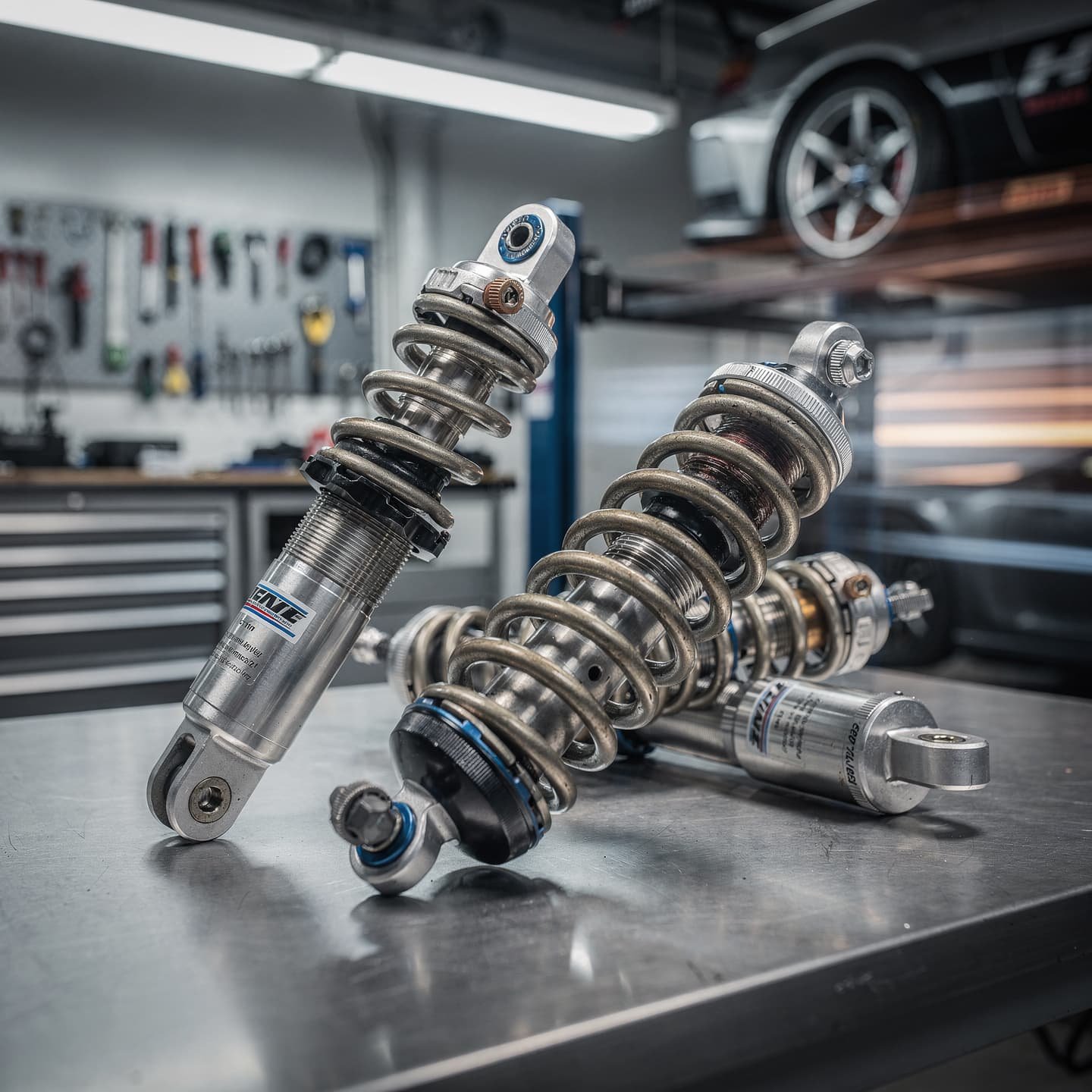
Racing suspension and shock absorber engineering
- Format:
- Duration:
- Time: 1900 H
- Practices: Consult
- Language:
- Credits:
- Registration date: 08-10-2026
- Start date: 02-12-2026
- Available places: 2
9,000 $
Skills and results
What you will learn
- Analyze the interaction between valving, shim stacks, and dyno to obtain damping profiles and transient response under different compression and rebound velocities.
- Size and optimize shim stack, valving, and dyno configurations for different track scenarios, using FE and bench testing to predict load-velocity curves.
- Implement tuning and calibration strategies for valving and shim stacks, based on Dyno data and race conditions, to achieve stability, grip, and predictable response.
2. Rotor Optimization: Modeling and Performance
- Analyze flap–lag–torsion couplings, whirl flutter, and fatigue.
- Size laminates in composites, joints, and bonded joints with FE.
- Implement damage tolerance and NDT (UT/RT/thermography).
3. Comprehensive user-oriented design and validation (from modeling to manufacturing)
You will learn to integrate the entire product development process from concept to final validation, applying user-centered methodologies. You will develop competencies in parametric design, ergonomics, simulation, sustainable materials, 3D visualization, and manufacturing management, ensuring efficient, safe solutions aligned with current industry standards.
4. Unlock Valving, Dyno, and Shim Stacks for Competition Suspension: Advanced Engineering
- Analyze the interaction between valving, dyno, and shim stacks in competition suspensions: influence of compression and rebound velocity, flow profiles, and transient response.
- Size shim stack and valving configurations for different track scenarios, considering temperature, wear, and performance demands, with validation on test bench and Dyno.
- Implement optimization and diagnostic strategies: tuning on Dyno and on-track, monitoring temperature, vibrations, and valving response to achieve stability and reliability in competition.
5. Competition Suspension Engineering: Valving, Dyno, and Shim Stacks for Success
- Analyze couplings between valving, shim stacks, and dyno tuning to understand the dynamic-hydraulic response in competition and its interaction with the chassis.
- Size shim stacks and valving according to track conditions, evaluating stiffness, response, and stability, with bench testing and FE simulation.
- Implement damage tolerance and NDT (UT/RT/thermography) in suspension systems to ensure reliability and predictive maintenance.
6. Master Valving, Dyno, and Shim Stacks: Keys to Competitive Suspension Engineering
- Analyze couplings between valving, dyno, and shim stacks to understand their influence on suspension response.
- Size valving, dyno, and shim stacks with FE.
- Implement damage tolerance and NDT (UT/RT/thermography) to validate the robustness of valving and shim stack systems.
Who this program is for:
Racing suspension and shock absorber engineering
- Graduates in Aerospace Engineering, Mechanical, Industrial, Automation, or related fields.
- Professionals from rotorcraft/eVTOL OEMs, MRO, consulting, technology centers.
- Flight Test, certification, avionics, control, and dynamics professionals seeking specialization.
- Regulators/authorities and profiles in UAM/eVTOL requiring competencies in compliance.
Recommended requirements: background in aerodynamics, control, and structures; ES/EN B2+/C1. We offer bridging tracks if needed.
- Standards-driven curriculum: you will work with CS-27/CS-29, DO-160, DO-178C/DO-254, ARP4754A/ARP4761, ADS-33E-PRF from the very first module.
- Accreditable laboratories (EN ISO/IEC 17025) with rotor test bench, EMC/Lightning pre-compliance, HIL/SIL, vibration/acoustics.
- Master’s thesis oriented to evidence: safety case, test plan, compliance dossier, and operational limits.
- Industry mentoring: instructors with experience in rotorcraft, tiltrotor, eVTOL/UAM, and flight test.
- Flexible modality (hybrid/online), international cohorts, and support from SEIUM Career Services.
- Ethics and safety: safety-by-design approach, cyber-OT, DIH, and compliance as pillars.
1.1 Valving: fundamentals and functions in competition suspension
1.2 Dyno: testing principles, data acquisition, and curve reading
1.3 Shim Stacks: composition, impact on sag and response, thickness selection
1.4 Key valving parameters for different track conditions
1.5 Dyno calibration techniques: fine-tuning and verification
1.6 Data analysis: interpretation of damping curves, velocity, and lock-out
1.7 Safety, testing procedures, and operational limits
1.8 Tools, software, and equipment: gauges, test benches, simulation
1.9 Change management and traceability: MBSE/PLM for Valving, Dyno, and Shim Stacks
1.10 Case study: go/no-go with risk matrix and validation plan
2.1 Physical fundamentals of suspension: forces, damping, and transient response
2.2 Components and geometry of competition suspension
2.3 System dynamics: load, center of gravity, and balance
2.4 Instrumentation and testing: sensors, telemetry, and logs
2.5 Types of shock absorbers and springs: mono-tube, twin-tube, and advanced configurations
2.6 Relevance of friction, seals, and energy losses
2.7 Safety, regulations, and competition standards
2.8 Adjustment methodologies, documentation, and version control of setups
2.9 Integration of suspension with vehicle dynamics and load configuration
2.10 Case studies and analysis of winning setups
3.1 Introduction to Suspension Engineering: definitions, objectives, and scope
3.2 Historical context and evolution of suspension in competition
3.3 Suspension architectures: independent, semi-independent, and solid axle
3.4 Role of suspension in performance, handling, and safety
3.5 Fundamental design parameters: travel, stiffness, damping, and center of gravity
3.6 Critical components and their interaction: springs, shock absorbers, valving, and shim stacks
3.7 Testing methods and basic tests: test benches and suspension evaluation
3.8 Instrumentation and data collection: sensors, data logging, and performance monitoring
3.9 Safety, regulations, and professional ethics in suspension engineering
3.10 Initial project: objective definition, learning plan, and success criteria
4.1 Fundamentals of Valving: definition, components, and function
4.2 Dyno: measurement principles, data acquisition, and interpretation
4.3 Shim stacks: definition, materials, spacing, and effects on stiffness curve
4.4 Valve and orifice types: flow configuration in compression and rebound
4.5 Hydraulic fluid: viscosity, temperature, and compatibility with seals and oils
4.6 Dyno calibration and verification: methods, tools, and standards
4.7 Curve reading and diagnosis of suspension anomalies
4.8 Adjustment strategies for different competition scenarios
4.9 Maintenance, safety, and quality control in Valving and Dyno systems
4.10 Case study: diagnosis, optimization, and decision-making for a Valving and Dyno set in competition
5.1 Introduction to Valving, Dyno, and Shim Stacks: fundamentals and objectives
5.2 Valving: types, functions, and effects on suspension response
5.3 Dyno: testing methods, data acquisition, and performance analysis
5.4 Shim Stacks: configuration, spacers, and impact on stiffness and travel
5.5 Component selection: spring compatibility, preloads, and adjustments
5.6 Interactions between Valving, Dyno, and Shim Stacks under different racing regimes
5.7 Modeling and simulation tools for suspension pre-settings
5.8 Safety, calibration, and maintenance procedures in suspension systems
5.9 Integration with electronic damper control and sensorics
5.10 Case study: go/no-go and risk matrix for setup validation
6.1 Fundamentals of Valving: flow principles, orifices, and bypass in competition shock absorbers
6.2 Dyno and damping testing: bench setup, calibration, and data acquisition protocol
6.3 Shim Stacks: design, thicknesses, and sequences to control the damping curve
6.4 Valving–Shim interactions: combined effects on compression and rebound, and performance tuning
6.5 Valve configuration: ports, piloting, restrictions, and dynamic response
6.6 Measurement methods and data: sensors, acquisition, filtering, and signal analysis
6.7 Modeling and prediction: hydraulic models and correlation with test bench data
6.8 Diagnostics and maintenance: inspection, wear, spare parts, and preventive maintenance
6.9 Validation for competition: performance criteria, repeatability, and robustness
6.10 Case study: go/no-go with risk matrix
7.1 Fundamentals of Valving in Competition Suspension
7.2 Dyno: configuration, sensors, and key metrics
7.3 Shim Stacks: thickness selection and effects on stiffness
7.4 Compression and rebound valving: flow patterns and curves
7.5 Bench testing methods: replicating track conditions
7.6 Flow models: fixed vs progressive orifices
7.7 Influence of viscosity and temperature on performance
7.8 Optimization methodology: dyno-valving correlation
7.9 Data analysis and acceptance criteria
7.10 Case study: design and validation of valving and shim stacks for competition suspension
8.1 Unraveling Valving, Dyno, and Shim Stacks: fundamentals and terminology
8.2 Valving: types, flow principles, and leakage adjustment
8.3 Dyno: data interpretation, calibration, and performance optimization
8.4 Shim Stacks: thickness selection, distribution, and effects on stiffness
8.5 Effects of valving on compression and rebound: suspension dynamics
8.6 Measurement and validation methods on test bench (dyno)
8.7 Modeling and simulation of valving with engineering tools
8.8 Fault diagnosis and safe tuning: best practices
8.9 Case studies: winning configurations with Valving, Dyno, and Shim Stacks
8.10 Integration into race strategy: quick adjustment and performance verification
9.1 Fundamentals of Valving and Dyno in Competition Suspension Engineering
9.2 Advanced modeling and analysis techniques for Rotors and Dyno
9.3 How to optimize Shim Stacks for maximum suspension performance
9.4 Calibration and adjustment procedures in Valving and Dyno
9.5 Interpretation of Dyno data for suspension improvements
9.6 Practical cases of Valving, Dyno, and Shim Stacks adjustment in competition
9.7 Digital tools and software for suspension design and analysis
9.8 Best practices in the laboratory: accurate measurement and testing
9.9 Strategies to increase component durability and performance
9.10 Success cases and application in different competition categories
10.1 Introduction to Competitive Suspension Engineering: objective and scope
10.2 Suspension architectures in competition
10.3 Valving, Dyno, and Shim Stacks: fundamentals and selection
10.4 Modeling and simulation of suspension dynamics
10.5 Test and validation configurations on the bench
10.6 Instrumentation and data acquisition for suspension
10.7 Performance optimization: balance between grip, response, and stability
10.8 Integration with chassis and drivetrain
10.9 Safety, regulations, and compliance in competition
10.10 Case study: data analysis and adjustment decision-making
- Hands-on methodology: test-before-you-trust, design reviews, failure analysis, compliance evidence.
- Software (according to licenses/partners): MATLAB/Simulink, Python (NumPy/SciPy), OpenVSP, SU2/OpenFOAM, Nastran/Abaqus, AMESim/Modelica, acoustics tools, DO-178C planning toolchains.
- SEIUM Laboratories: scale rotor test bench, vibration/acoustics, EMC/Lightning pre-compliance, HIL/SIL for AFCS, data acquisition with strain gauging.
- Standards and compliance: EN 9100, 17025, ISO 27001, GDPR.
Capstone-type projects
- Valving, Dyno and Shim Stacks: Competition Suspension — optimization.
- Rotors: Modeling and Performance.
- Deep Analysis: Valving/Dyno/Shim for High Performance.
- Advanced Suspension: Keys to Victory.
DO-160: Test plan: vib, temp, EMI, lightning/HIRF; mitigation.
- Valving, Dyno and Shim Stacks: Competition Suspension — optimization.
- Rotors: Modeling and Performance.
- Deep Analysis: Valving/Dyno/Shim for High Performance.
- Advanced Suspension: Keys to Victory.
DO-160: Test plan: vib, temp, EMI, lightning/HIRF; mitigation.
- Valving, Dyno and Shim Stacks: tuning.
- Rotor Optimization: modeling and performance.
- Deep Analysis: valving/dyno/shim in high-performance suspension.
- Advanced Engineering: unlocking Valving, Dyno and Shim.
DO-160: environmental tests and mitigation.
- Valving, Dyno and Shim Stacks: tuning.
- Rotor Optimization: modeling and performance.
- Deep Analysis: valving/dyno/shim in high-performance suspension.
- Advanced Engineering: unlocking Valving, Dyno and Shim.
DO-160: environmental tests and mitigation.
- Blade optimization: BEMT+CFD; bench/tunnel
- AFCS/SCAS: hover/attitude, envelope protection, SIL/HIL
- Tiltrotor conversion control: corridor and margins
- Aeroelasticity: modal; whirl flutter; flutter clearance
DO-160: environmental tests and mitigation
Admissions, fees and scholarships
- Profile: Background in Computer Engineering, Mathematics, Statistics, or related fields; practical experience in NLP and information retrieval systems is valued.
- Documentation: Updated CV, academic transcripts, SOP/purpose essay, project or code samples (optional).
- Process: application → technical profile and experience evaluation → technical interview → practical case review → final decision → enrollment.
- Fees:
- Single payment: 10% discount.
- 3-installment payment: no fees; 30% upon enrollment + 2 equal monthly payments of the remaining 35%.
- Monthly payment: available with a 7% fee on the total; annual review.
- Scholarships: based on academic merit, financial situation, and promotion of inclusion; agreements with industry companies for partial or full scholarships.
Check “Calendar & calls”, “Scholarships & financial aid”, and “Fees & financing” in the SEIUM mega-menu.
Do you have any questions?
Our team is ready to help you. Contact us and we’ll get back to you as soon as possible.
F. A. Q
Frequently Asked Questions
Yes, we hold international certification.
Yes: experimental models, real data, applied simulations, professional environments, real case studies.
It is not mandatory. We offer leveling tracks and tutoring.
Completely. It covers e-propulsion, integration, and emerging regulations (SC-VTOL).
Recommended. There are also internal challenges and consortia.