
Protection Coordination Course in MV/LV Networks
About our
The Protection coordination course focuses on the design, implementation, and maintenance of electrical protection systems in medium and low voltage grids. This specialized Electrical Coordination training covers the study of protection relays, fuses, and other critical devices, deeply analyzing core engineering principles such as selectivity, sensitivity, and the proper coordination of protections. Students will delve into advanced electrical fault analysis, short-circuit current calculations, and current international electrical regulations. The ultimate goal is to equip professionals with the skills required to optimize the safety and reliability of power distribution systems.
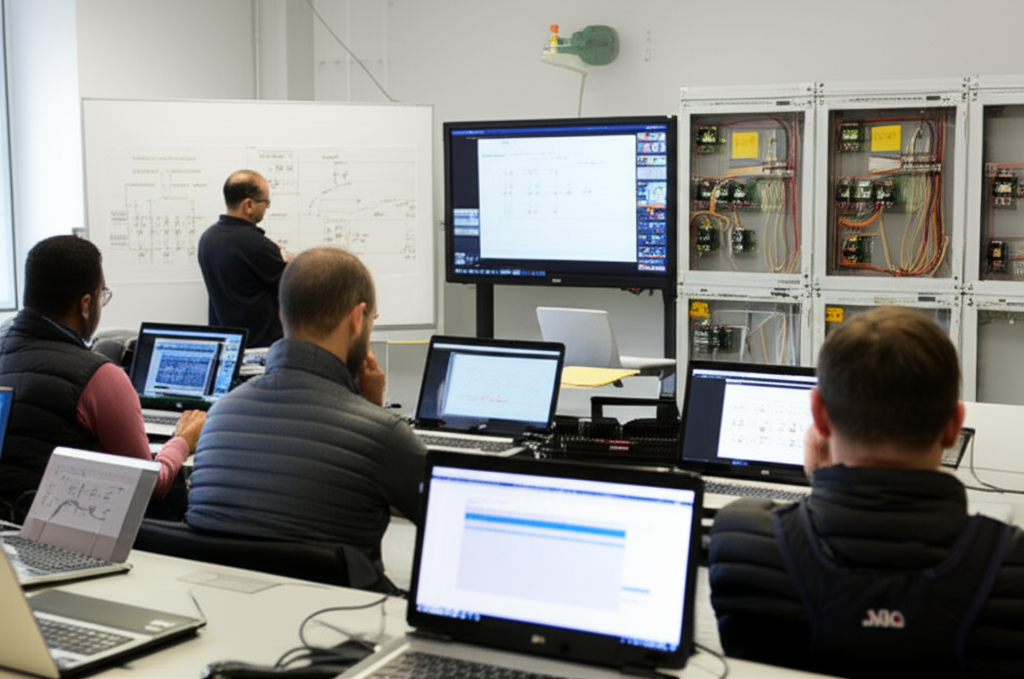
This program offers hands-on experience using industry-standard simulation and protection analysis software, enabling students to configure and calibrate devices while executing real-world coordination studies. This Protection coordination course prepares electrical engineers, protection technicians, and power grid specialists to enhance their ability to diagnose issues, troubleshoot complex electrical faults, and guarantee uninterrupted power supply across diverse industrial environments.
Protection Coordination Course in MV/LV Networks
- Modalidad: Online
- Duración: 4 meses
- Horas: 300 H
- Idioma: ES / EN
- Créditos: 60 ECTS
- Fecha de matrícula: 19-06-2026
- Fecha de inicio: 05-08-2026
- Plazas disponibles: 3
699 $
Competencies and outcomes
What you will learn
1. Comprehensive Mastery of Protection Coordination in MV/LV Electrical Networks
-
Fundamentals of power system protection in Medium and Low Voltage (MV/LV) networks.
-
Principles of coordination of protections: Selectivity, sensitivity, and operating speed.
-
Types of protection systems: Overcurrent, overvoltage, undervoltage, and ground faults.
-
Configuration and settings of advanced protection relays.
-
Fault analysis and failure diagnostics in electrical grids.
-
Comprehensive protection coordination course studies: Methodologies, frameworks, and engineering tools.
-
Application of cutting-edge simulation software for power system and electrical coordination training.
-
Relevant international standards and regulations for electrical network protection.
-
Maintenance protocols and testing procedures for protection relays.
-
Practical case studies and real-world examples of coordination of protections in MV/LV networks.
1. Advanced Optimization of Protections in MV/LV Electrical Networks
What You Will Learn (Course Objectives)
-
Fundamental Principles of Electrical Grid Protection: You will understand the core foundations of power system safety in Medium and Low Voltage (MV/LV) networks, highlighting the vital importance of selectivity, sensitivity, and operating speed within this coordination of protections.
-
Fault and Current Analysis: You will learn to identify different types of electrical faults (short-circuits, overloads, ground faults) and accurately calculate their associated fault currents.
-
Configuration and Settings of Protection Relays: You will become familiar with various types of protection relays (overcurrent, differential, distance, etc.) and learn how to configure and calibrate them properly to ensure equipment safety and power supply continuity.
-
Advanced Protection Coordination: You will master advanced techniques to guarantee selectivity and avoid nuisance tripping, including the use of time-current curves (TCC) and coordination diagrams as a core part of this Protection coordination course.
-
Optimizing Selectivity and Sensitivity: You will learn how to optimize protection settings to minimize the impact of electrical faults on the power system, ensuring a safe and highly efficient operation.
-
Specific Protection Applications: You will study specialized protection schemes and common configurations for transformers, generators, motors, and transmission lines.
-
Smart Grid Protection Systems Integration: You will explore current industry trends, including digital relays, communication protocols, and automation to improve grid reliability through this comprehensive Electrical Coordination training.
-
Regulations and Standards: You will gain deep knowledge of international standards and codes regulating power system protections, including IEC and ANSI frameworks.
3. Comprehensive user-oriented design and validation (from modeling to manufacturing)
You will learn to integrate the entire product development process, from initial model conception to final validation, applying user-centered methodologies. You will develop skills in parametric design, ergonomics, simulation, sustainable materials, 3D visualization, and manufacturing management, ensuring efficient, safe solutions that meet current industry standards.
4. Excellence in the Coordination of Protections for MV/LV Networks
4. Excellence in the Protection Coordination Course for MV/LV Networks
-
Identify and understand the fundamental principles of the coordination of protections in medium and low voltage grids.
-
Analyze the different types of protection systems utilized in the industry, including overcurrent, ground faults, overvoltage, and undervoltage.
-
Master calculation and calibration techniques for protection settings to guarantee optimum selectivity and sensitivity.
-
Evaluate the specific impact of distributed generation (DG) sources on overall power system safety and the coordination of protections.
-
Utilize specialized engineering software to simulate, analyze, and optimize your workflow within this Protection coordination course.
-
Interpret and analyze simulation reports to troubleshoot potential issues and improve grid design infrastructure.
-
Gain deep knowledge of international codes, regulations, and standards relevant to modern Electrical Coordination training.
-
Develop advanced troubleshooting and decision-making skills to effectively manage real-world electrical faults and system failures.
-
Comprehend the vital importance of protection settings in ensuring the overall safety, stability, and reliability of the electrical power network.
-
Apply all acquired engineering knowledge to practical case studies and real-life operational scenarios.
5. Specialization in Coordination of MV/LV Network Protection
5. Specialization in the Protection Coordination Course for MV/LV Networks
-
Foundations of Electrical Network Protection: You will gain deep knowledge of the core, foundational principles of power system safety in medium and low voltage (MV/LV) distribution systems.
-
Types of Protection Systems: You will study different critical protection devices utilized in the industry, such as overcurrent, differential, voltage, and frequency relays.
-
Coordination of Protections: You will learn how to properly execute the coordination of protections to ensure the required selectivity and sensitivity, minimizing the impact of system disturbances.
-
Advanced Fault Analysis: You will be fully trained in electrical grid fault analysis, including the calculation and diagnostic of short-circuits, overloads, and ground faults.
-
Simulation Software Engineering: You will utilize industry-standard, specialized software to simulate power grid behavior and evaluate the real-time performance of your safety settings within this Electrical Coordination training.
-
Regulations and Standards: You will study international codes and standards governing modern power network protection frameworks.
-
Practical Applications & Fieldwork: You will complete hands-on engineering case studies and practical exercises designed to apply your knowledge to real-world industrial scenarios.
-
Maintenance and Relay Testing: You will master preventive maintenance protocols and testing procedures for advanced protection devices.
-
Protection System Design: You will acquire the technical skills needed to design efficient, highly reliable, and safe electrical protection architectures.
-
Grid Protection Trends & Innovation: You will explore the latest technological trends driving the industry, such as digital protection relays, automation, and smart grids.
6. Strategic Implementation of MV/LV Protection Coordination
You will learn to integrate the entire product development process, from initial model conception to final validation, applying user-centered methodologies. You will develop skills in parametric design, ergonomics, simulation, sustainable materials, 3D visualization, and manufacturing management, ensuring efficient, safe solutions that meet current industry standards.
Who our [course/program] is aimed at:
Protection Coordination Course in MV/LV Networks
Target Audience (Who Should Attend)
-
-
Electrical, Electronic, or Power Systems Engineers and professionals with experience or interest in electrical power distribution systems.
-
Technicians and Supervisors working within electrical utility companies who wish to expand their expertise in power grid safety and protection.
-
Engineers and Technicians from installation and maintenance firms specializing in medium and low voltage (MV/LV) networks.
-
Industry Professionals involved in the design, construction, commissioning, and operation of MV/LV electrical distribution infrastructure.
-
Program Highlights & Methodology
-
-
Standards-Driven Curriculum: You will work directly with CS-27/CS-29, DO-160, DO-178C/DO-254, ARP4754A/ARP4761, and ADS-33E-PRF standards from the very first module.
-
Accredited Laboratories (EN ISO/IEC 17025): Access to cutting-edge facilities featuring rotor test benches, EMC/Lightning pre-compliance, HIL/SIL simulation, and vibration/acoustic testing.
-
Evidence-Oriented Final Project (TFM): Your capstone project will focus on producing industry-standard documentation, including safety cases, test plans, compliance dossiers, and operational limits.
-
Industry-Led Mentorship: Learn from world-class faculty with proven track records in rotorcraft, tiltrotor, eVTOL/UAM, and flight test operations.
-
Flexible Delivery: Available in hybrid and online formats, featuring international cohorts and full support from SEIUM Career Services.
-
Ethics & Safety: Our program is built on a safety-by-design approach, integrating cybersecurity for OT, digital innovation hubs (DIH), and strict regulatory compliance as core pillars.
-
Module 1: Fundamentals of the Protection Coordination Course for MV/LV Networks
-
1.1 Introduction to Medium and Low Voltage (MV/LV) Electrical Networks.
-
1.2 Key Components of MV/LV Grids: Transformers, circuit breakers, and auxiliary equipment.
-
1.3 The Vital Importance of Protection in Electrical Networks.
-
1.4 Core Principles of the Coordination of Protections: Achieving optimal selectivity and sensitivity.
-
1.5 Types of Protection Devices: Advanced relays, fuses, and associated hardware.
-
1.6 Time-Current Curves (TCC) and Their Engineering Interpretation.
-
1.7 Coordination Methodologies: Logical sequencing and professional fault analysis.
-
1.8 International Standards and Regulations Applicable to the Electrical Coordination training and grid safety.
-
1.9 Specialized Simulation Software and Tools for Protection Design.
-
1.10 Case Studies: Analysis of common electrical faults and effective solutions within a Protection coordination course.
-
2.1 Fundamentals of MV/LV Network Faults: Types, common causes, and grid impacts.
-
2.2 Protection Components: Circuit breakers, relays, and fuses.
-
2.3 Short-Circuit Current Calculations: Methodologies and industrial applications.
-
2.4 Time-Current Curves (TCC): Selection criteria and protection coordination.
-
2.5 Overload Protection: Detection logic and precise adjustment settings.
-
2.6 Short-Circuit Protection: Advanced coordination and selectivity strategies.
-
2.7 Differential Protection: Core operating principles and practical applications.
-
2.8 Sequence Analysis and Fault Simulation: Utilizing electrical coordination training techniques.
-
2.9 Testing and Maintenance of Protection Systems: Best practices for long-term reliability.
-
2.10 Case Studies: In-depth analysis of electrical faults and engineered solutions.
-
3.1 Fundamentals of MV/LV Network Protection: Essential engineering principles for power distribution systems.
-
3.2 Protection Types: Device classifications, configurations, and core operational functions.
-
3.3 Protection Parameter Selection: Optimization of current settings, time delays, and characteristic curves.
-
3.4 Protection Coordination Studies: Industry methodologies, technical workflows, and analytical tools.
-
3.5 Protection Scheme Design: Implementing overcurrent, differential, and distance protection solutions.
-
3.6 Fault Analysis and Selectivity: Diagnosing system faults to guarantee isolation and selectivity in MV/LV networks.
-
3.7 Protection Settings Calibration: Software-driven simulation, parameter tuning, and field testing.
-
3.8 Documentation and Standardization: Technical reporting, compliance files, and regulatory design standards.
-
3.9 SCADA System Integration: Connecting protection relays and monitoring units to industrial control automation.
-
3.10 Practical Case Studies: Real-world examples and engineering applications of MV/LV protection design.
-
4.1 Fundamentals of MV/LV Network Protection: Review of core concepts and engineering principles.
-
4.2 Protection Device Selection: Device types, technical characteristics, and practical applications.
-
4.3 Protection Coordination Studies: Methodologies, workflows, and analytical software tools.
-
4.4 Protection Scheme Design: Common network configurations and technical design criteria.
-
4.5 Protection Relay Setting: Parameter tuning, calibration, and characteristic curve selection.
-
4.6 Fault Analysis and Selectivity: Operational criteria, sensitivity, and clearing times.
-
4.7 Design and Setting of Overcurrent Protection: Configurations, calculations, and adjustments.
-
4.8 Design and Setting of Differential Protection: Implementation, balance criteria, and settings.
-
4.9 Design and Setting of Distance Protection: Operating zones, reach calculations, and settings.
-
4.10 Commissioning and Testing of Protections: Field procedures, validation protocols, and verification.
-
5.1 Fundamentals of MV/LV Networks: Structure and system components.
-
5.2 Importance of Protections in MV/LV Networks: Grid safety and operational reliability.
-
5.3 Protection Types: Overload, short-circuit, and ground fault protection.
-
5.4 Protection Devices: Circuit breakers, fuses, and industrial relays.
-
5.5 Operating Principles of Protection Relays: Core logic and tripping mechanisms.
-
5.6 Basic Concepts of Protection Coordination: Selectivity and timing principles.
-
5.7 Applicable Regulations and Standards: Compliance and international codes.
-
5.8 Introduction to Network Simulation and Analysis: Modeling software workflows.
-
5.9 Case Studies: Common electrical faults and their systemic impact.
-
5.10 Current Trends in Network Protection: Emerging technologies and future outlook.
-
6.1 Design of the MV/LV Protection Implementation Strategy: Strategic planning and deployment workflows.
-
6.2 Selection of Protection Devices: Key criteria and decision factors.
-
6.3 Protection Architecture Design: Network topology and configuration layout.
-
6.4 Configuration and Parameterization of Protection Relays: Setting adjustments and logic programming.
-
6.5 Communication and Monitoring in Protection Systems: Automation integration and supervisory control.
-
6.6 Testing and Commissioning of Protection Systems: Field validation and startup procedures.
-
6.7 Documentation and Lifecycle Management of Protection Systems: Asset tracking, records, and maintenance planning.
-
6.8 Safety Considerations and Applicable Standards: Regulatory compliance and risk mitigation.
-
6.9 Protection Implementation Project Management: Scheduling, execution, and quality control.
-
6.10 Practical Case Studies and Failure Analysis in Implementation: Diagnosing deployment challenges and technical errors.
-
7.1 Fundamentals of Medium and Low Voltage (MV/LV) Electrical Networks.
-
7.2 Key Components of MV/LV Grids: Transformers, circuit breakers, and auxiliary equipment.
-
7.3 Importance and Objectives of Protection in Electrical Networks.
-
7.4 Common Fault Types in MV/LV Networks: Short-circuits and overloads.
-
7.5 Basic Principles of Protection Coordination.
-
7.6 Protection Devices: Relays, fuses, and automatic circuit breakers.
-
7.7 Relevant Regulations and Standards in Electrical Protection.
-
7.8 Preliminary Analysis of Protection Systems.
-
7.9 Concepts of Selectivity and Sensitivity in System Protection.
-
7.10 Introduction to Network Simulation and Analysis Tools.
-
8.1 Fundamental Principles of Protection Design in MV/LV Networks.
-
8.2 Selection and Configuration of Protection Devices.
-
8.3 Fault Analysis and Protection Coordination.
-
8.4 Short-Circuit and Load Flow Calculations.
-
8.5 Protection Coordination Studies: Methodology and tools.
-
8.6 Protection Relay Adjustment: Curves and parameters.
-
8.7 Implementation of Protection Strategies in Different Network Configurations.
-
8.8 Design of Specific Protection Schemes for Transformers and Motors.
-
8.9 Documentation and Reporting of Protection Coordination Studies.
-
8.10 Optimization and Verification of Protection Design: Field testing.
-
9.1 Fundamental Principles of Protection Design in MV/LV Networks.
-
9.2 Selection of Protection Equipment: Criteria and standards.
-
9.3 Short-Circuit Calculations and Protection Coordination.
-
9.4 Configuration and Setting of Protection Relays.
-
9.5 Protection Coordination Studies: Methodology and tools.
-
9.6 Fault Analysis and Electrical System Protection.
-
9.7 Overload and Short-Circuit Protection in Transformers.
-
9.8 Distribution Line Protection: Reclosers and sectionalizers.
-
9.9 Commissioning and Testing of Protections.
-
9.10 Documentation and Maintenance of Protection Systems.
-
1.1 Fundamentals of MV/LV Protection Coordination: Comprehensive review.
-
1.2 Selection of Protection Devices: Criteria and applications.
-
1.3 Load Flow and Short-Circuit Studies: Foundations for coordination.
-
1.4 Coordination Methodologies: Detailed steps and techniques.
-
1.5 Protection Simulation Software: Tools and applications.
-
1.6 Analysis of Results: Interpretation and initial settings.
-
1.7 Design of Time-Current Curves: Criteria and examples.
-
1.8 Case Studies: Coordination in real-world networks.
-
1.9 Detection and Troubleshooting in Protection Coordination.
-
1.10 Final Project Presentation: Analysis and recommendations.
-
Hands-on Methodology: Test-before-you-trust, design reviews, failure analysis, and compliance evidence.
-
Software (depending on licenses/partners): MATLAB/Simulink, Python (NumPy/SciPy), OpenVSP, SU2/OpenFOAM, Nastran/Abaqus, AMESim/Modelica, acoustics tools, and DO-178C planning toolchains.
-
SEIUM Laboratories: Scale rotor test bench, vibrations/acoustics, EMC/Lightning pre-compliance, HIL/SIL for AFCS, and data acquisition with strain gauging.
-
Standards and Compliance: EN 9100, 17025, ISO 27001, and GDPR.
Capstone-type projects
-
Failure Analysis: Identification and mitigation of faults in MV/LV networks.
-
Selective Coordination: Implementation and optimization of selective coordination.
-
Simulation and Design: Software utilization for protection simulation and design.
-
Testing and Commissioning: Testing protocols and commissioning of protection systems.
-
Failure Analysis: Identification and mitigation of faults in MV/LV networks.
-
Selective Coordination: Implementation and optimization of selective coordination.
-
Simulation and Design: Software utilization for protection simulation and design.
-
Testing and Commissioning: Testing protocols and commissioning of protection systems.
-
Failure Analysis: Short-circuit simulation, selectivity studies, and relay coordination.
-
Settings Optimization: Protection curves, relay adjustment, and minimization of unprotected zones.
-
Protocol Implementation: IEC 61850, device configuration, and field testing.
-
Simulation and Validation: Simulation software, performance testing, and stability evaluation.
-
Analysis & Design: Load flow, short-circuit, and selectivity studies.
-
Calibration & Adjustment: Protection curves, coordination, and simulation.
-
Implementation & Testing: Relay configuration, alongside primary and secondary testing.
-
Optimization & Monitoring: Fault analysis, continuous improvement, and SCADA integration.
-
Failure Analysis: Modeling and simulation of MV/LV faults, alongside selectivity studies.
-
Relay Coordination: Adjustment and coordination of protection relays, and timing optimization.
-
Intelligent Systems: Implementation of smart protection algorithms and predictive analysis.
-
Field Testing: Verification of coordination parameters and event data analysis.
Admissions, fees, and scholarships
-
Profile: Background in Computer Engineering, Mathematics, Statistics, or related fields; practical experience in NLP and information retrieval systems is highly valued.
-
Documentation: Updated CV, academic transcripts, Statement of Purpose (SOP)/essay, and project or code samples (optional).
-
Process: Application $\rightarrow$ technical evaluation of profile and experience $\rightarrow$ technical interview $\rightarrow$ practical case review $\rightarrow$ final decision $\rightarrow$ enrollment.
-
Fees:
-
Single Payment: 10% discount.
-
3-Installment Plan: Interest-free; 30% upon enrollment + 2 equal monthly payments of the remaining 35%.
-
Monthly Payment: Available with a 7% fee on the total amount; subject to annual review.
-
-
Scholarships: Awarded based on academic merit, financial need, and diversity/inclusion initiatives; partnership agreements with industry companies are available for partial or full scholarships.
-
Inquiries: Please check “Calendario & convocatorias” (Calendar & Intake), “Becas & ayudas” (Scholarships & Financial Aid), and “Tasas & financiación” (Fees & Funding) in the SEIUM mega-menu.
Do you have any questions?
Our team is ready to help you. Contact us, and we will respond as soon as possible.
F. A. Q
Frequently asked questions
Yes, we have international certification
Yes: experimental models, real data, applied simulations, professional environments, real case studies.
It is not mandatory. We offer leveling tracks and tutoring.
Completely. It covers e-propulsion, integration, and emerging regulations (SC-VTOL).
Recommended. There are also internal challenges and consortia.
Yes. Online/hybrid format with planned labs and visa support (see “Visa & Residence”).