
Motorcycle Aerodynamics and Stability Engineering
About our Motorcycle Aerodynamics and Stability Engineering
Motorcycle Aerodynamics and Stability Engineering
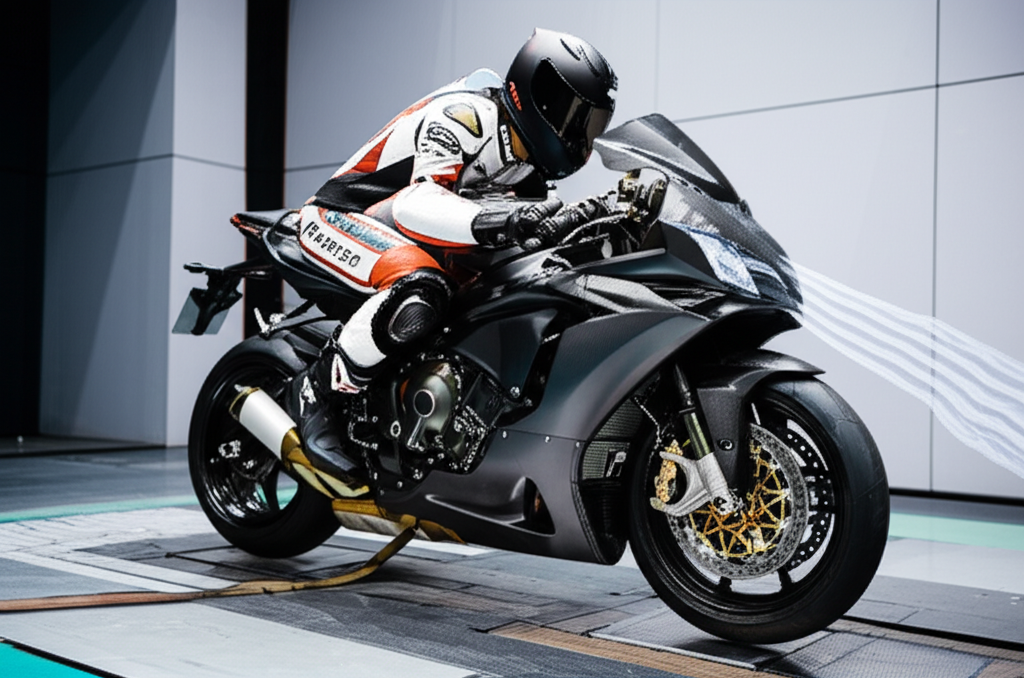
focuses on the advanced analysis of aerodynamic flows and vehicle dynamics to optimize performance and safety in high-speed motorcycles. This technical approach includes CFD modeling, LES and RANS simulations, aerodynamic load assessment, and longitudinal and lateral stability analysis through multibody methods (MBS) and dynamic control systems (DCS). It also integrates the study of aerodynamic interference under real conditions and parametric design based on optimization, covering everything from tires to fairings, with direct application in prototype development and controlled wind tunnel testing.
Laboratories equipped with HIL/SIL benches, advanced data acquisition, and acoustic vibration measurement systems allow model validation and ensure traceability under applicable international regulations and functional safety standards. Alignment with technical regulations guarantees certification and homologation of systems, preparing professionals for roles in aerodynamic design, control engineering, prototype testing, CFD simulation, and technical project management. Interdisciplinarity is key to excellence in stability and technological performance.
Motorcycle Aerodynamics and Stability Engineering
- Format:
- Duration:
- Time: 1900 H
- Practices: Consult
- Language:
- Credits:
- Registration date: 24-08-2026
- Start date: 18-10-2026
- Available places: 3
9,100 $
Skills and results
What you will learn
- Analyze flap–lag–torsion couplings, whirl flutter, and fatigue.
- Size laminates in composites, joints, and bonded joints with FE.
- Implement damage tolerance and NDT (UT/RT/thermography).
2. Key Principles of Aerodynamics and Stability for Helicopters and Rotary-Wing Aircraft
- Analyze flap–lag–torsion couplings, whirl flutter, and fatigue.
- Size aerodynamic configurations and stability in helicopters and rotorcraft, using CFD and rotor models to predict performance and control.
- Implement damage tolerance and NDT (UT/RT/thermography).
3. Comprehensive user-oriented design and validation (from modeling to manufacturing)
You will learn to integrate the entire product development process, from model conception to final validation, applying user-centered methodologies. You will develop competencies in parametric design, ergonomics, simulation, sustainable materials, 3D visualization, and manufacturing management, ensuring efficient, safe solutions aligned with current industry standards.
4. Aerodynamic Analysis and Stability Control of Rotary-Wing Aircraft
- Analyze flap–lag–torsion couplings, whirl flutter, and fatigue.
- Size laminates in composites, joints, and bonded joints with FE.
- Implement damage tolerance and NDT (UT/RT/thermography).
5. Performance and Stability Optimization in Helicopter Design
- Analyze flap–lag–torsion couplings, whirl flutter, and fatigue.
- Size laminates in composites, joints, and bonded joints with FE.
- Implement damage tolerance and NDT (UT/RT/thermography).
6. Mastery of Aerodynamics and Stability in Helicopter Design
Mastery of Aerodynamics and Stability in Helicopter Design
- Understand the fundamental principles of helicopter aerodynamics, including lift, drag, and thrust, as well as rotor theory.
- Study the static and dynamic stability of helicopters, addressing instability modes and control techniques.
- Analyze factors affecting stability, such as center of gravity, moment of inertia, and damping.
- Understand advanced rotor aerodynamics, including vortex analysis, blade theory, and separated flow.
- Delve into specific aerodynamic phenomena of helicopters, such as rotor retreat, autorotation, and ground effect.
- Analyze flap–lag–torsion couplings, whirl flutter, and fatigue.
- Study calculation and simulation methods for aerodynamic and structural analysis of helicopters.
- Learn about rotor design, including airfoil selection, geometry optimization, and performance evaluation.
- Size laminates in composites, joints, and bonded joints with FE.
- Learn about materials used in helicopter construction, including metals, composites, and their properties.
- Study structural design techniques, such as stress analysis, fatigue, and fracture resistance.
- Implement damage tolerance and NDT (UT/RT/thermography).
- Understand helicopter certification regulations and standards.
- Become familiar with software tools used in helicopter design and analysis.
- Apply the acquired knowledge in the conceptual and preliminary design of a helicopter.
Who this program is for:
Motorcycle Aerodynamics and Stability Engineering
- Engineers with a degree in Aerospace Engineering, Mechanical, Industrial, Automation or related degrees who are seeking a solid foundation in aircraft aerodynamics.
- Professionals working in the rotorcraft/eVTOL OEM sector, MRO companies, specialized consulting firms, or technology centers with an interest in aircraft design and stability analysis.
- Specialists in areas such as Flight Test, certification, avionics, flight control, and flight dynamics who wish to expand their knowledge and skills in aerodynamics and stability.
- Regulators, aeronautical authorities, and professionals involved in the development of UAM/eVTOL who need to acquire key competencies in compliance and regulations related to aircraft safety and design.
Recommended requirements: A foundational knowledge of aerodynamics, control, and structures is recommended. Proficiency in ES/EN at B2+/C1 level. We offer bridging tracks to address specific training needs.
- Standards-driven curriculum: you will work with CS-27/CS-29, DO-160, DO-178C/DO-254, ARP4754A/ARP4761, ADS-33E-PRF from the very first module.
- Accreditable laboratories (EN ISO/IEC 17025) with rotor test bench, EMC/Lightning pre-compliance, HIL/SIL, vibration/acoustics.
- Master’s thesis oriented to evidence: safety case, test plan, compliance dossier and operational limits.
- Industry mentoring: instructors with experience in rotorcraft, tiltrotor, eVTOL/UAM and flight test.
- Flexible modality (hybrid/online), international cohorts and support from SEIUM Career Services.
- Ethics and safety: safety-by-design approach, cyber-OT, DIH and compliance as pillars.
1.1 Fundamentals of Rotorcraft Aerodynamics: principles of rotor lift, tip speed, and disk loading
1.2 Stability and control in rotary-wing aircraft: longitudinal, lateral, and directional dynamics; coning and flapping effects
1.3 Rotor–fuselage interaction and influence on thrust and torques
1.4 Rotor control dynamics: collective, cyclic, and swashplate system
1.5 Rotor performance: hover, forward flight, speed conversion, efficiency, and autorotation
1.6 Aeronautical modeling and simulation: blade element theory (BEM), CFD methods, and wind tunnel testing
1.7 Aeroelasticity and vibrations: coning, flapping, bending, couplings, and vibration suppression
1.8 Blade materials and design: stiffness, weight, fatigue, damping, and leading-edge considerations
1.9 Fundamentals of safety and certification: basic standards, airworthiness requirements for rotorcraft
1.10 Case study: hover and stationary flight performance analysis with sensitivity evaluation and optimization
2.1 Fundamentals of Rotorcraft Aerodynamics: rotor lift concepts, induced flow and rotor efficiency
2.2 Key principles in rotor dynamics and stability: comparison between configurations and pitch control, flapping and coning
2.3 Flight Dynamics and rotorcraft performance: hover, translational lift, forward flight and autorotation
2.4 Rotor aerodynamic analysis: Blade Element Theory, Momentum Theory and inflow models
2.5 Stability and control of rotary-wing aircraft: flapping and lag dynamics, tail effects and cyclic/collective control
2.6 Performance and stability optimization in rotor design: blade profile, number of blades, weight, stiffness and vibration reduction
2.7 Mastery of aerodynamics and stability in helicopter design: integration between rotor, fuselage and control systems
2.8 Aerodynamic analysis and stability of rotating systems: rotor-engine coupling, powertrain and torque effects
2.9 Regulations, certifications and standards for rotary-wing aircraft: homologation requirements, stability and safety tests
2.10 Case studies: go/no-go with risk matrix for design and operation decisions
3.1 Fundamentals of Aerodynamics and Stability in Rotorcraft: rotor dynamics, thrust and flow profile, autorotation, dissymmetry of lift, turbulence and gust effects, longitudinal, lateral and directional stability, operational limits and primary performance.
3.2 Certification requirements and special conditions for rotorcraft: FAA/EASA regulations, special conditions and airworthiness requirements, flight testing, vibrations, system redundancies and certification of power and control subsystems.
3.3 Energy and thermal management in rotorcraft propulsion systems: electric/hybrid propulsion, battery energy density, thermal management, battery and motor cooling, inverters and power distribution, redundancy and electrical protection.
3.4 Design for maintainability and modular swaps: modularity of powertrain and rotor, accessibility for maintenance, quick-swap kits, documentation and standard interfaces for field replacement.
3.5 LCA/LCC in rotorcraft: life cycle assessment (environmental footprint, recyclable materials) and total cost of ownership, energy consumption analysis, production and maintenance impact, impact reduction strategies.
3.6 Operations and infrastructure: rotorcraft operations planning, integration into heliports and urban areas, takeoff/landing procedures, traffic management and operational safety.
3.7 Data and Digital Thread: MBSE/PLM for change control, systems modeling, change traceability, requirements management and product configuration throughout the lifecycle.
3.8 Technological risk and readiness: definition of TRL/CRL/SRL, maturity assessment of rotorcraft technologies, mitigation paths and development plans.
3.9 IP, certifications and time-to-market: intellectual property, patents, confidentiality, certification strategies and market timeline optimization.
3.10 Case clinic: go/no-go with risk matrix: practical decision exercise with risk criteria, acceptance thresholds and mitigation plans to advance or halt development.
4.1 Fundamentals of Aerodynamics for Helicopters: rotor theory, induction, flapping, and forward flight influence
4.2 Longitudinal, lateral, and directional stability in rotary-wing aircraft: effects of center of gravity, dihedral, and fuselage-rotor interaction
4.3 Flight Dynamics and State Model for Helicopters: 6-DOF equations of motion, trim, and dynamic responses
4.4 Aerodynamic Analysis and Stability of Rotating Systems: interactions between rotor, body, and flow
4.5 Modeling and Simulation Methods: BEM, boundary layer theory, and validation with test data
4.6 Rotor Dynamics and Aeroelasticity: flutter, vibrations, and mitigation through design
4.7 Performance and Stability Optimization in Helicopter Design: rotor diameter, pitch, rotor speed, and weight distribution
4.8 Systems Integration and Stability Control: sensors, actuators, control actuators, and control architecture
4.9 Vibration and Fatigue Analysis in Helicopters: natural frequencies, damping, and maintenance strategies
4.10 Case Study: go/no-go with risk matrix for design and validation decisions
5.1 Introduction to Helicopter Aerodynamics: Fundamental Concepts.
5.2 Rotary Motion Theory: Blades and Main Rotor.
5.3 Lift and Drag in Helicopters: Detailed Analysis.
5.4 Static and Dynamic Stability: Fundamentals in Rotorcraft.
5.5 Helicopter Control: Cyclic and Collective.
5.6 Airflow and Aerodynamic Effects: Vortex Ring State and Autorotation.
5.7 Rotor Design: Aerodynamic Profiles.
5.8 Key Concepts: Angle of Attack, Blade Pitch, and Rotation Speed.
5.9 Performance Analysis: Power and Speed Curves.
5.10 Introduction to Advanced Aerodynamics: CFD Modeling in Rotorcraft.
6. 1 Basic concepts of aerodynamics: lift, drag, and airflow.
6. 2 Fundamental principles of static and dynamic stability.
6. 3 Key aerodynamic components in helicopters and rotary-wing aircraft.
6. 4 Special aerodynamic effects: ground effect, tail rotor.
6. 5 Design parameters and their impact on stability.
6. 6 Introduction to equations of motion and forces in rotary flight.
6. 7 Basic simulation tools and software for aerodynamic analysis.
6. 8 Types of rotor configurations and their stability characteristics.
6. 9 Importance of aerodynamic design in flight safety.
6. 10 Initial considerations for stability and control analysis.
7.1 Fundamentals of Rotational Aerodynamics: Lift and Drag.
7.2 Blade Element Theory: Analysis and Applications.
7.3 Rotor Blade Aerodynamics: Airfoil Profiles and Load Distribution.
7.4 Effect of Flight State on Rotor Aerodynamics.
7.5 Induced Airflow and Energy Recovery in Rotorcraft.
7.6 Rotorcraft Aerodynamic Modeling and Simulation.
7.7 Static and Dynamic Stability in Helicopters: Key Concepts.
7.8 Flight Controls and Automatic Stabilization Systems.
7.9 Aerodynamics of Control Surfaces and Interaction Effects.
7.10 Rotor Aerodynamic Design and Optimization: Selection and Evaluation.
8. 1 Fundamental principles of aerodynamics applied to rotors.
8. 2 Effects of airflow on rotating blades: lift, drag, and torque.
8. 3 Concepts of static and dynamic stability in helicopters.
8. 4 Factors influencing stability: center of gravity, control surfaces.
8. 5 Rotor aerodynamic design: blade profile and its influence.
8. 6 Analysis of longitudinal and lateral stability in helicopters.
8. 7 Flight control systems and their impact on stability.
8. 8 Case studies: practical examples of aerodynamics and stability in helicopters.
8. 9 Advanced rotor aerodynamics: vortices and their behavior.
8. 10 Aerodynamic performance optimization to improve stability.
9. 1 Fundamentals of rotational aerodynamics: lift and drag in rotors
9. 2 Principles of static and dynamic stability in helicopters.
9. 3 Effects of design variables on stability (center of gravity, moments of inertia).
9. 4 Main rotor aerodynamic design: profiles, planform, and blade distribution.
9. 5 Analysis of forces and moments in hover and forward flight.
9. 6 Introduction to vibration modes and their influence on stability.
9. 7 Flight controls and their impact on directional and lateral stability.
9. 8 Vibration mitigation techniques and their relationship with stability.
9. 9 Introduction to helicopter certification and stability requirements.
9. 10 Case studies: Analysis of stability problems in helicopters.
10. 1 Fundamentals of Aerodynamics: Basic principles applied to rotary-wing aircraft.
10. 2 Static and Dynamic Stability: Key concepts and analysis in rotorcraft.
10. 3 Airfoil Profiles and Blade Design: Impact on performance and stability.
10. 4 Specific Aerodynamic Effects: Autorotation, ground effect, and vortex ring state.
10. 5 Helicopter Control: Control systems and their effects on stability.
10. 6 Flight Dynamics: Introduction to flight modes and their implications.
10. 7 Aerodynamic Design: Principles for performance optimization.
10. 8 Stability Analysis: Methods for evaluating stability in rotorcraft.
10. 9 Optimization: Strategies for improving performance and stability.
10. 10 Practical Applications: Case studies and design examples.
- Hands-on methodology: test-before-you-trust, design reviews, failure analysis, compliance evidence.
- Software (according to licenses/partners): MATLAB/Simulink, Python (NumPy/SciPy), OpenVSP, SU2/OpenFOAM, Nastran/Abaqus, AMESim/Modelica, acoustics tools, DO-178C planning toolchains.
- SEIUM Laboratories: scale rotor test bench, vibration/acoustics, EMC/Lightning pre-compliance, HIL/SIL for AFCS, data acquisition with strain gauging.
- Standards and compliance: EN 9100, 17025, ISO 27001, GDPR.
Capstone-type projects
- Blade optimization: BEMT+CFD; bench/tunnel correlation; BVI acoustics.
- AFCS/SCAS: hover, attitude hold, envelope protection, SIL/HIL.
- Tiltrotor conv.: evaluation of conversion corridor and margins.
- Aeroelasticity: modal analysis; whirl flutter; flutter clearance; mitig.
DO-160: environmental tests (vibration, temperature, EMI, lightning/HIRF) and mitigation.
- Blade optimization: BEMT+CFD; bench/tunnel correlation; BVI acoustics.
- AFCS/SCAS: hover, attitude hold, envelope protection, SIL/HIL.
- Tiltrotor conv.: evaluation of conversion corridor and margins.
- Aeroelasticity: modal analysis; whirl flutter; flutter clearance; mitig.
DO-160: environmental tests (vibration, temperature, EMI, lightning/HIRF) and mitigation.
- Rotor Design and Simulation: BEMT, CFD, BVI noise analysis.
- Flight Control Systems: Autopilot (hover, attitude), Envelope protection, SIL/HIL validation.
- Stability and Control: Tiltrotor conversion, Conversion corridor assessment.
- Aeroelasticity: Modal analysis, Flutter, Structural mitigation.
- Rotor Design and Simulation: BEMT, CFD, BVI noise analysis.
- Flight Control Systems: Autopilot (hover, attitude), Envelope protection, SIL/HIL validation.
- Stability and Control: Tiltrotor conversion, Conversion corridor assessment.
- Aeroelasticity: Modal analysis, Flutter, Structural mitigation.
- Blade optimization: BEMT + CFD; bench/wind tunnel correlation; BVI acoustics.
- AFCS/SCAS: hover/attitude hold, envelope protection, SIL/HIL validation.
- Tiltrotor conversion control: assessment of the conversion corridor and margins.
- Aeroelasticity: modal analysis and whirl flutter; flutter clearance; structural mitigations.
DO-160: environmental test plan (vibration, temperature, EMI, lightning/HIRF) and mitigation.
Admissions, fees and scholarships
- Profile: Background in Computer Engineering, Mathematics, Statistics, or related fields; practical experience in NLP and information retrieval systems is valued.
- Documentation: Updated CV, academic transcripts, SOP/purpose essay, project or code examples (optional).
- Process: application → technical evaluation of profile and experience → technical interview → review of practical cases → final decision → enrollment.
- Fees:
- Single payment: 10% discount.
- Payment in 3 installments: no fees; 30% upon enrollment + 2 equal monthly payments of the remaining 35%.
- Monthly payment: available with a 7% commission on the total; annual review.
- Scholarships: based on academic merit, economic situation, and promotion of inclusion; agreements with industry companies for partial or full scholarships.
Check “Calendar & calls”, “Scholarships & financial aid” and “Fees & financing” in the SEIUM mega-menu.
Do you have any questions?
Our team is ready to help you. Contact us and we’ll get back to you as soon as possible.
F. A. Q
Frequently Asked Questions
Yes, we hold international certification.
Yes: experimental models, real data, applied simulations, professional environments, real case studies.
It is not mandatory. We offer leveling tracks and tutoring.
Completely. It covers e-propulsion, integration, and emerging regulations (SC-VTOL).
Recommended. There are also internal challenges and consortia.