

Master’s in Motorcycle Dynamics and Rider-in-the-Loop
About our Master’s in Motorcycle Dynamics and Rider-in-the-Loop
The Master’s in Motorcycle Dynamics and Rider-in-the-Loop
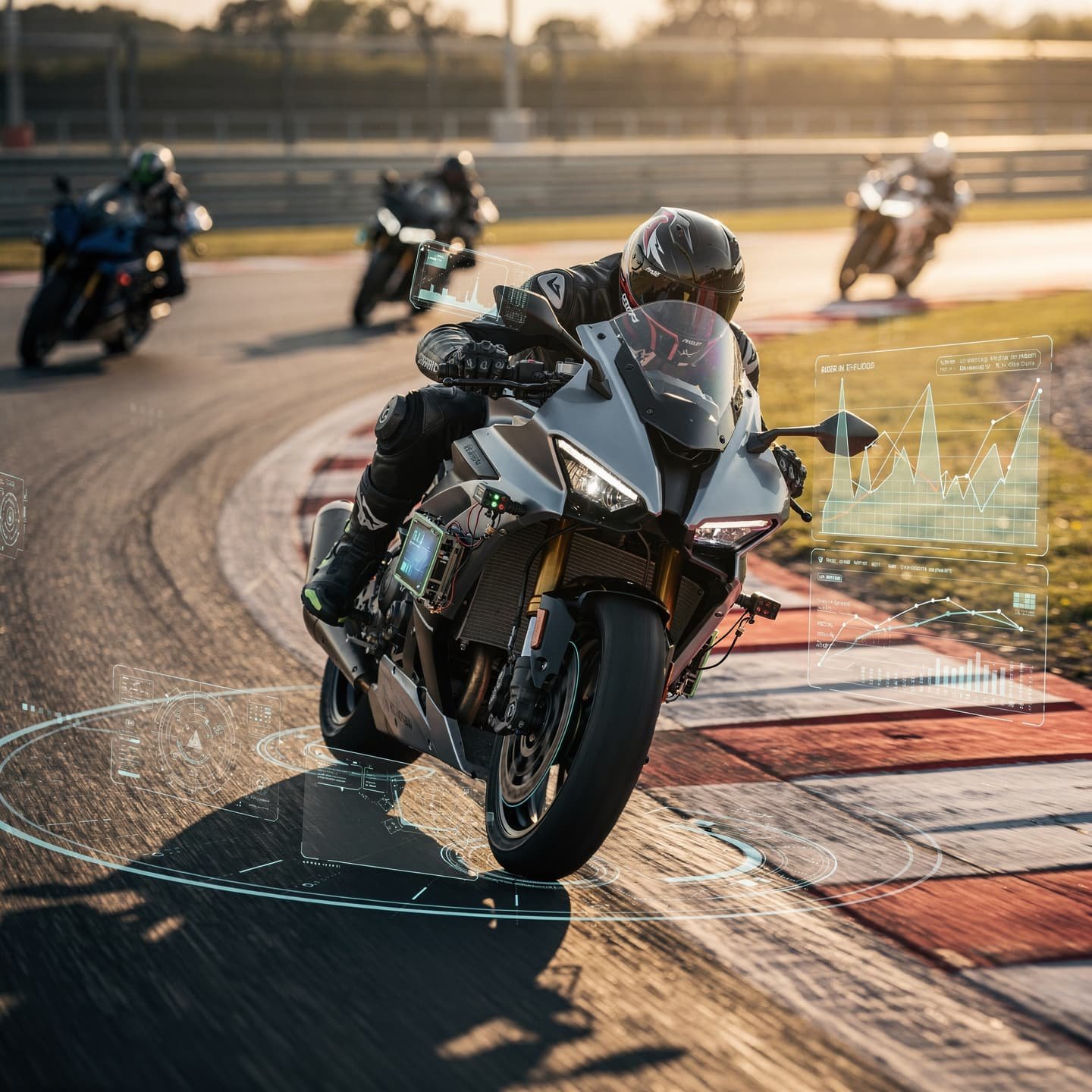
is an advanced program designed to train specialists capable of understanding, modeling, and optimizing motorcycle dynamics by integrating the rider as an active part of the system through rider-in-the-loop approaches. Throughout the master’s program, you will work in depth on the longitudinal and lateral dynamics of the motorcycle, the motorcycle–tire–asphalt interaction, the influence of the rider’s posture and actions, advanced motorcycle simulation, riding simulators with rider-in-the-loop, data acquisition, and analysis tools that allow evaluating the combined motorcycle–rider behavior. This master’s in motorcycle dynamics and rider-in-the-loop is oriented toward both street motorcycle engineering and motorsport engineering (speed, track days, competition), connecting mathematical models, real telemetry, ergonomics, and rider perception. The goal is for you to graduate prepared to lead projects where motorcycle dynamics and rider-in-the-loop systems are at the center of technical development, whether at manufacturers, racing teams, R&D centers, simulators, or specialized consulting firms.
Master’s in Motorcycle Dynamics and Rider-in-the-Loop
- Format:
- Duration:
- Time: 1900 H
- Practices: Consult
- Language:
- Credits:
- Registration date: 08-10-2026
- Start date: 02-12-2026
- Available places: 2
6,500 $
Skills and results
What you will learn
In the Master’s in Motorcycle Dynamics and Rider-in-the-Loop you will understand in depth the physical and mathematical fundamentals of motorcycle dynamics, from simplified single-track models to more complex multibody models. You will study the two-wheeled balance, the generation of lateral and longitudinal forces, the role of steering geometry, mass distribution, load transfer during braking, acceleration, and cornering. You will learn to connect these concepts with the practice of design, setup, and real behavior analysis of a motorcycle.
You will master the interaction between motorcycle dynamics and the rider, the true core of the rider-in-the-loop approach. You will analyze how posture, body movements, the rider’s weight distribution, and handlebar, brake, and throttle inputs influence the global dynamics of the rider–motorcycle system. You will see how perception, reaction time, sensitivity to grip, and rider confidence condition the real use of the motorcycle’s potential, and how to integrate these elements into models and simulations of motorcycle dynamics.
You will delve into the modeling and simulation of motorcycle dynamics, working with single-degree-of-freedom models, “single track” models, multibody models, and simplified approaches for real-time simulation. You will learn to build and calibrate models that reproduce motorcycle dynamics with sufficient fidelity to be used in simulation environments and on rider-in-the-loop platforms, where the rider interacts with a virtual motorcycle model that responds like a real vehicle.
You will learn to design, configure, and use rider-in-the-loop motorcycle simulators. You will study how hardware (motion platforms, handlebars, controls, screens, virtual reality) and software (motorcycle dynamics model, graphics engine, environment logic) are integrated to create simulation experiences useful from an engineering point of view. You will understand how to configure scenarios for training, R&D, or motorsport, and how to extract behavior data from both the virtual motorcycle and the real rider.
You will specialize in tires, wheel–ground contact, and friction within motorcycle dynamics. You will delve into tire models (Pacejka and other approaches), the construction of lateral and longitudinal force curves, and how these models are integrated into rider-in-the-loop simulations. You will learn to interpret temperature, pressure, slip, and wear data to improve the predictive capability of your motorcycle dynamics models and to validate simulations with real track data.
You will develop advanced competencies in data acquisition, telemetry, and signal analysis oriented toward motorcycle dynamics and rider analysis. You will work with channels such as speed, RPM, throttle, brake, gear, accelerations, lean angle (when available), as well as rider-related data (body angles, control usage, biometrics where applicable). You will learn to cross-reference objective data with the rider’s subjective perception, generating reports that serve both engineers and riders, especially in rider-in-the-loop simulation environments.
Who this program is for:
Master’s in Motorcycle Dynamics and Rider-in-the-Loop
The Master’s in Motorcycle Dynamics and Rider-in-the-Loop is aimed at engineers, technicians, and advanced students of mechanical engineering, automotive, industrial, aeronautical, electronics, or related fields who wish to specialize in motorcycle dynamics and rider-in-the-loop simulation. It is also suitable for motorsport engineers, R&D managers at manufacturers and suppliers, simulation professionals, and technicians at rider training centers who want to introduce advanced motorcycle simulation systems. It is ideal for those who already have a background in motorcycle engineering, motorcycle mechanics, or vehicle dynamics and want to take a step further toward modeling, simulation, and analysis of the rider–motorcycle system. Comfort with basic dynamics mathematics, some experience with calculation and simulation tools, and familiarity with technical motorcycle terminology are recommended.
SEIUM offers with this program a unique combination of motorcycle dynamics and rider-in-the-loop entirely in Spanish, with a deep technical focus and practical application. While other training programs focus only on motorcycle mechanics or generic vehicle dynamics, this master’s program approaches the motorcycle as a complex system where the rider is part of the model, integrating physics, simulation, and human perception. The Master’s in Motorcycle Dynamics and Rider-in-the-Loop is structured for professionals who wish to go beyond intuition and work with models, data, and advanced simulators, without losing touch with the reality of the track. SEIUM opts for a flexible, online methodology, compatible with professional life, with applied projects, analysis exercises, and activities designed so that you finish the master’s with cases and studies that you can showcase in your portfolio. The goal is for you to become a reference in motorcycle dynamics and rider-in-the-loop in your professional environment.
1.1 Overview of motorcycle engineering and its evolution
1.2 Introduction to motorcycle dynamics as a specific discipline
1.3 Key differences between car dynamics and motorcycle dynamics
1.4 Concept of the motorcycle–rider system and rider-in-the-loop vision
1.5 Applications of motorcycle dynamics in product, motorsport, and safety
1.6 Review of necessary basic kinematics and dynamics concepts
1.7 Main references and standards related to motorcycles
1.8 Types of motorcycles and their dynamic implications
1.9 Common tools in motorcycle dynamics projects
1.10 Professional competencies associated with motorcycle dynamics
2.1 Simplified motorcycle models: single-track model (single track model)
2.2 Fundamental degrees of freedom: roll, pitch, yaw, and translation
2.3 Forces involved: weight, ground reactions, tire forces, and aerodynamic forces
2.4 Steering geometry: rake angle, trail, offset, and effects
2.5 Mass distribution, center of gravity height, and stability
2.6 Load transfer during braking and acceleration
2.7 Cornering behavior: equilibrium, counter-steering, and lean angle
2.8 Typical phenomena: shimmy, wobble, weave, and their interpretation
2.9 Introduction to equations of motion in motorcycle dynamics
2.10 Limitations and practical uses of simplified models
3.1 Conceptual model of the rider: mass, posture, and contact points
3.2 Influence of the rider on motorcycle dynamics: weight and movement
3.3 Control actions: handlebar, front brake, rear brake, throttle, and gear shifts
3.4 Rider perception capacity: vision, hearing, sensation of forces
3.5 Reaction times and the human–vehicle control loop
3.6 Rider models in simulation: simple and advanced controllers
3.7 Interaction between ergonomics, comfort, and motorcycle dynamics
3.8 Human limitations and dynamic safety margins
3.9 Differences between expert and novice riders from a dynamics perspective
3.10 Implications of rider-in-the-loop in motorcycle design and validation
4.1 Types of motorcycle dynamics models: from simple to multibody
4.2 Structure of an extended single track model
4.3 Integration of tire models in motorcycle dynamics
4.4 Selection of parameters, geometric data, and mass data
4.5 Simulation of basic maneuvers: braking, lane change, constant cornering
4.6 Introduction to numerical simulation environments (MATLAB/Simulink or similar)
4.7 Basic validation of models with real data
4.8 Trade-offs between fidelity and computation time in simulation
4.9 Preparation of models for real-time simulation use
4.10 Documentation and traceability of motorcycle dynamics models
5.1 Characteristics of motorcycle tires and their uniqueness
5.2 Concepts of longitudinal and lateral slip
5.3 Longitudinal and lateral force curves: linear and nonlinear zones
5.4 Empirical models (Pacejka type) applied to motorcycle dynamics
5.5 Influence of pressure, temperature, and load on tire behavior
5.6 Differences between street, sport, and competition tires
5.7 Critical parameters for tire simulation in motorcycles
5.8 Validation of tire models with track data
5.9 Integration of tire models into rider-in-the-loop simulators
5.10 Implications of tires on stability and safety of the motorcycle–rider set
6.1 Types of simulators for motorcycles: static, dynamic, VR, and mixed
6.2 Architecture of a rider-in-the-loop simulator: hardware and software
6.3 Integration of the motorcycle dynamics model into the simulator
6.4 Human–machine interface: handlebar, controls, force, and haptic feedback
6.5 Visual representation: screens, virtual reality, and immersive projection
6.6 Design of test scenarios for R&D and rider training
6.7 Data logging from the simulator: virtual motorcycle and real rider variables
6.8 Limitations and challenges of rider-in-the-loop simulators
6.9 Subjective and objective validation of simulation quality
6.10 Use cases: product development, motorsport, safety, and training
7.1 Data acquisition systems on real motorcycles
7.2 Key sensors: speed, RPM, throttle, brake, steering angle, IMU, etc.
7.3 Structure of a telemetry session in motorsport
7.4 Signal processing for motorcycle dynamics analysis
7.5 Comparison between real motorcycle data and rider-in-the-loop simulation
7.6 Analysis of critical maneuvers: heavy braking, rapid direction changes
7.7 Visualization tools and technical dashboards
7.8 Fusion of objective data with rider feedback
7.9 Generation of technical reports for teams and R&D
7.10 Creation of databases for ongoing motorcycle dynamics projects
8.1 Use of motorcycle dynamics in geometry and setup design
8.2 Evaluation of electronic rider aids from a dynamics perspective
8.3 Applications of rider-in-the-loop in active safety system development
8.4 Optimization of ergonomics using simulation and rider data
8.5 Use cases in motorsport: lap analysis, lap time improvement, and consistency
8.6 Test campaigns integrating real motorcycles and simulators
8.7 Impact of dynamic improvements on end-user perception
8.8 Accident reduction projects from a motorcycle dynamics perspective
8.9 Applications in rider training and training programs
8.10 Management of applied projects with a dynamic and rider-in-the-loop approach
9.1 Planning of motorcycle dynamics and simulation projects
9.2 Selection of appropriate software and hardware tools
9.3 Collaboration between motorcycle engineering, design, electronics, and UX
9.4 Requirements management: what the market asks for vs. what dynamics demands
9.5 Cost and time estimation in rider-in-the-loop simulator projects
9.6 Communication strategies of results to non-technical profiles
9.7 Technical documentation and internal quality standards
9.8 Integration of dynamics results into product decisions
9.9 Data protection, IP, and confidentiality in R&D projects
9.10 Continuous improvement in motorcycle dynamics and simulation projects
10.1 Definition of the final project in motorcycle dynamics and rider-in-the-loop
10.2 Choice of case study: product, motorsport, or simulation
10.3 Design of the model, data sources, and validation methodology
10.4 Analysis of results and interpretation for decision-making
10.5 Preparation of a complete technical dossier and formal presentation
10.6 Defense of the project before an academic–technical committee
10.7 Building a professional portfolio in motorcycle dynamics
10.8 Career paths in industry, motorsport, simulation, and consulting
10.9 Personal continuous development plan in motorcycle dynamics and rider-in-the-loop
10.10 Closing of the master’s program and roadmap for the next professional steps
The methodology of the Master’s in Motorcycle Dynamics and Rider-in-the-Loop combines live online classes, on-demand content, calculation exercises, simulation practices, and applied projects. You will work with technical spreadsheets, numerical simulation environments (MATLAB/Simulink-type or equivalent tools), motorsport data analysis software, and examples of rider-in-the-loop simulator architectures. The “laboratory” is conceived as a combination of motorcycle dynamics simulation, analysis of real or example telemetry, and conceptual design of motorcycle simulation platforms. Through case studies, you will reproduce typical maneuvers, analyze the response of the motorcycle–rider system, and propose improvements. The methodology is designed so that you can apply what you have learned whether you work at a manufacturer, a motorsport team, a simulation company, or a motorcycle engineering consultancy.
Capstone-type projects
Basic motorcycle dynamics model for simulation. The student will develop a single track model with simplified tires, implement it in a simulation environment, and use it to reproduce several standard maneuvers. The result will be a foundation upon which a rider-in-the-loop simulator can be built in the future.
Basic motorcycle dynamics model for simulation. The student will develop a single track model with simplified tires, implement it in a simulation environment, and use it to reproduce several standard maneuvers. The result will be a foundation upon which a rider-in-the-loop simulator can be built in the future.
Conceptual design of a rider-in-the-loop simulator for motorcycles. The student will define the architecture of a simulator: hardware, software, motorcycle dynamics model, rider interface, variables to be recorded, and possible applications (training, R&D, motorsport). The project will include diagrams, specifications, and a validation plan.
Correlation of real data with simulation. The student will compare data from a real motorcycle (or provided dataset) with results from their motorcycle dynamics model in a specific maneuver. They will have to calibrate parameters, analyze differences, and improve the model’s fit, learning to close the loop between theory, simulation, and reality.
Integrating project on motorcycle dynamics and rider-in-the-loop. As the culmination of the master’s program, the student will develop a complete project that combines modeling, simulation, data analysis, and design of rider-in-the-loop experiments (real or conceptual). The result will be a professional dossier that demonstrates their ability to lead advanced projects in motorcycle dynamics and simulation with the rider in the loop.
Admissions, fees and scholarships
The Master’s in Motorcycle Dynamics and Rider-in-the-Loop is aimed at people with a solid technical background interested in deepening their knowledge of motorcycle dynamics and advanced simulation. It is recommended to have studies in engineering (mechanical, automotive, industrial, electronic, aerospace, etc.) or professional experience in motorcycle, motorsport, or simulation environments. The admission process may include a review of the CV, a motivation letter, and in some cases an interview to ensure that the candidate has the necessary level of mathematical and technical fundamentals. Regarding scholarships and financial aid, SEIUM may offer special conditions for students with outstanding academic records, working professionals, and international candidates. There are installment payment plans, designed to facilitate access to the program while maintaining the rigor and quality required for a specialization in motorcycle dynamics and rider-in-the-loop.
Do you have any questions?
Our team is ready to help you. Contact us and we’ll get back to you as soon as possible.
F. A. Q
Frequently Asked Questions
It is highly recommended to have seen basic concepts of vehicle dynamics, but the Master’s in Motorcycle Dynamics and Rider-in-the-Loop includes an initial review of fundamentals. From there, the level progresses gradually. If you have an engineering background and are willing to review, you will be able to follow the program.
Yes. The program is precisely designed to connect practical motorcycle engineering with motorcycle dynamics and simulation. You will see examples that start from the reality of the workshop or track and are translated into models. That said, you will need to familiarize yourself with calculation and simulation tools, for which guides and support are provided.
Totally. Motorcycle dynamics has many points in common with car dynamics, but also very important particularities (balance, lean angle, tires, rider–motorcycle interaction). The master’s program will allow you to adapt your simulation knowledge to an environment where the rider has an even more critical role, especially with the rider-in-the-loop approach.
Numerical calculation and simulation tools, spreadsheets, and data analysis software commonly used in engineering are employed. It is not essential to start with experience in a specific program, but you must be willing to learn a simulation environment that allows implementing motorcycle dynamics models.
Yes. All projects are designed to become portfolio pieces: motorcycle dynamics models, rider-in-the-loop simulator designs, data–simulation correlation reports, and proposals for applications in product or motorsport. You will be able to show them to manufacturers, teams, simulation companies, or consultancies.