
Master’s in E-Axles and Transmissions for EVs
About our Master’s in E-Axles and Transmissions for EVs
The Master’s in E-Axles and EV Transmissions
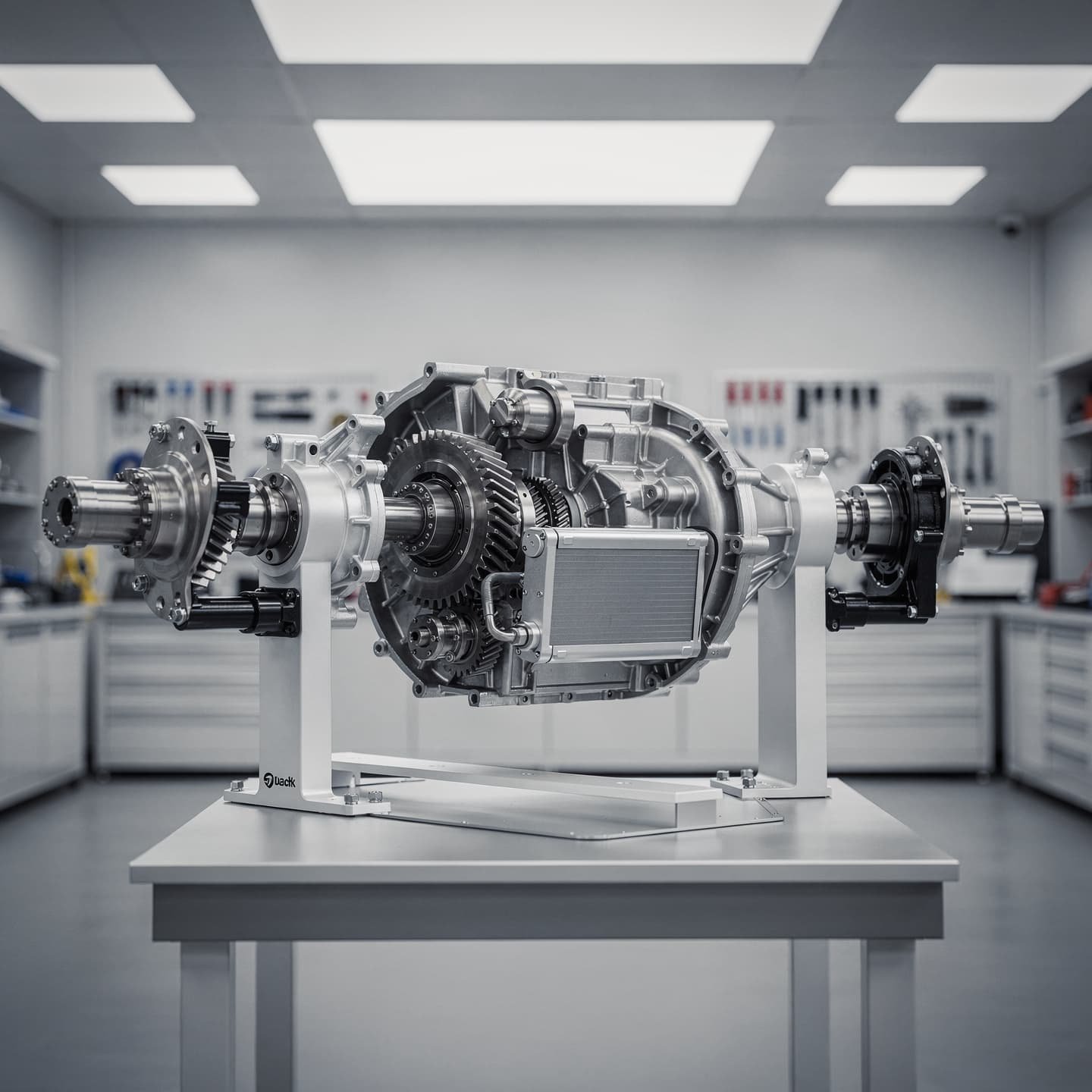
is an advanced program designed to train specialists in e-axle, EV transmission, and next-generation electric powertrain. Throughout the master’s program, you will work in depth on the design, sizing, and integration of complete e-axles (electric motor + gearbox + differential + associated electronics), as well as electric transmissions for light vehicles, sports cars, commercial vehicles, and high-performance applications. You will learn to translate vehicle requirements (acceleration, top speed, gradeability, NVH, efficiency, cost) into technical specifications for the e-axle and EV drivetrain, and to make architectural decisions that directly affect the range, performance, and comfort of an electric vehicle.
This Master’s in E-Axles and EV Transmissions combines advanced mechanics, vehicle dynamics, gear engineering, bearings and housings, with electric motor integration, torque control, thermal aspects, NVH, manufacturing, and validation. The focus is on the complete EV transmission: from the definition of the reduction ratio to the industrialization of the e-axle as a platform-ready module. The goal is for you to graduate prepared to work at OEMs, Tier 1 suppliers, R&D centers, or consulting firms as an e-axle, electric transmission, and electric powertrain engineer.
Master’s in E-Axles and Transmissions for EVs
- Format: Online
- Duration: 19 months
- Time: 1900 H
- Practices: Consult
- Language: ES / EN
- Credits: 60 ECTS
- Registration date: 08-10-2026
- Start date: 02-12-2026
- Available places: 2
4,200 $
Skills and results
What you will learn
You will understand the complete EV drivetrain ecosystem: electric vehicle architectures (front-wheel drive, rear-wheel drive, e-axles on both axles, dual motor, torque vectoring), differences between centralized systems and integrated e-axles, as well as the impact that the EV transmission has on performance, range, and efficiency. You will learn to compare different electric powertrain configurations and to justify why a certain e-axle scheme is more suitable for a specific market segment or platform type.
You will master the sizing workflow of an e-axle based on vehicle requirements: masses, acceleration targets, top speed, gradeability, wheel torque limits, battery and inverter constraints. You will see how to derive EV transmission ratios, nominal and maximum torques, gear and shaft stresses, as well as overall EV drivetrain efficiency requirements. The Master’s in E-Axles and EV Transmissions will teach you to go from a vehicle target sheet to a coherent technical specification for the e-axle and electric transmission.
You will delve into the mechanical design of e-axles and EV transmissions: spur and helical gears, single- or multi-speed reducers, open and limited-slip differentials, bearings, shafts, and housings. You will learn to evaluate stresses, fatigue life, micro-pitting, flank contact, stiffness, alignments, and tolerances. You will understand how packaging, cost, and durability are balanced in a real EV transmission, and how these decisions are integrated within the e-axle module.
You will understand the interaction between the e-axle, electric motor, and inverter within the electric powertrain. You will study motor efficiency maps, torque curves, thermal limits, and how they combine with the EV transmission to cover the operating range of the electric vehicle. You will learn to analyze the system from the standpoint of overall efficiency (battery-to-wheel), electric noise, and smoothness in torque delivery, ensuring that the EV drivetrain architecture makes sense both for engineering and for business.
You will specialize in NVH (Noise, Vibration & Harshness) and comfort applied to e-axles and EV transmissions. You will study gear excitations, electric motor torque orders, resonances, vibrations in housings and supports, and how these are perceived in the cabin. You will see strategies to reduce gear noise, whine, hums, and vibrations typical of the EV drivetrain, learning to design and tune an electric transmission that combines efficiency with acoustic comfort.
You will develop competencies in lubrication, thermal management, and sealing of e-axles and EV transmissions. You will work on specific oils for the e-axle, circulation and splashing, churning losses, foam generation, venting management, and design of oil circuits within the module. You will analyze how the heat generated by gears, bearings, and the integrated motor is dissipated, and how the overall cooling system of the electric vehicle coordinates with the electric powertrain.
Who this program is for:
Master’s in E-Axles and Transmissions for EVs
The Master’s in E-Axles and EV Transmissions is aimed at engineers and technicians in mechanical engineering, automotive, industrial, electrical, or related fields who want to specialize in e-axles, EV transmissions, and electric powertrains. It is also ideal for professionals who already work at OEMs, Tier 1 suppliers, or consultancies and wish to make the leap to electric vehicle projects, moving from conventional transmissions to integrated electric transmissions. It is advisable to have a background in machine mechanics, strength of materials, and fundamentals of vehicle dynamics, as well as comfort with spreadsheets and CAD/CAE tools. The ideal profile combines an interest in classical mechanics (gears, bearings, housings) with motivation for the future of the e-axle and the EV drivetrain.
SEIUM designs this program to cover a real gap: generic master’s degrees in electric vehicles are abundant, but very few delve with depth into the mechanical core of the electric powertrain: the e-axle and the EV transmission. The Master’s in E-Axles and EV Transmissions focuses exactly there, combining gear design, structural sizing, NVH, lubrication, thermal management, integration with the electric motor, and validation. The approach is applied: from the first module you will work with real EV drivetrain cases, reduction ratios, torque maps, and range targets. SEIUM’s online format allows you to combine training with professional activity and, at the same time, incorporate projects from your own environment as case studies. The goal is that, upon completion, you will be able to sit in an e-axle meeting and provide criteria on architecture, electric transmission, cost, efficiency, and robustness.
1.1 Evolution of the powertrain: from the classic gearbox to the e-axle
1.2 Electric vehicle architectures and EV drivetrain configurations
1.3 Concept of integrated e-axle vs centralized transmission
1.4 Front, rear, and dual e-axle drive axles
1.5 Impact of the electric powertrain on platform and packaging
1.6 Comparison of EV transmission solutions in different OEMs (conceptual overview)
1.7 Market requirements: range, performance, NVH, cost
1.8 Role of the electric transmission in the overall vehicle efficiency
1.9 Interaction between e-axles, batteries, inverters, and chassis
1.10 Professional competencies associated with e-axles and EV transmissions
2.1 Vehicle targets: masses, performance, driving cycles, gradeability
2.2 Derivation of wheel torque and top speed
2.3 Preliminary calculation of the EV transmission ratio
2.4 Torque–speed diagrams of the electric motor and usable zone
2.5 Range and efficiency requirements of the EV drivetrain
2.6 Calculation of gear and shaft stresses in early iterations
2.7 Thermal limits of the electric powertrain and their impact on sizing
2.8 Sensitivities: effect of varying e-axle ratio on performance and consumption
2.9 Documentation of functional specifications for the e-axle
2.10 Case study: sizing of an e-axle for a compact EV passenger car
3.1 Types of electric transmission: single-ratio, two-ratio, planetary reductions
3.2 Selection of gear topology: spur, helical, planetary
3.3 Gear calculation: contact, bending, fatigue life
3.4 Shaft and bearing design in e-axles
3.5 Housings for e-axle: stiffness, deformations, supports, and fastenings
3.6 Tolerances, alignments, and fits for EV transmissions
3.7 Sizing against impact loads, potholes, and extreme maneuvers
3.8 Weight, cost, and manufacturability considerations
3.9 Integration of sensors (speed, temperature) in the e-axle module
3.10 Generation of CAD models and design reviews for EV transmission
4.1 Types of motors used in EV drivetrain and their integration into e-axles
4.2 Mechanical coupling between motor and electric transmission: flanges, couplings, splines
4.3 Motor and inverter efficiency maps
4.4 Efficiency analysis from battery to wheel (B2W)
4.5 Mechanical losses in gears, bearings, and seals
4.6 Optimization of the EV transmission ratio for efficiency in real cycles
4.7 Regenerative braking and its impact on e-axle design
4.8 Considerations of torque vectoring and dual e-axles
4.9 Examples of consumption curves for different EV drivetrain designs
4.10 Trade-offs between performance, efficiency, and cost
5.1 Sources of noise in gears: pitch error, microgeometry, loads
5.2 Transmission of vibrations to housings and structure
5.3 Interaction between electric motor orders and gears in e-axles
5.4 Design techniques for gear whine reduction
5.5 Noise and vibration measurement on EV transmission test benches
5.6 Simplified NVH models for electric powertrain
5.7 Elastic mounting and supports of the e-axle module
5.8 Calibration strategies to improve driver perception
5.9 Common failure cases: whining, deceleration noises, low-speed vibrations
5.10 Documentation of NVH requirements in EV drivetrain projects
6.1 Funciones del lubricante en e-axles y transmisiones EV
6.2 Tipos de aceites específicos para e-axle y compatibilidades con componentes
6.3 Métodos de lubricación: baño, salpicadura, bombeo forzado
6.4 Pérdidas por agitación y su impacto en eficiencia del powertrain eléctrico
6.5 Gestión térmica interna: caminos de calor, puntos calientes y sensores
6.6 Integración con el sistema de refrigeración del vehículo eléctrico
6.7 Diseño de sellados y respiraderos para evitar fugas y sobrepresiones
6.8 Ensayos de estanqueidad y durabilidad de lubricación
6.9 Fallos típicos: espumación, degradación de aceite, contaminación
6.10 Buenas prácticas de diseño para lubricación y térmica de e-axles
7.1 Control functions associated with the EV drivetrain (torque request, creep, hill-hold)
7.2 Coordination between motor control, e-axle, and regenerative braking
7.3 Torque management in the EV transmission for comfort and mechanical protection
7.4 Torque limitation strategies due to temperature or load
7.5 Detection of mechanical faults through control signals
7.6 Introduction to functional safety (ISO 26262) applied to the electric powertrain
7.7 Integration of the e-axle module into the vehicle’s electronic architecture
7.8 Advanced functions: launch control, driving modes, torque vectoring
7.9 Calibration tools and software–hardware test benches
7.10 Documentation of control requirements for e-axles and EV transmissions
8.1 Types of test benches for e-axle and electric transmission
8.2 Durability plans, load cycles, and test profiles
8.3 Measurement of efficiency, losses, and temperatures on the test bench
8.4 NVH tests specific to EV drivetrain
8.5 Validation of sealing and resistance to contamination
8.6 Full-vehicle tests: acceleration, gradeability, on-track NVH
8.7 Incident management and feedback to design in validation projects
8.8 Analysis of results and design freeze decision
8.9 Documentation of validation and preparation for homologation
8.10 Continuous improvement based on test campaigns
9.1 Manufacturing processes for gears, shafts, and housings for e-axles
9.2 Dimensional and quality control in EV transmission components
9.3 Assembly of the e-axle module: sequence, tightening torques, end-of-line tests
9.4 E-axle cost analysis: bill of materials, processes, logistics
9.5 Platform strategies: reuse of EV drivetrain across multiple ranges
9.6 Management of Tier 1 and Tier 2 suppliers in electric powertrain
9.7 Design for manufacturing and assembly (DFMA) applied to e-axles
9.8 Sustainability: materials, energy efficiency, and recyclability
9.9 Change management after SOP (Start of Production)
9.10 Lessons learned in the industrialization of e-axles and EV transmissions
10.1 Global system vision: from the platform to the e-axle module
10.2 Integration of chassis, body, and electronics requirements
10.3 Selection of the case for the final project: passenger car, SUV, sports car, or commercial vehicle
10.4 Development of the EV drivetrain concept for the chosen case
10.5 Definition of e-axle and electric transmission architecture
10.6 Initial sizing and efficiency calculations
10.7 NVH, thermal, and manufacturing considerations in the design
10.8 Preparation of the technical dossier and executive summary
10.9 Presentation and defense before an academic–technical committee
10.10 Professional projection and next steps in the field of e-axles
The methodology of the Master’s in E-Axles and EV Transmissions combines live online classes, on-demand content, calculation exercises, CAD/CAE activities at a conceptual level, and analysis of real EV drivetrain cases. You will work with technical spreadsheets to size EV transmission ratios, calculate gear stresses, and estimate electric powertrain efficiencies; you will use simple modeling tools to study NVH and thermal behavior at a conceptual level; and you will analyze documentation and datasheets of real e-axles. The “laboratory” is conceived as a virtual environment where you will propose e-axle designs, review housing sections, interpret test bench results, and build technical reports. The approach is practical and professional: every activity is aimed at enabling you to immediately apply the concepts in real electric vehicle projects.
Capstone-type projects
Electric transmission and gear train concept. Based on the previous sizing, the student will propose a gear topology for the electric transmission, perform basic gear and shaft calculations, and discuss implications of NVH, packaging, and cost.
Electric transmission and gear train concept. Based on the previous sizing, the student will propose a gear topology for the electric transmission, perform basic gear and shaft calculations, and discuss implications of NVH, packaging, and cost.
Efficiency and NVH analysis in an e-axle. The student will analyze mechanical losses and noise sources in an e-axle concept, proposing improvements in microgeometry, lubrication, or assembly to increase efficiency and reduce noise in the electric powertrain.
Thermal and lubrication integration in the EV transmission. The student will define a lubrication and thermal management scheme for an EV transmission, identifying hot spots, flow rates, oil type, and failure modes, and will propose design measures to mitigate them.
Integrative e-axle and EV drivetrain project. As the culmination of the master’s program, the student will develop a complete project that includes requirements, EV drivetrain architecture, e-axle and electric transmission design, and NVH, thermal, and industrialization considerations. The deliverable will be a professional dossier ready to be part of their portfolio.
Admissions, fees and scholarships
The Master’s in E-Axles and EV Transmissions is aimed at profiles with a solid technical background who wish to specialize in e-axles, EV transmissions, and electric powertrains. It is recommended to have studies in mechanical engineering, automotive, industrial, electrical, or similar, or relevant professional experience in transmissions, chassis, or electric vehicle projects. The admission process may include a review of the CV, a motivation letter, and in some cases an interview, to ensure a match between the technical level of the master’s and the candidate’s profile. SEIUM may offer scholarships and financial aid for working professionals, students with outstanding academic records, and international candidates, as well as installment payment plans designed to facilitate access to advanced training in e-axles and EV transmissions without compromising quality or technical depth.
Do you have any questions?
Our team is ready to help you. Contact us and we’ll get back to you as soon as possible.
F. A. Q
Frequently Asked Questions
It is not mandatory to have already worked in transmissions, but it is advisable to have a background in mechanics and strength of materials. The program begins with the fundamentals of EV drivetrain and electric transmission, and progressively advances toward the detailed design of e-axles.
The main focus is passenger cars and SUVs of electric vehicles, but the concepts of e-axle, EV transmission, and electric powertrain are applicable to light commercial vehicles, industrial vehicles, and high-performance platforms that use e-axles.
Yes, as long as you are willing to strengthen your mechanical background. The master’s program explains key concepts of gears, shafts, and housings in a guided manner within the context of the EV drivetrain. Your electronics profile will also be very valuable in the modules where the electric powertrain integrates with control and systems.
Yes. The Master’s in E-Axles and EV Transmissions is delivered in online mode, with live classes, recordings, documentation, and projects, so that you can combine it with your work in the automotive industry, electric vehicles, or related sectors.
Mainly technical spreadsheets, widely used CAD/CAE tools, and conceptual-level NVH and thermal analysis environments are employed. It is not necessary to master a specific software at the beginning; the objective is for you to learn methodologies applicable to different electric powertrain and EV transmission environments.