
Master’s Degree in SiC/GaN Power Electronics for e-Mobility
About our Master’s Degree in SiC/GaN Power Electronics for e-Mobility
The Master’s in SiC/GaN Power Electronics for e-Mobility
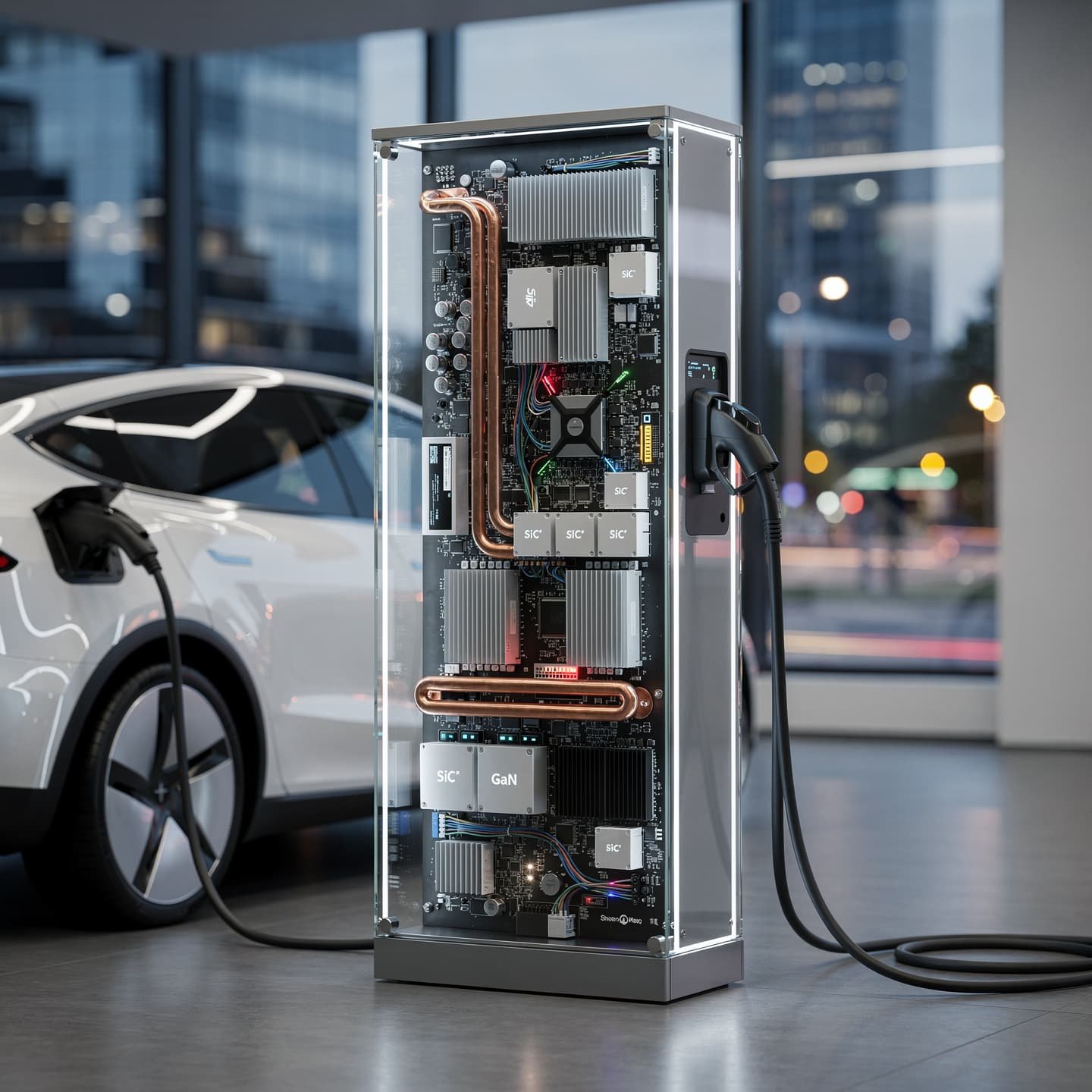
is an advanced program designed to train specialists capable of conceiving, designing, simulating, and validating power electronic converters based on SiC and GaN for e-mobility: traction inverters, DC-DC converters, on-board chargers, DC fast chargers, and electric vehicle auxiliary systems. Throughout the master’s program, you will work in depth with power electronics, wide-bandgap devices (SiC/GaN), modern converter topologies, digital control, thermal management, EMC/EMI, functional safety, and specific electric vehicle regulations. The goal is for you to be able to take on real responsibilities in industrial e-mobility projects, where the efficiency, power density, and reliability of SiC/GaN power electronics make the difference.
Master’s Degree in SiC/GaN Power Electronics for e-Mobility
- Format:
- Duration:
- Time: 1900 H
- Practices: Consult
- Language:
- Credits:
- Registration date: 08-10-2026
- Start date: 02-12-2026
- Available places: 2
6,300 $
Skills and results
What you will learn
You will understand the fundamentals of power electronics applied to e-mobility: energy conversion, switching, losses, efficiency, filter and magnetics design. You will see how an electric vehicle system is structured from an energy standpoint (grid–charger–battery–DC-DC converter–traction inverter–electric machine) and why SiC/GaN power electronics has become key to achieving more power, less weight, and greater range. You will learn to read schematics, datasheets, and power diagrams with engineering judgment.
You will master the properties of SiC and GaN power devices compared to traditional silicon devices: wider bandgap, breakdown voltage, switching speed, Rds(on) resistance, switching/conduction losses, and thermal behavior. You will study SiC MOSFETs, SiC diodes, and GaN transistors, understanding how to choose the appropriate component for each power electronics converter in e-mobility. You will see how SiC/GaN devices enable higher switching frequencies, reduce magnetic component sizes, and improve the efficiency of traction inverters and DC-DC converters.
You will delve into the power electronics converter topologies used in electric vehicles: AC-DC converters for chargers, isolated and non-isolated DC-DC converters, DC-AC inverters for traction, bidirectional converters for V2G, and auxiliary systems. You will study half-bridge, full-bridge, NPC, T-type, resonant, LLC, interleaved, etc., analyzing advantages, disadvantages, and how they benefit from SiC and GaN devices. The master’s will allow you to relate each power electronics topology with a specific e-mobility application.
You will learn to design and analyze traction inverters for electric vehicles based on SiC/GaN power electronics. You will see how the DC-link–inverter–machine chain is defined, how voltages and currents are selected, how modulation strategies (PWM, SVPWM, high-frequency modulation) are proposed, and how protection and diagnostic functions are integrated. You will understand how SiC and GaN devices impact power density, high-RPM performance, cooling, and the overall e-mobility powertrain architecture.
You will specialize in on-board chargers and DC fast chargers for electric vehicles, studying their power electronics architecture, sectioning, galvanic isolation, power factor correction, communication interfaces, and grid requirements. You will see how SiC/GaN power electronics enables more compact and efficient chargers, both in the vehicle and in the infrastructure. You will learn to design high-power AC-DC and DC-DC converters for e-mobility, ensuring efficiency, waveform quality, and electromagnetic compatibility.
You will develop competencies in digital control of power electronics converters: small-signal modeling, control loop design, implementation in DSP/MCU/FPGAs, protection and supervision strategies. You will work with DC-DC converter, traction inverter, and charger models in simulation environments and learn to go from simulation to actual firmware. You will understand how the characteristics of SiC/GaN (speed, dv/dt) influence control strategies and gate driver design.
Who this program is for:
Master’s Degree in SiC/GaN Power Electronics for e-Mobility
The Master’s in SiC/GaN Power Electronics for e-Mobility is aimed at engineers and technicians in electronics, electrical engineering, automotive, industrial, or telecommunications, as well as advanced students in these fields who wish to specialize in power electronics applied to electric vehicles and e-mobility. It is also very valuable for professionals who already work on converters, traction inverters, on-board chargers, or DC-DC converters and wish to make the leap to SiC and GaN technologies. It is recommended to have a background in analog electronics, power systems and control, and some familiarity with circuit simulation. The ideal profile is someone who wants to move from a general electronics level to become a specialist in SiC/GaN power electronics for e-mobility.
SEIUM presents this master’s program as a direct response to the real need for engineers specialized in power electronics and SiC/GaN technologies within the transition toward e-mobility. While other programs address the electric vehicle in a general way, here the focus is on what enables the entire system: the power electronics converters that connect the grid, batteries, traction inverters, and auxiliary systems. The curriculum combines solid theory with applied projects on traction inverters, DC-DC converters, and chargers for electric vehicles, always featuring SiC and GaN devices as the centerpiece. The online format allows the master’s to be combined with professional life, incorporating real cases and company documentation. The goal is that graduates not only understand SiC/GaN power electronics, but can also lead concrete e-mobility projects from specification to validation.
1.1 Basic concepts of power conversion in direct and alternating current
1.2 Types of converters in an electric vehicle system
1.3 Key parameters: voltage, current, power, efficiency, and power density
1.4 Switching, waveforms, and harmonics in power electronics
1.5 Magnetics: inductors, transformers, and filters in e-mobility
1.6 Losses in semiconductors and magnetics
1.7 Typical energy architecture of an electric vehicle
1.8 Introduction to the role of SiC and GaN in e-mobility
1.9 Basic power electronics simulation tools
1.10 Review of real-world converter cases in e-mobility
2.1 Properties of wide bandgap materials: SiC and GaN
2.2 SiC MOSFET: characteristics, models, and applications
2.3 SiC diodes: use in AC-DC and DC-DC converters
2.4 GaN transistors: HEMT and enhancement-mode devices
2.5 Comparison of Si vs SiC vs GaN in power electronics
2.6 Device selection for traction inverters and DC-DC converters
2.7 Gate drivers specific to SiC/GaN
2.8 Management of dv/dt and di/dt with high-speed devices
2.9 Simplified SPICE modeling of SiC/GaN devices
2.10 Examples of commercial families of SiC/GaN devices for e-mobility
3.1 Classification of AC-DC, DC-DC, and DC-AC converters
3.2 Half-bridge, full-bridge, and multiport topologies
3.3 Resonant and quasi-resonant topologies with SiC/GaN
3.4 Interleaved converters for high power
3.5 Bidirectional converters for V2G and storage
3.6 Topology selection criteria based on e-mobility requirements
3.7 PFC integration in electric vehicle chargers
3.8 Examples of traction inverter topologies for electric vehicle
3.9 Comparative study of losses and efficiency with SiC/GaN devices
3.10 Topology documentation and preliminary design
4.1 Typical architecture of a traction inverter
4.2 Sizing of the DC bus and inverter based on the motor
4.3 PWM and SVPWM modulation in power electronics
4.4 Integration of SiC/GaN devices in traction inverters
4.5 Phase current management and overcurrent limiting
4.6 Protections: overtemperature, overcurrent, and overvoltage
4.7 Integration of the inverter with the cooling system
4.8 Inverter–machine–BMS interaction in e-mobility
4.9 Analysis of fault cases and safe modes
4.10 Example of conceptual design of a SiC/GaN traction inverter
5.1 Arquitectura de cargadores AC-DC embarcados (OBC)
5.2 Cargadores rápidos DC y su electrónica de potencia
5.3 Corrección del factor de potencia (PFC) con SiC y GaN
5.4 Topologías aisladas para cargadores de alta tensión
5.5 Requisitos de red y calidad de energía
5.6 Aislamiento galvánico y seguridad eléctrica en cargadores de vehículo eléctrico
5.7 Eficiencia, densidad de potencia y refrigeración en cargadores
5.8 Comunicación con el BMS y protocolos de carga
5.9 Ejemplos de arquitecturas comerciales de cargadores para e-mobility
5.10 Tendencias futuras en cargadores SiC/GaN
6.1 Function of DC-DC converters in e-mobility
6.2 Isolated and non-isolated DC-DC topologies with SiC/GaN
6.3 Connection to the battery and high-voltage system
6.4 Converter–BMS–auxiliary loads coordination
6.5 Protection and HV disconnection strategies
6.6 Impact of power electronics on battery life
6.7 Auxiliary converters for 12/24/48 V services
6.8 Design of bidirectional DC-DC converters for e-mobility
6.9 Loss and efficiency study in DC-DC converters
6.10 Practical cases of DC-DC for electric vehicle
7.1 Modeling of converters for control design
7.2 Closed-loop control for DC-DC and AC-DC converters
7.3 Basic vector control applied to traction inverters
7.4 Implementation in DSP/MCU/FPGAs of power controllers
7.5 Protection management from firmware
7.6 Startup, shutdown, and fault management techniques
7.7 Verification of control strategies in HIL/SIL simulation
7.8 Optimization of control parameters for SiC/GaN
7.9 Control software documentation for automotive
7.10 Good practices for power firmware development in e-mobility
8.1 PCB design for high currents and high dv/dt
8.2 Current loops, parasitic inductances, and critical layout
8.3 Thermal management: heat sinks, TIM materials, and liquid/air cooling
8.4 Calculation and verification of temperatures in power modules
8.5 Fundamentals of EMC/EMI in power electronics
8.6 Input and output filtering for e-mobility converters
8.7 Shielding and grounding techniques
8.8 Basic electromagnetic compatibility tests
8.9 Robust design against noise for sensors and control
8.10 Hardware design documentation for certification
9.1 Automotive requirements applicable to power electronics
9.2 Basic concepts of functional safety (ISO 26262)
9.3 Isolation, creepage distances, and dielectric strength
9.4 Type tests for e-mobility converters
9.5 Reliability, thermal cycles, and lifetime of SiC/GaN modules
9.6 Failure mode analysis and mitigations
9.7 Technical documentation and component traceability
9.8 Coordination with systems, software, and homologation teams
9.9 Impact of regulations on converter design
9.10 Regulatory trends in e-mobility and power electronics
10.1 Overall view of the power system in an electric vehicle
10.2 Integration of inverter–DC-DC–charger–battery
10.3 System-level energy strategies for e-mobility
10.4 Coordination between power control and thermal management
10.5 Case selection for the final project
10.6 Definition of requirements and technical specifications
10.7 Development of preliminary design and key simulations
10.8 Conceptual validation and test plan
10.9 Preparation of the technical dossier of the final project
10.10 Presentation, defense, and professional projection
The methodology of the Master’s in SiC/GaN Power Electronics for e-Mobility combines live online classes, on-demand content, simulation exercises, real case studies, and applied projects. You will work with technical spreadsheets, circuit simulation (SPICE-type environments), and system modeling tools (MATLAB/Simulink-type or equivalent) to analyze power electronics converters, traction inverters, and electric vehicle chargers. The “laboratory” is conceived as a virtual environment where you will configure topologies, select SiC/GaN devices, adjust control parameters, and analyze losses, efficiency, thermal behavior, and EMC. Whenever possible, real examples of boards and e-mobility designs will be used, so that what is learned can be immediately transferred to the professional environment.
Capstone-type projects
SiC/GaN traction inverter
You will develop the concept of a traction inverter based on SiC/GaN power electronics, defining voltages, currents, filters, protections, and modulation strategies, with simulations illustrating its behavior.
SiC/GaN traction inverter
You will develop the concept of a traction inverter based on SiC/GaN power electronics, defining voltages, currents, filters, protections, and modulation strategies, with simulations illustrating its behavior.
On-board charger architecture
You will propose the architecture of an on-board charger for an electric vehicle, selecting AC-DC and DC-DC topologies, studying PFC, isolation, efficiency, and the main grid and battery requirements.
EMC and thermal in a power module
You will analyze a design of a power electronics module (real or proposed), identifying EMC/EMI risks and critical thermal management points, and propose improvements in layout, filtering, and cooling.
Integrating power system project for e-Mobility
As a culminating activity, you will develop a global project that combines several blocks (DC-DC converter, traction inverter, charger), integrating power electronics, SiC/GaN devices, control, thermal management, and regulations into a professional dossier ready for your portfolio.
Admissions, fees and scholarships
The Master’s in SiC/GaN Power Electronics for e-Mobility is aimed at profiles with a technical background in electronics or electrical engineering who want to steer their careers toward power electronics and e-mobility. It is recommended to have studies in electronic engineering, electrical engineering, automotive, industrial, or similar, or professional experience in power supply design, converters, inverters, or power systems. The admission process may include a review of the CV and a motivation letter, and in some cases an interview, to ensure that the candidate has the necessary background to tackle SiC/GaN power electronics. SEIUM may offer scholarships and financial aid for working professionals, students with outstanding academic records, and international candidates, as well as tailored installment payment plans, facilitating access to high-level training in e-mobility.
Do you have any questions?
Our team is ready to help you. Contact us and we’ll get back to you as soon as possible.
F. A. Q
Frequently Asked Questions
It is highly recommended to have previously seen basic concepts of power electronics (rectifiers, DC-DC converters, inverters). The master’s reviews the fundamentals, but advances quickly toward SiC/GaN devices and applications in e-mobility. With a background in general power electronics and a willingness to work, you will be able to follow the program.
The main focus is the electric vehicle passenger car, but the concepts and projects of SiC/GaN power electronics are applicable to buses, industrial vehicles, electric machinery, and other e-mobility applications that share similar power architectures.
The master’s focuses on the design and simulation of power electronics for e-mobility, using calculation and simulation tools. Whenever possible, real hardware examples and reference designs of inverters, DC-DC converters, and chargers are reviewed, but the practical work is mainly based on models and technical documentation.
SPICE-type environments for power electronics circuits and system modeling tools (for example, environments similar to MATLAB/Simulink) are used. It is not mandatory to know them in advance; during the master’s program, workflows adapted to the design of SiC/GaN converters for e-mobility are proposed.
Yes. The projects are designed so that you can showcase conceptual designs of DC-DC converters, traction inverters, on-board chargers, and thermal/EMC analysis, all within the context of SiC/GaN power electronics for e-mobility. They are very valuable pieces in selection processes.