Kinematics & Compliance Engineering and Advanced 7-Post Rig
About our Kinematics & Compliance Engineering and Advanced 7-Post Rig
Advanced Kinematics & Compliance (K&C) and 7-Post Rig Engineering
constitutes a fundamental pillar in dynamic and structural evaluation within aerodynamics, aeroelasticity, and flight dynamics applied to rotorcraft and eVTOL platforms. This approach integrates advanced models of flexible kinematics and variable stiffness to simulate the interaction between mechanical systems and structures, leveraging tools such as CFD, HIL/SIL simulators, and modal analysis techniques. The synergy with certification methodologies according to ARP4754A and ARP4761 ensures robustness in critical design and validation phases, essential for the development of AFCS/FBW systems in environments subject to EASA CS-27/29 and FAA Part 27/29 regulations.
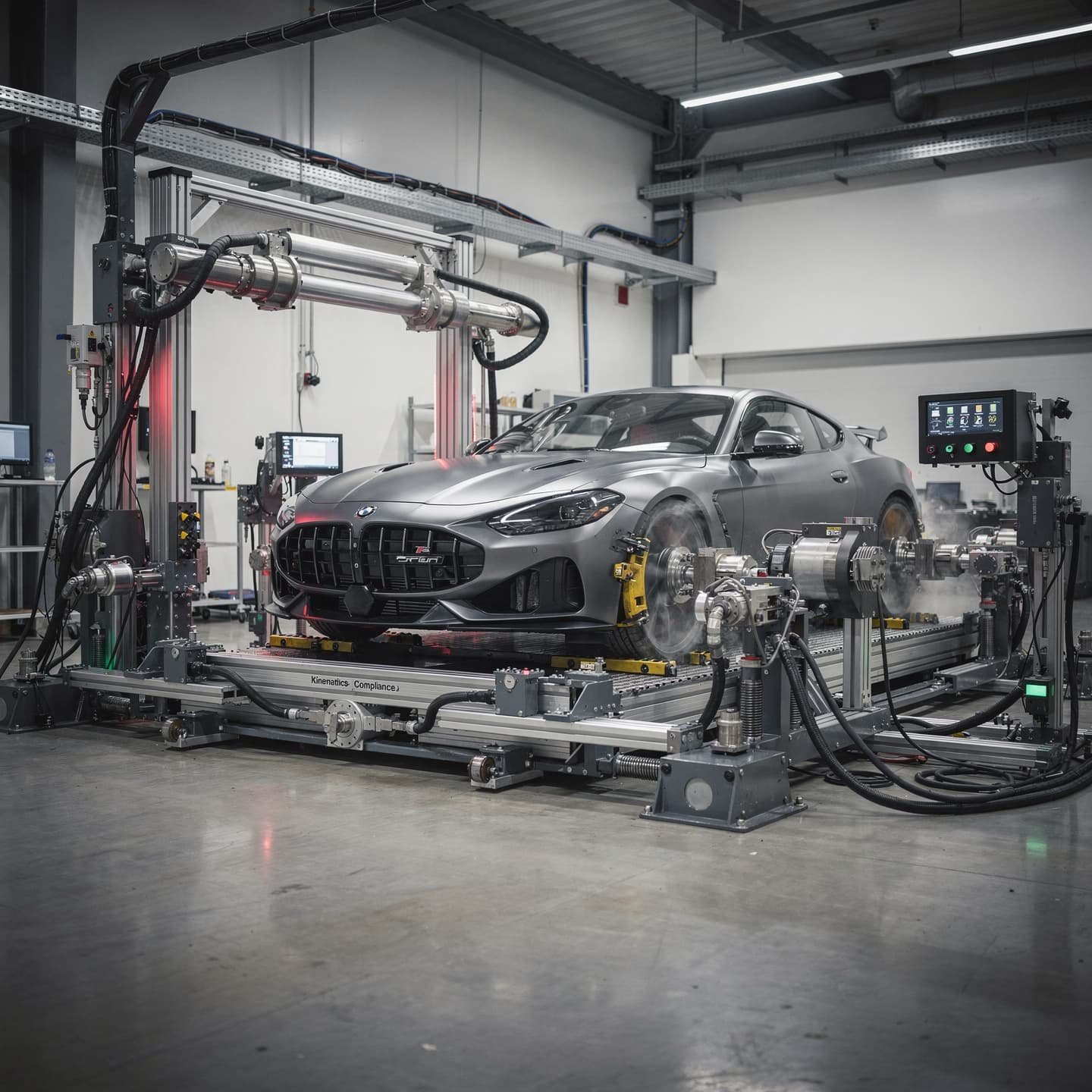
The laboratory equipped with an advanced 7-post rig facilitates the accurate replication of dynamic and vibrational conditions, enabling strength, fatigue, and acoustic analysis tests under standards such as DO-160 for environmental testing and DO-178C for critical control software. Data acquisition and traceability processes comply with international standards, promoting operational safety and regulatory certification. This specialization is in high demand for roles such as structural dynamics engineer, validation specialist, flight control engineer, vibration analyst, and aeronautical certification technician.
Kinematics & Compliance Engineering and Advanced 7-Post Rig
- Format:
- Duration:
- Time: 1900 H
- Practices: Consult
- Language:
- Credits:
- Registration date: 08-10-2026
- Start date: 02-12-2026
- Available places: 2
2,000 $
Skills and results
What you will learn
- Analyze flap–lag–torsion couplings, whirl flutter, and fatigue.
- Size laminates in composites, joints, and bonded joints with FE.
- Implement damage tolerance and NDT (UT/RT/thermography).
2. Expert Evaluation of Kinematics & Compliance (K&C) and 7-Post Rig: In-depth Analysis and Advanced Applications
- Analyze flap–lag–torsion couplings, whirl flutter, and fatigue.
- Size laminates in composites, joints, and bonded joints with FE and validation on the 7-Post Rig.
- Implement damage tolerance and NDT (UT/RT/thermography) for structural integrity in Kinematics & Compliance scenarios and testing with the 7-Post Rig.
3. Comprehensive user-oriented design and validation (from modeling to manufacturing)
You will learn to integrate the entire product development process, from model conception to final validation, applying user-centered methodologies. You will develop competencies in parametric design, ergonomics, simulation, sustainable materials, 3D visualization, and manufacturing management, ensuring efficient, safe solutions aligned with current industry standards.
4. Analysis and Advanced Application of Kinematics & Compliance (K&C) and 7-Post Rig in Naval Engineering
- Analyze flap–lag–torsion couplings, whirl flutter, and fatigue in K&C systems and 7-Post Rig configurations for naval engineering.
- Size laminates in composites, joints, and bonded joints with FE for K&C and 7-Post Rig applications.
- Implement damage tolerance and NDT (UT/RT/thermography) in bench testing and K&C analysis for 7-Post Rig simulation.
5. Specialization in Kinematics & Compliance (K&C) and 7-Post Rig: Naval Design and Analysis
- Analyze flap–lag–torsion couplings, whirl flutter, and fatigue.
- Size Kinematics & Compliance models and 7-Post Rig components with FE, including modal analysis, load assignment, and experimental validation.
- Implement damage tolerance and NDT (UT/RT/thermography).
6. Naval Design Optimization: K&C and Advanced 7-Post Rig
- Analyze flap–lag–torsion couplings, whirl flutter, and fatigue.
- Size laminates in composites, joints, and bonded joints with FE.
- Implement damage tolerance and NDT (UT/RT/thermography).
Who this program is for:
Kinematics & Compliance Engineering and Advanced 7-Post Rig
- Graduates in Aerospace Engineering, Mechanical, Industrial, Automation, or related fields.
- Professionals from rotorcraft/eVTOL OEMs, MRO, consulting, technology centers.
- Flight Test, certification, avionics, control, and dynamics professionals seeking specialization.
- Regulators/authorities and profiles in UAM/eVTOL requiring competencies in compliance.
Recommended requirements: background in aerodynamics, control, and structures; ES/EN B2+/C1. We offer bridging tracks if you need them.
- Standards-driven curriculum: you will work with CS-27/CS-29, DO-160, DO-178C/DO-254, ARP4754A/ARP4761, ADS-33E-PRF from the very first module.
- Accreditable laboratories (EN ISO/IEC 17025) with rotor test bench, EMC/Lightning pre-compliance, HIL/SIL, vibration/acoustics.
- TFM oriented to evidence: safety case, test plan, compliance dossier, and operational limits.
- Industry mentoring: instructors with experience in rotorcraft, tiltrotor, eVTOL/UAM, and flight test.
- Flexible modality (hybrid/online), international cohorts, and support from SEIUM Career Services.
- Ethics and safety: safety-by-design approach, cyber-OT, DIH, and compliance as pillars.
1.1 Definition and scope of K&C in naval engineering
1.2 7-Post Rig: structure and function in kinematics testing
1.3 Concepts of kinematics and compliance for vessels
1.4 Fundamentals of simulation for K&C: platforms and meshes
1.5 Instrumentation, sensors, and data acquisition in K&C tests
1.6 Experimental planning: boundary conditions and excitations
1.7 Initial modeling of stiffness and structural response
1.8 Initial model validation: criteria and metrics
1.9 Safety and regulations applicable to K&C testing
1.10 Introductory cases: naval examples of K&C with 7-Post Rig
2.1 Introduction to K&C and the 7-Post Rig: definitions, scope, and relevance in naval engineering
2.2 Fundamentals of Kinematics & Compliance (K&C): motion, constraints, and regulatory compliance
2.3 Architecture of the 7-Post Rig: configuration, axes, actuators, and sensors
2.4 Modeling and simulation: dynamics, stiffness, and responses for naval testing
2.5 Data acquisition and calibration: quality, noise, synchronization, and traceability
2.6 Performance metrics in K&C: accuracy, repeatability, stability, and robustness
2.7 Mathematical models and simulation techniques for K&C: linear and nonlinear approaches
2.8 MBSE/PLM integration: requirements management, changes, and documentation in naval K&C projects
2.9 Safety, regulations, and certifications applicable to K&C and 7-Post Rig in marine environments
2.10 Case study: planning a K&C test campaign with 7-Post Rig on a vessel
3.1 Introduction to K&C and 7-Post Simulation: fundamentals, scope, and course objectives
3.2 Basic configuration of 7-Post simulation: rig, nodes, and coupling
3.3 Kinematics & Compliance (K&C) modeling: motion laws and constraints
3.4 Data processing techniques and results visualization
3.5 Performance metrics and success criteria in K&C
3.6 Hardware and software requirements for naval simulations
3.7 Requirements management and MBSE for K&C projects
3.8 Safety and compliance standards in naval simulation
3.9 Initial case studies: hull and propulsion exercises
3.10 Practical workshop: launching a K&C 7-Post project
4.1 Principles of Kinematics & Compliance (K&C) and 7-Post Rig: fundamentals, scope, and objectives
4.2 Configuration of the 7-Post Rig: architecture, axes, actuators, and motion ranges
4.3 Kinematic and compliance modeling: equations, constraints, and parameters
4.4 Instrumentation and data acquisition: sensors, calibration, and synchronization
4.5 Simulation workflows for K&C: tools, models, and methodologies
4.6 Validation methods: comparison between simulation and testing, accuracy criteria
4.7 Uncertainty and sensitivity analysis in K&C and 7-Post Rig
4.8 Naval applications of K&C: dynamics, vibration, and structural coupling
4.9 Data management and MBSE/PLM for K&C: traceability, requirements, and change control
4.10 Case study: design, simulation, and evaluation of a K&C/7-Post Rig configuration
5.1 Introduction to Kinematics & Compliance (K&C) and Advanced 7-Post Rig: objectives and scope
5.2 Fundamentals of K&C: kinematics, compliance, and design constraints
5.3 Architecture of the 7-Post Rig: structure, actuators, and sensors
5.4 Dynamic modeling: equations of motion and boundary conditions
5.5 K&C integration with multibody simulation: interfaces and data flow
5.6 Preparation of test scenarios: static and dynamic loading
5.7 Initial calibration and validation: methods and procedures
5.8 Data collection and management: quality, filtering, and traceability
5.9 Performance metrics and acceptance criteria: stiffness, damping, response
5.10 Safety, regulations, and best practices in navigation and simulation
6.1 Introduction to Kinematics & Compliance (K&C) and 7-Post Rig: Fundamentals
6.2 Definition of Kinematics, Compliance, and their role in naval simulation
6.3 Architecture of the 7-Post Rig: actuators, topology, and sensors
6.4 Kinematics and dynamics: key concepts of motion, velocities, and accelerations
6.5 Compliance and structural responses: stiffness, elasticity, and operational limits
6.6 Instrumentation and data acquisition: sensors, calibration, and synchronization
6.7 Mathematical modeling: equations of motion, constraints, and transformations
6.8 Simulation principles: numerical integration, stability, and verification
6.9 Testing protocol and data quality: experiment design and variable control
6.10 Case study: proof-of-concept test plan with K&C and 7-Post Rig
7.1 Kinematics & Compliance (K&C): concepts, scope, and objectives
7.2 7-Post Rig: configuration, architecture, and simulation scenarios
7.3 K&C interactions with naval engineering: loads, limits, and responses
7.4 Modeling of actuators, sensors, and feedback in K&C
7.5 Equations of motion and constraint handling in 7-Post Rig
7.6 Numerical methods and solutions for K&C and 7-Post Rig simulation
7.7 Calibration, verification, and validation of K&C models
7.8 Performance metrics: accuracy, stability, convergence, and robustness
7.9 Safety requirements, naval regulatory compliance, and standards
7.10 Case study: initial design and analysis of K&C with 7-Post Rig
8.1 Introduction to Kinematics & Compliance (K&C) and 7-Post Rig: fundamentals and scope
8.2 Architecture of the 7-Post Rig: posts, actuators, and sensors
8.3 Concepts of kinematics and compliance in naval engineering
8.4 Geometric modeling of the 7-Post Rig system and motion constraints
8.5 Principles of control and rig dynamics for simulation
8.6 Instrumentation and data collection for K&C
8.7 Preparation of test scenarios and load profiles
8.8 Validation methods: comparison between simulation and testing
8.9 Safety, regulations, and risk management in K&C testing
8.10 Learning tools and competency assessment in K&C
9.1 Fundamentals of Kinematics & Compliance (K&C) in Naval Engineering
9.2 Introduction to the 7-Post Rig: Concepts and Operation
9.3 Importance of mastering K&C and 7-Post Rig in naval design
9.4 Basic principles of advanced simulation applied to K&C
9.5 Tools and equipment for Kinematics & Compliance testing
9.6 Initial applications and use cases in naval engineering
9.7 Integration of theoretical and experimental models in K&C and 7-Post Rig
9.8 Requirements and best practices in the use of advanced simulation equipment
9.9 Common challenges and solutions in diagnosing structural behavior
9.10 Initial evaluation of efficiency and accuracy in K&C analysis
10.1 Fundamentals of Kinematics & Compliance (K&C) and its application in 7-Post Rig for naval engineering and structural performance
10.2 Configuration of the 7-Post Rig: actuators, sensors, and alignment references
10.3 Dynamic modeling of K&C in vessels: kinematics, stiffness, and compliance limits
10.4 Interaction with environmental conditions: effects of wind, waves, and current on K&C and testing
10.5 Calibration and validation of the K&C system: techniques, traceability, and performance metrics
10.6 Data acquisition and processing: sensors, sampling, filtering, and noise reduction
10.7 Uncertainty analysis: error handling, tolerances, and robustness of results
10.8 Experimental design for 7-Post Rig: test plans, replicability, and variable control
10.9 Data analysis and extraction of K&C parameters: comparison with models and calibration
10.10 Use cases in naval engineering: design, performance, safety, and decision-making
- Hands-on methodology: test-before-you-trust, design reviews, failure analysis, compliance evidence.
- Software (according to licenses/partners): MATLAB/Simulink, Python (NumPy/SciPy), OpenVSP, SU2/OpenFOAM, Nastran/Abaqus, AMESim/Modelica, acoustics tools, DO-178C planning toolchains.
- SEIUM Laboratories: scale rotor test bench, vibration/acoustics, EMC/Lightning pre-compliance, HIL/SIL for AFCS, data acquisition with strain gauging.
- Standards and compliance: EN 9100, 17025, ISO 27001, GDPR.
Capstone-type projects
- K&C and 7-Post Rig: simulation and validation.
- K&C Optimization: performance and metrics.
- K&C Analysis with 7-Post Rig: naval.
- Naval Design with K&C: performance.
DO-160: environmental test plan and mitigation.
- K&C and 7-Post Rig: simulation and validation.
- K&C Optimization: performance and metrics.
- K&C Analysis with 7-Post Rig: naval.
- Naval Design with K&C: performance.
DO-160: environmental test plan and mitigation.
- Blade optimization: BEMT+CFD; bench/tunnel; BVI acoustics.
- AFCS/SCAS: hover/attitude hold, envelope protection, SIL/HIL.
- Tiltrotor conversion control: establishment of conversion corridor and margins.
- Aeroelasticity: modal analysis and whirl flutter; flutter clearance; mitigations.
DO-160: environmental test plan (vibration, temperature, EMI, lightning/HIRF) and mitigation.
- Blade optimization: BEMT+CFD; bench/tunnel; BVI acoustics.
- AFCS/SCAS: hover/attitude hold, envelope protection, SIL/HIL.
- Tiltrotor conversion control: establishment of conversion corridor and margins.
- Aeroelasticity: modal analysis and whirl flutter; flutter clearance; mitigations.
DO-160: environmental test plan (vibration, temperature, EMI, lightning/HIRF) and mitigation.
- K&C Optimization: 7-Post; CFD/FEA.
- K&C Evaluation: sensitivity; SIL/HIL.
- Implementation: testing; calibration.
- Naval Application: K&C/7-Post design.
DO-160: environmental tests and mitigation.
Admissions, fees and scholarships
- Profile: Background in Computer Engineering, Mathematics, Statistics, or related fields; practical experience in NLP and information retrieval systems is valued.
- Documentation: Updated CV, academic transcripts, SOP/purpose essay, project or code samples (optional).
- Process: application → technical profile and experience evaluation → technical interview → practical case review → final decision → enrollment.
- Fees:
- Single payment: 10% discount.
- 3-installment payment: no fees; 30% upon enrollment + 2 equal monthly payments of the remaining 35%.
- Monthly payment: available with a 7% fee on the total; annual review.
- Scholarships: based on academic merit, financial situation, and promotion of inclusion; agreements with industry companies for partial or full scholarships.
Check “Calendar & calls”, “Scholarships & financial aid”, and “Fees & financing” in the SEIUM mega-menu.
Do you have any questions?
Our team is ready to help you. Contact us and we’ll get back to you as soon as possible.
F. A. Q
Frequently Asked Questions
Yes, we hold international certification.
Yes: experimental models, real data, applied simulations, professional environments, real case studies.
It is not mandatory. We offer leveling tracks and tutoring.
Completely. It covers e-propulsion, integration, and emerging regulations (SC-VTOL).
Recommended. There are also internal challenges and consortia.