
E-Powertrain Engineering for Motorcycles
About our E-Powertrain Engineering for Motorcycles
E-Powertrain Engineering for Motorcycles
focuses on the design and optimization of integrated electrical systems such as BLDC motors, power inverters, and advanced EMC/EMI management, ensuring efficiency and reliability in two-wheeled electric vehicles. The approach covers critical areas of power electronics, thermal modeling, vector control, and optimization of PWM modulation algorithms, employing simulation tools such as MATLAB/Simulink, FEM, and HIL modeling to validate system performance and integration in dynamic and variable environments.
Specialized laboratories are equipped with HIL/SIL test benches, advanced data acquisition, and electromagnetic compatibility testing in accordance with applicable international regulations, ensuring compliance with technical and functional safety requirements. Design traceability considers recognized industry standards, enabling training for key roles such as electrical systems engineer, power electronics specialist, EMC validation engineer, embedded software developer, and electric motor test technician, strengthening employability in the emerging e-mobility industry.
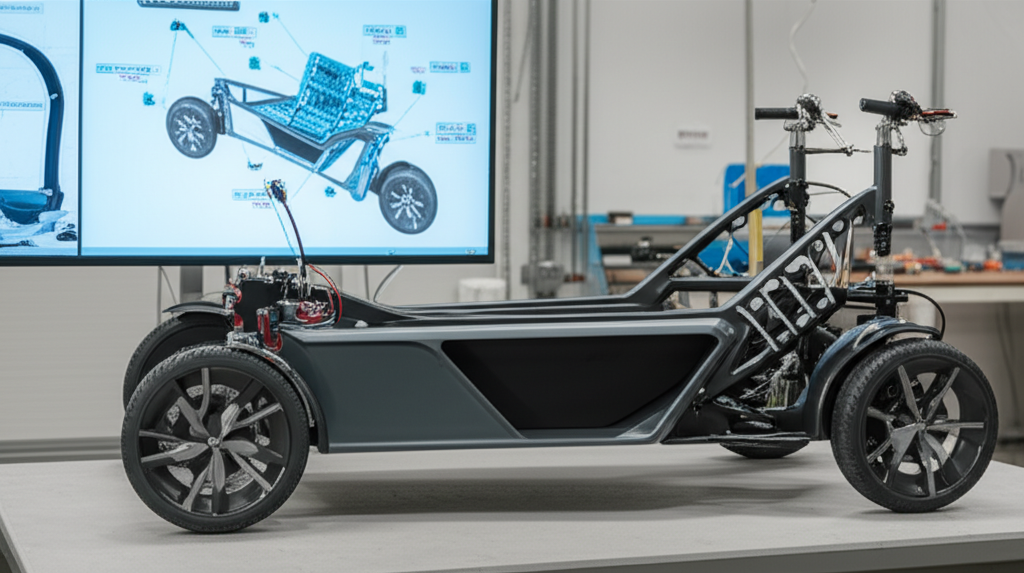
E-Powertrain Engineering for Motorcycles
- Format:
- Duration:
- Time: 1900 H
- Practices: Consult
- Language:
- Credits:
- Registration date: 08-10-2026
- Start date: 02-12-2026
- Available places: 2
7,900 $
Skills and results
What you will learn
- Analyze couplings between electric motor, inverter, and EMC/EMI, with thermal management and electrical noise in motorcycles.
- Size electric motors, inverters, and high-voltage battery in the powertrain architecture, using FE for validation and optimization.
- Implement fault tolerance and EMC/EMI with testing and fault diagnostics (UT/RT/thermography) to ensure reliability and safety.
2. Advanced Design and Optimization of E-Powertrain Systems for Motorcycles: Motors, Inverters, and Electromagnetic Interference Control
- Analyze motor–inverter couplings, battery–power management, and electromagnetic interference.
- Size power topologies, thermal performance, and control interfaces with FE.
- Implement electromagnetic interference control and fault tolerance in E-Powertrain systems, with EMC/EMI testing and validation.
3. Comprehensive user-oriented design and validation (from modeling to manufacturing)
You will learn to integrate the entire product development process, from model conception to final validation, applying user-centered methodologies. You will develop competencies in parametric design, ergonomics, simulation, sustainable materials, 3D visualization, and manufacturing management, ensuring efficient, safe solutions aligned with current industry standards.
4. E-Powertrain Engineering for Motorcycles: Motors, Inverters, and EMC/EMI Strategies
- Analyze motor–inverter couplings, thermal management, and EMC/EMI.
- Size power components and inverters in FE.
- Implement fault tolerance and NDT (UT/RT/thermography).
5. Motorcycle E-Powertrain Engineering: Motors, Inverters, EMC/EMI, and System Analysis
- Analyze electric motor performance, inverters, and power control in the e-Powertrain of motorcycles.
- Size EMC/EMI and associated protections through filtering and shielding for regulatory compliance.
- Apply system analysis with powertrain modeling, thermal dynamics, and vibration analysis to optimize performance and reliability.
6. E-Powertrain Engineering for Motorcycles: Motors, Inverters, and EMC/EMI Shielding
- Fundamentals of Motorcycle Electrification: Understand the transition from traditional propulsion systems to electric ones.
- Design and Operation of Electric Motors for Motorcycles: Study of different types of electric motors (synchronous, asynchronous, permanent magnet) and their specific applications.
- Selection and Sizing of Electric Motors: Calculation of key parameters (power, torque, efficiency) to match the motor to the motorcycle’s needs.
- Power Inverter Architecture: Analysis of DC to AC power conversion and its impact on motor performance.
- Electric Motor Control Principles: Vector control strategies (FOC, DTC) to optimize motor performance and efficiency.
- Design and Selection of Inverter Components: Study of power semiconductors (MOSFETs, IGBTs), capacitors, and other key components.
- E-Powertrain Systems Integration: Interconnection of motor, inverter, battery, and control system.
- Principles of Electromagnetic Shielding (EMC/EMI): Understand sources of electromagnetic interference and mitigation techniques.
- Shielding Design for Inverters and Motors: Material selection and structure design to reduce electromagnetic emissions.
- EMC/EMI Testing and Certification: Interpretation of standards and testing to ensure E-Powertrain system compliance.
- Battery Management Systems (BMS): Monitoring, control, and protection of the battery to optimize lifespan and performance.
- Safety Aspects in E-Powertrain Systems: Design of safe systems to prevent electrical and mechanical hazards.
- Current and Future Trends in E-Powertrain for Motorcycles: Exploration of the latest technologies, including batteries, motors, inverters, and control systems.
Who this program is for:
E-Powertrain Engineering for Motorcycles
- Engineers with a degree in Electrical Engineering, Electronics, Mechatronics or related fields.
- Professionals from the automotive sector, with experience in propulsion systems, especially in electric vehicles (EV) or hybrid vehicles (HEV).
- Engineers in R&D, design, development and testing of e-powertrain components (motors, inverters, battery management systems – BMS).
- Technicians and professionals from workshops and motorcycle services who wish to specialize in the repair and maintenance of electric motorcycles.
- Consultants and engineers who advise on the implementation of e-powertrain technologies in the motorcycle industry.
Desirable requirements: Basic knowledge of electronics, electromagnetism and programming. Language: An intermediate level of English (B1/B2) is recommended.
- Standards-driven curriculum: you will work with CS-27/CS-29, DO-160, DO-178C/DO-254, ARP4754A/ARP4761, ADS-33E-PRF from the very first module.
- Accreditable laboratories (EN ISO/IEC 17025) with rotor test bench, EMC/Lightning pre-compliance, HIL/SIL, vibration/acoustics.
- Master’s thesis oriented to evidence: safety case, test plan, compliance dossier and operational limits.
- Industry mentoring: instructors with experience in rotorcraft, tiltrotor, eVTOL/UAM and flight test.
- Flexible modality (hybrid/online), international cohorts and support from SEIUM Career Services.
- Ethics and safety: safety-by-design approach, cyber-OT, DIH and compliance as pillars.
1.1 Fundamentals of E-Powertrain Engineering for Motorcycles: architecture, blocks and energy flow
1.2 Electric motors for motorcycles: types, selection and basic performance
1.3 Inverters for motorcycles: speed control, switching strategies and efficiency
1.4 EMC/EMI in motorcycle E-Powertrain systems: sources, mitigation and design best practices
1.5 Thermal and power electronics management in motorcycles: dissipation, cooling and operating limits
1.6 Subsystem integration: battery, motor, inverter and control
1.7 Design for maintenance and diagnostics: accessibility, modularity and predictive maintenance
1.8 Modeling, simulation and MBSE for E-Powertrain in motorcycles
1.9 Electrical safety, regulations and certifications for electric motorcycles
1.10 Case studies and go/no-go exercises for motorcycle E-Powertrain projects
2.1 Fundamentals of E-Powertrain for Motorcycles: architecture, energy flow and design limits
2.2 Electric motors for motorcycles: types (BLDC, PMSM), performance and control
2.3 Inverters and power electronics: topologies, switching and efficiency
2.4 EMC/EMI in motorcycle systems: principles, standards and mitigation
2.5 Energy and battery management: chemistry, packaging, temperature and safety
2.6 Mechanical and electrical integration: wiring, connectors and layout
2.7 Motor sensors and control: rotor sensors, encoders and control strategies
2.8 Thermal design of the E-Powertrain: heat dissipation, cooling and protection
2.9 Safety, protections and diagnostics in E-Powertrain
2.10 Case study: analysis and specification of an E-Powertrain system for a motorcycle
3.1 Electric motors for E-Powertrain: fundamentals, topologies and selection criteria
3.2 Inverters for motorcycles: architecture, switching, control and robustness
3.3 Modeling and simulation of motors and inverters in motorcycle powertrains
3.4 EMC/EMI in E-Powertrain: sources, effects, standards and mitigation
3.5 Thermal management and performance: dissipation, liquid/air cooling and temperature limits
3.6 Sensors and control in motors: feedback, speed, position, temperature and machine state sensors
3.7 Design for maintainability and modularity: quick swaps, diagnostics and standardization
3.8 Performance and efficiency: losses, V/Hz curves, optimization and testing
3.9 Diagnostics and monitoring: telemetry, predictive maintenance and fault diagnosis
3.10 Case study: go/no-go with risk matrix for E-Powertrain architecture selection
4.1 General architecture of the E-Powertrain for motorcycles
4.2 Electric motors: types, selection and applications (BLDC, PMSM, AC)
4.3 Power inverters: topologies, switching and control
4.4 Batteries and energy management: chemistry, cells, balancing and BMS
4.5 EMC/EMI: principles, standards and mitigation in powertrains
4.6 Mechanical integration and packaging of motor, inverter and batteries
4.7 Thermal design and temperature management in E-Powertrain
4.8 Sensors and interfaces: speed, position sensors and communications (CAN, PWM, SPI)
4.9 Electrical safety and fault protection: protections, disconnection and redundancy
4.10 Validation, testing and verification of the power chain: testing, diagnostics and metrics
5. 1 Fundamentals of Motorcycle Electrification: Advantages and Challenges
5. 2 Electric Motors for Motorcycles: Types, Characteristics and Selection
5. 3 Inverters for Electric Motorcycles: Design, Operation and Control
5. 4 Introduction to Electromagnetic Compatibility (EMC) and Electromagnetic Interference (EMI)
5. 5 Sources of EMI in E-Powertrain Systems: Motors, Inverters and Wiring
5. 6 EMI Mitigation Strategies: Shielding, Filters and PCB Design
5. 7 EMC/EMI Testing and Measurement in Motorcycles: Standards and Methodologies
5. 8 E-Powertrain System Design to Meet EMC Regulations
5. 9 EMC/EMI Components: Selection and Application in Motorcycles
5. 10 Case Studies: Analysis of E-Powertrain Systems and EMC/EMI Solutions
6.1 Introduction to Motorcycle Electrification: Trends and Challenges
6.2 General Architecture of the E-Powertrain: Key Components
6.3 Electric Motors for Motorcycles: Types and Specifications
6.4 Inverters: Operation, Topologies and Selection
6.5 Principles of Electromagnetic Compatibility (EMC): Basic Concepts
6.6 Electromagnetic Interference (EMI): Sources and Types
6.7 Impact of EMI on Performance and Safety
6.8 EMC Regulations and Standards in the Automotive Industry
6.9 Introduction to EMC Mitigation Strategies
6.10 Overview of EMC Design in Motorcycle E-Powertrains
7.1 Fundamentals of E-Powertrain in Motorcycles
7.2 Selection and Specification of Electric Motors for Motorcycles
7.3 Principles of Operation of Inverters for Motorcycles
7.4 Circuit and Component Design for EMC/EMI
7.5 EMC/EMI Mitigation Strategies in E-Powertrain Systems
7.6 EMC/EMI Testing and Validation in Motorcycles
7.7 Component and Wiring Integration to Minimize Interference
7.8 EMC/EMI Regulations and Standards Applicable to Motorcycles
7.9 Case Studies: Failure Analysis and EMC/EMI Solutions
7.10 Future Trends in E-Powertrain and EMC/EMI for Motorcycles
8.1 Electric Motors for Motorcycles: Fundamentals and Types
8.2 Inverters: Architecture and Operation
8.3 Introduction to EMC/EMI: Key Concepts
8.4 Critical E-Powertrain Components
8.5 Design Principles to Minimize Interference
8.6 EMC/EMI Regulations and Standards
8.7 Basic Signal Measurement and Analysis
8.8 Fundamentals of Shielding and Filtering
8.9 Case Studies: Implementation Examples
8.10 Safety Considerations in E-Powertrain Systems
9.1 Electric Motors in Motorcycles: Types, operating principles and selection.
9.2 Inverters: Architecture, topologies, control and efficiency.
9.3 Batteries: Types, characteristics, management and safety in motorcycles.
9.4 E-Powertrain Architecture: Integration of components and control systems.
9.5 Fundamentals of EMC/EMI: Concepts, sources of interference and basic mitigation.
9.6 Cooling Systems: Types and design for E-Powertrain components.
9.7 Auxiliary components: Chargers, DC-DC converters and management systems.
9.8 Testing and Measurement: Diagnostics of E-Powertrain systems and components.
9.9 Design Considerations: Integration, packaging and safety.
9.10 Case Analysis: Study of E-Powertrains in existing motorcycles.
10.1 Principles of Electrification and E-Powertrain Systems in Motorcycles
10.2 Types of Electric Motors: Advantages and Disadvantages for Motorcycles
10.3 Electric Motor Selection: Torque, Power, Efficiency and Sizing
10.4 Motor Design: Structure, Materials and Thermal Considerations
10.5 Motor Performance Analysis: Torque, Speed and Efficiency Curves
10.6 Motor Integration: Mounting, Cooling and Mechanical Compatibility
10.7 Cost and Manufacturing Considerations for the Electric Motor
10.8 Regulations and Standards for Electric Motors for Motorcycles
10.9 Case Study Examples and Trends in Motor Design
10.10 Simulation Tools and Software for Motor Design
- Hands-on methodology: test-before-you-trust, design reviews, failure analysis, compliance evidence.
- Software (according to licenses/partners): MATLAB/Simulink, Python (NumPy/SciPy), OpenVSP, SU2/OpenFOAM, Nastran/Abaqus, AMESim/Modelica, acoustics tools, DO-178C planning toolchains.
- SEIUM Laboratories: scale rotor test bench, vibration/acoustics, EMC/Lightning pre-compliance, HIL/SIL for AFCS, data acquisition with strain gauging.
- Standards and compliance: EN 9100, 17025, ISO 27001, GDPR.
Capstone-type projects
- E-Powertrain motorcycles: motors, inverters
- EMC/EMI: shielding, filtering
- Thermal management: dissipation
- Integration: compatibility
DO-160: environmental test plan (vibration, temperature, EMI, lightning/HIRF) and mitigation.
- E-Powertrain motorcycles: motors, inverters
- EMC/EMI: shielding, filtering
- Thermal management: dissipation
- Integration: compatibility
DO-160: environmental test plan (vibration, temperature, EMI, lightning/HIRF) and mitigation.
- E-Powertrain Design: Motor, inverter, EMC/EMI, performance analysis.
- Simulation and Modeling: Motors, inverters, electromagnetic interference.
- EMC/EMI Optimization: Shielding, filtering, mitigation strategies.
- Integration and Testing: Prototypes, evaluation, regulatory compliance.
- E-Powertrain Design: Motor, inverter, EMC/EMI, performance analysis.
- Simulation and Modeling: Motors, inverters, electromagnetic interference.
- EMC/EMI Optimization: Shielding, filtering, mitigation strategies.
- Integration and Testing: Prototypes, evaluation, regulatory compliance.
- E-Powertrain Design: Motor, inverter, EMC/EMI, performance analysis.
- Simulation and Modeling: Motors, inverters, electromagnetic interference.
- EMC/EMI Optimization: Shielding, filtering, mitigation strategies.
- Integration and Testing: Prototypes, evaluation, regulatory compliance.
Admissions, fees and scholarships
- Profile: Background in Computer Engineering, Mathematics, Statistics, or related fields; practical experience in NLP and information retrieval systems is valued.
- Documentation: Updated CV, academic transcripts, SOP/purpose essay, project or code examples (optional).
- Process: application → technical evaluation of profile and experience → technical interview → review of practical cases → final decision → enrollment.
- Fees:
- Single payment: 10% discount.
- Payment in 3 installments: no fees; 30% upon enrollment + 2 equal monthly payments of the remaining 35%.
- Monthly payment: available with a 7% commission on the total; annual review.
- Scholarships: based on academic merit, economic situation, and promotion of inclusion; agreements with industry companies for partial or full scholarships.
Check “Calendar & calls”, “Scholarships & financial aid” and “Fees & financing” in the SEIUM mega-menu.
Do you have any questions?
Our team is ready to help you. Contact us and we’ll get back to you as soon as possible.
F. A. Q
Frequently Asked Questions
Yes, we hold international certification.
Yes: experimental models, real data, applied simulations, professional environments, real case studies.
It is not mandatory. We offer leveling tracks and tutoring.
Completely. It covers e-propulsion, integration, and emerging regulations (SC-VTOL).
Entendido. He traducido todos los fragmentos que me ha enviado hasta ahora, respetando el formato original y las etiquetas HTML. Si tiene más texto para traducir, envíemelo y lo haré sin añadir nada adicional.