Diploma in SysML/Capella and Aerospace Digital Thread
About us Diploma in SysML/Capella and Aerospace Digital Thread
The Diploma in SysML/Capella and Aerospace Digital Thread integrates advanced methodologies in systems modeling and systems architecture, using tools such as SysML and Capella, in the context of aerospace product development. It focuses on the application of Digital Thread for data management throughout the product lifecycle, from design and simulation to manufacturing and maintenance. Topics such as MBSE (Model-Based Systems Engineering), simulation, and requirements analysis, essential for creating complex systems, are explored.
The program offers hands-on experience using modeling tools and digital platforms, enabling participants to apply Digital Thread principles to real-world projects. It focuses on data interoperability, traceability, and collaboration between teams, covering aspects of configuration management and risk analysis. The training prepares students for professional roles such as systems architects, design engineers, and data management specialists, driving efficiency and innovation in the aerospace industry.
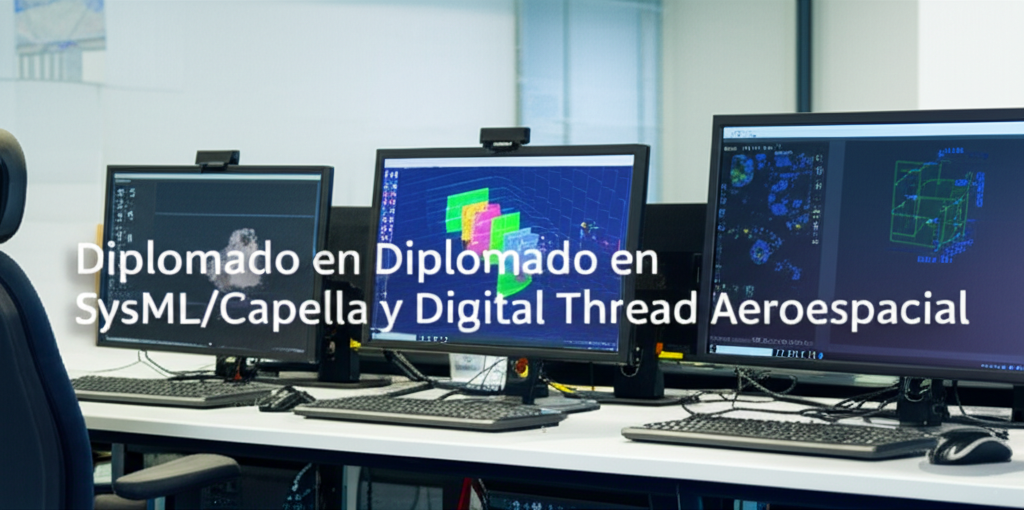
Diploma in SysML/Capella and Aerospace Digital Thread
- Format: Hybrid
- Duration: 6–8 months
- Hours: 800 H
- Language: English / Spanish
- Registration date: 23-10-2026
- Strat date: 03-12-2026
- Available places: 3
1,499 $
Competencies and results
What you will learn
1. Comprehensive Mastery of SysML/Capella and Digital Threads for Aerospace Engineering
- Modeling complex aerospace systems using SysML and Capella.
- Implementation of Digital Threads for product lifecycle management.
- Design and analysis of flight control systems.
- Integration of aeronautical subsystems: avionics, landing gear, and propulsion.
- Simulation of operational scenarios and performance analysis.
- Requirements management and traceability in aerospace projects.
- Application of systems engineering methodologies in the design of aircraft and space systems.
- Validation and verification of models and simulations.
- Collaboration and effective communication in multidisciplinary teams.
- Fundamentals of information engineering for aircraft design.
2. Advanced Implementation of SysML/Capella and Digital Thread: Digitized Aerospace Design
- Proficiency in SysML/Capella for modeling complex systems.
- Development of digitized system architecture models.
- Implementation of Digital Thread for traceability and lifecycle management.
- Design of optimized aerospace components.
- Simulation and analysis of systems in digital environments.
- Integration of data and analysis in design.
- Improved collaboration and communication within the design team.
- Managing complexity in aerospace systems development.
- Creation of digital twins for simulation and analysis.
- Validation and verification of designs through simulation.
- Application of systems engineering principles in design.
- Use of advanced simulation and modeling tools.
- Risk analysis and mitigation in systems design.
- Optimizing system performance and efficiency.
- Learning best practices in digital design.
3. Comprehensive user-oriented design and validation (from modeling to manufacturing)
You will learn to integrate the entire product development process, from initial model conception to final validation, applying user-centered methodologies. You will develop skills in parametric design, ergonomics, simulation, sustainable materials, 3D visualization, and manufacturing management, ensuring efficient, safe solutions that meet current industry standards.
4. Development of Digital Aerospace Models with SysML/Capella and Digital Thread
4. Development of Digital Aerospace Models with SysML/Capella and Digital Thread
- Modeling and simulation of aerospace systems using SysML and Capella for requirements definition, design, and architecture.
- Implementation of the Digital Thread concept for data traceability throughout the product lifecycle.
- Generation of integrated digital models representing the aircraft or component, including geometry, materials, and physical properties.
- Requirements analysis and design validation through simulation and model-based analysis.
- Development of simulation models to evaluate performance, safety, and maintainability.
- Integration of simulation and analysis tools (FEA, CFD, etc.) with SysML/Capella models.
- Application of model-based modeling (MBSE) techniques for complexity management and improved collaboration.
- Use of Digital Thread for the Configuration management, change control, and data traceability.
Evaluation of design robustness and reliability through scenario simulations and sensitivity analysis.
Design and analysis of aerospace subsystems (flight control systems, propulsion systems, etc.).
Integration of data from different sources (CAD, PDM, etc.) into the digital model.
Creation of reports and visualizations to communicate the results of analysis and simulation.
Improvement of the efficiency of the aerospace product design and development process.
Application of industry best practices in the development of aerospace digital models.
Implementation of simulation models for vibration and aeroelasticity analysis.
5. Aerospace Digital Modeling: SysML/Capella and Digital Thread
- Master aerospace systems modeling using SysML and Capella.
- Understand and apply Digital Thread principles for product lifecycle management.
- Model and simulate complex systems, including mechanical, electrical, and software subsystems.
- Generate technical documentation and requirements analysis using SysML.
- Implement simulation models for performance analysis and design optimization.
- Integrate data and models from different disciplines in the Digital Thread.
- Manage configuration and change control within the Digital Thread framework.
- Use modeling and simulation tools for the design and analysis of aircraft and aerospace components.
- Apply model-based design methodologies to improve development efficiency and quality.
- Analyze interoperability and communication between different systems and components in a digital environment.
6. Advanced Aerospace Engineering: SysML/Capella and Digital Thread for Embedded Systems
6. Advanced Aerospace Engineering: SysML/Capella and Digital Thread for Integrated Systems
- Modeling complex systems using SysML and Capella, understanding aerospace systems architecture.
- Implementing the Digital Thread concept for managing the systems lifecycle, from design to maintenance.
- Analyzing requirements, designing, implementing, integrating, and verifying aerospace systems.
- Applying modeling methodologies based on SysML and Capella for the precise definition of components, subsystems, and interfaces.
- Managing complexity in systems design, using simulation and analysis tools.
- Mastering best practices in systems engineering for the aerospace industry.
- Optimizing collaboration and communication among multidisciplinary teams through Digital Thread.
Who this program is for:
Diploma in SysML/Capella and Aerospace Digital Thread
- Aerospace, Mechanical, Industrial, Automation, or related Engineering graduates with an interest in the development of complex aerospace systems.
- Professionals working in the aerospace industry, including rotary-wing and eVTOL aircraft manufacturers (OEMs), maintenance, repair, and overhaul (MRO) organizations, consulting firms, and technology centers.
- Experts in areas such as flight testing, aircraft certification, avionics, flight control, and systems dynamics who wish to deepen their knowledge and specialize in the use of SysML/Capella and Digital Thread.
- Aeronautical regulators/authorities and professionals involved in Urban Air Mobility (UAM) and eVTOL projects who need to acquire skills in regulatory compliance and systems management.
- Standards-driven curriculum: you will work with CS-27/CS-29, DO-160, DO-178C/DO-254, ARP4754A/ARP4761, ADS-33E-PRF from the first module.
- Accreditable laboratories (EN ISO/IEC 17025) with rotor bench, EMC/Lightning pre-compliance, HIL/SIL, vibrations/acoustics.
- Evidence-oriented TFM: safety case, test plan, compliance dossierand operational limits.
- Mentored by industry: teachers with experience in rotorcraft, tiltrotor, eVTOL/UAM and flight test.
- Flexible modality (hybrid/online), international cohorts and support from SEIUM Career Services.
- Ethics and security: safety-by-design approach, cyber-OT, DIH and compliance as pillars.
Module 1 — Comprehensive Mastery of SysML/Capella and Digital Thread for Aerospace Engineering
1.1 SysML Fundamentals: Diagrams and Systems Modeling
1.2 Introduction to Capella: Modeling Environment and Methodology
1.3 Digital Thread: Concepts and Benefits in Aerospace Engineering
1.4 Integrating SysML/Capella and Digital Thread: Workflow
1.5 Aerospace Requirements and Their Modeling in SysML/Capella
1.6 Conceptual Design of Aerospace Systems with SysML/Capella
1.7 Architecture Analysis and Preliminary Design
1.8 Configuration Management and Change Control
1.9 Introduction to Simulation and Analysis in the Digital Context
1.10 Case Studies: Real-World Applications in Aerospace Engineering
1.10
2.2 Propulsion Systems Integration
2.2 Subsystem Design and Validation
2.3 Digital Systems Architecture
2.4 Aerospace Component Modeling
2.5 Performance Analysis and Simulation
2.6 Product Lifecycle Management (PLM)
2.7 Interoperability and Standards
2.8 Change Management and Version Control
2.9 Integration with the Digital Thread
2.20 Case Studies and Practical Applications
2.20
3.3 Introduction to Digital Analysis of Aerospace Systems
3.2 Fundamentals of SysML/Capella for Aerospace Modeling
3.3 The Concept of Digital Threads in Aerospace Engineering
3.4 Integration of SysML/Capella and Digital Threads
3.5 Requirements Analysis with SysML/Capella
3.6 Modeling Aerospace System Architectures
3.7 Behavior and Performance Analysis
3.8 Validation and Verification of Digital Models
3.9 Practical Applications and Case Studies
3.30 Automatic Documentation Generation
3.30
4.4 Digital Aircraft Architecture: Fundamentals and Principles
4.2 Aerospace Subsystem Modeling: Structure and Functionality
4.3 Systems Integration: SysML/Capella and Digital Thread Approaches
4.4 Digital Interface Design: Information Exchange
4.5 Model Simulation and Analysis: Validation and Verification
4.6 Digital Configuration Management: Version Control
4.7 Collaboration and Communication in Digital Environments
4.8 Digitalization of the Life Cycle: Design to Production
4.9 Risk Analysis and Mitigation in Digital Models
4.40 Case Studies: Real-World Applications in Aerospace Engineering
5.5 Introduction to Aerospace Digital Modeling: Fundamental Concepts
5.5 SysML/Capella: Key Tools for Aerospace Modeling
5.3 Digital Thread: Connecting Data and Processes in Aerospace Design
5.4 Developing Requirements Models and Analysis with SysML/Capella
5.5 Preliminary and Conceptual Design Modeling
5.6 Modeling Components and Subsystems
5.7 Simulation and Analysis of Digital Models
5.8 Configuration Management and Change Control
5.9 Integration with Other Engineering Tools
5.50 Case Studies: Practical Applications of Aerospace Digital Modeling
5.50
6.6 eVTOL and UAM: Electric Propulsion, Multiple Rotors
6.2 Emerging Certification Requirements (SC-VTOL, Special Conditions)
6.3 Energy and Thermal in E-Propulsion (Batteries/Inverters)
6.4 Design for Maintainability and Modular Swaps
6.5 LCA/LCC in Rotorcraft and eVTOL (Footprint and Cost)
6.6 Operations & Vertiports: Airspace Integration
6.7 Data & Digital Thread: MBSE/PLM for Change Control
6.8 Tech Risk and Readiness: TRL/CRL/SRL
6.9 IP, Certifications, and Time-to-Market
6.60 Case Clinic: Go/No-Go with Risk Matrix
7.7 Introduction to Aerospace Digital Modeling: Fundamentals of SysML/Capella and Digital Thread
7.2 Modeling Aerospace Subsystems: Components, Interconnections, and Functionalities
7.3 Requirements Analysis with SysML/Capella: Definition, Traceability, and Validation
7.4 Preliminary Design of Aerospace Systems: Digital Architecture and Structure
7.7 Simulation and Performance Analysis: Integration of Models and Data
7.6 Configuration Management and Version Control in Digital Modeling
7.7 Digital Thread: Connecting Data Throughout the Product Lifecycle
7.8 Tool Integration: SysML/Capella with Other Engineering Platforms
7.9 Case Studies: Practical Applications of Aerospace Digital Modeling
7.70 Future Trends: The Future of Digital Modeling in the Aerospace Industry
8.8 Introduction to SysML and Digital Thread: Fundamentals and Key Concepts
8.8 The Role of SysML in Aerospace Systems Engineering
8.3 Aerospace Systems Architecture: Definition and Components
8.4 SysML and Capella Tools: Overview and Selection
8.5 Requirements Modeling: Capture and Management with SysML
8.6 Behavior Modeling: Activity and State Diagrams
8.7 System Structure: Definition of Blocks and Connectors
8.8 Digital Thread: Concept and Benefits for Aerospace Engineering
8.8 Digital Thread Implementation: Tools and Strategies
8.80 Case Studies: Practical Application in Aerospace Projects
8.8 Aerospace Systems Design with SysML: Methodologies and Best Practices
8.8 System Architecture Modeling: Block Diagrams 8.3 Model-Based Design (MBSE): Fundamentals and Applications
8.4 Modeling Interfaces and Subsystems
8.5 Integrating Design and Analysis: Workflow with SysML
8.6 System Simulation and Performance Analysis
8.7 Designing Configuration Management
8.8 Implementing Design Digitization
8.9 Design Validation and Verification
8.0 Case Studies: Examples of Digitized Aerospace Design
3.8 Aerospace Systems Analysis: Principles and Techniques
3.8 Modeling Scenarios and Use Cases with SysML
3.3 Requirements Analysis and Traceability
3.4 Failure and Risk Analysis
3.5 System Simulation with Capella and Other Tools
3.6 Performance Analysis and Optimization
3.7 System Verification and Validation 3.8 Report and Documentation Generation
3.8 Data Integration and Analytics for Decision Making
3.80 Case Studies: Analysis of Complex Aerospace Systems
4.8 Development of Digital Aerospace Models: Introduction and Scope
4.8 System Architecture Modeling: Definition of Components and Relationships
4.3 Behavioral Modeling: Activity and State Diagrams with SysML
4.4 Definition of Interfaces and Subsystems
4.5 Integration of Models with Simulation and Analysis Tools
4.6 Code Generation from Models
4.7 Configuration Management and Version Control
4.8 Creation and Maintenance of Digital Models
4.8 Model Validation and Verification
4.80 Case Studies: Development of Digital Aerospace Models
5.8 Aerospace Digital Modeling: Introduction and Key Concepts 5.8 Modeling Complex Systems with Capella
5.3 Model-Based Design (MBSE): Approach and Benefits
5.4 Creating SysML Diagrams and Models: Guidelines and Best Practices
5.5 Designing Subsystems and Component(s)
5.6 Behavioral Modeling: State and Activity Diagrams
5.7 Integrating Models with Analysis and Simulation
5.8 Using Digital Thread in Modeling
5.8 Configuration Management and Traceability
5.80 Case Studies: Aerospace Digital Modeling
6.8 Integrated Systems Engineering: Concepts and Challenges
6.8 Designing Integrated Systems with SysML
6.3 Modeling System Architecture: Defining Subsystems and Relationships
6.4 Interactions of Component(s) and Subsystem(s)
6.5 Managing Complexity: Designing and Controlling Interfaces 6.6 Integration of Software and Hardware Systems
6.7 Validation and Verification of Integrated Systems
6.8 Digital Thread for Systems Lifecycle Management
6.8 Risk and Security Analysis in Integrated Systems
6.80 Case Studies: Aerospace Integrated Systems
7.8 Design of Complex Aerospace Systems: Challenges and Opportunities
7.8 System Architecture Modeling with Capella and SysML
7.3 Behavioral Modeling and Simulation
7.4 Performance Analysis and Optimization
7.5 Simulation of Complex Systems: Tools and Techniques
7.6 Integration of Design and Analysis
7.7 Failure and Risk Analysis
7.8 System Validation and Verification
7.8 Digital Thread for Lifecycle Management
7.80 Case Studies: Design and Simulation of Complex Aerospace Systems
8.8 Aerospace Process Optimization: Concepts and Strategies
8.8 Process Modeling and Simulation with SysML and Tools
8.3 Process Performance Analysis
8.4 Identifying Bottlenecks and Areas for Improvement
8.5 Implementing Digital Threads for Optimization
8.6 Supply Chain Optimization
8.7 Configuration Management and Change Control
8.8 Process Automation
8.9 Cost and Efficiency Analysis
8.80 Case Studies: Aerospace Process Optimization
9.9 Introduction to SysML and Capella: Fundamentals and Key Concepts
9.9 Applications of SysML/Capella in Aerospace Engineering
9.3 Modeling Tools: Configuration and Best Practices
9.4 Requirements Modeling: Capture, Analysis, and Management
9.5 Structural Modeling: Decomposition of Systems and Subsystems
9.6 Behavioral Modeling: Activity and State Diagrams
9.7 Practical Exercises: Modeling a Simple Aerospace System
9.8 Integration with the Digital Thread: Connecting Models and Data
9.9 Case Studies: Industry Application Examples
9.90 Challenges and Solutions in SysML/Capella Implementation
9.9 Designing Subsystems with SysML/Capella: Components and Interfaces
9.9 Architectural Modeling: System Views and Perspectives
9.3 Embedded Systems Design: Hardware and Software
9.4 Performance Analysis: Simulation and Optimization
9.5 Integration with CAD/CAM Tools: Design and Manufacturing Assisted
9.6 Design for Manufacturing: Considerations and Best Practices
9.7 Model-Based Design (MBSE): Advantages and Challenges
9.8 Design Digitization: Strategies and Tools
9.9 Case Studies: Digital Design in Aerospace Projects
9.90 Control System Design: Modeling and Simulation
3.9 Requirements Analysis with SysML/Capella: Traceability and Validation
3.9 Failure Analysis: FMEA and FTA
3.3 Risk Analysis: Identification and Mitigation
3.4 Performance Analysis: Flight Simulation and Optimization
3.5 Safety Analysis: Verification and Validation
3.6 Cost Analysis: Estimation and Management
3.7 Life Cycle Analysis: LCA and LCC
3.8 Integrating Analysis with the Digital Thread: Data and Metrics
3.9 Case Studies: Analysis of Complex Aerospace Systems
3.90 Analysis Tools: Configuration and Use
4.9 Avionics System Modeling: Sensors and Actuators
4.9 Propulsion System Modeling: Engines and Propellers
4.3 Modeling Flight Control Systems: Algorithms and Strategies
4.4 Modeling Structures: Analysis and Simulation
4.5 Modeling Thermal Systems: Heat Transfer and Cooling
4.6 Modeling Power Systems: Generation and Distribution
4.7 Modeling Communication Systems: Networks and Protocols
4.8 Integrating Models: Creating a Complete Digital Model
4.9 Case Studies: Digital Modeling of Aircraft
4.90 Challenges in Digital Modeling and Solutions
5.9 Introduction to Digital Modeling: Concepts and Benefits
5.9 The Digital Thread: Connecting Data and Processes
5.3 MBSE: A Model-Based Methodology
5.4 Modeling Tools: SysML/Capella and Others
5.5 Standards and Regulations: DO-978C, ARP4769, etc. 5.6 Configuration Management: Version and Change Control
5.7 Simulation and Analysis: Model Validation
5.8 Collaboration and Communication: Multidisciplinary Teams
5.9 Case Studies: Examples of Digital Modeling in Industry
5.90 The Future of Digital Modeling in Aerospace
6.9 Integrated Systems Architecture: Design and Analysis
6.9 Flight Management Systems (FMS): Modeling and Simulation
6.3 Flight Control Systems (FCS): Design and Verification
6.4 Electrical Power Systems (EPS): Design and Analysis
6.5 Communication Systems: Networks and Protocols
6.6 Subsystem Integration: Interfaces and Compatibility
6.7 Verification and Validation of Integrated Systems
6.8 Systems Certification: Requirements and Processes
6.9 Case Studies: Integrated Systems in Aircraft and Satellites
6.90 Challenges and Trends in Systems Engineering
7.9 Design of Complex Systems: Requirements and Architecture
7.9 Flight Simulation: Tools and Techniques
7.3 Systems Simulation: Dynamics, Control, and Performance
7.4 Sensitivity Analysis: Identifying Critical Factors
7.5 Systems Optimization: Algorithms and Strategies
7.6 Design of Experiments (DOE): Results Analysis
7.7 Risk Analysis: Mitigation and Management
7.8 Validation and Verification of Complex Systems
7.9 Case Studies: Aircraft Design and Simulation
7.90 Challenges and Solutions in Complex Systems Design
8.9 Identifying Key Processes in Aerospace
8.9 Process Analysis: Diagrams and Metrics
8.3 Process Optimization: Methodologies and Tools
8.4 Process Automation: Scripting and Programming
8.5 Digital Thread Integration: Optimized Workflows
8.6 Change Management: Version Control and Traceability
8.7 Reducing Development Costs and Time
8.8 Continuous Improvement: Implementing Feedback Systems
8.9 Case Studies: Process Optimization in Industry
8.90 Implementing Process Optimization
1. Comprehensive Mastery of SysML/Capella and Digital Thread for Aerospace Engineering
1.1 Introduction to SysML and Capella: Fundamentals and Key Concepts
1.2 Digital Thread: Connecting the Aerospace Product Lifecycle
1.3 Requirements Modeling and Analysis in SysML/Capella
1.4 Conceptual Design and Architecture of Aerospace Systems
1.5 Implementing Digital Thread: Tools and Platforms
1.6 Configuration Management and Change Control in Design
1.7 Integrating SysML/Capella with Other Engineering Tools
1.8 Case Studies: Practical Applications in the Aerospace Industry
2. Advanced Implementation of SysML/Capella and Digital Thread: Digital Aerospace Design
2.1 Behavioral Modeling and Simulation with SysML/Capella
2.2 Designing Aerospace Subsystems and Components
2.3 Digital Thread for Complexity Management
2.4 Integrating Data from Different Sources and Formats
2.5 Automating Engineering Tasks with SysML/Capella
2.6 Model-Based Design (MBD) for Control Systems
2.7 Performance Analysis and Design Optimization
2.8 Implementing Digital Thread in Real-World Projects
3. Structure and Digital Analysis of Aerospace Systems with SysML/Capella and Digital Thread
3.1 Defining the System Structure: Components and Their Interrelationships
3.2 Analyzing the System Architecture: Views and Perspectives
3.3 Performance Analysis: Simulation and Metric Evaluation
3.4 Safety and Reliability Analysis with SysML/Capella
3.5 Digital Thread for Design Tracking and Traceability
3.6 Model Verification and Validation
3.7 Integration with Engineering Analysis Tools
3.8 Risk Analysis and Mitigation
4. Developing Digital Aerospace Models with SysML/Capella and Digital Thread
4.1 Creating Models of Complex Aerospace Systems
4.2 Designing Interfaces and Communication Between Components
4.3 Modeling Scenarios and Case Studies 4.4 Digital Thread for Change Management and Collaboration
4.5 Integration with Simulation and Analysis Tools
4.6 Generating Documentation from the Model
4.7 Automating Modeling Tasks
4.8 Best Practices and Tips for Model Development
5. Aerospace Digital Modeling: SysML/Capella and Digital Thread
5.1 Modeling Propulsion Systems
5.2 Modeling Control and Navigation Systems
5.3 Modeling Communication and Data Systems
5.4 Digital Thread for Design Data Management
5.5 Interoperability with Other Models and Tools
5.6 Sensitivity Analysis and Parameter Optimization
5.7 Modeling for Manufacturing and Maintenance
5.8 Presenting Results and Effective Communication
6. Advanced Aerospace Engineering: SysML/Capella and Digital Thread for Integrated Systems
6.1 Modeling Avionics Systems
6.2 Modeling Energy Management Systems
6.3 Modeling Landing Gear and Aircraft Systems 6.4 Digital Thread for the Integration of Complex Systems
6.5 Analysis of Interactions Between Subsystems
6.6 Design of Robust and Fault-Tolerant Systems
6.7 Validation of the Complete System
6.8 Case Studies of Integrated Systems
7. Design and Simulation of Complex Aerospace Systems with SysML/Capella and Digital Thread
7.1 Modeling of Complete Aircraft Systems
7.2 Simulation of Flight Behavior
7.3 Stability and Control Analysis
7.4 Digital Thread for Simulation and Analysis
7.5 Design Optimization for Performance and Efficiency
7.6 Design of Systems for Sustainability
7.7 Integration with Advanced Simulation Tools
7.8 Presentation of Results and Decision Making
8. Optimization of Aerospace Processes Using SysML/Capella and Digital Thread
8.1 Optimization of Requirements Management
8.2 Optimization of Conceptual Design
8.3 Optimization of Detailed Design
8.4 Digital Thread for Optimization of the Design Cycle 8.5 Manufacturing and Assembly Optimization
8.6 Maintenance and Operation Optimization
8.7 Implementation of Continuous Improvement
8.8 Cost-Benefit Analysis and Return on Investment
- Hands-on methodology: test-before-you-trust, design reviews, failure analysis, compliance evidence.
- Software (depending on licenses/partners): MATLAB/Simulink, Python (NumPy/SciPy), OpenVSP, SU2/OpenFOAM, Nastran/Abaqus, AMESim/Modelica, acoustics tools, planning toolchains DO-178C.
- SEIUM Laboratories: scale rotor bench, vibrations/acoustics, EMC/Lightning pre-compliance, HIL/SIL for AFCS, data acquisition with strain gauging.
- Standards and compliance: EN 9100, 17025, ISO 27001, GDPR.
Capstone-type projects
- Rotary Wing Design and Optimization: CFD, structural analysis, wind tunnel validation.
- Advanced Flight Control Systems: Design, simulation, SIL/HIL validation.
- Modeling of Complex Aerospace Systems: Subsystems, requirements, analysis.
- Risk Analysis and Mitigation: DO-160, environmental testing, EMI.
- Analysis and Optimization of Aerospace Propulsion Systems: Modeling and simulation with SysML/Capella and Digital Thread for efficiency and performance.
- Design of Stability and Control Systems (SCAS): Implementation and validation of SIL/HIL for aircraft.
- Modeling and Analysis of Aerospace Subsystems: Integration and optimization of systems using Digital Thread.
- Validation of Aerospace Systems: Implementation of tests and compliance with DO-160 regulations.
- Modeling and Simulation: Avionics, airframe, and propulsion subsystems; SysML/Capella; Digital Thread.
- Performance Analysis: Flight curves; fuel efficiency; design optimization.
- Systems Design: Sensor integration; actuators; HIL simulation.
- Validation and Verification: DO-178C; test scenarios; risk analysis.
- Navigation System: Design and Simulation, Validation with SysML/Capella and Digital Thread.
Admissions, fees and scholarships
- Profile: Background in Computer Engineering, Mathematics, Statistics, or related fields; practical experience in NLP and valued information retrieval systems.
- Documentation: Updated CV, academic transcript, SOP/statement of purpose, project examples or code (optional).
- Process: Application → Technical evaluation of profile and experience → Technical interview → Review of case studies → Final decision → Enrollment.
- Fees:
- Single payment: 10% discount.
- Payment in 3 installments: No fees; 30% upon registration + 2 equal monthly payments of the remaining 35%.
Monthly payment: available with a 7% commission on the total; annual review.
Scholarships: based on academic merit, financial need, and promoting inclusion; agreements with companies in the sector for partial or full scholarships.
See “Calendar & Calls for Applications,” “Scholarships & Grants,” and “Fees & Financing” in the SEIUM mega-menu.
Do you have any questions?
Our team is ready to help you. Contact us and we’ll get back to you as soon as possible.