

CFD & Wind Tunnel Engineering for Motorcycles
About our CFD & Wind Tunnel Engineering for Motorcycles
CFD & wind tunnel engineering for motorcycles
focuses on the aerodynamic optimization of components such as vortices, fairings, and winglets, integrating advanced CFD analysis, fluid dynamics simulations, and experimental testing in high-fidelity wind tunnels. This discipline covers critical technical areas such as vehicle aerodynamics, heat transfer, structural dynamics, and stability control, employing tools such as adaptive mesh models, RANS solvers, LES methods, and validation with telemetry data to ensure optimal performance under international vehicle design regulations.
Laboratory capabilities include PIV data acquisition, environmental condition control, and aerodynamic noise analysis, ensuring traceability in safety and quality protocols in accordance with applicable international regulations regarding homologation and product testing. Associated professional profiles include aerodynamic engineers, CFD modelers, wind tunnel test technicians, thermal optimization specialists, and technical certification experts. This integrated approach facilitates the development of innovative solutions that improve the efficiency and safety of sport and high-performance motorcycles.
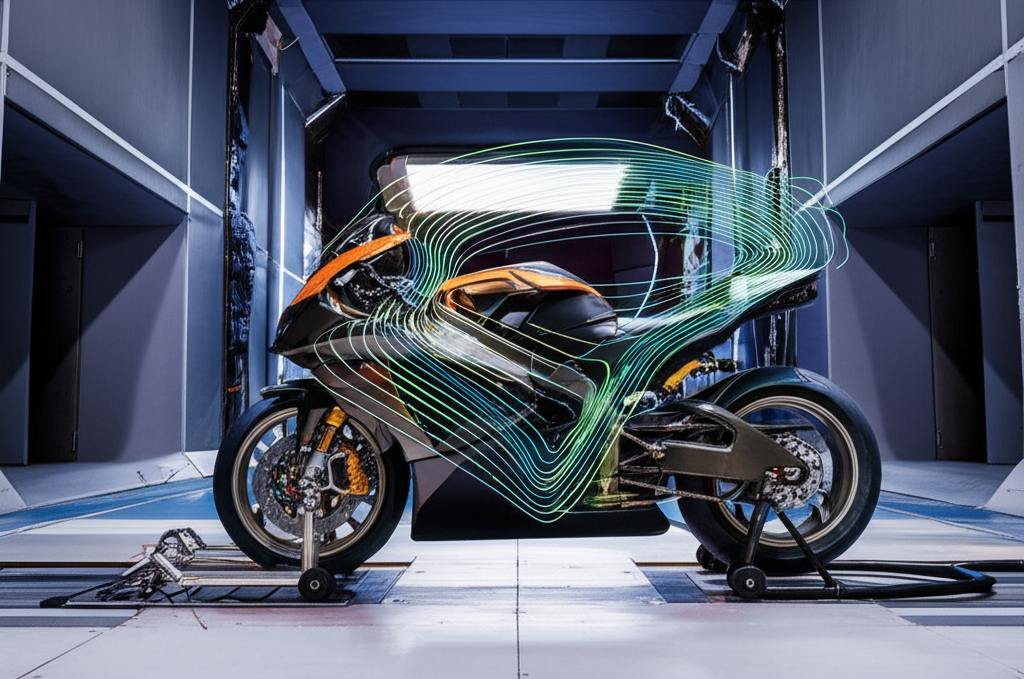
CFD & Wind Tunnel Engineering for Motorcycles
- Format:
- Duration:
- Time: 1900 H
- Practices: Consult
- Language:
- Credits:
- Registration date: 08-10-2026
- Start date: 02-12-2026
- Available places: 2
5,400 $
Skills and results
What you will learn
- Configure and execute CFD simulations to capture vortices and aerodynamic interactions between fairings, winglets, and the motorcycle geometry, with appropriate meshing and turbulence models.
- Design and optimize Fairings and Winglets geometries to minimize drag, reduce wake vortices, and improve stability and rider response using CFD and optimization techniques.
- Calibrate and validate CFD predictions with wind tunnel and experimental motorcycle data, establishing correlations and managing uncertainty for robust design decisions.
2. Aerodynamic Optimization of Motorcycles: CFD and Wind Tunnel Testing to Improve Vortices, Fairings, and Winglets
- Analyze the generation and control of vortices caused by fairings and winglets using CFD and wind tunnel, evaluating their impact on drag, lateral forces, and directional stability.
- Size geometries of fairings and winglets, optimizing vortex reduction and aerodynamic noise through FE and optimization methods.
- Implement validation and correlation between CFD and wind tunnel to ensure convergence between simulation and experimental data, with a focus on drag coefficient and directional stability.
3. Comprehensive user-oriented design and validation (from modeling to manufacturing)
You will learn to integrate the entire product development process, from model conception to final validation, applying user-centered methodologies. You will develop competencies in parametric design, ergonomics, simulation, sustainable materials, 3D visualization, and manufacturing management, ensuring efficient, safe solutions aligned with current industry standards.
4. Explore CFD and Wind Tunnel Testing: Motorcycle Aerodynamics (Vortices, Fairings, Winglets)
- Analyze couplings of vortices generated by fairings and winglets, whirl flutter and fatigue.
- Size laminates in composites, joints and bonded joints with FE.
- Implement damage tolerance and NDT (UT/RT/thermography) to validate CFD and wind tunnel results.
5. Learn CFD and Wind Tunnel Testing: High-Performance Motorcycle Aerodynamics (Vortices, Fairings, Winglets)
- Analyze the interaction between CFD and wind tunnel to capture the formation of vortices around fairings and winglets and their impact on drag and directional stability.
- Size and optimize the geometry of fairings and winglets to minimize drag, maximize downforce, and control separation, using CFD and grid convergence criteria with wind tunnel validation.
- Implement an aerodynamic performance workflow that combines CFD, wind tunnel testing, and post-process analysis to generate design recommendations for fairings and winglets aimed at drag reduction and stability improvement in real-world use.
6. Perfecting Motorcycle Aerodynamic Design: CFD and Wind Tunnel Testing for Vortices, Fairings, and Winglets
Master the Aerodynamic Design of Motorcycles: CFD and Wind Tunnel for Vortices, Fairings, and Winglets
- Master the use of CFD Software (Computational Fluid Dynamics) to simulate airflow around the motorcycle.
- Apply aerodynamic design techniques to optimize performance, stability, and efficiency.
- Understand and control the formation and impact of vortices on motorcycle performance.
- Design and analyze aerodynamic fairings to reduce drag and improve aesthetics.
- Explore and apply winglet design to generate downforce and improve cornering stability.
- Use wind tunnels to validate and refine aerodynamic designs.
- Analyze the influence of various motorcycle components on airflow, including rider position.
- Evaluate the impact of environmental conditions (wind, temperature) on aerodynamic performance.
- Optimize aerodynamic design for different types of motorcycles and riding scenarios (track, road).
- Know and apply research methodologies in motorcycle aerodynamic design.
Who this program is for:
CFD & Wind Tunnel Engineering for Motorcycles
- Engineers with a degree in Aerospace Engineering, Mechanical, or Industrial Engineering. Also, graduates in related disciplines such as Automation Engineering.
- Professionals working in the motorcycle sector, including designers, development engineers, and technicians.
- Engineers from motorcycle racing teams (MotoGP, Superbikes, etc.) looking to improve aerodynamic performance.
- Professionals from motorcycle manufacturers (OEMs) who wish to optimize the aerodynamic design of their products.
- Engineers and technicians from research and development centers working in aerodynamics and fluid dynamics.
Desirable requirements: A basic knowledge of aerodynamics, fluid mechanics, and vehicle design is recommended.
- Standards-driven curriculum: you will work with CS-27/CS-29, DO-160, DO-178C/DO-254, ARP4754A/ARP4761, ADS-33E-PRF from the very first module.
- Accreditable laboratories (EN ISO/IEC 17025) with rotor test bench, EMC/Lightning pre-compliance, HIL/SIL, vibration/acoustics.
- Master’s thesis oriented to evidence: safety case, test plan, compliance dossier and operational limits.
- Industry mentoring: instructors with experience in rotorcraft, tiltrotor, eVTOL/UAM and flight test.
- Flexible modality (hybrid/online), international cohorts and support from SEIUM Career Services.
- Ethics and safety: safety-by-design approach, cyber-OT, DIH and compliance as pillars.
1.1 Overview of Motorcycle Aerodynamics: definition, objectives, and relevance in performance and safety
1.2 CFD and wind tunnel: fundamentals, tools, and workflows for aerodynamic analysis
1.3 Geometry and test conditions of a motorcycle: bodywork, helmet, and rider posture
1.4 Fundamentals of drag, lift coefficient, and friction: interpretation and units
1.5 Boundary layer, transition, and turbulence on motorcycle surfaces: effects on efficiency
1.6 Vortices and aerodynamic control: generation, pressure distribution, and impact on stability
1.7 Introduction to fairings and winglets: functions, classification, and initial design criteria
1.8 Validation and verification plan: interaction between CFD, wind tunnel, and field testing
1.9 Safety, regulations, and ethics in motorcycle aerodynamic design
1.10 Introductory case study: analysis of a generic motorcycle, CFD objectives, and test plan
2.1 Advanced CFD in Motorcycles: Vortices, Fairings, and Winglets
2.2 Wind Tunnel: Preparation, Configuration, and Validation of Aerodynamic Models for Motorcycles
2.3 Fairing Design to Minimize Drag and Vortex Control in Motorcycles
2.4 Winglets in Motorcycles: Flow Optimization and High-Speed Stability
2.5 CFD Methods for Flow Analysis in Motorcycles: Visualization of Vortices and Pressure Fields
2.6 Preparation and Execution of Wind Tunnel Tests for Motorcycles
2.7 CFD vs Wind Tunnel Validation: Accuracy and Uncertainty Study
2.8 Multi-Objective Optimization: Aerodynamic Performance, Noise, and Consumption
2.9 CFD-Tunnel Integration in the Design Process: MBSE/PLM and Version Management
2.10 Practical Cases: Aerodynamic Design of a Motorcycle with Vortices, Fairings, and Winglets
3.1 CFD and Wind Tunnel: fundamentals, history, and applications in motorcycles
3.2 Navier–Stokes equations and simplifications: incompressible, compressible, flow criteria
3.3 Numerical methods in CFD: Finite Volume and meshing; stability and convergence
3.4 Turbulence models: RANS, k-ε, k-ω, LES and DNS; selection criteria for motorcycles
3.5 Geometric preparation and meshing: mesh generation, quality, refinement in critical sections
3.6 Simulation setup: boundary conditions, Reynolds number, scaling, and incident simulation
3.7 Wind tunnel: principles, types (closed, open), scales, similarity, and data acceptance
3.8 Verification and validation: V&V strategy, mesh testing, comparisons with experimental data
3.9 Results interpretation: aerodynamic coefficients, pressure distribution, and flow analysis
3.10 Workflow for motorcycles: CFD integration in the design cycle, traceability, and reproducibility
4.1 CFD fundamentals for motorcycles: Navier–Stokes equations, discretization, meshes and solvers; laminar vs turbulent and basic criteria for numerical stability
4.2 Turbulence models applied to motorcycle aerodynamics: k-ε, k-ω SST, RANS, DES/LES and their impact on vortices and handling
4.3 CFD and wind tunnel setup: boundary conditions, scaling, walls, slip/rolling and alignment between simulation and testing
4.4 Post-processing and performance metrics: coefficients Cx, Cy, Cz, drag, lift, pressure distribution and vortex visualization
4.5 Verification and validation: grid convergence, code verification, comparison with experimental data and uncertainty limits
4.6 Mesh design and quality: structured vs unstructured mesh, boundary layer resolution, local refinement and mesh independence criteria
4.7 Transient analysis and convergence: time-step choices, steady vs transient solutions, QoI monitoring and convergence criteria
4.8 Technical risk and readiness in CFD: TRL/CRL/SRL for simulation tools, validation plan and migration to production
4.9 Intellectual property, certifications and compliance: software licenses, model usage, regulations and results traceability
4.10 Case study: go/no-go study with risk matrix, mitigation plan and acceptance criteria for a motorcycle CFD project
5. 1 Fundamental Principles of Aerodynamics: Aerodynamic drag, lift, and forces on motorcycles.
5. 2 Introduction to CFD (Computational Fluid Dynamics): Software, simulation and analysis.
5. 3 The Wind Tunnel: Operation and applications in motorcycle aerodynamics.
5. 4 Vortices: Formation and control for aerodynamic optimization.
5. 5 Fairings: Design and function to reduce wind resistance.
5. 6 Winglets: Effects and applications to improve stability and performance.
5. 7 Design Tools: CAD and simulation software for aerodynamics.
5. 8 Aerodynamic Design Methodology: Workflow and best practices.
5. 9 Introduction to Aerodynamic Optimization: Strategies to improve performance.
5. 10 Case Analysis: Practical examples of aerodynamic design in motorcycles.
6.1 Fundamentals of Aerodynamics: Basic principles applied to motorcycles.
6.2 Aerodynamic Drag: Key concepts and their impact on performance.
6.3 Introduction to Vortices: Formation and effects on airflow.
6.4 Fairings and Aerodynamics: Design and function of fairings.
6.5 Winglets: Basic concepts and their application in motorcycles.
6.6 CFD: Introduction to Computational Fluid Dynamics Simulation and its use.
6.7 Wind Tunnel: Introduction to wind tunnel testing.
6.8 Key Metrics: Drag coefficient, lift and their implications.
6.9 Airflow Analysis: Visualization and understanding of the flow around the bike.
6.10 Initial Design: Considerations for aerodynamic optimization in motorcycle design.
7. 1 Fundamental Principles of Aerodynamics Applied to Motorcycles
7. 2 Aerodynamic Drag: Causes and Effects on Motorcycles
7. 3 Introduction to Vortices in Motorcycle Design
7. 4 Importance of Fairings and their Aerodynamic Impact
7. 5 Function and Design of Winglets to Improve Performance
7. 6 Introduction to CFD (Computational Fluid Dynamics) and its Application
7. 7 Fundamentals of the Wind Tunnel in Motorcycle Design
7. 8 Simulation Tools and Software for Motorcycle Aerodynamics
7. 9 Introduction to Aerodynamic Design: Methodology and Approach
7. 10 Case Study: Aerodynamic Analysis of an Existing Motorcycle
8.1 Introduction to Motorcycle Aerodynamics: Fundamentals and Objectives
8.2 What is CFD?: Principles and Applications in Motorcycle Design
8.3 Introduction to the Wind Tunnel: Operation and Methodology
8.4 Vortices: Formation, Control and Impact on Aerodynamic Performance
8.5 Fairings: Design, Function and Optimization to Reduce Drag
8.6 Winglets: Concepts, Design and Effects on Stability and Handling
8.7 Importance of CFD and Wind Tunnel in Motorcycle Design
8.8 CFD Software and Wind Tunnels: Key Tools and Selection
8.9 Aerodynamic Design Methodology: Iterative Process and Continuous Improvement
8.10 Introduction to the Next Lessons: Deep Dive into Vortices, Fairings and Winglets
9. 1 Introduction to Aerodynamics and its Importance in Motorcycles
9. 2 Aerodynamic Forces: Drag, Lift, and Moments
9. 3 Airflow: Laminar vs. Turbulent, Boundary Layer
9. 4 Key Concepts: Vortices, Fairings, and Winglets
9. 5 Analysis Tools: CFD and Wind Tunnel
9. 6 Design and Optimization: Influence on Motorcycle Performance
9. 7 Motorcycle Geometry: Impact on Aerodynamics
9. 8 Materials and Manufacturing: Aerodynamic Considerations
9. 9 Case Studies: Examples of Successful Aerodynamic Design
9. 10 Conclusions and Next Steps
10. 1 Introduction to Motorcycle Aerodynamics: Fundamental principles and aerodynamic forces.
10. 2 Introduction to CFD: Principles, software, and basic setup for analysis.
10. 3 3D Modeling of Motorcycles: Creation and preparation of models for CFD simulation.
10. 4 Flow Analysis: Setup and execution of simulations to determine vortices.
10. 5 Fairing Design: Aerodynamic optimization and CFD analysis of fairings.
10. 6 Winglet Design: Creation and analysis of aerodynamic appendages.
10. 7 Interpretation of Results: CFD data analysis and results visualization.
10. 8 Iterative Optimization: Continuous improvement process through CFD.
10. 9 Case Study: Application of CFD in the design of a specific motorcycle.
10. 10 Conclusions and future trends in motorcycle aerodynamic design.
- Hands-on methodology: test-before-you-trust, design reviews, failure analysis, compliance evidence.
- Software (according to licenses/partners): MATLAB/Simulink, Python (NumPy/SciPy), OpenVSP, SU2/OpenFOAM, Nastran/Abaqus, AMESim/Modelica, acoustics tools, DO-178C planning toolchains.
- SEIUM Laboratories: scale rotor test bench, vibration/acoustics, EMC/Lightning pre-compliance, HIL/SIL for AFCS, data acquisition with strain gauging.
- Standards and compliance: EN 9100, 17025, ISO 27001, GDPR.
Capstone-type projects
- Motorcycle Aerodynamics: CFD+tunnel; vortices, winglets.
- Aeroelasticity: flutter/whirl; mitigation.
- Optimal design: iteration and metrics.
- Integration: validation.
DO-160: environmental test plan (vib, temp, EMI, lightning/HIRF) and mitigation.
- Motorcycle Aerodynamics: CFD+tunnel; vortices, winglets.
- Aeroelasticity: flutter/whirl; mitigation.
- Optimal design: iteration and metrics.
- Integration: validation.
DO-160: environmental test plan (vib, temp, EMI, lightning/HIRF) and mitigation.
- Aerodynamic Optimization: CFD and Wind Tunnel; vortex analysis, fairings and winglets.
- Advanced Design: 3D Modeling, CFD simulation, component optimization.
- Validation and Testing: Wind tunnel, performance analysis, technical report.
- Performance Improvement: Reduction of aerodynamic drag, stability and handling.
- Aerodynamic Optimization: CFD and Wind Tunnel; vortex analysis, fairings and winglets.
- Advanced Design: 3D Modeling, CFD simulation, component optimization.
- Validation and Testing: Wind tunnel, performance analysis, technical report.
- Performance Improvement: Reduction of aerodynamic drag, stability and handling.
- Motorcycle Aerodynamics: CFD/Wind Tunnel; vortex, fairing, winglet optimization.
- Advanced Design: CFD analysis, tunnel testing, performance improvement.
- Innovative Strategies: Vortices, fairings, winglets; aerodynamic optimization.
- Aerodynamic Development: CFD/Wind Tunnel, design and improvement.
- Expert Optimization: CFD/Wind Tunnel, motorcycle design.
- Performance: CFD, wind tunnel, advanced design.
Admissions, fees and scholarships
- Profile: Background in Computer Engineering, Mathematics, Statistics, or related fields; practical experience in NLP and information retrieval systems is valued.
- Documentation: Updated CV, academic transcripts, SOP/purpose essay, project or code examples (optional).
- Process: application → technical evaluation of profile and experience → technical interview → review of practical cases → final decision → enrollment.
- Fees:
- Single payment: 10% discount.
- Payment in 3 installments: no fees; 30% upon enrollment + 2 equal monthly payments of the remaining 35%.
- Monthly payment: available with a 7% commission on the total; annual review.
- Scholarships: based on academic merit, economic situation, and promotion of inclusion; agreements with industry companies for partial or full scholarships.
Check “Calendar & calls”, “Scholarships & financial aid” and “Fees & financing” in the SEIUM mega-menu.
Do you have any questions?
Our team is ready to help you. Contact us and we’ll get back to you as soon as possible.
F. A. Q
Frequently Asked Questions
Yes, we hold international certification.
Yes: experimental models, real-world data, applied simulations, professional environments, real-world case studies.
It is not mandatory. We offer leveling tracks and tutoring.
Completely. It covers e-propulsion, integration, and emerging regulations (SC-VTOL).
Recommended. There are also internal challenges and consortia.