
Master’s Degree in Motorcycle Engineering
About our Master’s Degree in Motorcycle Engineering
The Master’s in Motorcycle Engineering
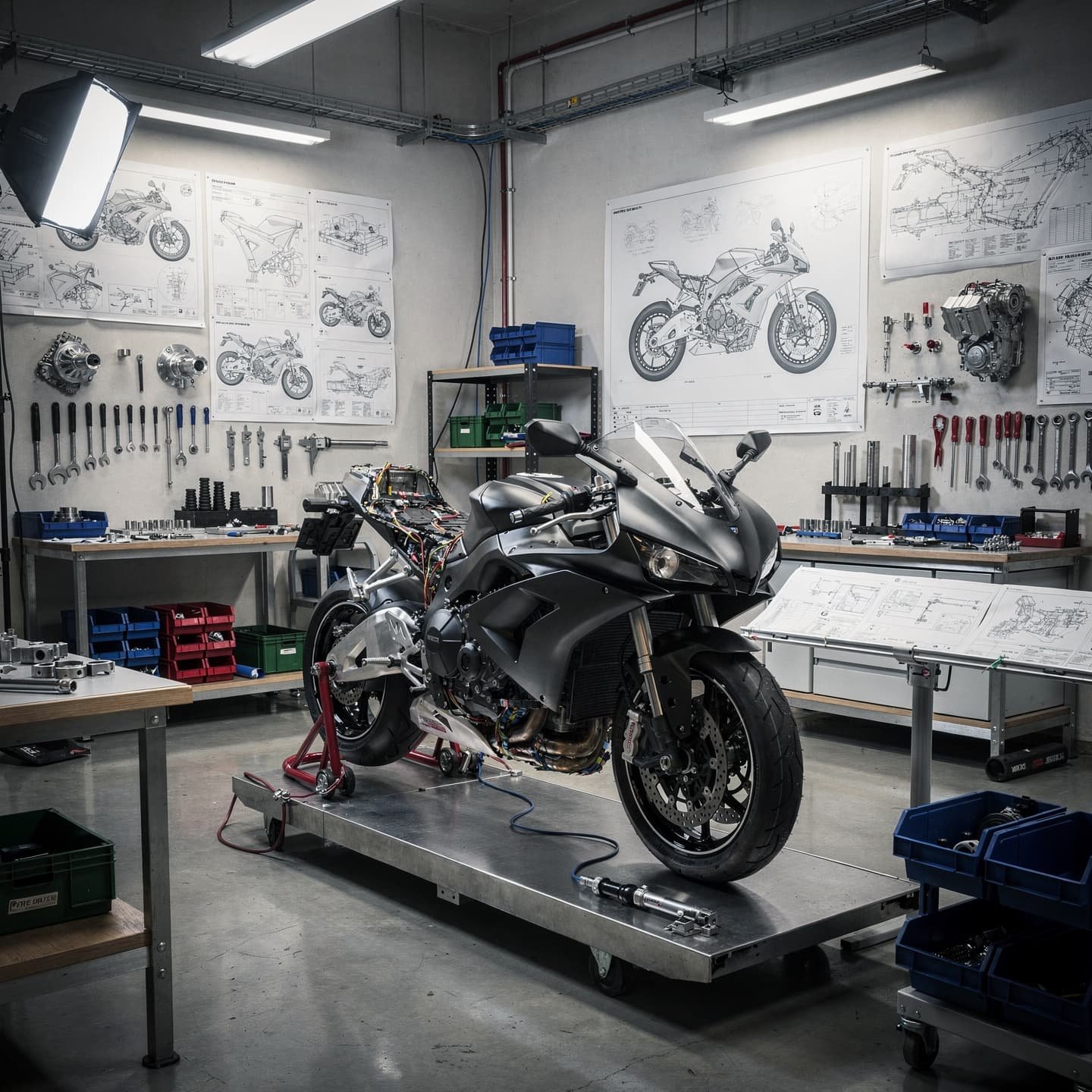
is an advanced program designed to train specialists in motorcycle engineering capable of working in the design, preparation, tuning, and technical analysis of street bikes, racing motorcycles, and off-road motorcycles. Throughout the master’s program, you will delve into motorcycle mechanics, motorcycle dynamics, chassis, suspensions, brakes, tires, combustion engines, and, where applicable, electric propulsion and hybrid systems. This Master’s in Motorcycle Engineering integrates calculation, simulation, regulations, active and passive safety, electronics, data acquisition, and product development methodology, so that you can intervene both in new motorcycle design projects and in motorsport optimization (speed, enduro, MX, rally raid, track days). The goal is for you to graduate prepared to work as a development engineer, track engineer, or technical manager in any environment where motorcycle engineering is at the center of the project.
Master’s Degree in Motorcycle Engineering
- Format:
- Duration:
- Time: 1900 H
- Practices: Consult
- Language:
- Credits:
- Registration date: 08-10-2026
- Start date: 02-12-2026
- Available places: 2
3,200 $
Skills and results
What you will learn
In the Master’s in Motorcycle Engineering you will understand the complete ecosystem of the motorcycle industry: manufacturers, suppliers, motorsport teams, specialized workshops, homologation centers, and technical services. You will see how the life cycle of a product is articulated from idea to commercialization, and what role motorcycle engineering plays at each stage. You will understand the differences between street bikes, sport bikes, trail bikes, scooters, and racing motorcycles, and how motorcycle mechanics and its design priorities change depending on the segment.
You will master the fundamentals of motorcycle dynamics, studying balance, steering geometry, mass distribution, load transfer, and behavior during braking, acceleration, and cornering. You will analyze concepts such as rake angle, trail, wheelbase, center of gravity height, and their impact on stability and agility. The Master’s in Motorcycle Engineering will teach you to translate rider sensations, telemetry data, and real behavior into motorcycle design decisions and adjustments to suspensions, brakes, and tires.
You will delve into motorcycle engines (single-cylinder, twin-cylinder, multi-cylinder in-line, V-twin, boxer, two-stroke and four-stroke) and their associated systems: intake, exhaust, cooling, lubrication, and primary transmission. You will see how torque and power curves are built, how injection and ignition maps are adjusted, and how performance is optimized without compromising reliability. The Master’s in Motorcycle Engineering will allow you to understand motorcycle mechanics from the inside, interpreting dynamometer and telemetry data to improve motorcycle engine performance and its integration with the chassis.
You will learn to design, analyze, and adjust motorcycle frames, swingarms, and subframes, evaluating stiffness, controlled flexibility, and behavior under load. You will study conventional and inverted forks, rear shock absorbers, linkage systems, suspension geometries, and their influence on tire–asphalt contact. The Master’s in Motorcycle Engineering will teach you to relate frame and suspension configurations with different motorsport disciplines and street bikes, optimizing motorcycle engineering for sporty, urban, or mixed use.
You will specialize in brakes and tires for motorcycles, two of the most critical elements in safety and performance. You will study calipers, discs, master cylinders, brake lines, brake balance, ABS, combined braking systems, and their integration with motorcycle dynamics. In tires, you will see compounds, structures, profiles, pressures, and thermal management for different types of motorsport and street use. You will learn to analyze wear, grip, stability, and feedback, using motorcycle mechanics as a basis to justify technical decisions.
You will develop competencies in electronics, rider assist systems, and data acquisition applied to motorcycle engineering. You will work with motorcycle ECUs, map management, quickshifters, traction control, advanced ABS, anti-wheelie, and riding modes. You will learn to record and analyze data (speed, throttle opening angle, brake, RPM, lean angle when technology allows), integrating electronics into the overall motorcycle design and motorsport package. This approach will make the motorcycle engineering you apply not only mechanical, but also digital.
Who this program is for:
Master’s Degree in Motorcycle Engineering
The Master’s in Motorcycle Engineering is aimed at engineers, technicians, and advanced students of mechanical engineering, automotive, industrial, electronics, or related fields who wish to specialize in motorcycle engineering. It is also ideal for motorcycle mechanics, workshop managers, preparers, motorsport professionals, dynamometer technicians, designers with technical interest, and profiles from the world of competition or motorcycle-oriented simracing. It is a program designed for those who wish to turn their passion for motorcycles into a solid technical career, covering everything from advanced workshop motorcycle mechanics to motorcycle design and on-track data analysis. A minimum background in physics, technical drawing, and computer tools is recommended, as well as familiarity with basic motorcycle engine and chassis terminology.
SEIUM offers with this Master’s in Motorcycle Engineering a training program focused 100% on motorcycle engineering, from a modern and industrial perspective, but with a strong component of motorsport and real application. While many automotive programs dedicate a marginal chapter to motorcycles, here the motorcycle is the absolute protagonist: motorcycle chassis, motorcycle engine, specific suspensions, brakes, tires, and electronics designed for two wheels. The curriculum is designed so that the student learns the motorcycle mechanics applied in the best workshops and at the same time the logic of motorcycle design used by R&D departments. SEIUM structures this master’s in an online format, with flexibility for working professionals, real cases, calculation and simulation exercises, analysis of motorsport projects, and support in building a technical portfolio. The combination of a practical approach, global vision, and specialization in motorcycle engineering makes this program a reference for those who want to make a real leap in their career.
1.1 History of the motorcycle and technological evolution
1.2 Current landscape of manufacturers, segments, and motorsport
1.3 Motorcycle typologies: urban, sport, trail, touring, off-road, electric
1.4 Role of motorcycle engineering in manufacturers and workshops
1.5 Life cycle of a motorcycle: design, development, validation, and sales
1.6 Introduction to the chassis department: motorcycle frame, suspensions, brakes, tires
1.7 Introduction to the motorcycle engine: architectures and applications
1.8 Key aspects of ergonomics and user experience in motorcycle design
1.9 Relationship between motorcycle mechanics, marketing, and product positioning
1.10 Competencies expected of a motorcycle engineer
2.1 Physical principles of balance on two wheels
2.2 Steering geometry: rake angle, trail, offset, and consequences
2.3 Mass distribution, center of gravity, and their effect on stability and agility
2.4 Load transfer during acceleration, braking, and cornering
2.5 Typical behaviors: understeer, oversteer, shimmy, headshake
2.6 Basic adjustments of the motorcycle chassis for different riding styles
2.7 Influence of the rider: position, weight, movements, and feedback
2.8 Introduction to simplified models of motorcycle dynamics
2.9 Basic calculation and behavior analysis tools
2.10 Practical application of motorcycle dynamics in setup and motorcycle design
3.1 Motorcycle engine architectures: single-cylinder, twin-cylinder, multi-cylinder
3.2 Two-stroke and four-stroke: advantages, disadvantages, and applications
3.3 Intake, exhaust, and supercharging systems in motorcycle engines
3.4 Cooling and lubrication systems: air, liquid, mixed solutions
3.5 Electronic engine management: injection, ignition, and maps
3.6 Primary transmission, clutch, gearbox, and secondary transmission
3.7 Torque and power curves: applied reading and interpretation
3.8 Work with dynamometer and adjustment of motorcycle mechanics
3.9 Reliability strategies and preventive maintenance of motorcycle engines
3.10 Integration of the motorcycle engine with the chassis and intended use
5.1 Types of motorcycle brakes: discs, calipers, master cylinders, and lines
5.2 Brake balance: front/rear distribution and combined braking
5.3 ABS systems and advanced braking aids
5.4 Motorcycle tires: compounds, structures, and profiles
5.5 Tire pressure, temperature, and wear management
5.6 Relationship between brakes, tires, and suspension setup
5.7 Evaluation of braking performance: stopping distance, feel, and stability
5.8 Tire grip, sliding, and traction limits in different conditions
5.9 Brake and tire integration in motorcycle dynamics
5.10 Practical cases of brake and tire optimization in motorsport and street use
5.1 Motorcycle brake systems: components and configurations
5.2 Sizing of discs, calipers, and master cylinders according to motorcycle type
5.3 ABS and combined braking systems: principles and basic calibration
5.4 Motorcycle tires: structure, compounds, and profiles
5.5 Optimal temperature and pressure windows for different uses
5.6 Tire–asphalt interaction and loss of grip phenomena
5.7 Wear analysis and typical patterns in different disciplines
5.8 Brake and tire adjustment for motorsport and intensive use
5.9 Preventive maintenance strategies in motorcycle mechanics
5.10 Dynamic safety: braking distances, emergency maneuvers, and design
6.1 Basic electrical architecture of a modern motorcycle
6.2 ECUs, sensors, and actuators in motorcycle engineering
6.3 Rider assist systems: riding modes, traction control, advanced ABS
6.4 Quickshifter, blipper, anti-wheelie, and other sport functions
6.5 Introduction to data acquisition in motorsport
6.6 Typical channels: speed, RPM, throttle, brake, gears, lean angle (where applicable)
6.7 Basic data analysis oriented toward tuning and riding
6.8 Integration of electronics into the design of new motorcycles
6.9 Future trends: connectivity, electric motorcycles, and advanced systems
6.10 Good practices in electrical installation and diagnosis in motorcycle mechanics
7.1 Basic homologation regulations for road motorcycles
7.2 Emissions, noise, and environmental requirements
7.3 Regulations on lighting, signaling, and mandatory equipment
7.4 Major modifications and legalization of motorcycle modifications
7.5 Structural safety standards applied to motorcycle frames and components
7.6 Homologation of motorsport components for road use
7.7 Rider protective equipment and its relationship with motorcycle design
7.8 Safety testing and validation procedures
7.9 Technical documentation required for motorcycle engineering projects
7.10 Professional ethics and responsibility in motorcycle engineering
8.1 Phases of the development of a new motorcycle
8.2 Product briefing: market requirements and technical objectives
8.3 Motorcycle design concept: style, ergonomics, and architecture
8.4 Collaboration between industrial design and motorcycle engineering
8.5 Prototypes, mock-ups, and proof of concept
8.6 Validation on bench, track, and user environment
8.7 Costs, industrialization, and supplier selection
8.8 Management of design changes and model versions
8.9 Documentation of motorcycle design projects for portfolio
8.10 Practical cases of product development in the motorcycle industry
9.1 Introduction to two-wheel motorsport: speed, endurance, off-road
9.2 Key differences between street and racing motorcycle engineering
9.3 Chassis preparation for the track: frame, suspensions, brakes, and tires
9.4 Motorcycle engine adjustments for sport use
9.5 Basic telemetry in motorsport and lap time analysis
9.6 Specific tuning for track days and amateur championships
9.7 Tire and brake management in motorsport events
9.8 Engineer–rider communication and decision-making in the box
9.9 Recording and analysis of setup evolution over a race weekend
9.10 Integration of competition motorcycle mechanics into professional projects
10.1 Definition and scope of the final project in motorcycle engineering
10.2 Integration of motorcycle engine, motorcycle frame, brakes, and electronics
10.3 Planning of validations (simulation, bench, track)
10.4 Definition of technical and user success metrics
10.5 Preparation of a complete technical dossier for the project
10.6 Presentation and defense of the project before an academic–technical committee
10.7 Building a professional portfolio in motorcycle engineering
10.8 Possible career paths: industry, motorsport, advanced workshops, consulting
10.9 Entrepreneurship in motorcycle mechanics and motorcycle design business
10.10 Personal continuous development plan in the motorcycle world
The methodology of the Master’s in Motorcycle Engineering combines online classes, on-demand materials, practical cases, and applied projects. You will work with technical spreadsheets, basic drawing and modeling software, data analysis tools oriented toward motorsport, examples from dynamometer testing, and real documentation from motorcycle engineering projects. The “laboratory” is conceived as a technical environment where the student analyzes motorcycle frame configurations, interprets torque and power curves of motorcycle engines, studies brake and tire behavior, and proposes improvements. Activities are designed for profiles already working in workshops or teams, so that they can transfer what they have learned to real motorcycle mechanics. The combination of applied theory, guided exercises, and projects makes the master’s program a direct tool for working in motorcycle design and motorsport.
Capstone-type projects
Proposal for amateur motorsport preparation. Based on a standard production motorcycle, the student will design a preparation plan for use in track days or entry-level competition, including changes to suspensions, brakes, tires, ergonomics, and, where applicable, the motorcycle engine. They must balance performance, reliability, costs, and regulations, applying principles of motorcycle mechanics and motorsport.
Proposal for amateur motorsport preparation. Based on a standard production motorcycle, the student will design a preparation plan for use in track days or entry-level competition, including changes to suspensions, brakes, tires, ergonomics, and, where applicable, the motorcycle engine. They must balance performance, reliability, costs, and regulations, applying principles of motorcycle mechanics and motorsport.
Data study and dynamic behavior analysis. The student will work with basic motorcycle data (engine curves, weights, geometry, simple telemetry logs) to analyze its behavior in a specific scenario (city, track, route). They must interpret the results and propose adjustments to the motorcycle frame, tires, or motorcycle design to improve safety or performance.
Pre-project for motorcycle design. The student will define the concept of a new motorcycle for a specific segment (urban, sport, trail, electric, etc.), preparing a technical briefing and a proposal for architecture: type of motorcycle engine, motorcycle frame, basic geometries, brakes, tires, and electronics. The focus will be to show how motorcycle engineering is applied to a realistic product idea.
Integrating motorcycle engineering project. As the culmination of the master’s program, the student will develop a complete project that combines analysis, design, basic simulation, and test planning for a real or conceptual motorcycle. They must integrate motorcycle mechanics, motorcycle engine, motorcycle frame, brakes, tires, and electronics into a high-level document that they can use as the centerpiece of their professional portfolio.
Admissions, fees and scholarships
The Master’s in Motorcycle Engineering is aimed at people with a technical background who wish to specialize in motorcycle engineering. It is recommended to have studies in engineering, automotive, mechanics, or electronics, or relevant professional experience in motorcycle mechanics, workshops, motorsport teams, or motorcycle design projects. The admission process may include a review of the CV, a motivation letter, and in some cases an interview to assess the fit between the candidate’s objectives and the technical level of the master’s program. Regarding scholarships and financial aid, special conditions may be offered for students with good academic records, working professionals, and international candidates. Installment payment plans are also available to facilitate access to the program without sacrificing the depth and quality of the training in motorcycle engineering.
Do you have any questions?
Our team is ready to help you. Contact us and we’ll get back to you as soon as possible.
F. A. Q
Frequently Asked Questions
It is not mandatory to be a professional mechanic, but it is advisable to have some background in motorcycle mechanics or automotive. The program starts from the fundamentals of motorcycle engineering, but advances to a demanding technical level. Those who have already worked with motorcycle engines or motorcycle frames will have an advantage, but more theoretical profiles can also follow it with dedication.
The Master’s in Motorcycle Engineering combines both worlds. It covers motorcycle engineering for production models (motorcycle design, regulations, homologation) and preparation oriented toward motorsport (suspensions, brakes, telemetry, tuning). This allows graduates to work both in industry and in sports projects.
Yes, the master’s program is designed in online format, with live classes, recordings, downloadable materials, and applied projects. This makes it easier for workshop professionals, engineers in companies, or motorsport technicians to combine it with their work, without sacrificing in-depth training in motorcycle engineering.
Mainly technical spreadsheets, data analysis tools commonly used in motorsport, basic drawing software, and, where relevant, examples of simulation environments are employed. The goal is that you can apply motorcycle engineering without the need for excessively expensive licenses, and that you can later make the leap to professional tools if your work environment requires it.
Yes. The projects are designed to become a technical portfolio where your ability in motorcycle mechanics, motorcycle chassis, motorcycle engine, motorcycle design, and data analysis can be seen. You will be able to present them to advanced workshops, manufacturers, motorsport teams, or clients looking for specialists in motorcycle engineering.